The Sower — the painting by Millet that Van Gogh painted throughout his life
Jean-François Millet — the painter of peasants →The Hague, fall 1880. Vincent van Gogh is twenty-seven years old; he has just given up preaching the Gospel in the Borinage, and he has decided to become a painter. For his very first serious exercise, he chooses a subject. He takes a sheet of paper and a pencil and copies a painting he knows by heart from his years as an art dealer at Goupil: Jean-François Millet’s *The Sower*.
There is nothing technically remarkable about this drawing. It is the work of an apprentice. But it marks the symbolic beginning of Van Gogh’s career. When, ten years later, he died in Auvers-sur-Oise after painting *The Starry Night*, *The Potato Eaters*, and so many other masterpieces, he would have returned to the motif of *The Sower* at least four times in his paintings: in June 1888 in Arles, in November 1888 in a version set at sunset that is now considered one of his most powerful, and in October 1889 in Saint-Rémy, where he meticulously copied Millet to combat the doubt that was assailing him.
“The Millet Sower ” is not just a painting. Thanks to Van Gogh, it has become a pictorial model that an entire movement in modern art would draw upon for half a century. This article explains how.
Millet’s Painting — 1850 Salon
In 1849, Jean-François Millet had just left Paris for Barbizon, fleeing the cholera epidemic. He was thirty-five years old, had few resources, and nine mouths to feed. But he had a conviction: he wanted to paint the peasant on a large scale, as a subject worthy of the Salon, and no longer as a decorative figure in pastoral scenes. *The Sower* was the first major work he created in this vein.
The painting was completed sometime in 1850. According to Alfred Sensier, his friend and first biographer, Millet painted it “with verve, with furious passion, ” but realized upon finishing that the canvas was too short—the sower’s gesture extended beyond it. He then reportedly created a second, complete version by tracing the lines of the first, producing what Sensier calls “the twin brother.” It was this second version that Millet submitted to the 1850–1851 Salon, which opened in late 1850 at the Palais Royal.
*The Sower* is exhibited alongside another painting, *The Bundlers*. At least nineteen critics write about the painting during the Salon—a considerable number, reflecting the attention it received. Opinions on the work are deeply divided.
The Painting — What It Depicts
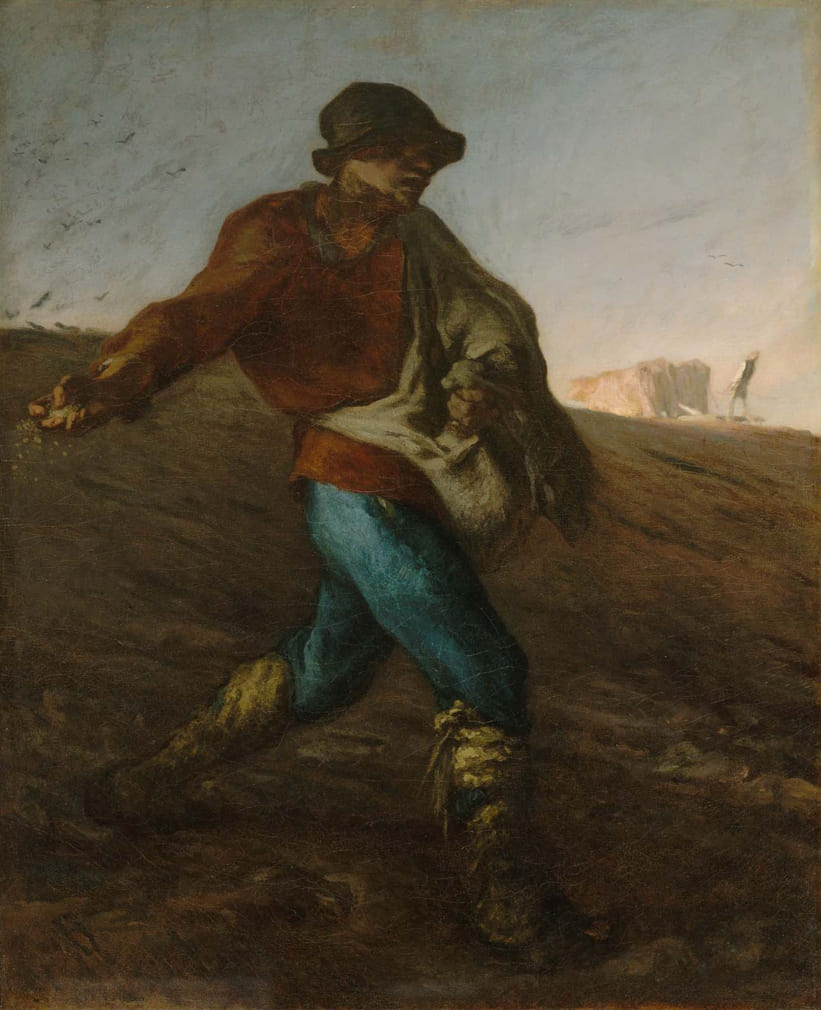
*The Sower* (Boston version, 1850) is an oil on canvas measuring 101.6 centimeters high by 82.6 centimeters wide. It is a vertical, nearly square composition. The painting has been housed at the Museum of Fine Arts, Boston, since 1917, having been donated by the children of Quincy Adams Shaw.
The painting depicts a single figure at the center of the composition: a peasant in the midst of sowing. He strides forward through a field that appears to have been freshly plowed. His attire is accurately depicted: a weather-beaten felt hat, a red or brown jacket, blue breeches, his legs wrapped in straw braids to protect them from the winter cold—a detail indicating that the scene takes place in late fall or early winter, the traditional sowing season in northern France. A bag of seeds hangs over his left shoulder. His right hand reaches into the bag, pulls it out, and flings the seeds forward.
In the background, on the right, a team of oxen is plowing the ground to prepare for the next phase of sowing. On the left, several crows are pecking at the ground—already there to scavenge the seeds that have just been sown. The sky is clear, and the sun appears at the top of the painting, signaling dawn.
The color palette is muted and earthy: browns, ochres, sienna, blue-gray for the sky, and a muted orange-red for the jacket. There are no bright colors. The light is low and oblique, like that of a low-hanging late-fall sun.
The Gesture — A Farmer in Motion
It is here that *The Sower* stands in stark contrast to the rest of Millet’s oeuvre and to 19th-century French rural painting.
Millet almost never paints peasants in motion. His major works depict peasants at rest: *The Gleaners* (1857) shows three women bent over the ground; *The Angelus* (1857–1859) shows two peasants standing motionless in prayer; *The Man with the Hoe* (1860–1862) depicts a peasant leaning on his tool to catch his breath. With *The Sower* in 1850, Millet painted, for the first and virtually only time , a peasant in the midst of action, in full motion.
Art historian Anthea Callen, in her 2008 study *Art, Sex, and Eugenics: Corpus Delecti*, analyzed precisely what Millet does to make this movement so striking. Her conclusion is unequivocal: Millet deliberately distorted the proportions of the sower to make him appear monumental. According to Callen, Millet elongated the figure to about nine heads tall, whereas the classical ideal of the male body—as inherited from ancient Greek and Roman statuary—is seven and a half heads. Based on the average height of a man at the time (1.70 m), this would make the sower approximately two meters four in real life.
This choice is pictorial, not naturalistic. Millet knows that his sower does not look like an ordinary man. He wants him not to look like an ordinary man. Enhanced by the low vantage point Millet adopts—the viewer looks up at the sower from below, as if he himself were on the ground—and by the sower’s dominance of the pictorial space (the figure alone occupies more than two-thirds of the canvas), the effect produced is massive, monumental, almost overwhelming. Art historian Robert L. Herbert, in his seminal study *Jean-François Millet* (1975), highlighted this monumental dimension as Millet’s principal pictorial innovation: transforming a peasant into an epic figure.
The American poet Walt Whitman, who discovered the painting in the United States around 1860, described it in his own words as “of sublime darkness and primal fury, ” and saw in it the prototype of the Creative Man, sowing the seeds of a new era. The comparison that recurs time and again in critical literature on this painting, from its first exhibition to the present day, is that with Michelangelo’s sculpted figures: through its suggested musculature, its monumental posture, and the way its silhouette fills the frame, Millet’s Sower bears a resemblance to the giants painted on the vaults of the Sistine Chapel. With one radical difference: Michelangelo painted prophets and sibyls. Millet painted a peasant.
It is precisely this dignified treatment accorded to a man of the people that will spark the scandal.
Multiple versions, multiple voices
“The Sower ” is not a one-of-a-kind painting. It is a motif that Millet revisited throughout his career, producing at least six documented versions.
The first version dates from 1847–1848 and is housed at the National Museum of Wales in Cardiff. In this Welsh version, the horizon is higher, the sower is less imposing, and the landscape plays a more prominent role than in later versions. This isthe embryonic form of the motif, predating the monumental transformation of 1850.
The two versions from 1850 —the one in Boston and its “twin” at the Yamanashi Prefectural Museum of Art (Kofu, Japan), originally sold by Millet to Alfred Sensier—are the canonical versions. According to Sensier, it was the Yamanashi version that was originally exhibited at the 1850 Salon (Millet having kept the Boston version to test the composition before painting the second version). The Boston version was purchased in 1851 by the American painter William Morris Hunt, who brought it back to the United States.
After 1850, Millet returned to the subject once again:
- A second, later oil version is housed at the Carnegie Museum of Art in Pittsburgh. In this version, the sower appears older, more stooped, and more deeply rooted in the landscape of Chailly-en-Bière (the background shows the “old tower of the Chailly plain,” according to Sensier).
- Two pastel versions from around 1865, in the collections of the Clark Art Institute in Williamstown and the Walters Art Museum in Baltimore
These six versions reflect a pictorial obsession: Millet never let go of *The Sower*. As he grew older, the gesture changed, the face changed, the landscape changed—but the motif remained. It was like a musical score that he would replay with different nuances each time.
A Scandal in 1850
The 1850–1851 Salon opened amid a tense political climate. The Second Republic was in the throes of a crisis—Louis-Napoléon Bonaparte would soon become president, and the coup d’état of December 2, 1851, was approaching. Paris’s wealthy classes feared popular uprisings, both urban and rural. Against this backdrop, *Le Semeur* was immediately perceived as a political work, whether or not it was intended to be one.
According to the Carnegie Museum of Art, the painting was “admired and criticized from the moment it appeared as a radical work of art and a powerful political statement.” Millet was one of the first to depict the French peasant as a heroic archetype rather than as a “rustic buffoon” or a picturesque prop. And this came at the worst possible time for conservative circles.
Critics are divided. Clément de Ris, writing in the magazine *L’Artiste*, enthusiastically defends the painting:
“A dynamic study full of movement.”
— Louis Clément de Ris, on *The Sower*, 1850 Salon, in *L’Artiste*
In contrast, Théophile Gautier, then France’s most influential art critic, mocked the painting. His now-famous remark would go down in art history: Gautier described *The Sower* as “trowel scraps” —the debris swept from a freshly plastered wall. The jab was cruel: it accused Millet of painting carelessly, like a poor mason. It also implied that painting peasants was not worthy of a serious artist.
The other critics fall somewhere between these two extremes. Albert de la Fizelière sees in the sower “a religious dignity” —a solitary man “in the midst of the bare, freshly turned earth, as if he understood the grandeur of his mission.” Sabatier-Ungher, taking a more political view, sees in him “the modern Demos, ” the Greek people personified, the archetype of democracy.Auguste Desplaces, on the other hand, believes that Millet “vilified the Sower” by making him too ugly, too stocky, too menacing.
This critical polarization reveals the painting’s true significance: *The Sower* is not merely a genre scene. From the moment it was released, it became a political object that commentators interpreted through the lens of their own convictions. Millet, for his part, had no conscious political intention—he painted, as he states in his letters to Sensier, out of loyalty to his peasant childhood in Normandy. But in 1850, at a Parisian Salon haunted by the fear of revolt, a monumental peasant was never just a peasant.
Van Gogh: Ten Years of Retrospectives
After Millet’s death in 1875, the story of *The Sower* took on a new life that surpassed anything the painter himself could have imagined. Vincent van Gogh embraced the subject and would never let it go.
1880, The Hague. Van Gogh, at the age of twenty-seven, had just given up his career as an evangelical preacher. He decided to become a painter. For his very first serious drawing exercise, he chose Millet’s *The Sower*, which he knew by heart from his years at Goupil. It is an apprentice drawing, now housed at the Van Gogh Museum in Amsterdam.
June 1888, Arles. Eight years later, after having gone through his dark Dutch period and the Parisian revelation of color, Van Gogh painted his first major personal version of *The Sower*. Oil on canvas, 64 × 80 cm, housed at the Kröller-Müller Museum in Otterlo (Netherlands). In this work, Van Gogh draws on Millet’s composition—a peasant dominating the center of the canvas, the crows, the gesture of the hand scattering seeds—but he transforms it through color.
In his correspondence with Theo during the summer of 1888, Van Gogh explained his project in detail, in a statement quoted bythe Encyclopædia Universalis:
“Replace [Millet’s] colorless gray with a simultaneous contrast of yellow and purple.”
— Vincent van Gogh, on his Arles version of *The Sower*, June 1888, quoted in *Encyclopædia Universalis*
The approach is clear: Van Gogh retains the subject matter but alters the chromatic structure. Where Millet painted with an earthy, muted palette, Van Gogh introduces saturated colors and the simultaneous contrast theorized by the Impressionist and Post-Impressionist painters. The sower remains, but he becomes someone else.
November 1888, Arles. Van Gogh painted *Sower at Sunset* (Emil Bührle Collection, Zurich), now considered his most accomplished version of the subject. The field is entirely purple, the sky and the sun are an intense yellow, and the simultaneous contrast reaches its climax. The Vincent van Gogh Foundation in Arles, which exhibited the work in 2019 as part of the exhibition *The Return of the Sower*, considers this painting one of the most powerful works of his entire Arles period.
October 1889, Saint-Rémy-de-Provence. A year later, Van Gogh was admitted to the Saint-Paul-de-Mausole asylum. During the winter, he painted about twenty-one copies of works by Millet, including a new version of *The Sower* —this time a meticulous copy based on Millet’s original, without the chromatic reinterpretation seen in the Arles version. Oil on canvas, 80 × 64 cm, now in a private collection. This late copy is not a step backward: it is an intimate dialogue between a sick painter and the voice of a master who had died fifteen years earlier.
Between 1880 and 1889, Van Gogh thus returned to the motif of *The Sower* at every decisive stage of his career: at its beginning, at its peak in Arles, and in its twilight years in Saint-Rémy. No other motif in the history of painting has been revisited with such consistency by one great artist based on the work of another great artist. It is probably, as was noted in the profile of Millet on Hors Cadre, the most beautiful tribute one painter has ever paid to another in the entire history of Western painting.
How to View the Work Today
*The Sower* is scattered among several collections, mainly in the United States and Japan. In France, none of the major versions are preserved—only a few preparatory drawings are found in French collections.
Museum of Fine Arts, Boston — the canonical version from 1850, part of the American collection since 1851. Address: 465 Huntington Avenue, Boston, MA. Permanent exhibition.
Yamanashi Prefectural Museum of Art — the “twin version” from 1850 sold by Millet to Alfred Sensier. Address: Kofu, Japan. Permanent exhibition.
National Museum of Wales, Cardiff — the first version from 1847–1848.
Carnegie Museum of Art, Pittsburgh — the second oil version painted after 1850.
Clark Art Institute, Williamstown, and Walters Art Museum, Baltimore —both pastel versions from around 1865.
To view Van Gogh’s versions:
- Kröller-Müller Museum, Otterlo (Netherlands) — *The Sower*, June 1888, Arles version
- Emil Bührle Collection, Zurich (on occasional loan) — *The Sower at Sunset*, November 1888
For those traveling to the Netherlands, the Kröller-Müller Museum offers the opportunity to view together the major Van Gogh copies based on Millet’s works (*The Sower*, *The Diggers*, *The Sundial*, and several others) in the same museum where *The Potato Eaters* (preparatory sketch) and numerous other works by Van Gogh are also on display. It is one of the most informative journeys exploring the Millet-Van Gogh connection that one can take today.
Further Reading
Primary sources cited
- Louis Clément de Ris, a critic at the 1850 Salon, in the journal *L’Artiste*, Paris, 1850.
- Théophile Gautier, a critic at the 1850 Salon; a statement attributed to him by later commentators.
- Vincent van Gogh, letter to Theo, June 1888, regarding the Arles version of *The Sower*. Quoted by *Encyclopædia Universalis* in the chronology from Arles to Auvers.
Leading Modern Studies
- Anthea Callen, “Man or Machine: Ideals of the Laboring Male Body and the Aesthetics of Industrial Production in Early Twentieth-Century Europe, ” in *Art, Sex, and Eugenics: Corpus Delecti*, edited by Fae Brauer and Anthea Callen, Ashgate, Aldershot, 2008. Reference for the analysis of elongated proportions.
- Robert L. Herbert, Jean-François Millet, exhibition catalog, Éditions des Musées nationaux, Paris, 1975. A standard academic reference work.
- Alexandra R. Murphy, Jean-François Millet, Museum of Fine Arts, Boston, 1984. Catalog of the major Millet exhibition in the United States.
- Alfred Sensier, *The Life and Work of Jean-François Millet*, Paris, 1881. The definitive edition of his writings and accounts.
Institutional Documentation
- Museum of Fine Arts, Boston — the institution that owns the 1850 version.
- Carnegie Museum of Art, Pittsburgh — a contextual analysis of *The Sower*.
- Encyclopædia Universalis, Vincent van Gogh Timeline : From Arles to Auvers — for Van Gogh’s quotes and dates.
Also check out on Hors Cadre
- Jean-François Millet—the painter of peasants —a portrait of the painter.
- “The Angelus”—how a 55-cm painting turned the French art market upside down —another major work by Millet, housed at the Musée d’Orsay.
- Vincent van Gogh—the artist who wrote as much as he painted —a portrait of the painter who copied *The Sower* at every stage of his career.
- “The Potato Eaters”—the painting that Van Gogh defended throughout his life —the painting in which the influence of Millet is most evident.
— M