Olympia — Victorine, Laure, and the Scandal of the 1865 Salon
Édouard Manet — From the *Luncheon* Scandal to His Last Painting →Paris, May 1865, Palais de l’Industrie on the Champs-Élysées, Official Salon. The jury of the Société des artistes français acceptedÉdouard Manet’s new work. But it made an unusual decision: it had the painting hung very high, in a remote room, against a dark picture rail. A discreet strategy to limit attention. The jury feared another scandal, two years after the uproar caused by *The Luncheon on the Grass* at the 1863 Salon des Refusés. This painting is called *Olympia*.
To no avail. From the very first days of the exhibition, crowds gathered in the remote room. The Palace guards had to intervene to protect the painting from the blows of canes and umbrellas that some visitors were trying to inflict on it. The Parisian press went wild. The scandal was even more violent than the one in 1863. Manet, deeply hurt, wrote to his friend Charles Baudelaire: “They’re dragging me through the mud.”
Yet today, *Olympia* is one of the Museum of Orsay’s absolute masterpieces. It is on permanent display in the Impressionist gallery, just a few meters from *Luncheon on the Grass* —the two scandals of 1863 finally reunited in France’s national pantheon.
This article recounts the origins of the painting, its two models (Victorine Meurent and Laure—the second female figure, who remained anonymous for a long time), the precise circumstances of the scandal, andthe extraordinary rescue effort organized by Claude Monet in 1889–1890, which enabled France to acquire *Olympia* before it was shipped to the United States.
1863 — *Olympia* was painted but kept hidden
The year 1863 was Édouard Manet’sannus mirabilis —the year in which he painted, in his studio on Rue Guyot in the 17th arrondissement, two of the most important works in the entire history of 19th-century Western painting: *Luncheon on the Grass* (which would be exhibited at the Salon des Refusés in May 1863) and *Olympia*.
But Manet had learned his lesson from the *Déjeuner* scandal. He knew that his new painting, which explicitly addressed the theme of contemporary Parisian prostitution, would provoke an even more violent reaction. He decided to keep *Olympia* in his studio rather than exhibit it at the 1864 Salon.
The painting lay untouched for two years. Manet showed it to a few friends—Baudelaire, Astruc, and Fantin-Latour—who encouraged him to exhibit it someday. In 1865, he finally decided to submit it to the official Salon.
The jury, aware of the precedent set in 1863, accepted the painting —according to several sources, the jury fearedthat Napoleon IIIwould organize another Salon des Refusés if Manet were rejected again. But the painting was deliberately placed in an unfavorable spot: high up, in a back room, and poorly lit. The jury’s strategy was to limit viewership and avoid crowds.
The calculation fails. Olympia becomes the highlight of the 1865 Paris Salon.
The Painting — What It Depicts
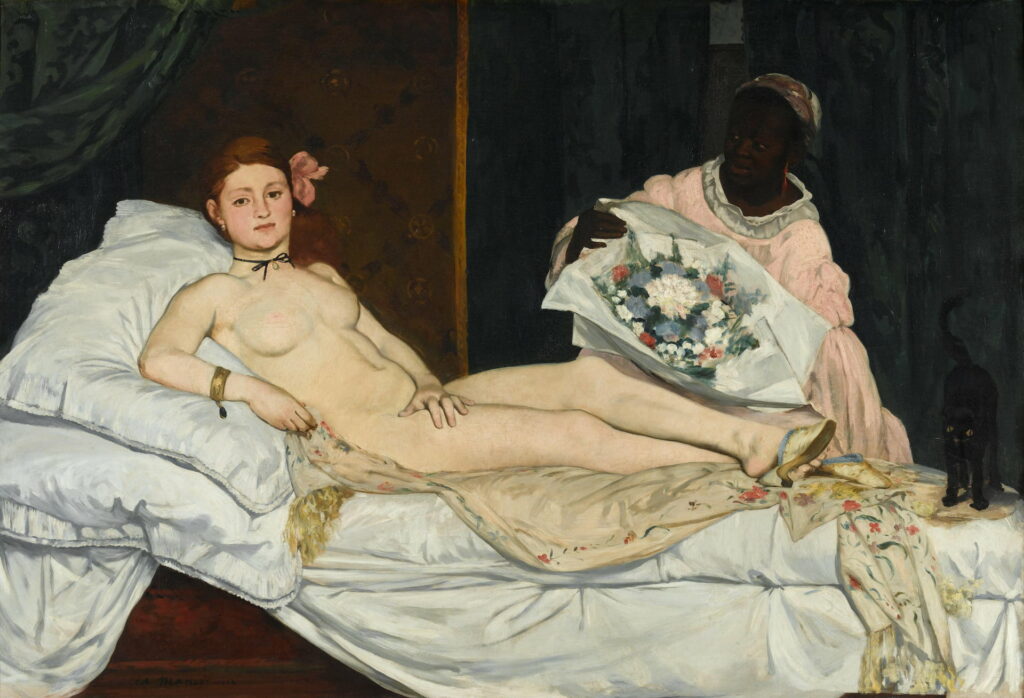
“Olympia” is an oil on canvas measuring 130.5 centimeters high by 190 centimeters wide (according to the official description from the Musée d’Orsay). Horizontal format. Signed “Édouard Manet 1863” in the lower left corner, on the white sheet.
At the center of the composition, a young, completely naked woman lies on an unmade bed, covered by a crumpled white sheet that emphasizes her nudity rather than concealing it. She is leaning against two large cream-colored pillows. Her left hand covers her genitals in a gesture that conceals nothing but affirms her self-possession. Her right hand rests limply along her body, palm up. Her gaze is direct and unflinching, without modesty or conventional seduction. She is fully present.
Three characteristics unambiguously indicate his social status:
— A thin black velvet ribbon tied around the neck — a signature accessory of Parisian courtesans during the Second Empire.
— A fine gold bracelet on her right wrist, a flower in her hair, and a red orchid behind her ear—jewelry and hairstyles characteristic of Parisian demi-mondaines.
— A pair of embroidered Oriental slippers —one being worn, the other lying on the floor—signalthe intimate interior of the room and the moment of the encounter with a client.
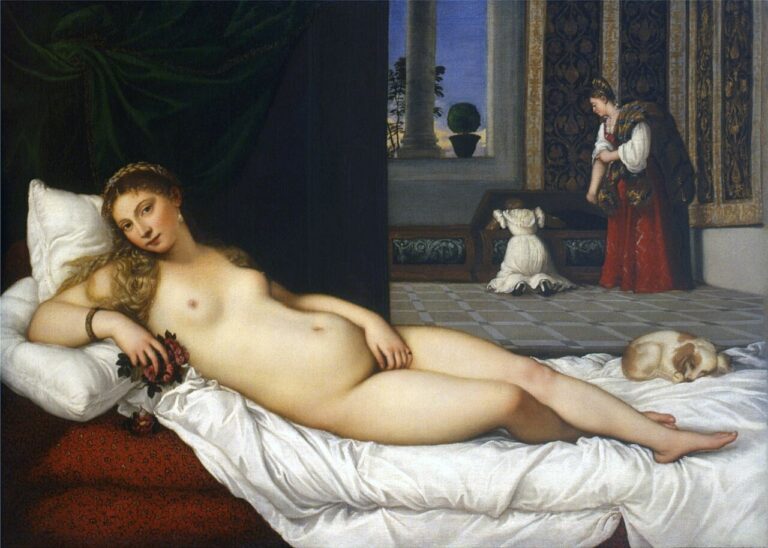
To the right, at her feet, a small black cat stands with its tail raised, its back arched, and its gaze fixed on the viewer. This is probably the most shocking element for contemporary viewers. The black cat replaces the traditional faithful dog found in mythological nudes (Titian’s Venus of Urbino has a dog at her feet). The black cat was an obvious sexual symbol in the 19th century—Baudelaire had published *Les Fleurs du mal* (1857) with its famous poems about cats—and the French word for the female sex translates as a feline allusion. Manet knew this. So did the public.
Behind Olympia, in the chiaroscuro of the dimly lit room, stands a second woman: a Black maid who brings Olympia a large bouquet of flowers wrapped in white paper —probably the bouquet sent by a client to announce his arrival. It is this second figure that contemporary biographers identify as Laure.
The color palette is deliberately limited and high-contrast: large areas of white (the sheet, the bouquet, the pillow), deep black (the background, the ribbon, the cat, Laure’s skin), pale pink (Victorine’s flesh), a few touches of gold (the jewelry, the ornament on the bouquet’s wrapping paper). No soft shading. No imperceptible transitions. Manet paints as one cuts—in contrasting planes.
It is this groundbreaking technique that will cause just as much of a scandal as the subject matter itself.
The Hidden Source — Titian’s “Venus of Urbino”
Manet makes no secret of his source. On the contrary: he claims it as his own. According to the official entry in the Musée d’Orsay catalog and the studies by Theodore Reff (Manet. Olympia, 1976), the original work is Titian’s *Venus of Urbino* by Titian (circa 1538, Uffizi Gallery, Florence).
Manet copied this painting during his trip to Italy in 1857. He had kept a sketch of it among his preparatory drawings. In 1863, he reproduced the composition, maintaining exactly the same structure:
- Nude Woman Lying on a Draped Bed—in the Works of Titian and Manet
- Head Turned Toward the Viewer —in the Works of Titian and Manet
- Animals at one’s feet: a faithful dog in Titian’s painting, a black cat in Manet’s
- Female figure(s) in the background: two fully clothed maids busy with a chest in a painting by Titian; a maid carrying a bouquet in a painting by Manet
- Intimate Interior Design — At Titian’s and Manet’s
But Manet changes everything through what he retains. Whereas Titian painted an idealized mythological Venus (or an allegorical young bride, according to modern interpretations), Manet paints a contemporary Parisian courtesan. Where Titian softened the flesh with imperceptible transitions, Manet hardened it with contrasting flat areas of color. Where Titian’s maid in the background was an anonymous young Italian woman busy with household chores, Manet’s maid is a young Black woman carrying a bouquet —a sexually charged element in the Parisian context of 1865.
The process is exactly the same as in *Luncheon on the Grass*: transposing a revered work from the pictorial tradition into contemporary Paris in 1863, and watching the scandal erupt.
Victorine Meurent — The Face of the Scandal
The model for *Olympia* was Victorine-Louise Meurent (1844–1927). She was nineteen years old at the time of the session, in late 1862 or early 1863. Manet had met her the previous year in Thomas Couture’s studio, where she was working as a professional model.
Victorine became Édouard Manet’s primary model for eleven years (1862–1873). She appears in nearly all of his major works from the 1860s: *The Street Singer* (1862), *Mademoiselle V. in an Espada Costume* (1862), *Luncheon on the Grass* (1863), *Olympia* (1863), *The Fife Player * (1866, long believed to depict a young boy but now identified as Victorine in disguise), and *The Railroad* (1872–1873).
But Victorine was not just a model. She was a painter in her own right. Starting in the 1870s, she took classes in drawing and painting. She exhibited her first painting at the official Salon in 1876 — the very year Manet was rejected by the Salon. She also exhibited in 1879, 1885, and 1904.
This historical irony is worth noting: the nude woman in *Luncheon on the Grass* and *Olympia*—the two paintings that caused a scandal at the Salon—became a signed exhibitor at the official Salon thirteen years after the scandal. In a sense, she followed the reverse path of her scandal —from a controversial subject to a recognized artist.
Victorine died in March 1927 in Colombes, in the Paris suburbs, at the age of 82. For a long time, historical accounts perpetuated the legend of a miserable end marked by poverty and alcoholism. Recent biographical research (notably Eunice Lipton’s *Alias Olympia*, 1992) has set the record straight: Victorine lived modestly but with dignity, in the company of a longtime friend, on a small pension and with the modest recognition she received as a respected amateur painter.
Laure — the second woman in the painting
For more than a century, the Black maid who brings the bouquet to Olympia had no name in art criticism. She was referred to as “the Black woman, ” “the maid, ” “the attendant” —or simply ignored, treated as part of the scenery.
This anonymity was resolved thanks to archival research. In a notebook belonging to Édouard Manet that was preserved after his death, researchers found this handwritten note: “Laure, a very beautiful Black woman, 11 rue de Vintimille, 3rd arrondissement.”
That’s all we know. A first name—Laure. An address—11 rue de Vintimille, in what is now the 9th arrondissement of Paris (at the time known as the 3rd arrondissement, before the 1860 administrative reform of Paris). No last name. No date of birth or death. No identified photograph.
The neighborhood around Rue de Vintimille, near Place Clichy, was home at that time to a small but growing Black community followingthe permanent abolition of slavery in the French colonies, decreed by Victor Schoelcher on April 27, 1848. Several sources suggest that Laure was of Caribbean or African descent, but there is no formal evidence to support this.
Laure poses for three works by Manet:
— Children in the Tuileries Garden (1862, Rhode Island School of Design Museum, Providence). Laure appears in the background, working as a nanny.
— The Black Woman (or Portrait of Laure, 1862–1863, Pinacoteca Giovanni e Marella Agnelli, Turin). The first portrait Manet painted of her. A studio work, likely serving as a study for *Olympia*.
— Olympia (1863, Musée d’Orsay), in which she is holding the bouquet.
The recognition of Laure and the spotlight shed on her role in several major works of 19th-century French art owes much tothe seminal exhibition organized by the Musée d’Orsay in 2019, *The Black Model, from Géricault to Matisse* (March 26–July 21, 2019), curated by Cécile Debray, Stéphane Guégan, Denise Murrell, and Isolde Pludermacher. The exhibition catalog (Flammarion / Musée d’Orsay, 2019) is now the definitive institutional source on Laure and, more broadly, on Black models in 19th-century European painting.
The 1865 Salon — The Scandal
The 1865 Salon opened on May 1, 1865, at the Palais de l’Industrie on the Champs-Élysées. *Olympia* was hung there as planned in Room 28, positioned very high on the picture rail to limit viewership. According to Antonin Proust’s account, the painting was hung “above a door, at the height of a third floor.”
The jury’s plan falls apart in the very first week. Word of mouth in Paris does its job. Visitors come specifically to see the painting everyone is talking about. The crowd gathers beneath the picture rail, necks craned upward.
The Parisian press is lashing out with unprecedented ferocity. Critics are outdoing one another in the harshness of their attacks.
In the June 24, 1865, issue of *Le Moniteur universel*, the influential critic Théophile Gautier published one of the most widely cited attacks:
“Olympia cannot be explained from any perspective, even if we take her for what she is—a frail model lying on a sheet. The skin tones are dull, and there is no modeling.”
— Théophile Gautier, *Le Moniteur universel*, June 24, 1865*
The fact that Gautier—a leading Romantic critic, friend of Baudelaire, and advocate of “art for art’s sake” —rejects *Olympia* so vehemently speaks volumes about the intensity of the shock the work provokes. If Gautier doesn’t understand it, who will?
Other critics used even harsher language. Paul de Saint-Victor referred toher as a “stale Olympia” in *La Presse* on May 28, 1865. Jules Claretie called her “Venus with a cat.” Amédée Cantaloube wrote in *Le Grand Journal* that she was “that odalisque with the yellow belly, a despicable model picked up from who knows where.”
Cartoonists took up the subject. Cham, in *Le Charivari*, drew Olympia covered with a modest sheet. Bertall, in *L’Illustration*, transformed her into a grotesque figure selling matches. Satirical drawings circulated throughout Paris.
Manet was struggling financially. He wrote to Baudelaire, who replied from Brussels on May 11, 1865, with a letter that has since become famous : “Do you think you’re the first person to find yourself in this situation? Do you have more genius than Chateaubriand and Wagner? People certainly made fun of them, didn’t they? They didn’t die from it.” Manet set out again, deeply affected, but continued to paint.
A year later, on May 7, 1866, a young, twenty-six-year-old writer named Émile Zola published a passionate defense of Manet in *L’Évènement*:
“When our artists give us Venuses, they distort nature; they lie. Édouard Manet asked himself why lie, why not tell the truth; he introduced us to Olympia, this modern-day girl whom we encounter on the sidewalks.”
— Émile Zola, “A New Style in Painting: Édouard Manet,” L’Évènement*, May 7, 1866*
This marked the beginning of a twenty-year friendship between Manet and Zola.
Why “Olympia” Causes More Outrage Than “The Luncheon”
TheOlympia scandal was more intense than that of *Luncheon on the Grass* two years earlier. Three factors explain this escalation:
First factor—The Official Salon, not the Refusés. *The Luncheon* had caused a scandal at the 1863 Salon des Refusés —an alternative, peripheral institution already known for showcasing rejected works. *Olympia* caused a scandal at the 1865 Official Salon —at the very heart of the French institutional temple. The transgression took place within the sanctuary itself, not on the fringes.
Second factor—The title as an indictment. *Le Déjeuner sur l’herbe* was originally given the neutral title “Le Bain.” “Olympia,” however, is named right from the start. Yet “Olympia” was a common first name among Parisian courtesans in the 19th century, as attested by police records of the time and the novels of Balzac and Dumas, Jr. The title explicitly states what the painting depicts: a high-class courtesan in her private quarters, welcoming a client through her maid, who is carrying a bouquet.
Third factor—The frontal gaze, even more intense. While Victorine in *Le Déjeuner* was already looking at the viewer, her gaze in *Olympia* is more direct, more confident, more unyielding. Reclining, defying the Salon visitor, she does not smile, does not lower her eyes, and does not engage in conventional seduction. She observes, like a professional sizing up a potential client. This reversal of the traditional position of the nude—in which the woman is offered up to the male gaze of the voyeur—was unbearable to the bourgeois public of the Second Empire.
Three cumulative transgressions that explain why *Olympia* sparked what would long remain the most scathing art critique ever written in 19th-century France.
1889–1890 — Monet Saves *Olympia* for France
After the scandal of 1865, *Olympia* remained in Manet’s studio until his death in 1883. No buyer came forward. The painting, which had become famous because of the scandal, had become unsellable precisely because of that fame—no bourgeois French collector would dare hang it in his living room.
When Manet died, *Olympia* passed to his widow, Suzanne Leenhoff. It remained in the family apartment for six years. Suzanne, facing financial difficulties, considered selling it.
Summer 1889. The major Manet retrospective took place at the Paris World’s Fair. *Olympia* was on display there and rediscovered by a new generation. Claude Monet, a longtime friend of Manet’s, was alerted by John Singer Sargent —an American painter living in London and a friend of Monet’s—thatan American collector was about to buy *Olympia* from Suzanne Manet to take it to the United States. The risk was immediate: France could lose one of the seminal works of modern painting.
Monet responded with remarkable energy. He decided to organize a public fundraising campaign to buy *Olympia* back from Suzanne Manet anddonate it to the French government.
In just a few months, between the fall of 1889 and early 1890, Monet raised more than twenty thousand francs from his friends—painters and writers. Contributors included John Singer Sargent, Pierre Puvis de Chavannes, Edgar Degas, Camille Pissarro, Pierre-Auguste Renoir, Stéphane Mallarmé, Théodore Duret, and many others. The final amount raised— 19,415 francs —made it possible to purchase the painting from Suzanne Manet and donate it to the French government on February 7, 1890.
The government’s official acceptance sparked a debate. The Minister of Fine Arts, Antonin Proust (a former friend of Manet’s), was in favor of it but hesitated to place *Olympia* in the Louvre immediately—an institution reserved for the old masters. The painting was ultimately placed in the Musée du Luxembourg —an institution then dedicated to contemporary art—before being later transferred to the Louvre, which was reserved for deceased artists.
In 1907, under pressure from Georges Clemenceau —then Prime Minister and a close friend of Monet’s— *Olympia* was acquired by the Louvre — twenty-four years after Manet’s death and forty-four years after the scandal at the 1865 Salon.
The painting then went to the Jeu de Paume Museum in the 1940s and 1950s, and later to the Musée d’Orsay when it opened on December 9, 1986.
From Manet to Cézanne to Picasso
Like *Luncheon on the Grass*, *Olympia* is one of the most frequently cited and reinterpreted works in modern Western painting.
Paul Cézanne responded to this as early as 1873–1874 with *A Modern Olympia* (Musée d’Orsay), a small canvas (46 × 55 cm) in which Manet’s composition is entirely reproduced but rendered according to Cézanne’s Impressionist vision —divided brushstrokes, a light palette, and the painter appearing in the corner of the composition as a witness to the scene. Cézanne painted two versions of this *Moderne Olympia* —the first, from 1869–1870, is more intense and is now in a private collection.
Pierre-Auguste Renoir, Edgar Degas, and Berthe Morisot constantly refer to *Olympia* in their writings and correspondence as the seminal work that made everything they painted afterward possible.
In the years 1900–1910, Pablo Picasso drew several studies based on *Olympia*. His own vision of the modern female nude, as expressed in Les Demoiselles d’Avignon (1907, MoMA, New York), owes to *Olympia* the direct frontal gaze and the incorporation of the theme of prostitution into the large-scale painting.
In the 20th century, American painter Larry Rivers reinterpreted *Olympia* in his *I Like Olympia in Black Face* (1970, Centre Pompidou)—a variation in which Olympia and the servant swap roles, offering a contemporary political interpretation.
In the 21st century, the exhibition *The Black Model, from Géricault to Matisse* (Musée d’Orsay, 2019) marked a milestone in art history: for the first time, Laure was named, her story was placed in the context of the French abolition of slavery in 1848, and her role in several of Manet’s works was documented.
The work has never ceased to have an impact—far beyond the scandal of 1865.
How to View the Work Today
“Olympia ” is housed at the Musée d’Orsay in Paris, in the Impressionist gallery on the upper level, Room 14. Practical information:
- Address: 1 rue de la Légion d’Honneur, 75007 Paris
- Subway: Solférino (Line 12) or RER C (Musée d’Orsay)
- Reservations recommended: limited time slots, online tickets
- Admission: around €16 for general admission; free for EU residents under 26; free on the first Sunday of every month
- Inventory Number: RF 644
Also on view in the same gallery at the Musée d’Orsay:
- Luncheon on the Grass (1863), Édouard Manet — the companion piece, painted the same year, on display a few meters away
- The Piper (1866), Édouard Manet
- The Balcony (1868–1869), Édouard Manet — with Berthe Morisot in the foreground
- The Portrait of Émile Zola (1868), Édouard Manet—a tribute to the defender of*Olympia*
- A Modern Olympia (1873–1874), Paul Cézanne — the Impressionist reinterpretation
A guided tour focusing on Manet at the Musée d’Orsay can be completed in an hour. It is likely the most informative museum exhibition on the birth of modern painting that one can experience in a European museum.
Further Reading
Institutional sources cited in this article
- Musée d’Orsay, official entry for*Olympia*. Inventory number RF 644.
- Denis Rouart and Daniel Wildenstein, *Edouard Manet: Catalogue Raisonné*, Vol. I (Paintings), Lausanne/Paris, La Bibliothèque des arts, 1975, no. 69. The standard *catalogue raisonné*.
- Theodore Reff, *Manet: Olympia*, The Penguin Press, New York/London, 1976. A standard monograph on the artist’s work.
- Manet: 1832–1883, exhibition catalog for the Galeries nationales du Grand Palais (April 22–August 1, 1983) and the Metropolitan Museum of Art (September 10–November 27, 1983), Réunion des musées nationaux, 1983, no. 64.
- The Black Model, from Géricault to Matisse, exhibition catalog of the Musée d’Orsay (March 26–July 21, 2019), edited by Cécile Debray, Stéphane Guégan, Denise Murrell, and Isolde Pludermacher, Flammarion / Musée d’Orsay, 2019. A key reference for identifying Laure.
Primary sources cited
- Théophile Gautier, *Le Moniteur universel*, June 24, 1865 — review of*Olympia*.
- Émile Zola, “A New Style in Painting: Édouard Manet,” *L’Évènement*, May 7, 1866 — in defense of Manet.
- Charles Baudelaire to Édouard Manet, letter dated May 11, 1865, from Brussels.
Modern Studies
- Eunice Lipton, *Alias Olympia: A Woman’s Search for Manet’s Notorious Model and Her Own Desire*, Scribner, New York, 1992. A biography of Victorine Meurent.
- Adolphe Tabarant, *Manet and His Works*, Gallimard, Paris, 1947.
Institutional Documentation
- Musée d’Orsay, Paris — institution that has owned it since 1986.
- Uffizi Gallery, Florence — for Titian’s Venus of Urbino, the inspiration forOlympia.
See also on Hors Cadre
- Édouard Manet—From the *Luncheon* Scandal to His Last Painting —A Portrait of the Painter.
- *Luncheon on the Grass*—the painting that made everything possible —the companion piece to*Olympia*, painted the same year.
- Claude Monet—the painter who gave his name to Impressionism —the friend who organized the 1889–1890 fundraising campaign and saved *Olympia* for France.
— M