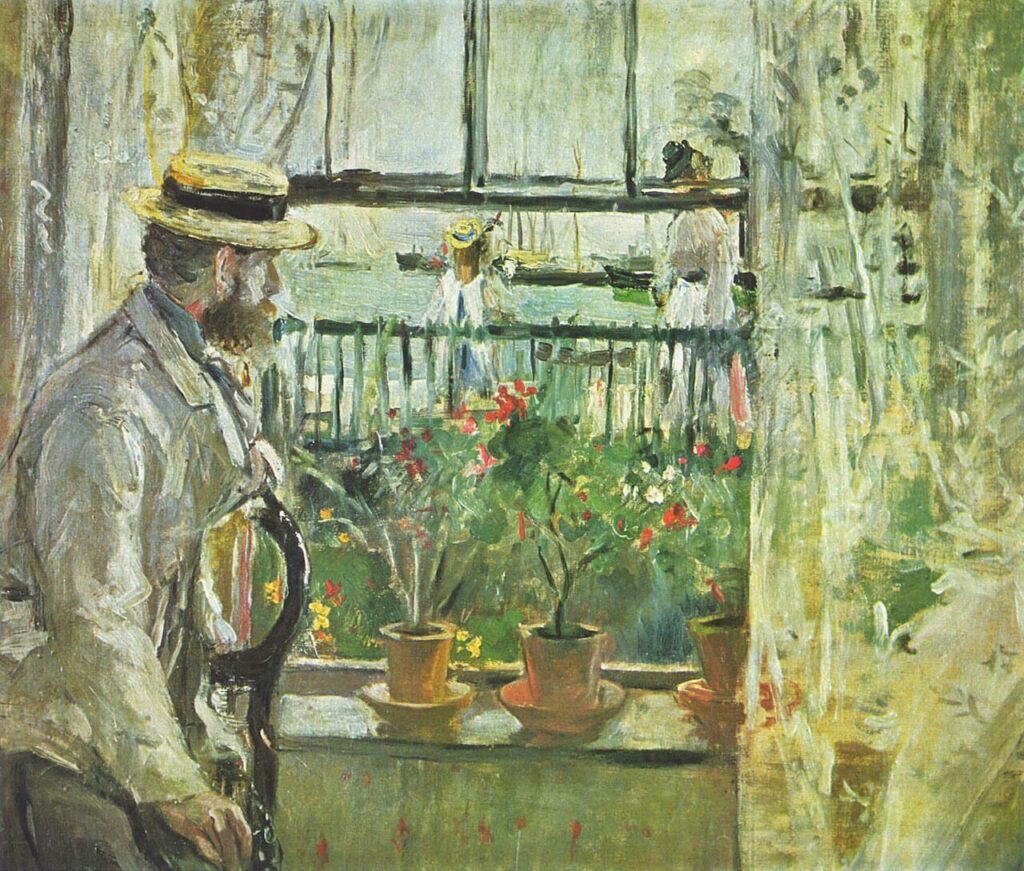
Eugène Manet on the Isle of Wight — the painter’s portrait of her husband
Berthe Morisot — the painter who influenced Manet's work →Cowes, Isle of Wight, England, March 1875. Three months after her wedding to Eugène Manet, which took place in Paris on December 22, 1874, Berthe Morisot continued the honeymoon she had begun in France with her new husband. The couple settled into the sitting room of the Globe Cottage hotel in Cowes, a small port town on the Isle of Wight. Berthe had brought her painting supplies with her. She was thirty-four years old. She had been married for ninety-seven days.
It was in this room in an English hotel, facing a window that looked out onto the harbor, that she painted the first portrait she dedicated to her husband. Eugène stands in profile, slightly bent over, leaning on the sill of a window draped in muslin. He is looking out—at a garden, two elegant women in white passing by, and boats lined up at the harbor dock. Berthe paints him from inside the room, from behind, half-hidden by sheer curtains and drapes.
This small painting —measuring just 38 × 46 centimeters— silently subverts the conventional conventions of 19th-century Western painting. Édouard Manet, Eugène’s brother and Berthe’s brother-in-law, had painted eleven portraits of Berthe between 1868 and 1874. She had been the subject, the model, the one sitting for the painting. A few weeks after her wedding, Berthe reversed the roles. She was the one painting. Eugène was the model. And he wasn’t even really posing: he was looking out the window, distractedly, without posing, without even being aware—according to biographical sources—that he was being painted.
This article explores the context of this pivotal work from the Morisot series—the March 1875 honeymoon in Cowes— the painting’s unique composition, the exceptional role of Eugène Manet in his wife’s work (he is the only man Berthe painted with such intensity throughout her entire career), and the painting’s journey through the art world —it remained in the family for over a century before joining the collections of the Marmottan Monet Museum in 1993.
December 22, 1874—a wedding in the Manet family
On December 22, 1874, at the age of 33, Berthe Morisot married Eugène Manet at the Passy town hall and then atthe Notre-Dame-de-Grâce-de-Passy church in Paris’s 16th arrondissement. It was a simple ceremony attended by family members. Édouard Manet served as a witness at the wedding.
Eugène Manet (1833–1892) was Édouard’s younger brother. Born on November 21, 1833, he was the second son of Judge Auguste Manet and Marie-Eugénie Désirée Fournier. He was two years older than Berthe. He, too, studied law. He, too, painted, but without the passion or talent of his older brother. In 1889, he published a novel titled *Victimes* —a testament to a life devoted more to writing, republican political thought, and supporting his wife’s career than to his own artistic practice.
The wedding marked the end of a difficult period in Berthe’s life. A few months earlier, in January 1874, her father, Edme-Tiburce Morisot, had died at the age of 67. Berthe had spent the year in semi-mourning, yet in April 1874 she had accepted the momentous decision to participate in the first Impressionist exhibition at Nadar’s gallery—against the advice of Édouard Manet and Pierre Puvis de Chavannes.
According to the official description from the Marmottan Monet Museum, “Both from bourgeois backgrounds, Berthe and her husband were free from financial worries, which allowed them to devote themselves fully to their passion for the arts.” It was a union of class as much as of love, but it would prove to be profoundly unusual in nature.
Eugène gave the couple his full support for Berthe’s artistic career. He did not hold her back in any way—on the contrary, heactively encouraged her to continue painting after their marriage. Berthe continued to exhibit under her maiden name , “Berthe Morisot, ” rather than “Madame Manet,” as social conventions would have dictated. This decision, supported by Eugène, was in itself an act ofprofessional self-assertion.
March 1875 — the honeymoon in Cowes
The couple left for their honeymoon in early 1875. Their destination: England. More specifically, southern England —first London, thenthe Isle of Wight, an elegant seaside resort off the southern coast of England in the county of Hampshire.
In the 19th century, the Isle of Wight was a popular destination for the English and continental bourgeoisie — Queen Victoria had maintained her summer residence there, Osborne House, since 1845. Cowes, the main town in the north of the island, was home to one of Europe’s most prestigious yacht clubs (the Royal Yacht Squadron, founded in 1815). It was an elegant and peaceful resort, ideal for both seaside strolls and plein air painting.
Berthe and Eugène checked into the Globe Cottage Hotel in Cowes, a hotel overlooking the harbor. Berthe wasted no time. She had brought her painting supplies—an easel, canvases, palettes, tubes of oil paint, and brushes. During the few weeks of their stay in Cowes (the exact duration is not precisely documented, but it is measured in weeks, not months), Berthe painted several works:
- Eugène Manet on the Isle of Wight (1875, Musée Marmottan Monet) — the one we’re studying here
- View of the Solent (1875, private collection) — view of the strait separating the Isle of Wight from the southern coast of England
- The Pier at Cowes (1875, Richmond, Virginia Museum of Fine Arts)
- View of a Small English Town (1875, private collection)
- Several landscape studies and harbor scenes
This intensive output during a honeymoon is remarkable in itself. Many bourgeois wives of the 19th century viewed the honeymoon as a time for rest. Berthe turned it into an open-air studio. This decision reveals Berthe Morisot’s character —painting was her primary calling, not a marital pastime.
In a letter to her sister Edma written from Cowes in March 1875, Berthe confides:
“Eugène is a thousand times better than in Paris. And I think he’s really kind to me. He lets me do whatever I want, but there are times when the complete isolation I’m condemned to gets me down.”
— Berthe Morisot, letter to her sister Edma, Cowes, March 1875
This passage is revealing in two ways: it attests to Eugène’s support for her artistic practice (“ “he lets me do whatever I want””) but also to the sense of isolation she felt in this solitary pursuit—a sentiment that runs throughout her early correspondence and that the birth of her daughter Julie in 1878 would profoundly alter.
The Painting — What It Depicts
*Eugène Manet on the Isle of Wight* is an oil on canvas measuring 38 × 46 centimeters. It is a small, intimate work, half the size of *The Cradle* (56 × 46 cm), painted three years earlier. It is a studio-sized work —easy to transport while traveling. Berthe likely painted it in a few consecutive sessions in the hotel’s sitting room.
The composition is built around a diagonal line and a window that give structure to the entire canvas.
In the foreground on the left, Eugène Manet stands, seen in three-quarter view from behind and in profile. He is dressed in a dark suit (likely a day jacket, a bourgeois travel outfit), with a black hat perched on his head. He is looking out the window, leaning slightly on the windowsill. His posture is stooped, almost meditative—he lacks the upright posture of 19th-century official portraits. He is observed in the intimacy of his everyday life, not striking a pose.
In the center of the painting, the sitting room window opens wide onto the outdoors. The windowsill is adorned with vases of red flowers — which, according to several critics, are “tiny splashes of red that warm the composition.” Above the windowsill, a sheer curtain filters the English daylight.
Beyond the window, the hotel garden slopes down toward the sea. Two elegant women dressed in white —seen from behind—walk through the garden. In the background, at the harbor, several boats are lined up along the dock. The sea forms a blue-gray backdrop.
The color palette is typical of Berthe Morisot’s works: light grays, off-whites, soft blues, and touches of red for the flowers. There are no deep blacks (unlike in Édouard Manet’s portraits of Berthe). There are no sharp contrasts. The light is soft and veiled, as if filtered through the muslin of the curtains.
The composition is asymmetrical. Eugène is positioned on the left side of the frame. The window occupies the center. The garden and the harbor take up the right half. This composition shifts the human subject to the edge of the canvas to bring the outdoor landscape into the painting. According to Women’s Art Tours, “this interplay between the interior and the exterior, as well as the role of the gaze, are characteristic of her artistic output.”
This is probably the most remarkable aspect of the work: two gazes meet in the painting —Eugène’s gaze outward (toward the women, the harbor, the journey), and Berthe’s gaze, from behind Eugène, as she watches him watching. The viewer is invited to watch Berthe watching Eugène watch. This triple interlocking of gazes gives structure to the work’s entire sophistication.
Exchanging Glances — Eugène looks outside; Berthe looks at Eugène
An analysis of the gazes in Eugène Manet on the Isle of Wight sheds light on Berthe Morisot’s unique position within Impressionist painting.
Eugène’s gaze is directed outward —toward the garden, toward the women in white, toward the harbor, toward the boats. This classic male gaze toward the outside world is a 19th-century pictorial convention: the man looks outward, toward the sea, toward the future, toward society. It is the posture found in the great Romantic male portraits.
As a painter, Berthe’s gaze is fixed on Eugène. But Berthe is inside the room. She paints from the privacy of the sitting room—she does not go outside to paint the harbor, as Monet used to go out to paint the Seine at Argenteuil. She stays indoors and makes the gaze of the man outside her subject.
According to several contemporary interpretations, this composition reveals a specific social reality: in 1875, a bourgeois woman could not paint alone outdoors in England, in a foreign port, among sailors and strangers. From her permitted vantage point —the hotel room—Berthe paints what she cannot directly access: the open outdoors of the male-dominated world.
The work thus becomes a meditation on the freedom of the gaze: who can look at what, from where, and from what social position? Eugène, as a married bourgeois man, can freely look at the young women passing through the garden. Berthe, as a female painter, watches Eugène watching these women —a gesture that embodies both a keen awareness of her own social limitations and the transformation of those limitations into pictorial material.
This dual perspective is one of Berthe Morisot’s most original contributions to Impressionist painting. Several contemporary biographical articles highlight this aspect as a defining characteristic of her work. But—in keeping with your editorial perspective on Berthe—it must be emphasized that this interpretation does not turn the painting into a manifesto. Berthe does not denounce. She observes and composes. It is the rigorous eye of a painter who takes note of her position and transforms it into a composition.
Eugène, the Only Man in Berthe’s Work
Eugène Manet on the Isle of Wight is the first portrait Berthe Morisot painted of her husband. It would not be the last—but according to several institutional sources, Eugène remains the only man she painted with true intensity in her entire body of work.
The works Berthe dedicated to Eugène can be counted on one hand:
— Eugène Manet on the Isle of Wight (1875, Musée Marmottan Monet)—the one examined here— Eugène Manet and His Daughter in Bougival (1881, Marmottan Monet Museum) — Eugène playing with Julie in the garden of their summer home in Bougival — Eugène Manet and His Daughter in the Garden (c. 1883, private collection) — A few studies and sketches scattered among private collections
Compared to the dozens of portraits of her sister Edma, the hundreds of portraits of her daughter Julie, or even the landscapes and still lifes, Eugène’s place in Berthe’s body of work is modest yet central. Modest in quantity—four or five major works. Central in significance —Eugène is the only man Berthe viewed as a painter.
The scarcity of male figures in her work can likely be attributed to the social conventions of the time. A bourgeois woman in the 19th century could not ask an unknown man to pose for her—the social promiscuity that this implied was unacceptable. Berthe therefore painted men only within the permitted family circle: her husband, and later her nephew. She had no professional male models throughout her entire career.
This limitation is, in and of itself, a historical fact. It reveals something about the material conditions of women’s painting in the 19th century—not by condemning those conditions, but by rigorously documenting them.
Other works from Wight’s journey
Berthe’s stay in Cowes in March 1875 was one of the most productive periods of her early married life. In just a few weeks, she painted several important works.
View of the Solent (1875, private collection): a view of the Solent strait, which separates the Isle of Wight from the southern coast of England. A classic Impressionist seascape—water, sky, and sailboats on the horizon. Very different from the portrait of Eugène: no human figures, maritime light, and a light color palette.
The Pier at Cowes (1875, Richmond, Virginia Museum of Fine Arts): a harbor scene. Quick brushstrokes, foam, masts, a shifting sky. Berthe experimented with plein air painting in the tradition of Corot and Boudin—though she likely painted from a windowsill or a sheltered gazebo, rather than out in the open.
Boats on the Isle of Wight (1875, several versions, private collections): variations on the motif of boats lined up in the harbor, previously sketched in the background of *Eugène Manet on the Isle of Wight*.
These English works from 1875 showcase the diversity of subjects Berthe explored during her stay: seascapes, harbor scenes, landscapes, and intimate portraits. They also demonstrate the swift brushwork that became her hallmark—bold brushstrokes, a light palette, and open backgrounds. It is in these English works that Berthe Morisot’s distinctive style takes shape, setting her apart from both her teacher Corot and her friends Monet, Renoir, and Sisley.
In retrospect, the honeymoon would prove to be the defining moment in Berthe’s artistic maturity. She returned to Paris in the spring of 1875 a changed woman—not because of her marriage (which provided a stable framework) but because of the weeks she spent in England, where she painted nonstop.
Eugène, artistic and political partner
Beyond his role as a model, Eugène Manet played a much more active role in Berthe’s artistic life than most artists’ husbands of the time did.
Eugène manages the couple’s day-to-day affairs so that Berthe can paint. He handles domestic matters (managing staff, shopping, travel) that would otherwise have fallen to Berthe. He writes some of the business correspondence with art dealers—notably Paul Durand-Ruel, who became the couple’s primary dealer starting in the 1880s. According to several biographical sources, Eugène is more comfortable with financial negotiations than Berthe, who prefers to devote herself to her studio.
Eugène played a role in the political defense of the Impressionists. When the critic Albert Wolff published his famous attack on the Impressionist exhibition in *Le Figaro* in 1876 (including the sexist attack on Berthe: “feminine grace holds its ground amid the excesses of a delirious mind”), Eugène sent a letter of protest to Wolff —a rare gesture for an artist’s husband, and one that attests to his personal commitment to defending his wife’s career.
Eugène held strong republican sympathies, inherited from the Manet family tradition. His father, Auguste Manet, had been a judge; his brother Édouard sympathized with the Republican Left and Zola; and Eugène himself published a novel in 1889 titled *Victimes* —an account of the crushing of the Paris Commune by Adolphe Thiers in 1871 — which clearly places him in the progressive Republican camp.
Eugène’s political commitment partly explains why the Manet-Morisot couple welcomed not only Impressionist painters (Monet, Renoir, Degas, Pissarro, Caillebotte), but also politically engaged writers and critics (Mallarmé, Théodore Duret, Gustave Geffroy).
Eugène and Berthe are, in fact, one of the most modern artistic couples of the 19th-century French art world—a couple of artists on equal footing, in which the husband actively supported his wife’s professional career.
From Cowes to Marmottan — The Material History of the Painting
The history of Eugène Manet’s art collection on the Isle of Wight is representative of how Berthe Morisot’s works were passed down through the family.
1875: Berthe painted the canvas in Cowes in March. She brought it back to Paris in the spring. The painting was not exhibited immediately—Berthe likely considered it a personal work, meant to be kept in the private sphere.
1880–1895: The painting remained inBerthe’s studio on Rue de Villejust in Paris. According to the partial inventories available, it was among the works Berthe kept until her death in March 1895.
1895–1900: Upon Berthe’s death, the painting passed to her only daughter, Julie Manet (1878–1966), who was 16 years old at the time. Julie inherited virtually the entire contents of her mother’s studio —several hundred works, most of which never left the family.
1900: Julie Manet married the painter Ernest Rouart (1874–1942), son of the painter and collector Henri Rouart. This marriage brought the Morisot artistic legacy into the Rouart family, one of the leading families of collectors and artists in early 20th-century France.
1900–1966: The painting remained in the Rouart collection, passed down through the family. It appeared in several one-off exhibitions organized by Julie Manet-Rouart (notably the 1941 exhibition at the Orangerie, with a preface by Paul Valéry), but remained primarily a private collection piece.
1966: Julie Manet-Rouart dies. The collection passes to her descendants.
1993: Bequest by Annie Rouart, Berthe Morisot’s granddaughter, to the Marmottan Monet Museum. Annie Rouart, the direct heir to the family collection, chose to donate the bulk of her Morisot collection to the Marmottan Museum. The bequest comprises approximately 80 works by Berthe Morisot — it is this bequest that today makes the Marmottan Monet Museum the world’s leading collection of works by Berthe Morisot, and which includes *Eugène Manet on the Isle of Wight* under inventory number 6029.
The work thus remained in the Morisot and then Rouart family for 118 years before entering a public museum collection. This is a typical example ofthe relative obscurity that Berthe Morisot’s work suffered in the 20th century—not due to neglect, but to jealously guarded family preservation, which paradoxically limited its public exposure.
“La postérité”—A Model for the Modern Couple Portrait
In the 19th century, Eugène Manet’s *On the Isle of Wight* did not have the same public impact as *The Cradle* (1872) or the major works of Monet, Renoir, and Manet. The painting remained largely unseen for decades, kept within the family.
But as Berthe Morisot was rediscovered in the second half of the 20th century, *Eugène Manet on the Isle of Wight* became one of the most widely reproduced and discussed paintings in her body of work—particularly in retrospective exhibitions:
— 1941: Exhibition at the Musée de l’Orangerie, with a foreword by Paul Valéry—her first institutional recognition in France. — 1987: Major traveling exhibition in the United States (National Gallery of Art, Washington; Fort Worth; South Hadley). — 2012: “Berthe Morisot” retrospective at the Marmottan Monet, featuring 150 works. — 2019: “Berthe Morisot, Impressionist Woman” retrospective at the Musée d’Orsay . — 2023: “Berthe Morisot and 18th-Century Art” exhibition at the Marmottan Museum .
At each of these exhibitions, Eugène Manet on the Isle of Wight was among the featured works. Several contemporary art critics (notably Anne Higonnet in her seminal 1989 biography) have described this painting as the embodiment of the 19th-century feminine pictorial gaze—the window, the husband, the distant outdoors, the exchanged glances.
Beyond the individual work, Eugène Manet on the Isle of Wight pioneered the modern marital portrait in Western painting—in which the artist-wife depicts her husband as a subject in his own right, without hagiography or hierarchy, in the simplicity of a moment during a journey. This modern perspective on the marital relationship would find its heirs in the 20th century in Suzanne Valadon (who painted her son Maurice Utrillo), Frida Kahlo (who painted Diego Rivera), and Lee Krasner (who painted Jackson Pollock indirectly in her work). All these 20th-century female painters, who made their husbands or partners subjects of their art, continued—often without realizing it—the tradition pioneered by Berthe Morisot in March 1875 in Cowes.
As Stéphane Mallarmé wrote in the preface to the catalog for the Boussod-Valadon retrospective exhibition in March 1896:
“This great artist, this woman, lived out her magnificent destiny through painting—living apart from the world to paint better, and behind her art, yet also portrayed by everyone around her.”
— Stéphane Mallarmé, preface to the catalog for the Boussod, Valadon & Cie exhibition, March 1896
“Painted, too, by her entire circle” —Mallarmé’s phrase encapsulates the essence of the pictorial reciprocity between Berthe and the Manets. Édouard painted Berthe eleven times. Berthe painted Eugène four or five times. The Manet-Morisot family remains one of the most intensely intertwined families of gazes in the entire history of French painting.
How to View the Work Today
*Eugène Manet on the Isle of Wight* is housed at the Marmottan Monet Museum in Paris. Practical information:
- Address: 2 rue Louis-Boilly, 75016 Paris
- Subway: La Muette (Line 9)
- Bus: 22, 32, 52, 63, 70, P.C.
- Hours: Tuesday through Sunday, 10 a.m.–6 p.m. (until 9 p.m. on Thursdays)
- Price: about €14 for general admission; free for children under 7
- Inventory Number: 6029
- Bequest: Annie Rouart, 1993
Also worth seeing at the Marmottan Monet Museum:
The Marmottan Monet Museum houses the world’s largest collection of works by Berthe Morisot, thanks to the bequest from Annie Rouart in 1993. Approximately 80 works are housed there, including:
- The Port of Cherbourg (1871) — early Impressionist seascape
- Woman with a Fan (1875) — another work from the English trip
- Eugène Manet and His Daughter in Bougival (1881) — the second major portrait of Eugène, in the garden of their summer home
- The Cherry Tree (1891) — a monumental late work
- Self-Portrait (1885)—the most iconic work representing Berthe’s artistic identity
- Dozens of portraits of Julie Manet at every stage of her life, from childhood to adolescence
Along with the Musée d’Orsay, this is probably the most informative museum tour of Berthe Morisot’s work that one can take in a single visit to Paris.
To see more works from Wight’s journey:
- Musée d’Orsay, Paris — View of the Small Harbor at Lorient (1869) and Other Early Seascapes
- Virginia Museum of Fine Arts, Richmond — The Pier at Cowes (1875)
- Private Collections — View of the Solent (1875) and several English studies
Further Reading
Institutional sources cited in this article
- Marmottan Monet Museum, official catalog entry for Eugène Manet’s *On the Isle of Wight*. Inventory number 6029. Bequeathed by Annie Rouart, 1993.
- Marie-Louise Bataille and Georges Wildenstein, *Berthe Morisot: A Catalog Raisonné of Paintings, Pastels, and Watercolors*, with an introduction by Denis Rouart, Paris, Les Beaux-Arts, 1961. The definitive catalog raisonné.
- Berthe Morisot, Impressionist Woman, exhibition catalog from the Musée d’Orsay, 2019.
- Berthe Morisot and 18th-Century Art, exhibition catalog from the Musée Marmottan Monet, 2023.
Primary sources cited
- Berthe Morisot, letter to her sister Edma, Cowes, March 1875.
- Stéphane Mallarmé, preface to the catalog for the retrospective exhibition “Boussod, Valadon & Cie,” March 1896.
Leading Modern Studies
- Anne Higonnet, Berthe Morisot, Adam Biro, Paris, 1989. A definitive biography.
- Jean-Dominique Rey, Berthe Morisot: 1841–1895, Éditions Hazan, Paris, 2012.
- Charles F. Stuckey, William P. Scott, and Suzanne G. Lindsay, *Berthe Morisot, Impressionist*, Hudson Hills Press, 1987.
Sources and Family Journals
- Julie Manet, *Journal* (1893–1899), Klincksieck, Paris, 1979. The personal diary of Berthe Morisot’s daughter.
Institutional Documentation
- Marmottan Monet Museum, Paris — owner since 1993.
- Musée d’Orsay, Paris — major Impressionist collections.
See also on Hors Cadre
- Berthe Morisot—the painter who influenced Manet’s work —a portrait of the artist.
- *The Cradle*—the “mother” of Impressionism —Berthe’s first major work, presented at the 1874 exhibition.
- Édouard Manet—from the *Déjeuner* scandal to his final painting —Eugène’s older brother and Berthe’s brother-in-law, who painted eleven portraits of Berthe between 1868 and 1874.
— M