Le Berceau — the forerunner of Impressionism
Berthe Morisot — the painter who influenced Manet's work →Paris, April 15, 1874, the former studio of photographer Nadar, 35 Boulevard des Capucines. The group exhibition opening today has gone down in history as the first Impressionist exhibition. Thirty artists. 165 works on display. And just one woman among the founding group: Berthe Morisot, thirty-three years old, who is exhibiting nine paintings.
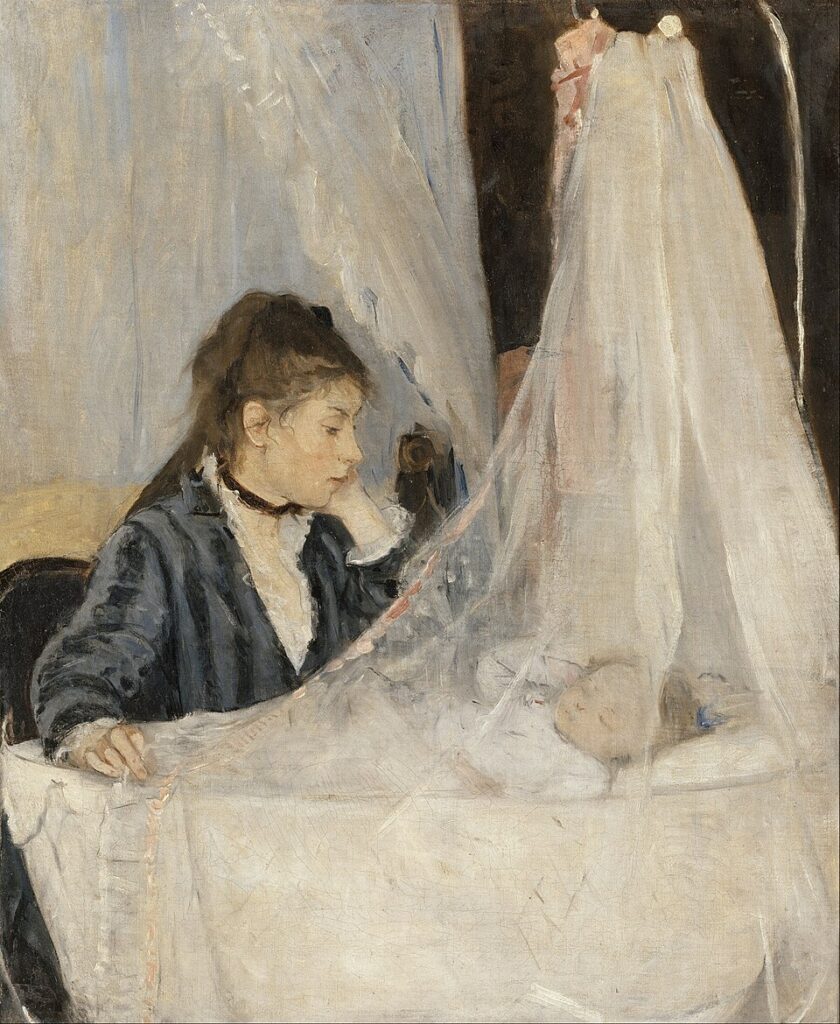
At the heart of this collection is a small-scale work—measuring just 56 × 46 centimeters—which is nevertheless considered his most famous work today: The Cradle. In the painting, a young mother dressed in black watches over a cradle draped with a white veil that ripples like a wave. The mother rests her chin in her hand. She gazes at her sleeping child. It is an intimate, silent, almost motionless scene.
The work was not one of the most talked-about pieces in the 1874 exhibition—critics reserved their criticism for Monet, Cézanne, and Pissarro. But *The Cradle* marks a historic turning point: it is the first major maternal work in Impressionist painting, and the image that would define for an entire generation of painters what would later be called “modern intimate painting.” Mary Cassatt, Pierre-Auguste Renoir, and Édouard Vuillard would all, in their own ways, take up the motif of mother and child pioneered here.
This article recounts the origins of the work, its two models —Berthe’s sister, Edma, who had become Madame Pontillon, and her niece Blanche, born a few months earlier—the context of the 1874 exhibition, the lukewarm critical reception (notably Albert Wolff’s infamous sexist remark), and the extraordinary journey that took this painting from the Pontillon apartment to the Musée d’Orsay, after spending fifty-eight years in Edma’s family.
1872 — Paris: Edma has been back for a few weeks
The painting has family and personal roots. Edma Morisot (1839–1921), Berthe’s older sister, was living in Lorient at the time, where her husband,the naval officer Adolphe Pontillon, was stationed. Edma herself had been a painter—she studied under the same teachers as Berthe (Chocarne, Guichard, Corot) and exhibited at the Salon in the 1860s. But her marriage to Pontillon in February 1869 coincided with her permanent abandonment of painting. In Lorient, Edma devoted herself to her life as an officer’s wife and then to her children.
On December 23, 1871, Edma gave birth to Blanche Pontillon, her first child. A few months later, in early 1872, Edma spent several weeks in Paris with her parents in the Passy neighborhood. She brought little Blanche with her, who was then two to three months old.
Berthe was thirty-one years old at the time. She was still living with her parents—she would not marry Eugène Manet until two years later. She was preparing for the 1872 Salon, to which she submitted her works, as she had done every year since 1864.
It was during this family vacation that she painted *The Cradle*. According to correspondence from that time (notably the letters between Berthe and Edma published in the standard biographies), the session was arranged in the Paris apartment of Mme. Morisot, the two sisters’ mother. Edma sat down near the cradle, while Berthe set up her easel a few meters away. Several sessions were required. The painting, completed in the spring of 1872, remained in Berthe’s possession—she did not exhibit it at either the 1872 Salon or the 1873 Salon.
The painting lay untouched for two years in Berthe’s studio. It would not emerge from obscurity until April 1874, at the exhibition held at Nadar’s.
The Painting — What It Depicts
*The Cradle* is an oil on canvas measuring 56 centimeters high by 46 centimeters wide —a vertical format of modest dimensions (compared to the 208 × 264 cm of Manet’s *Luncheon on the Grass* ). It is an intimate work, intended for close observation.
The composition is structured around a clear diagonal line that runs across the entire canvas:
On the left, slightly elevated, Edma is seated on a chair or armchair, dressed in black or dark colors. She is shown from the waist up, leaning slightly toward the cradle. Her left hand is folded, her chin resting on her fingers in a pensive, contemplative gesture. Her right arm lifts a white muslin veil that forms a curtain above the cradle.
On the right, below, the cradle is draped with a white, translucent muslin veil that ripples across the entire right half of the canvas. Beneath the veil, Blanche’s face appears, her eyes closed, fast asleep. Her left hand is folded over the pale pink blanket— a mirror image of her mother’s folded gesture.
Edma’s gaze is entirely focused on her daughter. Not for a single moment does she turn toward the viewer. Not for a single moment does she pose. It is a scene captured in its true intimacy—the mother gazing at her sleeping child, oblivious to the painter watching her.
The color palette is deliberately limited: deep blacks (Edma’s dress, the background), translucent whites (the veil, the pillow), pale pink (the blanket), and the pale skin tones of the mother and child’s faces. No bright colors. No spectacular lighting effects. Everything relies on the subtlety of the transitions between whites and blacks.
The diagonal line that runs across the canvas —from Edma’s gaze to Blanche’s hand—creates an invisible physical bond between mother and child. This is likely the most striking element of the composition. Berthe Morisot does not merely depict a maternal scene; she makes the bond itself visible, through the interplay of the composition alone. The veil that the mother lifts between the viewer and the child accentuates the sense of protected intimacy —as if Berthe were offering us, the viewers, a split second in a world that does not belong to us.
Edma and Blanche—the two models
Edma Morisot (1839–1921) was Berthe’s immediate older sister. Born in Valenciennes, she accompanied Berthe throughout her artistic training—taking classes with Chocarne in 1857, then with Guichard, and later with Corot in Ville-d’Avray. Edma began exhibiting at the Salon in 1864 —the same year as Berthe—and several art critics of the time considered her to be equally talented.
But in February 1869, at the age of thirty, Edma married Adolphe Pontillon (1832–1894), a naval officer stationed in Lorient. The marriage marked Edma’sdefinitive abandonment of painting. Biographers have put forward several theories: life as an officer’s wife far from Paris made it difficult to continue painting; Edma may have consciously stepped aside in the face of Berthe’s talent; or simply, the demands of motherhood may have taken precedence.
This decision stands in stark contrast to the one Berthe would make five years later. On December 22, 1874, Berthe married Eugène Manet —a marriage that, unlike Edma’s, would not put an end to her career but, on the contrary,would intensify it. Eugène, an atypical husband, would actively step back to support his wife’s painting.
Blanche Pontillon (1871–1947), Berthe’s niece and the daughter of Edma and Adolphe, was born on December 23, 1871, in Lorient. When she posed for *Le Berceau* in the spring of 1872, she was about three months old. Blanche grew up in Lorient and later in Paris. She did not become a painter—she married and had children of her own. The painting remained in the Pontillon family for fifty-eight years, passed down from generation to generation before being purchased by the government in 1930.
Edma appears in several other works by Berthe Morisot: *Portrait of Madame Edma Pontillon* (1871, Musée d’Orsay), *Madame Pontillon in the Garden on Rue Franklin* (1873), and *Edma on the Grass* (1873). Berthe painted her sister more than fifteen times over the course of her career—a figure of absolute reference, a model of loyalty and a confidante. The correspondence between the two sisters, partially published by biographers (notably in Anne Higonnet, *Berthe Morisot*, 1989), constitutes one of the most valuable biographical sources on Berthe.
The Subject—Motherhood as an Impressionist Theme
According to the Musée d’Orsay, *The Cradle* is “the first appearance of a maternal image in Morisot’s work, a subject that would become one of her favorite themes.” More broadly, it is also the first major maternal work in the entire history of Impressionist painting.
The theme of motherhood was not absent from the history of Western painting, but it remained largely governed by religious conventions: Christian Nativity scenes (from the Italian Renaissance to Georges de La Tour in the 17th century, including the “Madonna and Child” paintings by all the great masters) or allegories of Charity. Contemporary bourgeois motherhood, observed in its everyday banality, was simply not a subject for painting in the mid-19th century.
Berthe Morisot created this subject in 1872. She does not stage the scene, she does not mythologize it, and she does not dramatize it. She observes her sister watching over her niece, just as so many other mothers watched over their children throughout bourgeois France at the end of the Second Empire. And she turned it into a major work of art.
The motif was immediately taken up by the other Impressionists:
— Pierre-Auguste Renoir painted several “Maternité” works in the 1880s, including *Maternité (Madame Renoir and Her Son Pierre) * in 1885.
— Camille Pissarro painted numerous works depicting his wife, Julie, watching over or feeding their children.
— Mary Cassatt (1844–1926), an American painter who arrived in Paris in 1874 and became friends with Degas and Morisot, made the mother and child her primary subject for forty years. More than 200 of Cassatt’s works explore this motif. She undoubtedly saw *The Cradle* at the Impressionist exhibitions in which she participated beginning in 1879.
— In the 1890s and 1900s, Édouard Vuillard would continue this domestic observation, which he had inherited from Morisot, in an intimate style that became one of the hallmarks of the Nabi movement.
*Le Berceau* is thus, in the literal sense, the cradle of an entire strand of modern painting—that ofintimate, everyday life observed without mythologizing.
Degas’s Invitation, Manet’s Opposition
The story ofthe April 1874 exhibition at Nadar’s studio is made particularly interesting by the behind-the-scenes story of Berthe Morisot’s decision to participate.
According to institutional sources (notably the magazine *Orsay 2025* and leading biographers), it was Edgar Degas who personally invited Berthe Morisot to participate in this first independent group exhibition. Degas, a longtime friend, saw Berthe as a natural ally for the venture the young painters wanted to undertake.
But Berthe hesitates. And her close circle of artistic friends and colleagues strongly opposes her participation. Two prominent figures try to dissuade her:
Édouard Manet, her friend since 1868 and soon-to-be brother-in-law, was categorically opposed. He believed—as he had demonstrated in his own work—that the battle for modern painting must be waged within the official Salon, not on the fringes. Manet never participated and would never participate in the eight Impressionist exhibitions. He would prefer that Berthe continue to exhibit at the Salon, as she had been doing since 1864.
Pierre Puvis de Chavannes, a Symbolist painter and friend of the Morisot circle, was also opposed to the idea. According to biographers, he even predicted to Berthe that the exhibition would be a commercial and critical failure. A week before the opening, he still tried to convince her to withdraw her works.
Berthe ignored this. She chose her side—that of the young painters gathered around Monet, Renoir, Pissarro, Degas, and Cézanne. She submitted nine works to the exhibition at Nadar’s (according to the Musée d’Orsay’s catalog entry)—or fourteen oil paintings, three pastels, and three watercolors, according to exhaustive counts that include works not listed in the exhibition catalog. *The Cradle* is among the major works.
In fact, it is an act of courage and independence: Berthe is giving up the institutional security she has enjoyed for the past ten years to embark on an adventure with an uncertain outcome, against the advice of her most respected loved ones.
History will prove him right.
April 15, 1874 — The Welcome on Boulevard des Capucines
The exhibition opened on April 15, 1874, in the former studio of the photographer Nadar (Gaspard-Félix Tournachon), at 35 Boulevard des Capucines in Paris’s 9th arrondissement. The artists organized themselves under the official name “Société anonyme coopérative d’artistes peintres, sculpteurs, graveurs” (Cooperative Corporation of Painters, Sculptors, and Engravers).
165 works are on display by 30 artists. Among them, in addition to Berthe Morisot, are Claude Monet, Auguste Renoir, Camille Pissarro, Edgar Degas, Alfred Sisley, Paul Cézanne, Eugène Boudin, Armand Guillaumin, and several others.
Berthe Morisot was the only woman in the group to exhibit under her own name (another woman, referred to as “Mademoiselle X,” exhibited under a pseudonym—her identity remains a subject of debate among historians).
Critical reception of *Le Berceau* has been mixed but without any major hostility:
— Léon de Lora mentions it in *Le Gaulois* without dwelling on it. — Castagnary in *Le Siècle* speaks favorably of it, emphasizing the “grace” of the work. — Several critics note Berthe Morisot’s technical mastery and her delicate handling of light.
But the controversy centered primarily on Monet, Cézanne, and Pissarro. Monet’s *Impression, Sunrise* drew sarcastic remarks from Louis Leroy in *Le Charivari* on April 25, 1874—it was this review that, in derision, coined the term “Impressionists” to describe the group.
For Berthe, the experience was generally positive. Several sympathetic critics praised her talent. She sold one painting (though not *Le Berceau*, which remained unsold). She was definitively accepted into the circle of modern painters. Her decision to participate—made against the advice of Manet and Puvis de Chavannes—proved to be the right one.
As for *Le Berceau*, it was returned to Berthe’s home after the exhibition. No buyer came forward. The painting returned to the studio—and was later given to Edma, his sister and the model for the work. It remained in the Pontillon family for fifty-eight years.
Albert Wolff and Sexist Criticism
Among the reviews of the Impressionist exhibition, one of the most frequently cited by historians is thatof Albert Wolff, an art critic for *Le Figaro*. Wolff (1835–1891), an influential and feared critic of the time, wrote a review in which he referred to Berthe Morisot’s presence in a phrase that has become famous for its crude sexism:
“There is also a woman in the group, as in all famous bands. Her name is Berthe Morisot. In her work, feminine grace endures amid the excesses of a delirious mind.”
— Albert Wolff, on the 1874 Impressionist exhibition
This sentence is worth analyzing for what it reveals, in factual terms, about the status of women painters in 1874.
First, Wolff acknowledges Berthe’s presence —something that was far from obvious to male art critics of the time, who often simply ignored female painters. The mere fact that he mentions her name attests to his recognition of her as a member of the group.
Second, the phrase “as in all famous bands” betrays the idea that the presence of a woman in a group of men is in itself a curiosity —not a visual reality to be examined. The woman is treated as a symbol or a mascot, not as an artist in her own right.
Third,the final oxymoron (“feminine grace endures amid the excesses of a delirious mind”) reveals the double standard applied to women painters by critics. “Grace” is expected; yet the “excesses of a delirious mind” are projected onto Berthe as if her artistic practice were a form of madness.
In a letter to Edma from the same period, Berthe Morisot directly describes the difficulty she faces—not from professional art critics, but within her own family circle:
“My mother politely told me yesterday that she had no faith in my talent and that she didn’t believe I would ever be able to do anything serious.”
— Berthe Morisot, letter to her sister Edma, circa 1869–1870
These two quotes form a historical diptych: external sexist criticism (Wolff) and internal family conflict (Marie-Cornélie Morisot doubting her daughter’s worth). Berthe painted *Le Berceau* in this specific context —not amid general support, but in the face of multiple obstacles.
This is probably one of the reasons why, a century and a half later, *Le Berceau* still moves us. It is not merely a scene of tenderness—it is also an assertion of a right: a woman’s right to depict her sister and niece as a serious subject in painting, and to establish that subject within the grand narrative of modern painting.
From Paris to Orsay — Fifty-Eight Years with the Pontillon Family
The physical history of the painting after 1874 is unique.
1874–1872: Berthe brought the painting back to Paris after the Nadar exhibition. No buyer came forward. The painting returned to Berthe’s studio on Rue Franklin.
Probably before 1880: Berthe gave the painting to her sister Edma. The exact date of the gift is not documented, but based on family correspondence and the Morisot family’s custom, the work naturally passed to Edma Pontillon —the model and sister—some time after the exhibition. The painting thus found its way to Edma in Lorient or at her subsequent residences.
1872–1921: *Le Berceau* remained in Edma Pontillon’s personal collection for nearly fifty years, hanging in her family home. Edma died in 1921 in Maurecourt (Val-d’Oise), where she had retired in her later years. The painting was passed down to her descendants.
1930:The French government acquires *Le Berceau* from the Pontillon family for the Musée du Luxembourg (then the State Museum of Contemporary Art). This effectively marked Berthe Morisot’s entry into the French national collections —eighty years after her birth and thirty-five years after her death.
1940s–1950s: The museum was moved from the Musée du Luxembourg to the Louvre, and then to the Musée du Jeu de Paume, which is dedicated to the Impressionists and Post-Impressionists.
December 9, 1986: Opening of the Musée d’Orsay. *Le Berceau* is on permanent display in the Impressionist Gallery, under inventory number RF 2849. Today, it is one of the museum’s iconic works —regularly featured on the covers of publications dedicated to Berthe Morisot.
The work’s physical journey— fifty-eight years in a family collection, followed by its belated acquisition by the government—illustratesthe relative obscurity to which Berthe Morisot fell during the first half of the 20th century. Her institutional rediscovery did not truly begin until the1941 exhibition atthe Orangerie (with a preface by Paul Valéry) and, even more so, with the major retrospectives of the 1980s–2020s.
Posterity—the cradle of all Impressionist motherhood
The influence of the Cradle on modern Western painting extends far beyond the scope of any single work.
Mary Cassatt (1844–1926), an American painter who arrived in Paris in 1874 and became friends with Degas in the late 1870s, began exhibiting with the Impressionists in 1879. She undoubtedly saw *The Cradle* during the successive Impressionist exhibitions. Beginning in the 1880s, Cassatt made the mother-and-child motif the central theme of her career —more than 200 works explore this theme. *La Petite Toilette* (1891, Art Institute of Chicago), *Mother and Child with Red Hair* (1898, Detroit Institute of Arts), *The Child’s Bath* (1893, Art Institute of Chicago)—all these works continue the artistic direction pioneered by Morisot.
Pierre-Auguste Renoir painted *Maternity (Madame Renoir and Her Son Pierre) * (1885, Saint Louis Art Museum)—in which his wife, Aline Charigot, is breastfeeding their first son.
Camille Pissarro painted numerous works featuring his wife, Julie Vellay, caring for their children, particularly in intimate scenes from the 1880s.
Édouard Vuillard (1868–1940) continued this domestic observation during the 1890s and 1910s, in bourgeois interior scenes where mothers, sisters, and children form the fabric of everyday life observed without drama. The connection to *Le Berceau* is clear—Vuillard had seen it several times.
Beyond direct homages, *Le Berceau* brings about a structural transformation in Western painting. It paves the way for three essential shifts:
- Contemporary bourgeois motherhood is becoming a major subject in painting—moving away from religious Nativity scenes and allegories.
- The presence of a child in a major work ceases to be merely anecdotal—the child becomes a subject in his or her own right in modern painting.
- The female perspective on domestic life took on a pictorial dignity it had not previously possessed—paving the way for Mary Cassatt, Paula Modersohn-Becker, and all the female painters of the 20th century.
It is in this sense—and quite literally—that *Le Berceau* can be called “the first mother of Impressionism.” Not only because it was the movement’s first birthplace—but because all the subsequent artistic “birthplaces” in modern Western painting owe something to this small painting, measuring 56 × 46 centimeters, painted in Paris in the spring of 1872 by a young woman aged thirty-one.
How to View the Work Today
“The Cradle ” is on display at the Musée d’Orsay in Paris. Practical information:
- Address: 1 rue de la Légion d’Honneur, 75007 Paris
- Room: upper level, Impressionist gallery
- Subway: Solférino (Line 12) or RER C (Musée d’Orsay)
- Reservations recommended: limited time slots, online tickets
- Admission: around €16 for general admission; free for EU residents under 26; free on the first Sunday of every month
- Inventory Number: RF 2849
Also on view in the same gallery at the Musée d’Orsay:
- Young Woman Applying Powder (1877), Berthe Morisot — an intimate work from the third Impressionist exhibition
- Butterfly Hunting (1874), Berthe Morisot — in which Edma plays with her children in an orchard
- Portrait of Madame Edma Pontillon (1871, pastel), Berthe Morisot — another portrait of Edma
- Berthe Morisot with a Bouquet of Violets (1872), Édouard Manet — a portrait of Berthe by her brother-in-law
To see more of Berthe Morisot’s early works:
- Marmottan Monet Museum, Paris — *Woman and Child on a Balcony* (1872), *The Cherry Tree * (1891), and several portraits of Julie Manet as a child
- National Gallery of Art, Washington — The Artist’s Sister with Her Child (c. 1872), an intimate variation on the maternal theme
Further Reading
Institutional sources cited
- Musée d’Orsay, official catalog entry for the cradle. Inventory number RF 2849.
- Marie-Louise Bataille and Georges Wildenstein, *Berthe Morisot: A Catalog Raisonné of Paintings, Pastels, and Watercolors*, with an introduction by Denis Rouart, Paris, Les Beaux-Arts, 1961. The definitive catalog raisonné.
- Berthe Morisot, Impressionist Woman, exhibition catalog from the Musée d’Orsay, 2019.
- Inside Berthe Morisot: Painting Modern Life, the Musée d’Orsay magazine, March 2025.
Primary sources cited
- Berthe Morisot, letter to her sister Edma, circa 1869–1870.
- Albert Wolff, critic of the Impressionist exhibition, 1874.
Modern Studies
- Anne Higonnet, Berthe Morisot, Adam Biro, Paris, 1989. A standard biography.
- Jean-Dominique Rey, Berthe Morisot: 1841–1895, Éditions Hazan, Paris, 2012.
- Sylvie Patry and Sylvie Patin (eds.), *Berthe Morisot, an Impressionist Woman*, exhibition catalog, Musée d’Orsay, 2019.
Institutional Documentation
- Musée d’Orsay, Paris — institution that has owned it since 1986.
See also on Hors Cadre
- Berthe Morisot—the painter who influenced Manet’s work —a portrait of the artist.
- Claude Monet—the painter who gave his name to Impressionism and was a co-founder of the movement—exhibited alongside Morisot in April 1874 at Nadar’s gallery.
- Édouard Manet—from the *Luncheon* scandal to his final painting —Berthe’s friend and brother-in-law, who opposed her participation in the 1874 Impressionist exhibition.
— M