“The Dance at the Moulin de la Galette” — the icon of joyful Impressionism
Pierre-Auguste Renoir — Joyful Modernity →Montmartre, spring 1876. A thirty-five-year-old French painter rents a small studio at 78 rue Cortot, on the slopes of the Butte. This address was not chosen at random. It is a three-minute walk from one of the most popular open-air dance halls in northern Paris—the Moulin de la Galette. The painter’s name is Pierre-Auguste Renoir. He has an ambitious project: to paint, en plein air, directly on site, Sunday after Sunday throughout the summer, a monumental scene of a dance at this popular open-air dance hall.
The chosen format is colossal for an outdoor scene: 131 centimeters high by 175 centimeters wide—three times larger than a standard easel canvas. To transport such a canvas from his studio on Rue Cortot to the open-air dance hall every Sunday, Renoir was helped by his friends — Franc-Lamy, Norbert Goeneutte, Georges Rivière, and Edmond Renoir (his brother). They carried the canvas together, cleared a space at the edge of the dance floor, and set up the easel on the steps of a wooden staircase. Renoir painted directly from life, using a radical plein air technique that had never before been employed on such a large scale.
The work was completed in the fall of 1876. Presented at the third Impressionist exhibitionin April 1877 at 6 rue Le Peletier, it received a mixed critical reception —the dissolution of forms in the vibrant brushstrokes baffled the public. But it immediately caught the attention of Gustave Caillebotte, an Impressionist painter and wealthy Parisian heir, who purchased the painting in 1879. Caillebotte kept the work in his private collection for fifteen years. Upon his death in 1894, his will bequeathed the painting tothe French government —a donation that was ultimately accepted in 1896.
Now housed at the Musée d’Orsay, the “The Ball at the Moulin de la Galette” is, in fact, one of the most reproduced images in the entire history of Western painting. It is an iconic image of Impressionism, of joyful Parisian modernity, and of the popular joy of the 1870s. This article traces the precise genesis of this work—the radical technique of large-scale plein air painting,the identification of the models (all friends of Renoir, none of whom were professional models), the complex composition in three planes structured around soft light, the work’s long journey from Caillebotte to the Orsay, via the Luxembourg and the Louvre, and the work’s iconic status at the heart ofthe retrospective exhibition *Renoir and Love. “La modernité heureuse” is on view at the Musée d’Orsay through July 19, 2026.
Le Moulin de la Galette — the last open-air dance hall on the Butte
To understand the work, you have to understand the place. The Moulin de la Galette is not a fictional or symbolic place—it is a real open-air dance hall located on Montmartre Hill, which can still be seen today (it has been the Musée de Montmartre since 1960).
History of the mill: In the early 19th century, Montmartre Hill was home to several dozen windmills used to grind wheat from the Parisian plains. By the mid-19th century, industrialization had rendered these traditional mills obsolete. Most were demolished. Two remain: the Moulin Radet (still visible today on Rue Lepic) and the Moulin Blute-Fin (at the summit of the hill). A family of millers, the Debrays, bought the two remaining mills between 1830 and 1860 and gradually transformed them into an open-air guinguette —an open-air restaurant with a dance floor and a bandstand.
The name “Galette” comes from the rye flatbreads that the Debray family originally sold to visitors— flatbreads baked on site and served with the light wine offered to the dancers.
Atmosphere: Every Sunday afternoon, starting at 3 p.m., the Moulin de la Galette open-air café welcomes a socially diverse crowd:
- Factory workers and young seamstresses (sewing apprentices) from the 9th arrondissement
- Parisian petty bourgeois who have come to mingle with the common folk
- Painters, students, and bohemians from all over Paris’s Right Bank
- Boaters from the banks of the Seine, hailing from Chatou and Argenteuil
- Foreigners Visiting Paris
The ball lasts until midnight. Gas lighting in the evening— glowing globes hanging from trees and poles, visible in Renoir’s painting on the left in the background, beneaththe musicians’ platform.
Social diversity and freedom: In 1870s Paris, the Moulin de la Galette open-air dance hall was one of the few places where people from all social classes mingled without any formal hierarchy. There, people danced the polka, the waltz, and the quadrille. Women could attend without a chaperone —an unusual freedom in the bourgeois Paris of the time. Renoir, the son of a laborer who became a painter, felt at home in this mix of social classes. It wasthis very atmosphere that he wanted to paint.
The Painting — What It Depicts
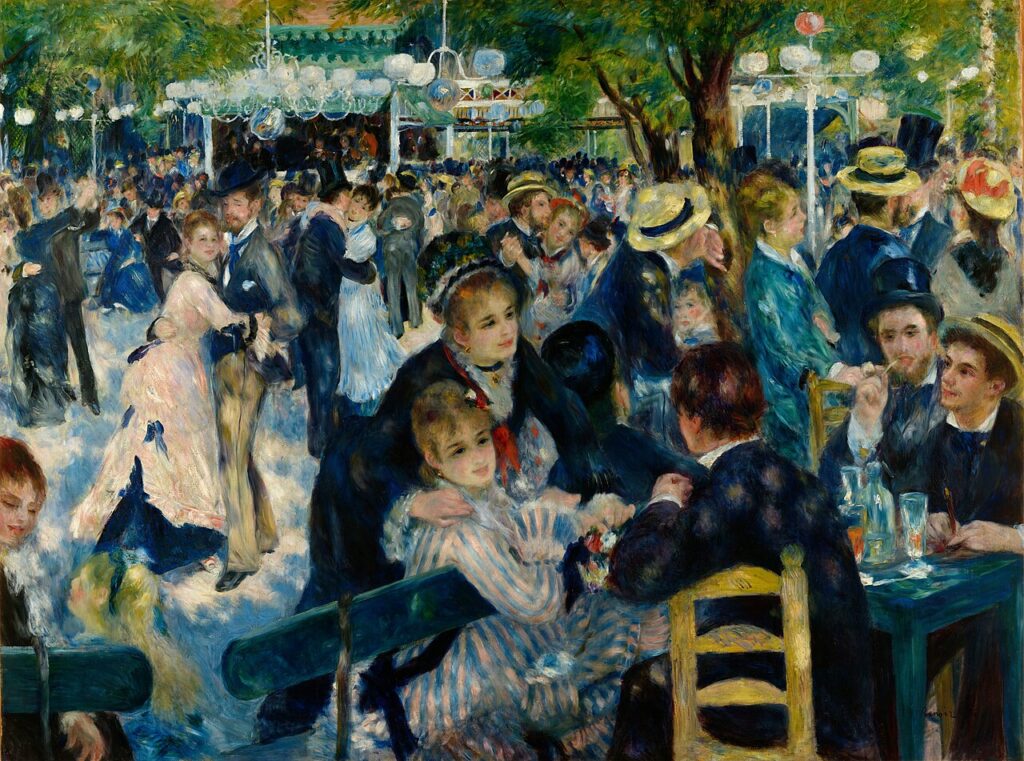
The Dance at the Moulin de la Galette is an oil on canvas measuring 131 × 175 centimeters — a wide landscape format, almost like an early form of Cinemascope. This width allows Renoir to unfold a complex composition blending dozens of figures within a continuous space.
The composition is organized from an elevated vantage point —Renoir painted the scene from the steps of a wooden staircase overlooking the dance floor. This bird’s-eye view allows him to see the following simultaneously:
- The dance floor in the foreground on the left
- The customers’ tables in the foreground on the right
- The Crowd in the Background
- The musicians’ platform in the back left, with its gas lamps
The painting is constructed along three interrelated levels:
Shot 1 — Background: an indistinct crowd effect. A multitude of figures jostling together, suggested by quick brushstrokes without precise outlines. Couples dancing. Men drinking. Women laughing. No individual is clearly recognizable. It is the density of the crowd that matters.
Shot 2 — Medium shot, left: pairs of dancers in motion. A couple in the center—the man in profile, wearing a black bowler hat and a dark suit, his arm around his partner’s waist. His partner—wearing a pink dress with a ribbon— dances facing him, her gaze turned toward the painter (and thus toward the viewer). This central couple appears to have paused their polka to look at the painter —a moment suspended between movement and attention.
Shot 3 — Foreground, right: a group of about ten people seated around a café table. Several are wearing boater hats. On the table are glasses likely containing grenadine or light beer. This group is easily identifiable —they are Renoir’s personal friends.
Light is, in fact, the true subject of the painting. Renoir captures the light filtered through the leaves of the acacia trees lining the courtyard. The sun’s rays filter through the foliage and scatter the ground, the clothing, and the faces with shifting patches of light —referred to as “sun spots” in Anglo-Saxon art criticism and “macules solaires” in French.
These patches of light are painted with juxtaposed strokes of pale pink, orange, and lemon yellow on a general blue-mauve background. Optical effect: the painting seems to vibrate to the eye, as if the light were actually moving across the canvas. This is the essence of Impressionism condensed into a major work.
As summarized in the official description from the Musée d’Orsay:
“The depiction of a moving crowd in both natural and artificial light is rendered with vibrant, colorful brushstrokes. The sense that the forms were somewhat dissolved was one of the reasons for the negative reactions from critics at the time.”
— Musée d’Orsay, official entry for the work
A crowd of friends and models—who’s who?
One of the distinctive features of *The Dance at the Moulin de la Galette* is that Renoir did not use any professional models for this work. All of the identifiable figures are personal friends of the painter—other artists, art critics, and young female workers from Montmartre whom he paid to pose.
This valuable information comes from the memoirs of Georges Rivière, an art critic and close friend of Renoir, who published a memoir in 1921 titled Renoir and His Friends (Editions Floury). In it, Rivière identifies several of the figures in the painting, more than forty years after it was painted.
In the center of the painting:
- Henriette Anna Lebœuf, known as Margot (1856–1879)— a young woman of 20 at the time the painting was created. Renoir’s favorite model at the time. She died prematurely three years later, at the age of 23, likely from typhoid fever. Her untimely death would deeply sadden Renoir for years to come.
- The central couple looking at the painter —a man in a bowler hat dancing with a young woman in a pink dress. Rivière did not document their specific identities.
In the foreground on the right (the group seated around the table):
- Georges Rivière himself (1855–1943), art critic, wearing a boater hat and holding a pen. At the time the painting was created, he was 21 years old and was publishing his first art reviews in the magazine *L’Impressionniste*.
- Pierre-Franc Lamy (1855–1919), a painter and friend of Renoir and Rivière. Along with Goeneutte and Rivière, he co-founded the short-lived magazine *L’Impressionniste*, which championed the movement.
- Norbert Goeneutte (1854–1894), painter and engraver, a friend from the same circle. He died prematurely at the age of 39 from tuberculosis.
- Estelle Lebœuf, the younger sisterof Henriette Lebœuf, also known as Margot. She is pictured in the center of the group seated at the table, wearing a blue-and-pink striped dress. According to Rivière, she is the one in the foreground, seated and engaged in a lively conversation.
Jeanne Samary (1857–1890), an actress at the Comédie-Française who was Renoir’s favorite model at the time, does not appear in the main painting—according to Rivière, she was 16 at the time and was having an affair with a local boy, so she refused to pose. Her sister Estelle Samary posed in her place (not to be confused with Estelle Lebœuf). Jeanne Samary appears in another major work by Renoir painted around the same time: The Swing (1876, Musée d’Orsay)—a work also bequeathed by Caillebotte and now housed in the same museum.
Edmond Renoir (1849–1944), Pierre-Auguste’s younger brother, was a journalist for the daily newspaper *La Presse*. He helped Pierre-Auguste transport the painting from the studio on Rue Cortot to the open-air dance hall. His identity was confirmed by Rivière’s recollections.
Clothing detail: Renoir used to give his models a straw hat with a wide red ribbon called a “timbale” —a hat that was in fashion in Paris in the 1870s. The straw hat with a red ribbon visible in the upper right corner of the painting is an example of this Renoir “timbale.” The painterwould bring it with him to sittings and lend it to different models depending on the needs of the composition.
Summary: *The Dance at the Moulin de la Galette* is, for the most part, a collective self-portrait of Renoir’s artistic circle in 1876— Montmartre bohemians, working-class models, journalists, and artist friends. The painting is not a neutral scene observed from the outside—it is a staged depiction ofthe painter’spersonal circle.
Renoir Painted on Location — The Radical Technique of Plein Air Painting
The most radical aspect of the creation of *The Dance at the Moulin de la Galette* is the working method Renoir adopted: painting on site, in front of the living scene, directly at the open-air café, on a colossal canvas measuring 131 × 175 cm.
In 1876, no canvas of this size had ever been painted entirely outdoors. Large-scale works were traditionally reserved for studio painting —where the artist would reconstruct complex scenes from studies under controlled conditions (artificial light, posed models, and an extended painting process ).
Renoir broke with this tradition. Here is the specific technique he adopted, as documented in the memoirs of Georges Rivière (1921) and the accounts of Pierre-Franc Lamy and Norbert Goeneutte:
1. A studio as close as possible to the subject. Renoir rented, specifically for this project, a small studio at 78 Rue Cortot in Montmartre, a three-minute walk from the guinguette. This studio was the most modest he had ever occupied— a single room with dim lighting and sparse furnishings. But its proximity to the Moulin de la Galette wasthe deciding factor in his choice. Renoir could carry his canvas from the studio to the guinguette in just a few minutes.
2. Transporting the painting. A 131 × 175 cm painting on a wooden stretcher weighs about 8 to 12 kilograms. Renoir cannot carry it by himself —especially since he also has to carry the easel, the palette, the brushes, and the thinner. According to Rivière, every Sunday, three or four of Renoir’s friends helped him carry the equipment from the studio on Rue Cortot to the guinguette. Norbert Goeneutte, Franc-Lamy, Edmond Renoir, and Georges Rivière himself took turns handling this logistical task.
3. Set up on the steps of a staircase. At the guinguette, Renoir sets up his easel on a wooden staircase overlooking the dance floor. This elevated position gives him the bird’s-eye view characteristic of the painting. Itplaces him far enough away from the dancers so that he can observe the entire scene without being disturbed.
4. Preparatory studies. Before beginning work on the large painting, Renoir produced several preparatory studies: two overall sketches in oil (small format, approximately 60 × 80 cm—one is housed at the Ordrupgaard Museum in Copenhagen, the other at the Petit Palais in Paris). Plus about a dozen partial studies of groups or individual figures —studies that are now scattered among several international collections.
5. Sunday work over several months. Sunday afternoons were the highlight of the open-air café—the largest crowds,the liveliest atmosphere, and the summer light. Renoir returned every Sunday between May and September 1876 to continue working on the painting. According to Rivière, it took about twenty to twenty-five sessions to complete the work.
6. Industrial paint tube.The recent invention (around 1841 by John Goffe Rand, commercially popularized in the 1860s and 1870s) of the metal tube for oil paint made this outdoor practice materially possible. Before the paint tube, painters had to prepare their palettes in the studio and transport the paint in airtight but fragile pig bladders. The metal tube made it easy to transport large quantities of ready-to-use paint—a technical revolution that madeoutdoor Impressionism practically feasible.
This radical method is, in fact, unprecedented in the history of Western painting. No painter before Renoir had ever painted a work measuring 131 × 175 cm entirely en plein air. Monet, Pissarro, and Sisley painted outdoors but on modest canvases (rarely larger than 80 × 100 cm). *The Dance at the Moulin de la Galette* is, in this regard, the practical manifesto of Impressionism.
April 1877 — the third Impressionist exhibition
The painting was shown to the public for the first time at the 3rd Impressionist Exhibition, held from April 4 to 30, 1877, at 6 Rue Le Peletier in Paris’s 9th arrondissement. Renoir exhibited 21 works there—the largest number by any single artist in the exhibition.
Alongside *The Dance at the Moulin de la Galette*, Renoir exhibited *La Balançoire* (also 1876, Musée d’Orsay), several portraits of women, and scenes from contemporary Parisian life. This was the last Impressionist exhibition in which Renoir participated with such a large number of works —afterward, his involvement in the movement would become more sporadic.
Critical reception has been mixed, and at times downright hostile:
- Several critics have praisedthe work’sambition and its atmospheric success —the painting “brings to life” a Montmartre open-air café
- Others reject the dissolution of forms in the vibrant brushstrokes — “you can no longer make out the faces, ” “the painting becomes an impressionistic blur”
- Academic critics condemn the ” lowbrow” subject matter —painting a working-class open-air dance hall is deemed unworthy of a large canvas traditionally reserved for heroic or religious scenes
As historian John Rewald later noted in his seminal work *History of Impressionism* (1946), *The Ball at the Moulin de la Galette* was hailed by supporters of the movement as “the first masterpiece of Impressionism, ” but was misunderstood by most critics in 1877.
Financially, the exhibition was a partial failure. Few works sold. No museums are acquiring any works. But the painting catches the eye of a key collector: Gustave Caillebotte, himself an Impressionist painter exhibiting at the same show and a wealthy heir to a Parisian textile family.
Around 1879 (according to various sources), Caillebotte purchased *Le Bal du Moulin de la Galette* directly from Renoir for an estimated sum of between 1,500 and 2,000 francs. This was as much an act of friendship as it was an investment: Caillebotte knew that Renoir was experiencing financial difficulties at the time, and he was building his private collection in part to provide financial support to his Impressionist friends.
An interesting historical detail: that same year, 1879, Gustave Caillebotte painted himself in *Portrait of the Artist at the Easel* (private collection, Switzerland). In this painting, we see Caillebotte painting —and behind him, hanging on the wall of his studio, is Renoir’s *The Dance at the Moulin de la Galette* by Renoir. This is the first visual evidence confirming that Caillebotte had owned the work since 1879.
From Caillebotte to the Musée d’Orsay—The Story of a Contested Bequest
1879–1894: *The Dance at the Moulin de la Galette* remained in Gustave Caillebotte’s private collection in Paris. There were no major public exhibitions of the painting during this period. The painting remained hidden from the general public and was visible only to the collector’s close friends.
February 21, 1894: Gustave Caillebotte died suddenly at the age of 45 at his estate in Petit-Gennevilliers, as a result of pulmonary congestion that occurred while he was gardening. His will, drawn up in 1876, along with subsequent codicils, bequeathed his collection of Impressionist works (67 pieces in total) tothe French government, on the conditionthat the entire collection be exhibited at the Musée du Luxembourg or the Louvre.
Pierre-Auguste Renoir was appointed executor of the Caillebotte bequest. He had to negotiate withthe Frenchmuseum authorities to securetheir formal acceptance of the bequest.
Difficult negotiations (1894–1896). The French government hesitated. The curators at the Louvre considered Impressionism too recent, too controversial, and too unorthodox to merit official inclusion in the national collections. Several members of the Academy publicly opposed accepting the donation. Jean-Léon Gérôme (Mary Cassatt’s former professor in Paris) publicly declared that “France has no need for this rubbish” —a statement that would come to symbolize the academic resistance to Impressionism.
After two years of negotiations, the French government accepted only part of the bequest— 38 of the 67 works. *Le Bal du Moulin de la Galette* has been accepted.
1896: Officially added to the collection of the Musée du Luxembourg in Paris, which at the time served as a museum dedicated to living artists. The painting remained on permanent display there for 33 years.
1929: Transferred to the Louvre ‘s Jeu de Paume Gallery (which at the time housed the Louvre’s Impressionist collections).
1947: The painting was exhibited at the Jeu de Paume in the Tuileries, which had become the Museum of Independent Impressionism.
1986: Opening of the Musée d’Orsay. *Le Bal du Moulin de la Galette* was transferred there from the Jeu de Paume. It has been on permanent display there ever since, cataloged under the number RF 2739.
Symbolically: the painting, rejected by academic critics in 1877 and only partially and reluctantly accepted by the French government in 1896, became, a century later, one of the most reproduced images from the Musée d’Orsay andthe emblem of happy Parisian modernity.
The second version—a mystery and a world record
A little-known fact: there is a second version of *The Dance at the Moulin de la Galette*, a smaller one (78 × 114 cm), also painted by Renoir, which has had a fate just as extraordinary as that of the Orsay version.
This smaller version was likely painted by Renoir as a preparatory study or as a replica created after the exhibition —the exact chronology remains a subject of debate among art historians. Some believe it predates the large version (a study in preparation for the large-scale work), while others believe it was painted afterward (a replica commissioned by a collector following the relative success of the 1877 exhibition).
Documented provenance:
- 1880s–1929: The abridged version passed through several private European collections
- Around 1929: purchased by John Hay Whitney (1904–1982), an American magnate and diplomat (who would later serve as U.S. Ambassador to the United Kingdom from 1957 to 1961). Whitney’s collection is one of the largest private collections of Impressionist art in the United States
- 1982: John Hay Whitney dies. The collection passes to his widow, Betsey Cushing Whitney.
- May 17, 1990: The smaller version of *The Dance at the Moulin de la Galette* was auctioned at Sotheby’s in New York. Buyer: Ryōei Saitō, Japanese paper magnate (1916–1996), owner of Daishōwa Paper
Auction price: $78.1 million —the second-highest price ever paid for a work of art at that time (the all-time record had been set just a few days earlier by Van Gogh’s *Portrait of Dr. Gachet* by Van Gogh, which sold for $82.5 million to the same buyer, Ryōei Saitō).
Saitō told the press at the time that he “wished to be cremated along with these two works” upon his death—a statement that caused an uproar in the art world. He faced fierce public criticism and later retracted the statement.
1996: Ryōei Saitō died. The two paintings (by Renoir and Van Gogh) disappeared from public view. Their current whereabouts remain partly unknown:
- “Le Bal du Moulin de la Galette ” is now believed to be in a private collection in Switzerland (according to several confidential sources)
- No public exhibition since 1990
- No recent photos available
This private version is identical to the Orsay version in its overall composition, but rendered in a more fluid style (freer brushstrokes, less defined contours). It is not officially known which ofthe two wasexhibited at the third Impressionist exhibition in 1877 —the exhibition catalog from that time does not specify the dimensions of the work on display. The academic consensus favors the Orsay version as the primary original work, but some doubt remains.
“Posthumous Fame” — The Universal Icon of Impressionism
In the 20th and 21st centuries, *The Dance at the Moulin de la Galette* became the most reproduced image of Impressionism, rivaled only by Monet’s *Water Lilies* by Monet and Impression, Sunrise by the same Monet.
Some documented lines of influence and adaptations:
Picasso, 1955: Bal du Moulin de la Galette, a Cubist reinterpretation of the work by Picasso, held in a private collection in Paris. An explicit homage to Renoir’s painting, rendered in Picasso’s late Cubist style.
Toulouse-Lautrec: His cabaret scenes from the 1890s (Moulin Rouge, *Au Salon de la rue des Moulins*) are a direct continuation of the tradition pioneered by Renoir—popular open-air dance halls, non-professional models, artificial lighting, and Parisian social diversity.
French cinema:
- Jean Renoir, the painter’s son, directed the 1955 film French Cancan (starring Jean Gabin and Maria Felix)—a film explicitly inspired by his father’s paintings of the Moulin de la Galette and the Montmartre dance halls
- Vincente Minnelli, An American in Paris (1951) — final ballet sequence set in a scene directly inspired by the Bal du Moulin de la Galette
Advertising, fashion, design: mass reproduction in global popular culture since the 1950s. Postcards, posters, mugs, T-shirts, scarves, planners, wallpaper. The image is as much a part ofglobal iconography as the Mona Lisa or The Starry Night.
Visual Analysis: In 1876, Renoir unwittingly createdthe archetypal image of Parisian happiness—an image that was appropriated, reinterpreted, and reproduced throughout 20th-century Western culture. So much so that for many people, Paris = Moulin de la Galette = *Bal du Moulin de la Galette* = Renoir. A complete visual association between a place, a work of art, and an artist.
How to View the Work Today
“Le Bal du Moulin de la Galette” is housed at the Musée d’Orsay in Paris. Practical information:
- Address: 1 rue de la Légion d’Honneur, 75007 Paris
- Subway: Solférino (Line 12) or RER C (Musée d’Orsay)
- Gallery: Currently part ofthe retrospective exhibition Renoir and Love: The Joy of Modernity (1865–1885) through July 19, 2026. After July 19, 2026, the painting will return to its permanent location in the Impressionist Gallery on the middle level.
- Inventory number: RF 2739 (bequest from Gustave Caillebotte, 1894; accepted in 1896)
- For complete pricing and hours: see the article “Musée d’Orsay—What to See, Hours, Tickets” on Hors Cadre
Also in this gallery:
- The Swing (1876, Renoir)—a companion piece to *The Ball at the Moulin de la Galette*, painted in the garden on Rue Cortot that same year, also from the Caillebotte bequest. Jeanne Samary (who refused to pose for *The Ball*) appears in it
- Young Girls at the Piano (1892, Renoir) — a work from his mature classical period
- Gabrielle with a Rose (1911, Renoir) — Late Renoir, diagnosed with polyarthritis
- The Large Bathers (The Nymphs) (1918–1919, Renoir) — a work created shortly before his death
To watch the second version of *Le Bal du Moulin de la Galette*:
As noted above, the smaller version (78 × 114 cm) has been in an unidentified private collection (probably in Switzerland) since 1990. It has not been exhibited publicly. To date, there are no plans to loan it to a museum.
To visit the historic site:
The Musée de Montmartre (12 rue Cortot, 18th arrondissement, Paris)—housed in the former buildings of the Moulin de la Galette and the gardens immediately adjacent to the studio where Renoir painted the work. A must-see for art lovers. More specifically, the studio at 78 rue Cortot where Renoir worked is now part of the Musée de Montmartre.
Further Reading
Institutional sources cited
- Musée d’Orsay, official information sheet on the Bal du Moulin de la Galette.
- Musée d’Orsay, a magazine marking the painting’s 150th anniversary, March 2026.
- Larousse, Encyclopedia of Art, entry on “Bal du Moulin de la Galette.”
- Exhibition catalog: *Renoir and Love: The Joy of Modernity (1865–1885)*, Musée d’Orsay, 2026.
Primary sources cited
- Georges Rivière, *Renoir and His Friends*, Floury, Paris, 1921. An essential primary source on the painting and the identification of the models.
- Pierre-Auguste Renoir, as quoted by his son Jean Renoir in *Renoir, My Father*, Paris, 1962.
Leading Modern Studies
- John Rewald, *A History of Impressionism*, Albin Michel, Paris, 1946 (French edition). A reference work on the Impressionist movement.
- Anne Distel, *Renoir: A Painter, a Life, a Body of Work*, Hazan, Paris, 2009.
- Guy-Patrice Dauberville, Michel Dauberville, *Renoir: A Catalog Raisonné of Paintings, Pastels, Drawings, and Watercolors*, 5 volumes, Bernheim-Jeune, Paris, 2007–2014. The definitive catalog raisonné.
- John House, *Renoir in the 20th Century*, exhibition catalog for *Renoir and Tradition*, National Galleries of the Grand Palais, Paris, 2009.
Institutional Documentation
- Musée d’Orsay, Paris — the museum has been the owner since 1986 (moved from the Jeu de Paume).
- Montmartre Museum, Paris — located on the historic site of Renoir’s studio on Rue Cortot.
See also on Hors Cadre
- Pierre-Auguste Renoir — Joyful Modernity — Portrait of the Artist, A Comprehensive Overview of His Career.
- Edgar Degas—the painter of frozen movement —a contemporary and exhibitor at the same third Impressionist exhibition in 1877.
- Musée d’Orsay — what to see, hours, tickets — a complete guide to the museum that houses the artwork.
— M