Young Girls at the Piano — Renoir’s First Official Commission
Pierre-Auguste Renoir — Joyful Modernity →Paris, early 1892. Pierre-Auguste Renoir was fifty-one years old. He had behind him a thirty-year artistic career, four of the eight Impressionist exhibitions, the absolute masterpiece *Le Bal du moulin de la Galette* (1876), the scandal of his Ingresque period (1881–1888), and now a mature body of work in which he achieves a synthesis between classical drawing and the Impressionist palette. But one fact remains —a fact that his friends and admirers find scandalous: the French government has never placed a single official commission with the painter. No national museum owns a Renoir. Not a single work has been purchased with public funds.
This institutional anomaly deeply troubled Stéphane Mallarmé (1842–1898), the Symbolist poet who was then a respected figure in the Parisian art world. Mallarmé had known Renoir personally since the 1870s. He had been friends with Manet (who painted his portrait in 1876, now in the Musée d’Orsay). He deeply admired Renoir’s work. He decided to take action.
With the support of Roger Marx (1859–1913), a young civil servant inthe Fine Arts Administration who was open to innovative movements, Mallarmé orchestrated discreet efforts in the spring of 1892 to bring Impressionist works into the national collections. Roger Marx, who worked as a journalist and art critic alongside his administrative duties, had recently been appointed Inspector General of Museums and had the necessary authority to place official commissions.
The result of this restoration project was an informal commission awarded to Pierre-Auguste Renoir to create a work for the Musée du Luxembourg —then known as the Musée des Artistes Vivants and dedicated tocontemporary French art. Renoir, proud of this first official recognition at the age of 51, chose his subject: Young Girls at the Piano. He set to work with relentless dedication —such was his determination that he painted six different versions of the same composition, four of which were signed (and thus considered finished), yet he remained unsatisfied with any of them.
The version ultimately acquired by the French government in 1892 is now housed at the Musée d’Orsay. This article recounts the precise genesis of this work—the discreet Mallarmé-Roger Marx operation to bring Renoir into public collections, the mature technique of the “pearly” period (1890–1897), the obsessive perfectionism that led Renoir to paint six nearly identical versions, and the work’s unique historical status as the first official recognition of a major Impressionist painter by French institutions.
1892 — Renoir is 51 years old and still has not received an official commission
To understand the significance of the work, one must understand the institutional context in which Renoir found himself in the early 1890s.
A thirty-year career. Renoir began exhibiting at the Paris Salon in 1864 —he was accepted there sporadically between 1864 and 1872. He participated in the Impressionist exhibitions of 1874, 1876, 1877, and 1882 —four out of eight. He painted several hundred paintings during this period. He enjoyed moderate commercial success thanks to the art dealer Paul Durand-Ruel, who had been championing the Impressionists since 1870.
But the French government never bought anything from him. In 1892, at the age of 51, Renoir found himself in a paradoxical situation for a painter:
- Recognized by his peers (Monet, Pissarro, Cassatt, Berthe Morisot)
- Prized by private collectors (Caillebotte, Charpentier, Ephrussi)
- Commercially viable thanks to the private market
- But completely absent from France’s national museums
This institutional invisibility can be attributed to several factors:
1. Persistent academic resistance.The École des Beaux-Arts andthe Academy still regarded Impressionism as a frivolous movement, unworthy of national collections. Several academicians (notably Jean-Léon Gérôme, William Bouguereau, and Alexandre Cabanel) actively block any entry of Impressionist works into museums.
2. The lack of a formal mechanism. At the time, French national museums acquired works primarily through private donations, purchases at the Salon, or official commissions focused on academic historical painting. The system itself was not designed to accommodate avant-garde contemporary art.
3. Administrative reluctance. Museum curators are cautious —they fear the criticism that might arise if public funds were spent on works that are still controversial among the general public.
For Renoir, at age 51, this situation was becoming a psychological burden. He knew his career was entering its late maturity —he was beginning to experience the first signs of joint pain (which would be diagnosed as rheumatoid arthritis a few years later). He wanted at least one of his works to be included in the national collections during his lifetime.
It is this unspoken expectation that his friends will use as a catalyst for action.
Stéphane Mallarmé and Roger Marx — The Rehabilitation Effort
The initiative came primarily from Stéphane Mallarmé (1842–1898), a central figure in the Parisian art world of the 1880s and 1890s.
In 1892, Stéphane Mallarmé was one of the greatest living French poets. Author of *Les Fenêtres* (1863), and *L’Après-midi d’un faune* (1876, from which Claude Debussy drew inspiration for his orchestral prelude in 1894), and *A Roll of the Dice Will Never Abolish Chance* (1897)—he hosted the famous “Tuesdays on Rue de Rome” —his literary salon where Paul Verlaine, Paul Valéry, André Gide, Joris-Karl Huysmans, and several Impressionist painters, including Édouard Manet, Berthe Morisot, Edgar Degas, and Pierre-Auguste Renoir.
Mallarmé had maintained a deep friendship with Édouard Manet since the 1870s. Manet painted him in 1876 in an intimate portrait (27.5 × 36 cm, now in the Musée d’Orsay)—a small, precious painting that has, in hindsight, become one of the poet’s most famous portraits. Upon Manet’s death in 1883, Mallarmé delivered the eulogy at his funeral.
Mallarmé had known Renoir personally since that same decade. He frequented Renoir’s Parisian studios, discussed painting and poetry with him, and occasionally purchased minor works for his small private collection. Like all his Parisian intellectual contemporaries, he had a deep admiration for Renoir’s work.
In the spring of 1892, Mallarmé decided to put his network to work for Renoir. He turned to a valued colleague in the civil service: Roger Marx (1859–1913).
Roger Marx is a young civil servant inthe Fine Arts Administration. As an art critic in addition to his official duties, he actively supports innovative movements —he has written for several specialized journals (Revue encyclopédique, Gazette des Beaux-Arts) in support ofImpressionism,Art Nouveau, and the Nabis. Around 1890, he became Inspector General of the Fine Arts Administration—a position that gave him the authority to place official commissions andinfluence museum acquisitions.
The Mallarmé-Roger Marx alliance was, in fact, the key tothe Impressionists’ entry into French public collections in the early 1890s. Roger Marx discreetly advised Mallarmé on administrative procedures, identified available budgets, and suggested arguments that might convince the higher-ups.
In the spring and summer of 1892, Mallarmé and Roger Marx took action. They convincedthe administration of the Beaux-Arts to place an informal commission with Pierre-Auguste Renoir for a work intended for the Musée du Luxembourg —a Parisian museum dedicated tocontemporary French art (located until 1937 inthe former orangery of the Palais du Luxembourg, 6th arrondissement).
The commission was placed sometime in 1892. Mallarmé personally informed Renoir of it during a visit to his studio. Renoir accepted with great emotion —it was the institutional recognition he had been waiting for for thirty years.
The 1892 Commission — Renoir Chooses His Subject
Renoir had complete freedom to choose the subject and composition. The commission was informal —no specific requirements, no set dimensions, and no prescribed theme. Renoir was simply expected to deliver a work representative of his art, worthy of inclusion in the national collections.
Renoir thought long and hard about which work to choose. According to accounts reported by Georges Rivière (1921) and Albert André (a painter and friend of Renoir’s), he wavered between:
- A ball scene (a continuation of *The Ball at the Moulin de la Galette*)
- A solo portrait (a genre in which he had several commercial successes)
- An intimate scene featuring women (a genre he has explored extensively since 1880)
He ultimately chose the intimate female scene —more specifically, the theme of young girls at the piano. There are several well-documented reasons for this:
1. A respectable “bourgeois” theme. In 1890s France, the piano was the ultimate symbol of the cultured bourgeoisie. Every “proper” bourgeois family had an upright piano in its living room, on which the daughters learned to play. The theme is therefore institutionally respectable.
2. A recurring theme in his work. Renoir had already explored this subject a few years earlier with *The Piano Lesson* (c. 1889, private collection). He is familiar with the composition, the dynamics of the two female figures, and the rendering of the piano.
3. A theme suited to the “pearly period.” The artistic period in which Renoir found himself in 1892— the “Pearly Period” (1890–1897)—emphasized intimate scenes featuring women, in which Renoir could showcase his characteristic treatment of luminous flesh tones and silky textiles.
4. A concession to bourgeois tastes, but not a betrayal. Renoir adapts his subject matter to the institutional patron —he knows that an intimate bourgeois scene will be more readily accepted by the administration than a scene of a popular open-air dance hall. But he does not abandon his style—the modernity of his painting remains intact.
May–December 1892: Renoir worked on the painting without any major interruptions for several months. He produced several preparatory studies (including a pastel of the same dimensions, now in a private collection, and a smaller oil sketch housed at the Musée de l’Orangerie).
Late 1892–early 1893: The final version was delivered to the Ministry of Fine Arts, whichaccepted it. It then became part of the collections of the Musée du Luxembourg.
The Painting — What It Depicts
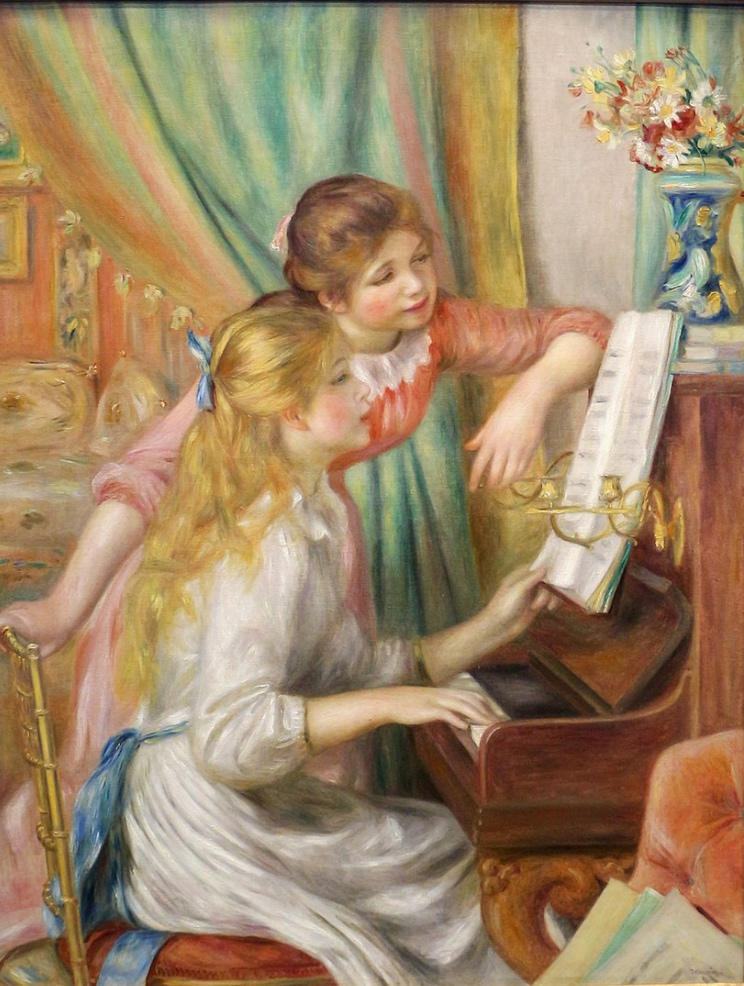
Young Girls at the Piano is an oil on canvas measuring 116 × 90 centimeters — a vertical, medium-to-large format, the traditional size for intimate group portraits.
The painting depicts two young girls in a typical upper-class parlor of the late 19th century, playing the piano.
Main figure, on the left: a young blonde girl, about 15–17 years old, sitting at the piano, seen in profile. She is wearing a white dress with a lace collar and a colorful fabric belt around her waist. Her hands are resting on the keyboard —she is playing or has just finished playing. Her gaze is fixed on the sheet music lying open before her. Calm concentration. Her blonde hair falls loosely down her back, tied with a ribbon.
Secondary figure, on the right: a young girl with brown hair (perhaps a little younger, 13–15 years old), standing behind the pianist, leaning on the piano in profile. She is wearing a darker orange dress with a closed neckline. She is looking at the sheet music — the pianist’s musical partner. Her gaze is also fixed on the sheet music. Her brown hair is pulled back into a high bun.
The two young girls can be identified by their physical characteristics:
- Approximate age: teenage girls, around 13–17 years old
- The difference in hair color suggests two separate people —not the same model in two poses
- The models are not specifically identified in contemporary sources—Renoir was in the habit of painting the daughters of the bourgeois families he associated with (notably the Lerolle daughters, whom he would paint five years later in a similar work, *Yvonne and Christine Lerolle at the Piano* from 1897, Orangerie Museum)
The piano: a black lacquered upright piano, seen in a three-quarter view. Its strict geometric lines — the rectangles of the keyboard, the lid, and the back panel—contrast with the flowing lines of the two young girls. On the piano: a small bouquet of flowers in a vase, familiar objects found in a middle-class home.
In the background, on the right: a pleated, orange-red velvet curtain that covers the wall on the right. A spatial clue to domestic bourgeoisie —the interior is socially coded.
The palette is dominated by warm, pearlescent tones:
- Pale roses on the skin of the two young girls
- The warm orange hue of the standing girl’s dress
- The off-white color of the pianist’s dress
- Brownish red of the velvet curtain
- The piano’s deep black
There are no vibrating, juxtaposed brushstrokes as in *Le Bal du moulin de la Galette* —on the contrary, there are soft chromatic transitions, subtle modeling, and delicate gradations. This is the technique of his mature, pearlescent period.
The drawing is firm and precise. The outlines of the two young girls are clearly defined —a legacy of the Ingresque period (1881–1888). But the color palette is lyrical and luminous —a legacy of earlyImpressionism.
As summarized in the official description from the Musée d’Orsay:
“The firm yet supple line work clearly defines the figures while giving free rein to the lyricism of the color palette.”
— Musée d’Orsay, official entry for *Young Girls at the Piano*
It is this successful blend of classicism and impressionism that makes the work one of the most iconic of Renoir’s ” pearly” period.
The Pearlescent Period (1890–1897) — The Mature Synthesis
To put it in context Young Girls at the Piano within Renoir’s body of work, one must understand the painter’s stylistic evolution:
Impressionist period (1869–1881) — vibrant brushstrokes, dissolution of forms, atmospheric light. Masterpiece: *The Dance at the Moulin de la Galette* (1876).
Ingresque or “austere” period (1881–1888)—after his trip to Italy and his discovery of Raphael, Renoir rejected Impressionism and returned to precise drawing, classical composition, and an austere color palette. Masterpiece: The Large Bathers (1884–1887, Philadelphia Museum of Art).
The Pearlescent Period (1890–1897)— a mature synthesis of revived classicism and early Impressionism. Broader brushstrokes than during the Ingresque period, iridescent colors, and female flesh rendered with a characteristic pearlescent luminosity. Masterpiece: Young Girls at the Piano (1892).
Late or “Red” Period (1897–1919)— monumental simplification, explosive colors (reds, oranges, intense yellows), and a focus exclusively on female nudes and family scenes. Masterpiece: *The Large Bathers* (*The Nymphs*) (1918–1919, Musée d’Orsay).
Young Girls at the Piano is, in this chronology, the emblematic work of the “pearly” period. It precisely illustrates the synthesis Renoir had been seeking since 1888:
- Drawing has made a comeback (in the style of Ingres)
- The color palette remains lyrical (an Impressionist legacy)
- The flesh has that distinctive pearlescent sheen (new invention)
- The subject matter is calm, intimate, and bourgeois (a concession to the tastes of the time)
It is, in fact, one of Renoir’s best-composed works — masterful technique, a balanced color palette, and confident line work. No element is excessive or lacking. It reflects the artistic maturity of a painter who has weathered every possible stylistic crisis and has finally found a lasting balance.
The term “pearly period” derives fromthe characteristicpearly appearance of the female flesh painted by Renoir during those years— a milky translucence, iridescent pinks, and subtle variations that evoke mother-of-pearl or pearls. This pearlescent effect was achieved technically by applying multiple glazes over white preparatory layers —a time-consuming technique that required several sessions on the same surface.
Six versions, four signed — obsessive perfectionism
One of the most remarkable aspects of *Young Girls at the Piano* is that Renoir, perpetually dissatisfied, painted six different versions of it between 1892 and, most likely, 1893.
The six documented versions:
- Orsay Version (116 × 90 cm) — officially acquired by the French government for the Musée du Luxembourg in 1892. Signed. Considered the primary version.
- Metropolitan Museum of Art, New York, version (116 × 81 cm) — acquired by the Met in 1937 through a gift from the Estate of Robert Lehman. Signed. This version is very similar to the one at the Musée d’Orsay but features some variations in the rendering of the curtain and the posture of the standing girl.
- National Gallery of Art, Washington, D.C. version(116 × 81 cm) — donated by Mrs. Pillsbury in 1962 (probably; attribution to be verified in the catalogs raisonné). Signed.
- Private collection version (Sterling and Francine Clark Art Institute Collection, Williamstown, Massachusetts) — similar dimensions. Signed.
- Oil sketch — small format, in the collection of the Musée de l’Orangerie, Paris (Walter-Guillaume Collection).
- Pastel — same dimensions as the oil versions (116 × 90 cm). Private collection. A preparatory study or an alternative finished work in a different medium.
Of these six versions, four are signed by the painter —which means that Renoir considered them finished. An unsigned work by Renoir is typically a study or an unfinished version that he did not consider worthy of being presented as a final work.
Why six versions? There are several possible explanations:
1. Perfectionism. Renoir was perpetually dissatisfied. He would revisit his works, modify them, sometimes destroy them, and start over. This artistic anxiety is documented by all his biographers (Jean Renoir, Albert André, Vollard).
2. The weight of the institutional commission. Renoir knew that this work was intended for a national collection. The psychological pressure was considerable. He made numerous attempts so as not to disappoint.
3. Demand from art dealers. Once the official commission was accepted, several art dealers (notably Paul Durand-Ruel) commissioned studies from Renoir—they knew that a work destined for the national museum would have greater commercial value. Renoir fulfilled these commissions by producing several nearly identical versions intended for the private market.
4. The practice of “repetitions.” According to Renoir himself (as recounted by his son Jean Renoir), he viewed painting as a craft in which creating multiple versions of the same subject was normal and acceptable. For him, painting a subject multiple times reinforced his mastery and improved each successive version.
This multitude of versions now complicatesthe study of the work. Art historians do not fully agree on the precise chronology of the six versions —which one was painted first, which is the most accomplished, and which one corresponds exactly to the one delivered to the French government in 1892.
The current consensus identifies the Orsay version as the principal work —it was this version that was purchased by the government, it was this version that entered the Musée du Luxembourg in 1892, and it is this version that is listed as the reference version in the catalogs raisonné.
From Luxembourg to Orsay — The Canonized Work
The provenance of the Orsay version of *Young Girls at the Piano* is one of the simplest in the entire Impressionist corpus—the work has never left French public collections since 1892.
1892:The FrenchMinistry of Fine Arts officially purchased the work from Pierre-Auguste Renoir. It was placed in the Musée du Luxembourg in Paris, in the gallery dedicated tocontemporary French art.
1929: As the Musée du Luxembourg was gradually phased out as a venue for exhibiting contemporary art (this role was transferred to the Musée National d’Art Moderne, which would be established in 1947), the Impressionist works from the Musée du Luxembourg were transferred to the Louvre, specifically to the Musée du Jeu de Paume.
1947: *Young Girls at the Piano* was exhibited at the Jeu de Paume museum in the Tuileries, which became the Museum of Independent Impressionism starting that year.
1986: The Musée d’Orsay opened. All of the Impressionist works from the Jeu de Paume were transferred there, including *Young Girls at the Piano*. The painting has been on permanent display in the gallery dedicated to Renoir ever since, under inventory number RF 755.
A Unique Place in Art History: ” Young Girls at the Piano ” is, in fact, the first work by Renoir to enter French national collections — two years before the Caillebotte bequest (1894–1896), which would bring several other Renoirs (including “The Ball at the Moulin de la Galette ” and “The Swing“).
Symbolically, the work represents France’s first institutional recognition of Impressionism— a historic milestone in the movement’s canonization. All subsequent Renoir works acquired by the government or bequeathed by collectors would pass through this door opened by Mallarmé and Roger Marx in 1892.
Posthumous Reputation — Renoir the Bourgeois or Renoir the Master?
Young Girls at the Piano divides modern art critics along a persistent fault line.
Critical Reading 1 — The Controversial “Bourgeois” Work
Several 20th-century art critics viewed *Young Girls at the Piano* as a work of compromise — suggesting that Renoir adapted his style to bourgeois tastes in order to please the authorities. The subject matter (bourgeois young women at the piano) is said to be conventional, uncontroversial, and far removed from the Impressionist modernity of the 1870s. According to this interpretation, Renoir betrayed his initial avant-garde spirit in order to gain entry into museums.
This critical interpretation is championed in particular by art historians who are heirs to formalist modernism (Clement Greenberg, Meyer Schapiro), who emphasizetechnical innovation and a break with tradition.
Critical Reading 2 — The Mature Synthesis
Other, more recent critics, on the contrary, consider *Young Girls at the Piano* to be one of Renoir’s most accomplished works. According to this interpretation, the work transcends the dilemma between classicism and modernity by synthesizing the two. The technique is masterful, the composition balanced, and the intimate emotion authentic. The work proves that modern painting does not need to be provocative to exist.
This critical interpretation is championed by historians such as John House (who organized the major retrospective *Renoir in the 20th Century* at the National Galleries of the Grand Palais in 2009) and Anne Distel (author ofthe definitivebiography of Renoir, published by Hazan in 2009).
Personal Assessment: *Young Girls at the Piano* is, in fact, one of the most reproduced works in Renoir’s late catalog. It appears on countless posters, postcards, and art history textbooks. It has been on continuous display in museums in France for 130 years. It is regarded as emblematic of the “pearly” period in all specialized works.
Influence on 20th-century painting: less directly traceable than that of *Le Bal du Moulin de la Galette*, but documented in:
- Pierre Bonnard (1867–1947) — Intimate Domestic Scenes Featuring Women from the 1900s to the 1940s
- Édouard Vuillard (1868–1940) — bourgeois interiors, musical scenes, pearlescent color palette
- Henri Matisse (1869–1954) — Early Years (Before Fauvism), Domestic Scenes Inspired by Renoir
Renoir the bourgeois or Renoir the master? The honest answer is probably: both. *Young Girls at the Piano* is both a concession to institutional taste and a technically masterful work. This ambivalence is what makes it unique —it is the work in which Renoir most perfectly achieves a synthesis between the avant-garde and institutional acceptability.
How to View the Work Today
Young Girls at the Piano is housed at the Musée d’Orsay in Paris. Practical information:
- Address: 1 rue de la Légion d’Honneur, 75007 Paris
- Subway: Solférino (Line 12) or RER C (Musée d’Orsay)
- Gallery: Currently part ofthe retrospective exhibition Renoir and Love: The Joy of Modernity (1865–1885) through July 19, 2026. After July 19, the work will return to its permanent location in the Renoir Gallery on the middle level.
- Inventory number: RF 755 (commissioned by the French government, 1892)
- For complete pricing and hours: see the article “Musée d’Orsay—What to See, Hours, Tickets” on Hors Cadre
Also in this gallery:
- The Dance at the Moulin de la Galette (1876)—a signature work of the Impressionist period, stylistically contrasting with *Young Girls at the Piano*
- The Swing (1876) — a companion piece to *The Ball at the Moulin de la Galette*
- Gabrielle with a Rose (1911) — Late Renoir, Red Period
- The Great Bathers (The Nymphs) (1918–1919) — a posthumous work
To see other versions of the Young Girls at the Piano :
- Metropolitan Museum of Art, New York — holds a signed version, similar to the one at the Musée d’Orsay
- Musée de l’Orangerie, Paris — holdsthe oil sketch (Walter-Guillaume Collection)
- National Gallery of Art, Washington, D.C. — holds a signed version
- Sterling and Francine Clark Art Institute, Williamstown — holds another signed version
To place the work within the “Nacré” period:
- Musée de l’Orangerie, Paris — Yvonne and Christine Lerolle at the piano (1897), a later variation on the same theme by Renoir
Further Reading
Institutional sources cited
- Musée d’Orsay, official description of *Young Women at the Piano*.
- Musée de l’Orangerie, description of the sketch *Girls at the Piano*.
- Exhibition catalog: *Renoir and Love: The Joy of Modernity (1865–1885)*, Musée d’Orsay, 2026.
Primary sources cited
- Pierre-Auguste Renoir, as quoted by his son Jean Renoir in *Renoir, My Father*, Paris, 1962.
- Stéphane Mallarmé, correspondence with Berthe Morisot and Roger Marx.
Leading Modern Studies
- John Rewald, *A History of Impressionism*, Albin Michel, Paris, 1946. A reference work on the Impressionist movement and the Mallarmé-Renoir episode.
- John House, *Renoir in the 20th Century*, exhibition catalog for *Renoir and Tradition*, National Galleries of the Grand Palais, Paris, 2009.
- Anne Distel, *Renoir: A Painter, a Life, a Body of Work*, Hazan, Paris, 2009. A definitive biography.
- Guy-Patrice Dauberville, Michel Dauberville, *Renoir: A Catalog Raisonné of Paintings, Pastels, Drawings, and Watercolors*, 5 volumes, Bernheim-Jeune, Paris, 2007–2014. The definitive catalog raisonné.
Institutional Documentation
- Musée d’Orsay, Paris — institution that has owned it since 1986.
- Metropolitan Museum of Art, New York — has another version.
- Musée de l’Orangerie, Paris — houses the oil sketch.
See also on Hors Cadre
- Pierre-Auguste Renoir — Joyful Modernity — Portrait of the Artist, A Comprehensive Overview of His Career.
- *The Dance at the Moulin de la Galette*—an iconic work of joyful Impressionism and a signature piece of the Impressionist period (1876)—stands in stark stylistic contrast to *Young Girls at the Piano* (1892).
- Musée d’Orsay — what to see, hours, tickets — a complete guide to the museum that houses the artwork.
— M