The Scream — Munch
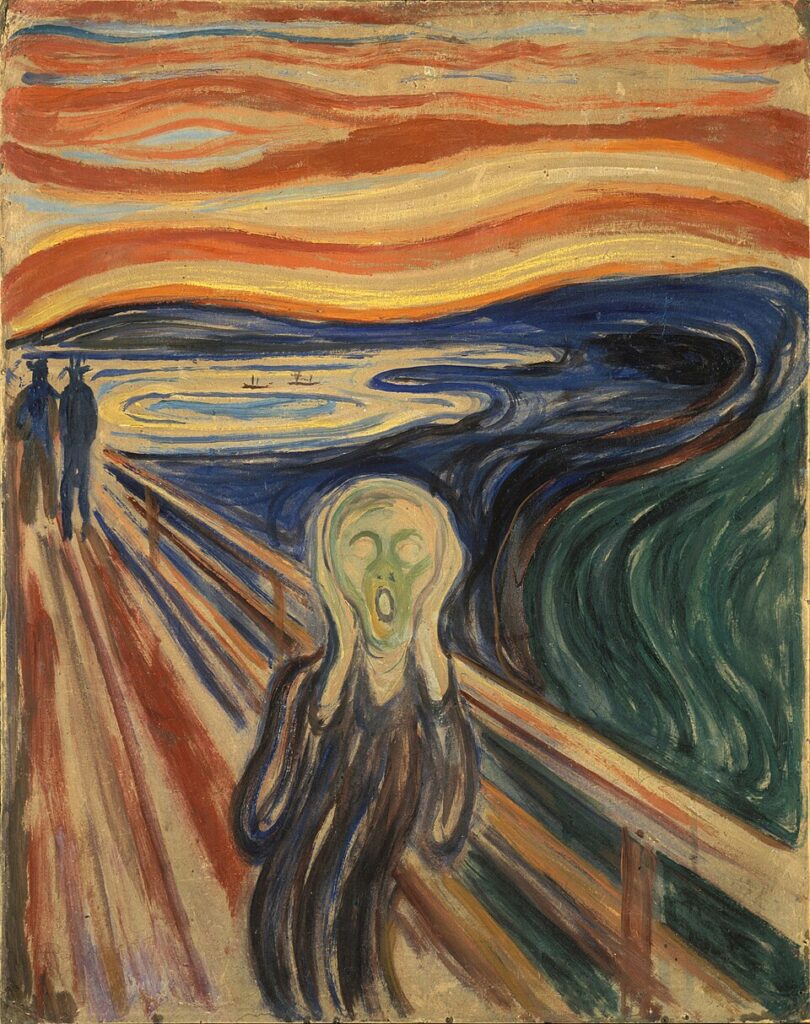
Edvard Munch — Anxiety Transformed into Color →A ghostly figure, his face reduced to a mask of terror, his hands pressed against his ears, his mouth open in a silent scream, standing on a bridge overlooking a fjord, while the sky blazes blood-red: Edvard Munch’s *The Scream* is one of the most famous images in the entire history of art, and the most universal expression of human anguish. After *The Mona Lisa*, it is perhaps the most recognizable work of art in the world.
Painted in 1893, *The Scream* is Munch’s masterpiece and one of the seminal works of Expressionism. It does not depict an event, but rather a state of mind: the distress, terror, and existential vertigo of modern man in the face of the world. By breaking with descriptive painting to convey emotion directly through color and line, Munch brought about a revolution that would pave the way for 20th-century art. Housed in Oslo, the work exists in several versions, whose history is as tumultuous as the emotion it expresses.
This article offers an analysis of this iconic work: its description, its origins, the mystery of its red sky, its composition, its meaning, and the extraordinary journey that has made it a universal symbol.
The Work — A Figure of Terror
In the center of the painting stands a figure who has become universally famous, whose posture and facial expression convey utter distress. This figure, along with the world surrounding it, creates an image of extraordinary emotional power.
The figure in the foreground is a undulating, almost ghostly silhouette, with a sinuous body and a distorted face, reduced to a skeletal mask: two wide-open eyes, gaping nostrils, a mouth open in a long scream, and two emaciated hands pressed against the cheeks and ears. This face, which no longer bears any individual resemblance, has become the very image of anguish. The figure stands on a bridge, whose diagonal line cuts across the composition. This bridge corresponds to a real location: a road lined with a railing on Ekeberg Hill, overlooking the city of Oslo and its fjord.
Behind the figure, in the distance on the bridge, two dark silhouettes are walking away, seemingly indifferent to the drama unfolding. These two figures, reduced to shadows, accentuate the loneliness of the central figure, alone with his anguish in the midst of a world that carries on as usual. Below, the Oslo Fjord spreads its dark, blue-black waters, while the city looms faintly on the horizon.
But what dominates and stirs the soul is the sky. A sky ablaze with blood-red, orange, and yellow, streaked with long, undulating bands that seem to ripple, vibrate, and scream in unison with the figure. Everything in the landscape participates in this undulation: the lines of the sky, the fjord, and the hills echo one another in sinuous waves, as if all of nature were being swept by a single shock wave. Only the straight line of the bridge cuts through this whirlwind, anchoring the character in a world that, all around him, seems to be dissolving in anguish.
The Genesis — A Cry Through Nature
Contrary to what one might think, the figure in *The Scream* is not screaming: he is hearing a scream. This nuance, revealed by Munch himself, sheds light on the entire meaning of the work and its deeply personal origins.
In his diary, Munch recounted the experience that inspired the work. One evening, as he was walking along a path with two friends at sunset, the sky suddenly turned a deep blood-red. Munch stopped, overcome by a profound sense of fatigue and anguish, and it seemed to him that he heard an immense, infinite scream piercing through all of nature. It is not, therefore, the figure who is screaming: it is nature that is screaming, and the figure, overwhelmed by this cosmic scream, covers his ears so as not to hear it, his face contorted with terror. The work thus conveys an inner experience, a real-life anxiety attack, transposed into an image.
This autobiographical aspect is essential. The figure in *The Scream* is, in a sense, Munch himself—or rather, the embodiment of his anguish; the two figures walking away on the bridge are the friends mentioned in his account. The work stems from a personal experience, a moment of acute distress that the painter—haunted throughout his life by anxiety, illness, and death—sought to express. Munch did not paint what he saw, but what he felt: fear, vertigo, and the sensation of being overwhelmed by a force that was both internal and external.
By transforming an intimate emotional experience into a universal image in this way, Munch invented a new way of painting. The work does not depict a landscape or a scene: it gives form to a psychological state, to a pure emotion. It is this ability to make the invisible visible—anxiety, the anguish of the soul—that makes *The Scream* revolutionary and so powerful. Munch opened up the realm of the psychological depths to painting, heralding Expressionism and the explorations of modern art.
The Red Sky — Science and Mystery
The fiery sky in *Le Cri*, so surreal that it seems to have come straight out of a nightmare, has intrigued both viewers and scientists alike. Several explanations have been put forward, adding to the mystery and richness of the work.
The most widely accepted theory links this blood-red sky to a real natural phenomenon: the 1883 eruption of Mount Krakatoa in Indonesia. This eruption, one of the most violent in history, propelled immense quantities of ash and particles into the atmosphere, which for months produced sunsets of spectacular intensity and color around the world—skies ablaze with red and orange. Researchers have suggested that Munch, in the years that followed, may have been struck by these extraordinary twilights and recalled them when painting the sky in *The Scream*. The surreal red of the painting would thus have its source in a very real atmospheric phenomenon.
Another mystery surrounds the character’s face itself. Some researchers have hypothesized that Munch may have been inspired by a mummy—specifically, a Peruvian mummy he may have seen on display in a Paris museum in the late 1880s, while he was staying in the French capital. The resemblance between the mummy’s crouched posture—with its hands near its face and its mouth open—and the figure in *The Scream* is indeed striking. This possible source, among others, illustrates how Munch may have drawn on a variety of references—both real and imaginary—to create a figure of unprecedented power.
But beyond these explanations, the red sky in *The Scream* defies any identifiable source. Whether it comes from Krakatoa or from Munch’s imagination, it functions first and foremost as the pictorial expression of a state of mind: the unnatural, violent, and distressing color conveys inner anguish, not observed reality. This is the essence of Munch’s modernity: he liberates color from its descriptive function to make it a pure means of emotional expression. The sky is not red because the world was, but because the character’s soul—and the painter’s—was.
An Expressionist Composition
“The Scream” is one of the seminal works of Expressionism, a movement that prioritizes the expression of emotion over a faithful representation of reality. Every element of its composition contributes to this expression, with a boldness that broke with all tradition.
The fundamental principle of the work is distortion in the service of emotion. Nothing in the painting is depicted realistically: the figure’s face is reduced to an unreal mask, his body undulates as if it were liquefying, and the entire landscape twists into sinuous waves. These distortions are not artistic blunders: they visually convey a psychological state—the way anxiety distorts one’s perception of the world. Under the influence of distress, the world loses its stability, its contours, and its solidity; everything wavers and undulates. Munch conveys this experience through line and form.
The composition powerfully contrasts two principles. On one hand, the straight, rigid line of the bridge, which runs diagonally and structures the space; on the other, the curved, undulating, swirling lines of the sky, the fjord, and the hills. This tension between the bridge’s straight lines and the landscape’s curves creates an imbalance, an instability, that heightens the sense of unease. The figure, positioned at the intersection of these forces, seems caught in a whirlwind that threatens to sweep him away. The diagonal of the bridge, which recedes into the background, further heightens the sense of vertigo and draws the eye toward the two distant, indifferent silhouettes.
Color, finally, plays a major expressive role. The blood-red sky evokes violence, suffering, and alarm; the dark blues and blacks of the fjord suggest depth, emptiness, and death; the pallid tones of the face reinforce the figure’s ghostly and morbid appearance. These unnatural colors are chosen for their emotional power, not for their descriptive accuracy. Through this expressive use of line, form, and color, Munch creates an image that does not merely depict anxiety but makes the viewer feel it directly. It is this emotional impact that makes *The Scream* such a powerful and modern work.
Meaning — The Anxiety of Modern Man
The reason *The Scream* resonates universally is that it goes far beyond a personal anecdote to convey a profound and shared meaning. The work has become the very symbol of modern man’s existential anguish.
Although born of Munch’s personal experience, the painting nevertheless expresses something everyone can relate to: a sense of anguish, loneliness, and vertigo in the face of existence. The figure has no identity, no gender, and no defined age: he is man, every man, gripped by distress. His scream—or rather, the scream he hears and which overwhelms him—is that of the fundamental anxiety of the human being, confronted with a vast, indifferent, and terrifying world. This universality explains the power and resonance of the work, which speaks to each person about their own fears.
The work is part of a larger body of work, the great cycle that Munch called *The Frieze of Life*, devoted to the major themes of existence: love, anguish, illness, and death. Within this cycle, *The Scream* occupies a central place, embodying the very essence of anxiety and distress. It engages in a dialogue with Munch’s other works, which are haunted by the same obsessions. The painter, marked from childhood by loss and suffering, had made his art a means of exploring and expressing the painful depths of the human psyche. *The Scream* is the most accomplished and universal expression of this.
Munch was fully aware of the disturbing and radical nature of his work. On one of the versions, he wrote a revealing phrase in his own hand, asserting that the work could only have been painted by a madman. When *The Scream* was exhibited for the first time, the reviews were harsh, casting doubt on the painter’s mental health. But this audacity, this rejection of conventions, and this plunge into raw emotion were precisely what made Munch modern. Where his contemporaries saw madness, we now recognize the genius of an artist who dared to express, through painting, the inexpressible nature of human anguish.
The Five Versions and the Fate of an Icon
“The Scream” is not a one-of-a-kind work, but a painting that Munch created in several versions, and whose fate—marked by thefts and spectacular sales—has helped make it a global icon. This eventful history is part of the work’s legend.
Munch created five versions of *The Scream* between 1893 and the late 1910s, using various techniques: oil painting, pastel, and even a lithograph, which made it possible to reproduce the image. The most famous version, painted in 1893, is housed at the National Museum in Oslo; the Munch Museum, also in Oslo, holds other versions; one version remains in private hands. This diversity attests to the profound significance this image held for Munch, who returned to it repeatedly throughout his life.
The fate of these works has been as tumultuous as the emotion they express. Two versions of *The Scream* were the subject of spectacular thefts that made headlines: one was stolen in 1994, only to be recovered a few months later; another was stolen in broad daylight in 2004 and was not recovered until two years later. These thefts, which received extensive media coverage, paradoxically reinforced the work’s already immense fame. Furthermore, one of the versions, put up for auction in 2012, fetched a staggering price, ranking among the most expensive works ever sold, which cemented its status as an icon of the art market.
Beyond museums and auction houses, *Le Cri* has taken the world of popular culture by storm. Its instantly recognizable image has been endlessly reproduced, referenced, parodied, and reimagined—in advertising, film, and illustration, right down to the emojis on our phones. The figure with his hands over his ears has become the universal symbol of anxiety, panic, and the stress of modern life. Few works of art have achieved such widespread dissemination and universality. *The Scream* now belongs to humanity’s collective imagination, a timeless expression of an anxiety that everyone has, at some point, experienced.
Where to see the artwork
Versions of *The Scream* are housed in Oslo, Norway, Munch’s hometown. The most famous painted version, the one from 1893, is on display at the Nasjonalmuseet, the National Museum of Norway, among the treasures of the national collection. The Munchmuseet, a museum entirely dedicated to the artist, houses other versions and offers an unparalleled overview of his work. To explore *The Scream* and Munch’s world, Oslo is therefore the must-visit destination. Given the fragility of the works and the fact that they are displayed on a rotating basis, it’s a good idea to check the official websites before your visit to see which version is on display and at which museum.
Further Reading
Institutional Documentation
- Nasjonalmuseet, Oslo — the National Museum of Norway, where the 1893 version is housed.
- Munchmuseet, Oslo — the museum entirely dedicated to the artist.
See also on Hors Cadre
- Edvard Munch — Anxiety in Color — A Portrait of the Painter.
- The Sick Child —the work that inspired all of his art.
- Madonna — love and death intertwined.
- Vincent van Gogh —the other great forerunner of Expressionism.
— M