Young Woman with a Water Pitcher — America’s first Vermeer
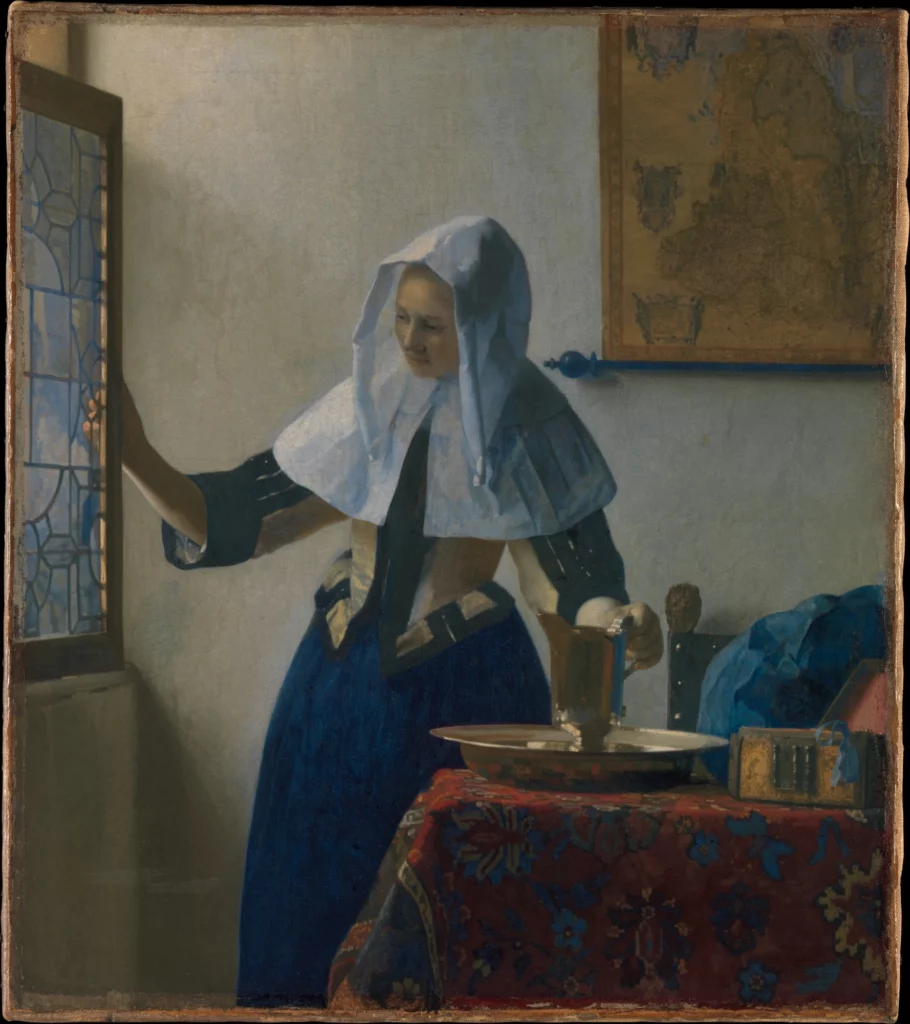
Vermeer — the inventor of interior light →The day is beginning. Standing by a window of small leaded panes, a young woman pushes the casement with one hand; with the other she holds the handle of a gilded pitcher resting in a basin. A large white linen hood covers her head and falls over her shoulders. On the table lie an Oriental rug and an open box with a string of pearls spilling out. On the wall hangs a map. Nothing moves.
Painted by Johannes Vermeer around 1662, Young Woman with a Water Pitcher is a tiny canvas, barely eighteen inches high. It is also one of the Metropolitan Museum of Art’s most treasured paintings, and the first Vermeer ever to enter an American collection.
We do not know who this woman is or what she is thinking. Vermeer tells no story. He shows an ordinary moment and makes it unforgettable.
A morning toilette
The Met reads the scene simply: a woman begins her day with her ablutions, using a pitcher and basin of gilt silver. The white linen covering her hair and shoulders protects her dress while she washes. She is not yet ready to be seen in public.
That is the picture’s almost voyeuristic charm, the museum suggests: we catch her in a private moment, before she presents her public face to the world. Is she opening the window, or about to close it? The gesture remains suspended.
Some historians have wanted to read a symbol into it, since a pitcher and basin traditionally stood for purity. Walter Liedtke, for many years a curator at the Met, preferred a concrete reading: a seventeenth-century viewer would have recognized the head and shoulder coverings, the silver-gilt basin and pitcher, “with which one would not normally water plants,” and the jewelry box as the accoutrements of a well-to-do city woman’s toilette. He also related the scene to Leiden paintings of an attractive young woman opening a window or pushing a curtain aside: Vermeer may have conflated two such images, or followed a Leiden model now unknown.
The objects speak of a comfortable household. A pitcher of this quality was a rare and costly possession. John Michael Montias, a Yale economist who became the leading expert on Vermeer’s archives, linked it to a gilded wine jug mentioned in a will of Maria Thins, the painter’s mother-in-law, in whose Delft house the couple lived: she had given it to her daughter Catharina, Vermeer’s wife.
The room by the window
Met curator Adam Eaker points out that Vermeer often set his pictures in the same well-lit room, with a window on the left. You can recognize it from canvas to canvas: the glass panes, the pale wall, the light slanting in, the map hanging from a rod.
“One of Vermeer’s key preoccupations as a painter is always the play of light, how the eye perceives light,” he says in the museum’s audio guide. Here the light does everything. It passes through the linen hood, turning its edges almost transparent, outlines the young woman’s profile, and settles on the metal of the pitcher and basin, gilding and defining their edges so that they seem all the more present. The reflections are uncannily precise: the blue of a cloth reappears on the side of the pitcher, and the red of the rug tints the underside of the basin.
Writers have often spoken of transfiguration in Vermeer’s work: he takes the most ordinary things, a woman, a jug, a window, and makes them sublime. The blue that dominates the canvas, from the wall to the shadows of the hood, is ultramarine, the most expensive pigment of his day. The centuries have altered some colors: the red velvet lining the jewelry box has faded, except along the edge of the canvas, where the frame protected it from light.
A painted-out chair
The picture’s simplicity is the result of hard work. Technical analysis has revealed two changes of mind. In the lower left foreground, Vermeer first painted the back of a chair, set at an angle and partly overlapping the window. And the map was larger: it extended farther to the left, behind the young woman, so that her head was framed in its lower left corner.
By removing the chair and shrinking the map, the painter cleared the space around his figure. As Arthur Wheelock, for many years a curator at the National Gallery of Art in Washington, put it, Vermeer “preserved the purity of the white wall between the woman and the window, thus allowing the light to flow directly onto her.” The map itself shows the Seventeen Provinces of the Netherlands.
The abandoned chair also helps date the canvas. For the Met, it reflects Vermeer’s manner of about 1658–62, as do two other features of the picture: the open window that organizes the space, and the bright, clear colors. Other scholars, such as Arthur Wheelock, place it a little later, around 1664–65. The museum also notes that over his career Vermeer pushed the furniture back: in Young Woman with a Lute, as here, chairs and tables are set further back from the foreground, offering a bridge into the painting.
From Metsu to Vermeer
Once the painter was gone, in 1675, his name faded into obscurity for nearly two centuries, and his paintings circulated under other names. In the nineteenth century, Young Woman with a Water Pitcher belonged to a London collector, Robert Vernon, who lent it to the British Institution in 1838 as a work by Gabriel Metsu, another Dutch painter.
It was still sold as a Metsu at Christie’s in London on April 21, 1877. Three weeks later, a critic writing in The Athenaeum gave it back to Vermeer. The following year its new owner, an Irish aristocrat, Lord Powerscourt, showed it at the Royal Academy as the work of “Jan van der Meer.” It then passed through dealers in London and Paris.
Henry Marquand’s gift
In 1887, in Paris, the New York banker Henry Gurdon Marquand bought it for $800. It was probably the first Vermeer to cross the Atlantic. The price says a great deal about the painter’s standing at the time: the year before, Marquand had paid $40,000 for a portrait by Van Dyck, James Stuart, Duke of Richmond and Lennox.
Born in New York City in 1819, Marquand started out in the family silversmithing firm, Marquand & Company, before prospering in banking and railroads; Richard Morris Hunt designed his mansion on East Sixty-Eighth Street. He was also one of the Met’s early leaders, a trustee from 1871, the year after the museum’s founding, and later its treasurer.
In December 1888 he lent thirty-seven paintings from his collection to the museum’s new South Wing, among them the Vermeer, the Van Dyck, Frans Hals’s The Smoker and a Rembrandt Portrait of a Man, perhaps the first authentic Rembrandt to reach America. These paintings, the New-York Tribune wrote, “furnish an illustration of great art such as we have not had before.” On January 10, 1889, he gave them outright, asking only that they be kept together “as much as practicable,” since he believed they would be of far greater service to the public in a gallery open to all. A month later he became the Met’s second president, a post he held until his death in 1902.
Today the museum owns five Vermeers, more than any other in the world. After Marquand came Benjamin Altman’s bequest in 1913, with A Maid Asleep; that of Collis P. Huntington, who died in 1900, with Young Woman with a Lute; Michael Friedsam’s collection in 1931, with Allegory of the Catholic Faith; and the 1979 gift of Charles and Jayne Wrightsman, with Study of a Young Woman. But it all began with this small canvas.
Staying in New York
While the skylights over the European paintings galleries were being renovated, the Met made Young Woman with a Water Pitcher the face of In Praise of Painting: Dutch Masterpieces at The Met, on view from October 2018 to October 2020 in the Robert Lehman Wing. Just before, in the summer of 2018, all five of the museum’s Vermeers had even hung side by side on a single wall.
Some of these canvases never leave New York: the terms of Benjamin Altman’s bequest, for instance, prevent A Maid Asleep from being lent. In 2023, when the Rijksmuseum in Amsterdam brought together twenty-eight of the painter’s works for the largest Vermeer exhibition ever staged, the Met lent Young Woman with a Lute and Allegory of the Catholic Faith, but not Young Woman with a Water Pitcher. The Frick Collection, then closed for renovation, sent its three Vermeers in an exceptional loan.
Seeing Young Woman with a Water Pitcher at the Met
The painting hangs in Gallery 614, on the second floor, among the Dutch paintings. It measures 18 by 16 inches (45.7 × 40.6 cm), an intimate format suited to this scene of private life.
About a dozen blocks south, the Frick Collection holds three more paintings by Vermeer. With eight of the roughly thirty-five Vermeers known today, New York is the city where you can see more of them than anywhere else in the world.
Further Reading
Institutional Documentation
- Young Woman with a Water Pitcher — The Metropolitan Museum of Art — the museum’s record and downloadable image.
- Esmée Quodbach, “Collecting Old Masters for New York” — Journal of Historians of Netherlandish Art — Henry Marquand and the beginnings of the Met’s collection.
- Photo Credit : The Metropolitan Museum of Art, New York
See also on Hors Cadre
- The Metropolitan Museum of Art — what to see, hours, tickets — plan your visit, from the Dutch masters to the American Wing.
- Vermeer — the inventor of inner light — the life of the painter of Delft and his rediscovery in the nineteenth century.
— M