The Rape of the Sabine Women — Poussin’s Controlled Chaos
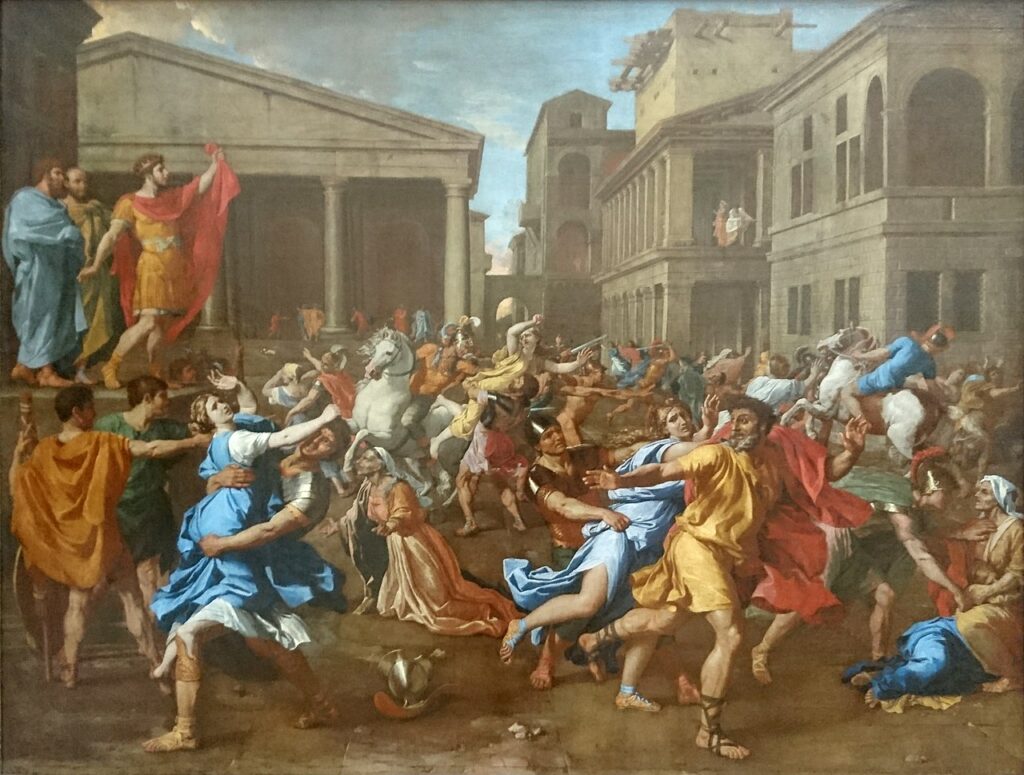
Nicolas Poussin — the painter-philosopher →A man, draped in purple, stands on the left atop a promontory, in front of a temple. He raises his arm, lifting a corner of his cloak: that is the signal. Immediately, the square is transformed into a battlefield. Soldiers rush forward, seize the young women, and carry them away; the women struggle, scream, and reach out their arms; desperate old men, frantic mothers, and weeping children add to the tumult. This is the Rape of the Sabine Women, one of the founding episodes of the legend of Rome—and one of Nicolas Poussin’s most impressive history paintings.
This large canvas, housed at the Louvre, reveals a different facet of Poussin’s genius than that seen in *The Shepherds of Arcadia*. Here, there is no serene contemplation, but rather a scene of violence, movement, and passion. And yet, it is still the same painter-philosopher at work: for this apparent chaos is in reality perfectly controlled, ordered, and composed with the precision of a geometer. Behind the tumult lies a skillful, carefully considered composition, in which each figure occupies its exact place. This is the very paradox and the very genius of Poussin: depicting disorder with absolute order.
*The Rape of the Sabine Women* is thus a striking demonstration of Poussin’s classical artistry as applied to history painting—the noblest and most difficult genre, one that recounted the great events of history and mythology. In this work, Poussin displays the full extent of his mastery: rigorous composition, the expression of passions, erudition in classical antiquity, and moral significance. He transforms a violent subject into a work of intelligence and beauty, in which reason triumphs over fury.
This article explores the secrets of this masterpiece—the legend of Romulus it depicts, the gesture of the signal, the admirable order that masters chaos, the way Poussin conveys violence without depicting it, his almost theatrical compositional method, the moral significance of the work, its two versions, and the considerable influence it exerted, from David to Picasso.
The Painting — What It Depicts
*The Rape of the Sabine Women* is a large-scale oil on canvas: 159 centimeters high by 206 centimeters wide, in the case of the Louvre version. Its imposing size is commensurate with the ambition of the subject—a grand historical scene featuring numerous figures.
The scene takes place in a vast square, framed by monumental Roman architecture: a columned temple on the left, palaces, and a triumphal arch in the background, all evoking the splendor of ancient Rome. A scene of turmoil and violence is unfolding in this square. On the left, standing on a promontory in front of the temple, Romulus, the founder of Rome, draped in a purple cloak, raises his arm: he is giving the signal for the abduction. Below and around him, chaos reigns.
Strong, armored Roman soldiers rushed at the young Sabine women and carried them off by force. The women struggle, strain against their captors, and stretch their arms toward the sky or toward their loved ones in gestures of distress. All around, panic reigns: fathers and elderly men try in vain to defend their daughters, mothers collapse, and children weep on the ground. In the center, an old woman, her face contorted with horror, implores Romulus. Bodies intertwine, gestures multiply, and glances meet amid apparent confusion.
The work is striking for its richness of color and movement. The touches of red—Romulus’s cloak, a soldier’s tunic, the old Sabine woman’s dress—punctuate the composition and guide the eye across the scene. The drapery flutters, the bodies twist, and the poses echo one another. It is an outpouring of movement and passion. And yet, as one looks more closely, one discovers that this chaos is in fact a composition of perfect precision. Therein lies the secret of the work.
The Legend of Romulus
The subject of *The Rape of the Sabine Women* is drawn from the legendary account of Rome’s origins, as recounted by ancient authors—notably Plutarch in his *Life of Romulus*, but also Livy. In Poussin’s view, this founding episode deserved the noble treatment of history painting.
The legend takes place at the very dawn of Rome, shortly after its founding by Romulus. The young city, populated mainly by men—adventurers, soldiers, and fugitives who had come to settle there—was sorely lacking in women to ensure its lineage and future. The neighboring peoples, wary of the Romans, refused to give their daughters in marriage to them. Romulus then devised a stratagem: he organized a great festival and games in honor of a god, and invited the neighboring peoples—including the Sabines—who came in droves with their families.
In the midst of the festivities, at a prearranged signal given by Romulus, the young Romans rushed forward and abducted the Sabine maidens, while the Sabine men—unarmed and caught off guard—were forced to flee. It is this precise moment—the start of the abduction, at Romulus’s signal—that Poussin chose to depict. According to legend, the abducted Sabine women became the wives of the Romans, and later, when the Sabines returned in arms to reclaim them, it was the women themselves who stood between their fathers and their new husbands, reconciling the two peoples, who merged to form the Roman people.
This subject was not merely a pretext for a spectacular scene. For Poussin and his educated contemporaries, it had profound historical and moral significance: it was the story of Rome’s origins, of the birth of a great civilization, and even—according to some interpretations—of the institution of Roman marriage. By choosing this theme, Poussin took on one of the great subjects of ancient history and affirmed the highest ambition of his art: to make painting an equivalent of great poetry and history, capable of depicting the founding events of humanity.
Romulus’s Signal
The figure of Romulus, on the left side of the painting, is the key to the entire composition. He is the one who sets the action in motion, and his gesture structures the entire scene. Poussin gave him considerable importance and significance.
Romulus stands apart from the fray, perched on a promontory, in front of the columns of a temple. Draped in a loose purple cloak and wearing a crown, he commands the scene with the authority of a leader and a founder. His gesture is precise: he raises his arm and lifts a corner of his cloak. This is the agreed-upon signal—the one that triggers the abduction. With a single gesture, Romulus commands the entire tumult raging below him. He is the director of this chaos—the one who willed it, organized it, and set it in motion.
Romulus has indeed been compared to a conductor. Just as the conductor raises his baton to set the music in motion, Romulus raises his arm to set the action in motion. His gesture is the starting point for the entire composition, the element that organizes and explains the movement of the crowd. This comparison is illuminating: it highlights that, behind the apparent disorder, there is an organizing intelligence, a will that controls and directs the chaos. Romulus, in the painting, is the image of the painter himself, organizing his composition.
Romulus’s pose is not an invention: it derives directly from Roman imperial statuary—those statues of emperors in majestic poses, with one arm raised in a gesture of authority and command—which Poussin had studied in Rome. This ancient source lends the figure a nobility, a monumentality, and a dignity that elevate him above the fray. Romulus is no ordinary aggressor: he is a founder, a hero, whose action—however brutal its consequences may be—stems from a higher historical necessity—the founding of Rome. Through this reference to ancient art, Poussin endows his character with the grandeur of historical heroes.
Controlled chaos — order amid the turmoil
Here lies the essence of Poussin’s genius—what makes *The Rape of the Sabine Women * an absolute masterpiece of Classicism: the way in which a scene of chaos, violence, and movement is, in reality, constructed with perfect order and precision. Behind the apparent turmoil lies a composition of geometric intelligence.
At first glance, the painting gives the impression of chaos: dozens of figures are moving in every direction, their bodies intertwined, their movements contradictory—it’s total panic. But as you look closer, you realize that this chaos is a skillfully orchestrated illusion. The composition is based on a rigorous structure: diagonal lines that radiate from the edges of the painting and converge toward the center, toward the triumphal arch in the background, which serves as the vanishing point of the perspective. The architecture, with its vertical, stable columns, frames and gives rhythm to the scene, contrasting its permanence with the agitation of the figures.
Poussin also organizes the crowd into distinct groups, each carefully composed. It has been shown that the narrative revolves around the abduction of three principal Sabine women, positioned at three points in the composition, around whom the secondary figures are arranged. The patches of light color, the accents of red, and the flashes of light on the helmets or bodies form, throughout the crowd, invisible geometric shapes that structure the whole and guide the viewer’s gaze. Nothing is left to chance: every character, every gesture, every color has its place and function within a carefully considered whole.
It is this paradox that defines Poussin’s art: depicting disorder with order, passion with reason, and movement with restraint. Where a Baroque painter would have sought to emphasize confusion, impetuosity, and turmoil, Poussin masters and disciplines chaos. He creates a fruitful tension between the subject—violent, passionate, tumultuous—and the treatment—orderly, clear, and reasoned. The fury of the action is contained within the rigor of the form. This union of passion and reason, of movement and order, is the hallmark of Poussin’s classicism and one of the greatest achievements of his art.
Violence Without Blood
A remarkable aspect of *The Rape of the Sabine Women* is the way Poussin depicts violence. The subject matter is brutal—a forced abduction, a scene of struggle and panic—but Poussin portrays it without any sensationalism of the horror, without blood, and without explicit cruelty. The violence lies entirely in the expression, not in the spectacle.
Poussin depicts no wounds, no blood, no dead bodies. The violence of the scene is conveyed not through gory or macabre details, but through the expressions on the bodies and faces. Arms raised, heads thrown back, mouths open in screams we cannot hear, bodies rearing up and thrashing about, faces contorted by terror or despair: it is through these postures, these gestures, and these expressions that Poussin conveys the full violence and distress of the scene. The fury lies in the eloquence of the bodies, not in the display of horror.
This approach was part of what theorists of the time called the “expression of the passions.” Poussin, as a learned and thoughtful painter, had studied how to convey the various states of the soul—terror, supplication, fury, despair, helplessness—through gestures and facial expressions. Each figure in *The Rape of the Sabine Women * expresses a specific, clearly identifiable passion that the viewer can decipher. The old woman implores, the father is overcome with despair, the soldier is consumed by his conquering fury, and the young Sabine struggles in terror. The painting is a true study of human passions, a repertoire of emotions translated into eloquent poses.
This restraint in the depiction of violence is characteristic of Poussin’s classical art and distinguishes him from Baroque painters, who were more inclined toward spectacular effects and exaggerated pathos. Poussin aims not for raw emotion, but for a reflective, controlled emotion that appeals to the intellect as much as to the senses. The viewer is not overwhelmed by horror: instead, they are invited to interpret, understand, and reflect on the scene and the passions it conveys. Once again, the painter-philosopher transforms a violent subject into an object of reflection and intelligent contemplation.
Poussin’s Theater
The perfection of the composition in *The Rape of the Sabine Women* is not the result of chance or inspiration alone: it stems from a rigorous, almost scientific approach to his work, which reveals the deeply thoughtful nature of Poussin’s art.
Poussin had a unique method for developing his compositions. Rather than composing directly on the canvas, he built small miniature theaters—a sort of optical box—in which he arranged small wax figures that he modeled and dressed himself. He would place these figurines in the box, move them around, arrange them, and study their positions and groupings from different angles—and, above all, the effects of light and shadow as he varied the lighting. This setup allowed him to arrange his composition just as a director arranges actors on a theater stage, before capturing the result on canvas.
This method sheds light on the nature of Poussin’s art. Each painting is the result of patient craftsmanship and deep reflection on the arrangement of the figures, the overall balance, the light, and the expression. Nothing is improvised: everything is thought out, calculated, and carefully considered. Poussin was a painter of the studio and of reflection, not of spontaneous inspiration. This methodical rigor is the flip side of the classical perfection of his compositions: if they appear so precise and balanced, it is because they have been worked on at great length.
This theatrical and thoughtful dimension brings Poussin closer to the classical theater of his time. A contemporary of the playwright Corneille and the philosopher Descartes, and a reader of Aristotle, Poussin shared the classical ideal of an art governed by reason, subject to rules, and aimed at the ideal of beauty. It has been noted that *The Rape of the Sabine Women* adheres to a form of unity comparable to the three unities of classical theater—unity of time, place, and action: a single moment, a single place, and a single, concentrated action. Like a tragedy by Corneille, Poussin’s painting constructs its drama with order, clarity, and necessity. Classical painting and theater stem from the same spirit: to make art a work of reason and beauty.
A Moral Painting
Like all of Poussin’s work, *The Rape of the Sabine Women* is not merely a depiction of an event: it is also a painting rich in meaning, a work to be contemplated. The painter-philosopher always infuses his history paintings with a moral and reflective dimension.
The very choice of subject and the moment depicted is significant. Poussin could have painted the peaceful resolution of the story—the reconciliation of the Sabines and the Romans thanks to the women. Instead, he chose the most dramatic moment: that of the abduction, violence, and passion. But this choice is not arbitrary: by depicting this founding act of force, Poussin invites us to reflect on the origins of Rome, on the birth of civilizations, and on the paradoxical blend of violence and necessity that characterizes the great beginnings of history. The founding of a great civilization requires this brutal act—it is a historical and moral truth that the painting invites us to contemplate.
The work also invites us to reflect on the fate of the Sabine women themselves. Poussin depicts these women with dignity, with a humanity that elevates them beyond the role of mere victims. Their beauty, their distress, and their resilience are portrayed with respect. And we know that, as the legend continues, it is they who will reconcile the two peoples, playing a decisive role in the founding of Rome. Implicit in the painting is this reflection on the role of women in history—on how the violence they endure can be transformed into a force for reconciliation.
This moral significance is characteristic of Poussin’s conception of history painting. For him, this noble genre was not meant merely to please or impress, but to instruct and provoke thought. The history painting is a lesson, a meditation on the great questions of human and collective destiny. *The Rape of the Sabine Women* is not merely a spectacular scene: it is a reflection on origins, violence, civilization, and destiny. The painter-philosopher, even amid the turmoil of an action-packed scene, never fails to provoke thought.
Two versions of the same topic
As with *The Shepherds of Arcadia*, Poussin painted two versions of *The Rape of the Sabine Women*, a few years apart. A comparison of these two versions sheds light on his method and the evolution of his art.
The first version, painted around 1634–1635, is now in the collection of the Metropolitan Museum of Art in New York. The second, the one in the Louvre, was painted around 1637–1638 for Cardinal Luigi Omodei. Both paintings depict the same subject and feature many of the same figures and groups: Romulus on the left giving the signal, the melee of soldiers and women, and the general panic. However, they differ in composition, proportions, and the arrangement of the figures.
Experts have observed how Poussin developed his composition from one version to the next. In the New York version, Romulus dominates the scene by his size, as the central figure of the painting. In the Louvre version, Poussin altered the balance: he raised the horizon line, reduced Romulus’s size, and, above all, enriched and added complexity to the foreground by adding striking groups of figures—the woman in blue being carried away by an armored soldier, the dramatic trio of a Roman, a woman, and a fleeing Sabine. The composition of the Louvre version is thus more complex, more structured, and more accomplished. The architecture is more prominent and monumental, better framing the scene.
This practice of creating dual versions is characteristic of Poussin and reveals the reflective nature of his art. Far from being satisfied with a first draft, he would return to his subjects, rework them, and explore them more deeply, seeking each time a composition that was more accurate, clearer, and more meaningful. We see this approach in *The Shepherds of Arcadia*, *The Poet’s Inspiration*, and other subjects. These second versions are all testaments to Poussin’s patience, high standards, and depth of thought. For the painter-philosopher, painting was an act of thought—always open to improvement, never exhausted.
Legacy — From David to Picasso
“The Rape of the Sabine Women ” had a lasting influence on history painting and classical art, inspiring generations of artists and cementing Poussin’s role as a model for the French school.
The most direct influence was felt in Neoclassical painting of the late 18th and early 19th centuries. Jacques-Louis David, the great master of Neoclassicism, drew deeply on Poussin’s example. He himself painted a large canvas based on this legend, *The Intervention of the Sabine Women * (or *The Sabine Women*), now in the Louvre, which depicts the moment when the Sabine women step between their fathers and their husbands to reconcile them. In this work, David draws on Poussin’s legacy: noble history painting, rigorous composition, classical inspiration, and moral significance. Through David, Poussin stands as one of the founding sources of Neoclassicism as a whole.
Ingres, David’s heir and a champion of the classical tradition, also drew inspiration from Poussin, whom he revered as a model of drawing, composition, and thought. The lineage of “Poussinists,” who championed drawing and reason, saw works such as *The Rape of the Sabine Women* as the perfect example of noble and learned art. The great French classical tradition, from Poussin to David and Ingres, is thus passed down through these historical masterpieces.
Poussin’s influence extends even to modern art. Twentieth-century painters—Pablo Picasso foremost among them—contemplated Poussin’s art, his structure, and his mastery of composition. Picasso, who so often measured himself against the old masters, studied Poussin closely. And contemporary artists have revisited and reinterpreted *The Rape of the Sabine Women*, transposing its theme of violence and abduction into the context of modern conflicts—a testament to the work’s enduring relevance. Four centuries after its creation, this masterpiece continues to inspire and provoke thought—as does the entire body of work by this painter-philosopher.
From Cardinal Omodei to the Louvre
The journey of *The Rape of the Sabine Women*, from its commission in Rome to the French royal collections and then to the Louvre, illustrates the prestige Poussin enjoyed during his lifetime and the way in which France came to acquire his work.
The painting was created around 1637–1638 for a prestigious patron: Cardinal Luigi Omodei, a high-ranking official of the Papal States. This commission attests to the considerable reputation Poussin enjoyed in Rome, where he was among the painters most sought after by major collectors and princes of the Church. Cardinal Omodei kept the work in his collection until his death in 1685.
It was then that the painting made its way to France. Upon Omodei’s death, his work attracted much interest, and it was acquired for King Louis XIV, a great art lover and collector, who sought to assemble the masterpieces of Poussin—that French painter who, though he lived in Rome, was the pride of the national school and the model for the Royal Academy. The acquisition was arranged through the director of the French Academy in Rome. The work, which had been damaged during its transport to France, was restored and then added to the royal collections.
From the collections of Louis XIV, *The Rape of the Sabine Women* was transferred after the Revolution to the national collections and the Louvre Museum, where it is counted among Poussin’s masterpieces. Alongside the master’s other great works— *The Shepherds of Arcadia*, *The Four Seasons*, and *The Poet’s Inspiration* —it helps make the Louvre the preeminent place to discover and understand the art of the greatest French painter of the 17th century. France had succeeded in assembling, around its painter-philosopher, a collection unmatched anywhere in the world.
How to View the Work Today
*The Rape of the Sabine Women* is housed at the Louvre Museum in Paris, where it is displayed among the masterpieces of 17th-century French painting in the galleries dedicated to Poussin. The Louvre’s main entrance provides access to these galleries; since the museum is so popular, it’s best to book your ticket in advance and visit during off-peak hours.
Seeing the work in person allows one to appreciate its scale and richness: the multitude of figures, the brilliance of the colors, the monumentality of the architecture, and above all, the fascinating tension between the tumult of the scene and the order of the composition. It is by taking the time to observe that one discovers, beneath the apparent chaos, the secret geometry that structures the painting. A work that rewards the attentive and patient viewer.
To further your exploration of Poussin, the Louvre houses the world’s finest collection of his works. A side-by-side comparison of *The Rape of the Sabine Women* and *The Shepherds of Arcadia* is particularly illuminating: on one hand, the tumult of history; on the other, serene contemplation; but in both cases, the same genius for composition, the same depth of thought, and the same artistry of the painter-philosopher. These two facets of Poussin—action and contemplation—together reveal the full scope of his art.
Further Reading
Institutional sources cited
- Louvre Museum, description of *The Rape of the Sabine Women*.
- Panorama de l’art (RMN), analysis of *The Rape of the Sabine Women*.
- Plutarch, *Life of Romulus* (ancient source on the subject).
Sources and Reference Studies
- Pierre Rosenberg, Nicolas Poussin, catalog, RMN.
- Anthony Blunt, Nicolas Poussin, 1967.
- Daniel Arasse, *Stories of Paintings*, Gallimard, 2004.
Institutional Documentation
- Louvre Museum, Paris — the institution that houses the work.
See also on Hors Cadre
- Nicolas Poussin—the Painter-Philosopher —A Portrait of the Artist, His Life, and His Art.
- The Shepherds of Arcadia — Death in Paradise, by Poussin — The Other Side of Poussin: Serene Contemplation Amid the Turmoil of History.
- Eugène Delacroix—the standard-bearer of Romanticism —the painter of movement and passion, who admired Poussin as a master of composition.
— M