The Portrait of Baldassare Castiglione — The Pinnacle of Portraiture According to Raphael
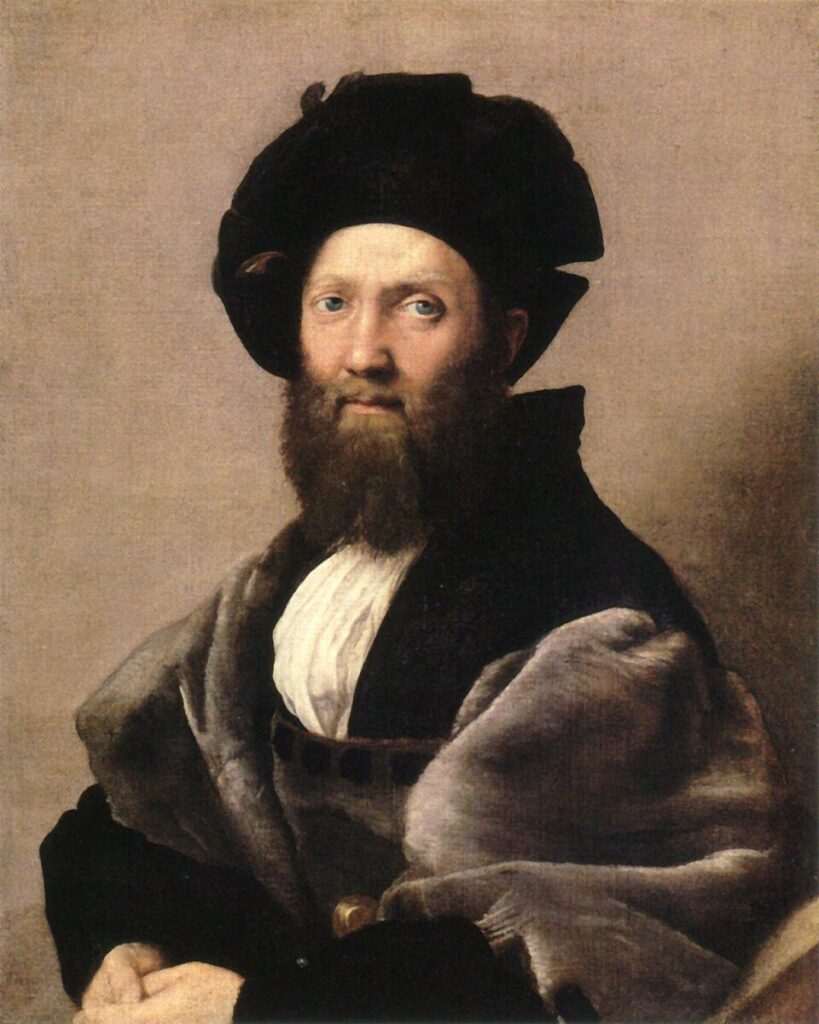
Raphael — Grace and Harmony →A man looks at us, calm and fully present. Dressed in gray and black, wearing a dark beret, his hands clasped, he gazes at the viewer with a gentle yet penetrating gaze, imbued with intelligence and serenity. Nothing ostentatious, no pomp: just a human presence of rare intensity, captured with admirable accuracy and restraint. This is Raphael’s Portrait of Baldassare Castiglione —one of the most beautiful portraits of the Renaissance and a masterpiece of the Louvre.
Painted around 1514–1515, this portrait depicts one of the great humanists of the Renaissance, Baldassare Castiglione, a close friend of Raphael and author of the famous *Book of the Courtier*. But beyond being a tribute to a friend, the work is a meditation on the art of portraiture itself, a demonstration of what painting can achieve in its depiction of the human figure. With its restraint, psychological depth, and subtle harmony, it stands as a pinnacle of the genre.
The work also engages in a fascinating dialogue with another masterpiece in the Louvre: Leonardo da Vinci’s *Mona Lisa *. For in painting Castiglione, Raphael drew inspiration from Leonardo, echoing the pose, composition, and spirit of the famous portrait. The Castiglione is thus like a male counterpart to the Mona Lisa, a tribute from the prince of painters to the genius who had preceded him. Fate would, moreover, bring the two works together in an unexpected way.
This article explores the secrets of this portrait—what it depicts, the figure of Castiglione, its dialogue with the *Mona Lisa*, the art of portraiture that Raphael displays in it, its influence on the great masters, and the history of its presence at the Louvre.
The Painting — What It Depicts
The Portrait of Baldassare Castiglione is a medium-sized oil painting on canvas, measuring approximately 82 centimeters high by 67 centimeters wide. This format—that of an easel portrait—invites close contemplation and an intimate, face-to-face encounter with the subject.
The painting depicts a man in a three-quarter view, shown from the waist up, turned slightly to his left but looking directly at the viewer. He is dressed in simple, elegant attire: a gray coat, a fur-trimmed overcoat, a black beret, and a white shirt, the collar of which is visible. His hands are clasped in front of him in a calm and composed manner. Nothing in his attire suggests wealth or power: it is the discreet elegance of a man of taste and culture, not the pomp of a man of power. The background—neutral, understated, and devoid of decoration—focuses all attention on the figure.
What strikes the viewer immediately is the harmony of the colors. The portrait is built on a limited and refined range of grays, blacks, beiges, and whites, with subtle accents. This chromatic restraint, far from being dull, creates a harmony of supreme elegance, an atmosphere of calm and distinction. Raphael demonstrates that a limited palette, masterfully employed, can produce a beauty greater than that of vibrant, vivid colors. This restraint is one of the work’s greatest achievements.
But the heart of the portrait is the face—and above all, the gaze. Castiglione looks directly at the viewer with a gentle, direct gaze, imbued with profound intelligence and serenity. This gaze establishes a presence, a connection, a relationship. One has the impression of being in the presence of a living, thinking, feeling man—not an image, but a person. This intense psychological presence, achieved through the accuracy of the gaze and expression, is what gives the work its power. Raphael captured not only his model’s features, but also his soul, his inner life, and his nobility of spirit.
Who was Baldassare Castiglione?
The subject of this portrait is no stranger: Baldassare Castiglione was one of the leading figures of the Italian Renaissance, a man whose influence, through his writings, had a lasting impact on European civilization. Learning about his life sheds light on the portrait.
Baldassare Castiglione (1478–1529) was a diplomat, man of letters, and humanist from the nobility of northern Italy. An accomplished courtier, he served several princes, carried out important diplomatic missions, and frequented the most refined courts of his time, notably that of Urbino—Raphael’s birthplace—which was then one of the most brilliant centers of Renaissance culture. Cultured, elegant, and pleasant in his manner, and well-versed in literature, the arts, and the military, he embodied the ideal of the Renaissance man.
Castiglione owes his enduring fame to a single work: *The Book of the Courtier* (*Il Cortegiano*), which he published in 1528. This book, one of the most famous and influential of the Renaissance, describes the ideal of the perfect courtier: cultured, elegant, virtuous, skilled in the arts, literature, and the use of arms, and displaying in all things that natural, effortless grace that Castiglione called “sprezzatura.” This work established a model of behavior, refinement, and civility that profoundly influenced the customs and education of European elites for centuries. In it, Castiglione defined the image of the ideal gentleman, combining the qualities of body and mind.
Castiglione and Raphael were bound by a deep friendship. Both hailing from the refined circles of Urbino and sharing the same ideals of culture, beauty, and moderation, they held each other in high regard and appreciated one another. Castiglione admired Raphael’s genius and exchanged ideas about art with him; it is even believed that he occasionally advised the painter. This portrait is therefore that of a friend, painted with all the affection and understanding that such intimacy allows. Raphael poured into it not only his artistry but also his esteem and friendship for a man who, like himself, embodied the Renaissance ideal of grace and harmony. The portrait is the meeting of two kindred spirits.
The Male Counterpart to the Mona Lisa
One of the most fascinating aspects of the Portrait of Castiglione is its dialogue with Leonardo da Vinci’s Mona Lisa. In painting his friend, Raphael drew inspiration from his elder’s masterpiece, creating a work that serves as both a reflection of and a tribute to it.
The resemblance between the two portraits is striking—and intentional. Like the *Mona Lisa*, Castiglione’s portrait depicts the subject in a half-length pose, turned in a three-quarter view, with his hands clasped in front of him and his gaze directed toward the viewer. The pose, the composition, the alignment of the body and head, and the positioning of the hands—all are reminiscent of Leonardo’s portrait. Raphael, who had admired the Mona Lisa in Florence, reflected on it and incorporated its innovations. He adopts this portrait style in which the subject, captured in a natural and intimate pose, establishes a direct and lively connection with the viewer. The Castiglione thus appears as an echo, a variation, and a tribute to Leonardo’s masterpiece.
That is why the Castiglione has been seen as a sort of male counterpart to the Mona Lisa. Where Leonardo had created the perfect image of an enigmatic woman with an elusive smile, Raphael presents that of a consummate man with a serene and penetrating gaze. The two portraits echo one another: the same composition, the same psychological depth, the same intense presence of the subject, but with different expressions and atmospheres. The mysterious gentleness of the Mona Lisa is matched by the noble serenity of Castiglione. Together, they form an ideal diptych of High Renaissance portraiture—one feminine, the other masculine.
Fate was to bring the two works together in an unexpected way. Both housed at the Louvre, they were involved in a remarkable incident in 1911: when the Mona Lisa was stolen—a sensational theft that shook the world—it was Raphael’s Portrait of Castiglione that was hung in its place, on the now-empty wall, while the world awaited the return of Leonardo’s masterpiece. For a time, Raphael’s portrait thus took the place of the Mona Lisa, as if the homage were reversed, as if the companion piece were filling the void left by the original. This anecdote seals, in history, the bond that unites the two works—the two greatest portraits of the Renaissance, now together at the Louvre.
The Art of Portraiture According to Raphael
The Portrait of Castiglione is not merely the image of a man: it is a demonstration of the art of portraiture, a meditation on what painting can achieve in its depiction of the human being. Raphael displays such mastery in this work that it has become a model of the genre.
The work’s greatest achievement is its ability to unite likeness and depth, accuracy and emotion. Raphael renders Castiglione’s features with perfect accuracy; yet he goes far beyond mere physical resemblance. He captures his subject’s character, personality, and inner life. Through the gaze, the expression, and the posture, he reveals a man in his psychological and moral truth: his intelligence, his serenity, his nobility of spirit, and his culture. The portrait thus becomes the revelation of a person, the embodiment of a living, thinking being. This is the highest level of the art of portraiture: to paint not only the face, but the soul.
Simplicity is the key to this success. By doing away with all pomp, all decoration, and all glitz, Raphael focuses attention on what matters most: the face, the gaze, and the presence. The limited color palette, the neutral background, and the calm demeanor—all contribute to this minimalist style that brings out the model’s inner essence. This restraint, this economy of means, is the pinnacle of art: Raphael achieves the greatest effect with the fewest resources, the greatest depth with the greatest simplicity. He shows that truth and emotion do not require ostentation, but arise from accuracy and moderation.
This work also reflects the humanist ideal shared by Raphael and Castiglione. The portrait embodies the values they both cherished: grace, moderation, harmony, nobility of spirit, and that understated elegance and self-control that defined the accomplished Renaissance man. In painting Castiglione, Raphael also painted an ideal—an image of the cultured and serene humanity to which his era aspired. The portrait is thus, beyond an individual image, the expression of a civilization, a way of life, and a conception of humanity. This is what gives it its universal significance and grandeur.
An influential masterpiece
The Portrait of Baldassare Castiglione not only captivated his contemporaries; over the centuries, it has become a model for the greatest masters of portraiture, who have studied, admired, and imitated it. Its influence is a testament to its perfection.
From the time of Raphael onward, the portrait was recognized as a masterpiece of its genre, a model of what portraiture could achieve. Its reputation spanned borders and centuries. Among its most illustrious admirers were two giants of 17th-century painting: Rembrandt and Rubens. Rembrandt, the Dutch master of portraiture and light, was familiar with the work and made a drawing of it after it appeared at an auction; he referenced it in some of his own self-portraits, echoing the pose and spirit of Raphael’s model. Rubens, the great Flemish master, also made a copy of it. These tributes from two of the greatest painters in history attest to the admiration the work inspired.
This influence can be explained by the portrait’s perfection, which makes it an unsurpassable model. The formula developed by Raphael—the half-length, three-quarter-profile figure with a direct gaze, captured in its psychological truth against a sober background—became a benchmark for portraiture. Generations of painters drew inspiration from it, finding in it an example of how to depict the human figure with dignity, depth, and harmony. The Castiglione took its place among those works that define a genre and serve as models for posterity, alongside the Mona Lisa and a few other masterpieces of portraiture.
Even today, the portrait is studied and admired as one of the finest examples of Renaissance portraiture. It ranks among the major works of the Louvre, where it hangs alongside the *Mona Lisa* and other masterpieces of the Italian Renaissance. Its simplicity, depth, and harmony continue to move visitors and inspire artists. It stands as proof that a great portrait is not a matter of pomp or flashy virtuosity, but of accuracy, truth, and presence—the art of capturing, in a face, the full humanity of a person. It is in this respect that the *Castiglione* remains, five centuries later, a pinnacle and a model.
From *The Book of the Courtier* to the Louvre
The journey of the *Portrait of Castiglione*, from Raphael’s studio to the galleries of the Louvre, is a fascinating story of collections that attests to the work’s enduring prestige throughout the centuries.
After the deaths of Castiglione and Raphael, the portrait passed through various hands, changing owners through inheritances and sales. Its quality and prestige made it a work sought after by major collectors. In the 17th century, it passed through the Netherlands—where Rembrandt saw it—before finding its way into French collections. It became part of the collection of Cardinal Mazarin, the art-loving minister who assembled one of the finest collections of his time. Upon Mazarin’s death, the work was acquired by King Louis XIV, thus becoming part of the French royal collections.
It was through the royal collections that the portrait eventually found its way to the Louvre. When, during the Revolution, the royal collections became the core of the Louvre Museum—which was opened to the public—the Portrait of Castiglione found its permanent home there. It has since been counted among the treasures of the Department of Paintings, one of the finest examples of the Italian Renaissance preserved in Paris. Its presence at the Louvre, alongside works by Leonardo da Vinci and other masters, allows visitors to appreciate Raphael’s genius and compare it with that of his great contemporaries.
Thus, the portrait of an Italian humanist, painted by his most brilliant friend, has become, in Paris, one of the most admired masterpieces in one of the world’s greatest museums. The image of Castiglione—the man who, in his *Book of the Courtier*, defined the ideal of the Renaissance gentleman—continues to shine, brought to life by Raphael’s art. The writer and the painter, united by friendship and a shared ideal of grace and harmony, have thus secured, together, immortal glory. The portrait stands as a monument to this friendship and this shared ideal.
How to View the Work Today
The Portrait of Baldassare Castiglione is housed in the Louvre Museum in Paris, in the Department of Paintings. It is on display there among the masterpieces of the Italian Renaissance, not far from the works of Leonardo da Vinci.
Seeing the work in person allows one to appreciate all its subtleties: the harmony of the grays and blacks, the softness of the modeling, the intensity of the gaze, and the psychological depth. It is a work to be contemplated up close, in an intimate encounter, and one that rewards the viewer’s attention with the emotion of a genuine connection with the model. Its restraint stands in stark contrast to the brilliance of many of the surrounding works, but it is precisely this restraint that gives it its strength and distinction.
The fact that Leonardo da Vinci’s *Mona Lisa* is on display in the same museum allows visitors to compare the two portraits, appreciate their interplay, and understand Raphael’s tribute to his elder. This is one of the wonderful encounters the Louvre offers: the coming together of the two greatest Renaissance portraits, united under one roof. To further explore Raphael’s work, the Louvre also houses several of his Madonnas, and the Vatican Museums in Rome offer the chance to admire his great frescoes, including *The School of Athens*. From Paris to Rome, visitors can thus trace the entire career of the prince of painters.
Further Reading
Institutional sources cited
- Louvre Museum, description of the Portrait of Baldassare Castiglione (INV 611).
- Baldassare Castiglione, *The Book of the Courtier* (1528).
- Giorgio Vasari, *The Lives of the Most Excellent Painters* (1568).
Sources and Reference Studies
- Jean-Pierre Cuzin, *Raphaël: Life and Work*.
- Louvre Museum documentation on Renaissance portraits.
Institutional Documentation
- Louvre Museum, Paris — the institution that houses the work.
See also on Hors Cadre
- Raphael—Grace and Harmony —A Portrait of the Artist, His Life, and His Art.
- The Mona Lisa—the world’s most famous smile —Leonardo’s portrait, to which Castiglione serves as the male counterpart.
- The Louvre Museum—the world’s largest museum—the museum that houses the work, alongside the Mona Lisa.
— M