The Grande Odalisque — Ingres’s Ideal Line
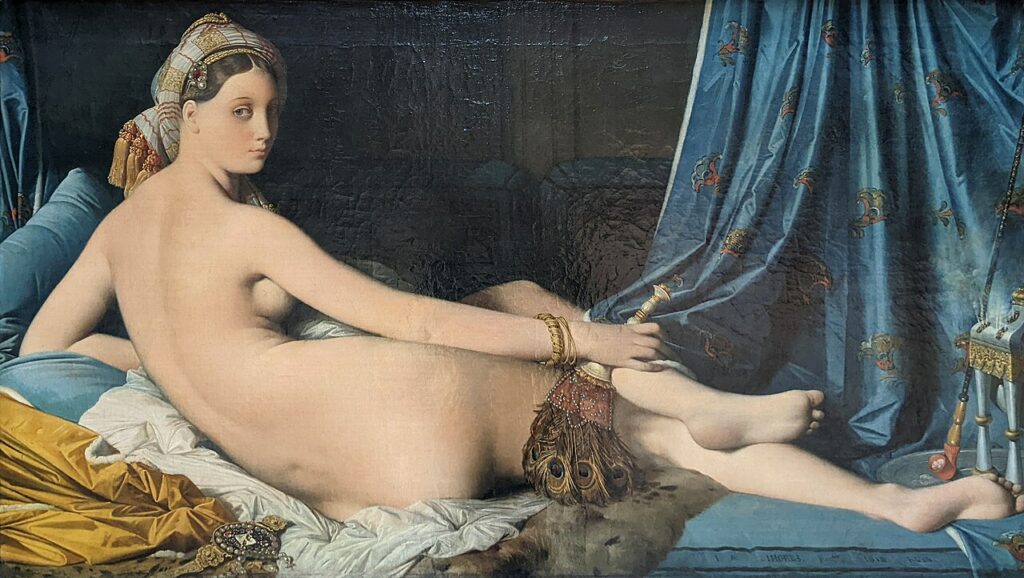
Ingres — The Cult of the Line →A nude woman lies on her back, seen from behind, in an oriental setting of silk and fur. She turns her face toward us, her gaze cold, distant, and inscrutable. Her body forms a long, sinuous curve of hypnotic grace—a line so perfect, so fluid, that it becomes unreal. For this back is anatomically impossible: Ingres added the equivalent of several vertebrae, stretching the body far beyond what nature allows. This is *La Grande Odalisque*, one of the most famous and fascinating works in the Louvre, and a manifesto of Ingres’s “cult of the line.”
Painted in 1814, this odalisque—this nude harem woman—is one of the most analyzed paintings in the entire history of art. Her enigmatic beauty, her cool eroticism, and above all her famous anatomical distortions have made her a subject of fascination and debate for more than two centuries. How could Ingres, the champion of drawing and classical rigor, have committed such a glaring anatomical “error”? The answer is that it is not a mistake, but a deliberate and brilliant choice: Ingres sacrificed the accuracy of the body to the beauty of the line.
That is the very essence of the work, and the key to Ingres’s art. For him, ideal beauty takes precedence over anatomical accuracy. If a longer line or a purer curve makes the figure more harmonious, then one must lengthen the back, stretch the body, and sacrifice reality to the ideal. The Grande Odalisque is the perfect illustration of this boldness: a body reinvented in the name of the beauty of the line, an impossible anatomy in the service of perfect grace.
This article explores the secrets of this masterpiece—what it represents, the mystery of its anatomical distortions, the primacy of line over the body, the Eastern world it evokes, its porcelain-smooth finish, its roots in the great tradition, the scandal it provoked, and how this neoclassical nude ultimately heralded modern art.
The Painting — What It Depicts
*The Grande Odalisque* is a medium-sized oil on canvas: 91 centimeters high by 162 centimeters wide. Its horizontal, elongated format complements the figure’s stretched pose and accentuates the effect of the body’s long, sinuous line.
The work depicts an odalisque—a term that, in the Ottoman Empire, referred to a slave or servant in the harem, and which, in Western art, came to denote reclining female nudes in an Oriental setting. The woman lies naked on a bed draped in rich fabrics, her back turned toward the viewer, her head turned over her shoulder to look at us. She holds a peacock-feather fan in her hand; at her feet rest an oriental pipe and some fabrics; a heavy blue curtain frames the scene. All these accessories—the turban, the fan, the pipe, the silks, the fur—evoke the world of the Eastern harem.
The odalisque’s face is one of the most unsettling elements of the work. She is looking at us, but her expression is indecipherable: cold, distant, detached, devoid of any apparent emotion. This distant gaze, this absence of explicit seduction, lends the figure an enigmatic, almost unsettling quality. The woman presents herself to the viewer’s gaze, yet remains inscrutable, like an idol.
The entire work is executed with dazzling technical perfection. The surface of the painting is smooth and polished, with no visible brushstrokes—a “porcelain” finish that highlights the purity of the contours and the rendering of the materials. The textures of the skin, silk, fur, and feathers are rendered with extraordinary precision and delicacy, inviting the viewer to linger over each surface. It is a pinnacle of technical virtuosity in the service of an ideal vision.
The Back with Extra Vertebrae
The most famous and most talked-about aspect of *La Grande Odalisque* is, without a doubt, the figure’s anatomy—and particularly her seemingly endless back, which has been the subject of so much discussion for the past two centuries.
If you look closely at the odalisque’s body, you’ll notice that it’s anatomically impossible. Her back is much too long: studies have estimated that Ingres added the equivalent of two to three extra lumbar vertebrae, stretching her torso far beyond natural proportions. The right arm, on which the figure is leaning, is also abnormally elongated. The bent left leg forms an unnatural angle, and the pelvis appears strangely positioned. The entire body has been reshaped, stretched, and rearranged, defying the laws of anatomy.
These distortions did not escape the notice of his contemporaries. When the work was exhibited at the 1819 Salon, critics lashed out at these “errors.” They mocked the endless back, the false proportions, and the incorrect anatomy. One critic quipped that the odalisque had three too many vertebrae. For advocates of academic precision, these distortions were unforgivable faults, especially coming from a painter who presented himself as a champion of drawing and classical rigor.
But what critics mistook for clumsiness was in fact a series of deliberate and perfectly executed choices. Ingres, a draftsman of absolute precision, knew exactly what he was doing. If he elongated that back and stretched that arm, it was intentional, in service of a specific effect: to create a long, continuous, and fluid line, from the turban to the toes—an unbroken curve of perfect grace. The anatomical distortion is not a mistake, but the very instrument of ideal beauty. It is the very signature of Ingres’s art.
The Line Before Anatomy
*The Grande Odalisque* is the most striking embodiment of the fundamental principle of Ingres’s art: the primacy of line and ideal beauty over the accuracy of reality. To understand this principle is to understand not only this work, but the painter’s entire artistic approach.
For Ingres, the purpose of art is not to faithfully imitate nature, but to attain ideal beauty. Yet this beauty lies, in his view, in the purity and harmony of the line. A beautiful line—a fluid, continuous curve—is more important than an anatomically accurate body. If nature does not provide the perfect line, the artist must correct it, idealize it, and sublimate it—even if it means deviating from anatomical accuracy. The beauty of form takes precedence over fidelity to the model.
In *The Grande Odalisque*, this principle is taken to its extreme. The woman’s body is entirely subordinate to the beauty of her silhouette. Ingres reshaped it so that it forms a single, grand arabesque—a sinuous, unbroken line that winds from her face to the tips of her toes, without interruption or sharp angles, in perfect fluidity. This ideal line, this musical curve, is the true subject of the painting—more so than the woman herself, more so than the Oriental anecdote. The odalisque is a pretext for the line.
This subordination of the body to the line gives the work its strange, almost abstract character. The figure seems to float outside of time and space, in an ideal universe where only the beauty of form reigns. The body is no longer a real body, subject to the laws of nature, but a creation of the mind, a pure form, an idea of beauty. It is in this way that Ingres, the classicist, paradoxically foreshadows modern art: by asserting the artist’s right to distort reality in the name of an autonomous formal beauty, he paves the way for all the artistic freedoms that modern artists would later embrace.
An Odalisque — The Dream of the Orient
*The Grande Odalisque* is part of a major movement in 19th-century painting: Orientalism—European artists’ fascination with an idealized, sensual, and exotic Orient. But Ingres offers a very distinctive take on the subject, halfway between Classicism and the Eastern imagination.
The very subject of the odalisque is rooted in this oriental imagination. The harem—that closed, forbidden place where the sultan’s women lived—fascinated nineteenth-century Europe, which projected onto it its fantasies of sensuality, luxury, and mystery. The nude odalisque, reclining in her Eastern setting, had become a favorite motif of this reverie. By choosing this subject, Ingres was responding to the growing fashion for exoticism and the allure of the East, which was then taking hold in art and literature.
Yet Ingres’s Orientalism differs from that of the Romantics. Whereas Delacroix, after his trip to Morocco, painted an Orient that was observed, colorful, vibrant, and full of movement and drama, Ingres—who never set foot in the East—presented an entirely imagined Orient, reconstructed in his studio using props and his imagination. Above all, he treats it not with Romantic fervor, but with classical purity: his odalisque possesses the nobility, calm, and formal perfection of an ancient figure. For Ingres, the Orient is merely a backdrop, a pretext for unfolding his ideal of beauty.
This tension between the sensual, Eastern subject and the classical, idealized treatment lends the work some of its fascinating ambiguity. *The Grande Odalisque* is at once a sensual nude and an idealized figure, an Eastern reverie and a classical manifesto, an image of desire and a cold icon. It bridges the gap between the waning Neoclassicism and the emerging Orientalist Romanticism—without quite belonging to either, in that singularity that is the hallmark of Ingres’s genius.
The Porcelain Surface
A key aspect of *La Grande Odalisque*, which sets it apart radically from the works of his Romantic contemporaries, is its finish: a smooth, polished surface, devoid of any visible brushstrokes, that appears to be made of porcelain. This style of painting is the very embodiment of Ingres’s “cult of the line.”
In all his paintings, Ingres sought a flawless surface where the brushwork disappears entirely. No thick layers, no visible brushstrokes, no visible texture: the paint had to be smooth, blended, perfect—as if glazed. This painting style highlights the purity of the outline and the precision of the drawing by eliminating anything that might distract the eye from the line. The smooth surface serves to emphasize the line.
This approach stands in striking contrast to that of his great rival, Delacroix. In the work of Delacroix and the Colorists, the brushstroke is visible, vibrant, and expressive; the paint is rich, and the color is applied in strokes that convey the painter’s gesture. With Ingres, on the contrary, everything is smoothed, polished, and subdued: the gesture disappears, leaving only the perfection of the outline and the rendering of textures. It is the fundamental opposition between line and color, between drawing and brushstroke, that shaped the entire artistic debate of the era—a contrast epitomized in the very painting styles of the two artists.
In *La Grande Odalisque*, this porcelain surface achieves perfection. The rendering of the skin—smooth and pearlescent—as well as the silk, the fur, and the feathers of the fan, is a display of breathtaking virtuosity. Each material is rendered with a tactile precision that invites the eye to linger. This technical perfection—this smooth, flawless coolness—adds to the work’s strangeness: the odalisque appears as a porcelain idol, an object of pure, sublime, and impenetrable beauty.
The Sources of a Scholarly Work
“The Grande Odalisque,” as daring as it may be, did not come out of nowhere. Ingres, a deeply cultured painter steeped in tradition, drew upon art history to create his masterpiece. Understanding his sources reveals just how masterful this work is.
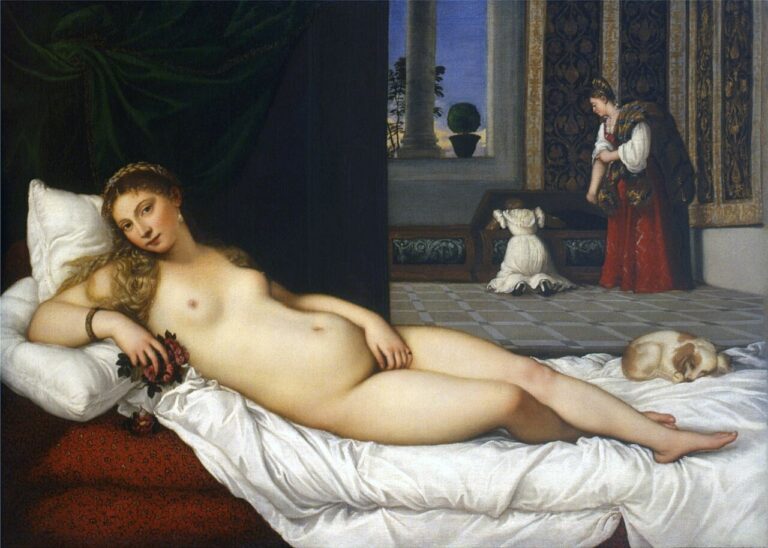
The motif of the reclining nude woman was one of the major themes in Western painting, and Ingres consciously measured himself against his illustrious predecessors. For the general concept of the reclining female nude, he drew inspiration from the Venetians, particularly Titian’s Venus of Urbino, one of the canonical models of the genre. He was also familiar with Renaissance nudes, the figures of Michelangelo and Raphael, whom he revered above all others.
In the pose and grace of her figure, Ingres also drew inspiration from his master, Jacques-Louis David, and in particular from his famous portrait of Madame Récamier, in which a languid woman is rendered with classical elegance and purity. The connection is clear: Ingres takes up and transforms this legacy, pushing stylization and idealization even further. His odalisque is the heir to a long line of female figures in great painting, whom he reinvents in his own way.
But Ingres does not merely imitate his models: he surpasses them through his formal audacity. Where Titian or David adhered to anatomy, Ingres distorts it in the name of the ideal line. Where his predecessors sought a balance between beauty and truth, Ingres resolutely sacrifices truth to beauty. The Grande Odalisque is thus both deeply traditional—in its subject matter, its sources, and its cultural context—and radically new—in its boldness, its stylization, and its freedom. It is this combination that makes it a masterpiece.
The Scandal and Belated Recognition
Like so many works that are celebrated today, *La Grande Odalisque* was initially poorly received. Its journey—from initial misunderstanding to critical acclaim—reveals the disconnect between Ingres and the tastes of his time.
The work was commissioned in 1813 by Caroline Murat, Queen of Naples and Napoleon’s sister, as a companion piece to another nude (now lost). But the fall of the Empire in 1814–1815 likely deprived Ingres of payment for his commission. The work was not shown to the public until 1819, at the Paris Salon. And there, it received harsh criticism.
Critics lashed out at the anatomical distortions—the back that was too long, the incorrect proportions. Ingres was criticized for his “errors,” his incorrect anatomy, and his strange, cold style. For many, this odalisque with extra vertebrae was proof of the painter’s misguidedness—that he sacrificed truth to a mannered pursuit of beauty. The work was disconcerting and unsettling because of its strangeness and its rejection of anatomical conventions. Once again, Ingres was ahead of his time.
It took decades for *La Grande Odalisque* to be fully recognized as the masterpiece it is. Acquired by the French government in 1899, it entered the Louvre, where it became one of the most admired and most-visited works. Perceptions had changed: what had once been considered flaws now appeared as brilliant strokes of genius; this strange and ideal beauty captivated viewers. Today, *La Grande Odalisque* is unanimously regarded as one of the pinnacles of French painting and the perfect embodiment of Ingres’s genius.
From Neoclassicism to Modernity
“The Grande Odalisque” occupies a unique place in art history: though a neoclassical work in terms of its cultural context and principles, its boldness foreshadows some of the most radical freedoms of modern art. It is this paradox that gives the work its richness and modernity.
Through its deliberate distortion of the body and the priority it gives to the ideal line over anatomical accuracy, *The Grande Odalisque* establishes a principle that would lie at the heart of modern art: the artist’s right to depart from the imitation of reality in the name of a higher, formal, ideal truth. Ingres asserts that the beauty of form and the harmony of line are more valuable than fidelity to nature. The modern artists would make this principle their own, taking it even further.
The work’s influence on 20th-century art is direct and widely recognized. Henri Matisse, in his art of pure line and arabesque, and in his own odalisques, drew inspiration from the sinuous grace of Ingres’s figures. And Pablo Picasso, fascinated by Ingres’s distortions, drew open inspiration from them: during his neoclassical period of the 1920s, but also, more profoundly, in his freedom to reinvent the human body. The anatomical distortion of the odalisque, once derided, appears in retrospect as a foreshadowing of the liberties that modern artists would take with the human figure.
Thus, *La Grande Odalisque*, a work by a painter who saw himself as the guardian of classical tradition, turns out to be one of the starting points of modernity. The worship of the line, taken to the point of distorting the body, paradoxically paved the way for the formal freedom of modern art. This is one of the great ironies of art history: the most classical of painters was also, without realizing it, one of the most modern.
How to View the Work Today
The Grande Odalisque is housed at the Louvre Museum in Paris, where it is on display in the Denon Wing, among the major galleries of French painting. It is located in the same wing as the Mona Lisa, allowing visitors to see both works during a single visit. The French painting galleries are generally less crowded than the Italian galleries, offering a more peaceful visiting experience.
The entrance to the Louvre leads to these galleries; since the museum is so crowded, it’s best to book your ticket in advance and visit during off-peak hours. Standing before the painting, you can take the time to observe the famous sinuous curve of the body, the sumptuous rendering of the materials, and that cold, distant gaze that embodies the mystery of the odalisque.
To further explore Ingres’s work, the Louvre houses his other masterpieces— *The Turkish Bath*, *The Valpinçon Bather*, *The Apotheosis of Homer*, and *Portrait of Monsieur Bertin*. And the Ingres-Bourdelle Museum in Montauban, the painter’s hometown, houses the most extensive collection of his drawings, where visitors can admire his devotion to the line.
Further Reading
Institutional sources cited
- Louvre Museum, entry for *La Grande Odalisque*.
- History of the Arts (Ministry of Culture), entries on Ingres.
- Larousse and Encyclopædia Universalis, entries for “Ingres” and “The Grande Odalisque.”
Sources and Reference Studies
- Charles Baudelaire, Salon of 1846 (on Ingres and his nudes).
- Daniel Ternois, Ève Camesasca, *The Complete Paintings of Ingres*, Flammarion.
- Ingres Catalog, National Galleries of the Grand Palais / Louvre, 2006.
Institutional Documentation
- Louvre Museum, Paris — the institution that houses the work (Denon Wing).
- Ingres-Bourdelle Museum, Montauban — the master’s collection of drawings.
See also on Hors Cadre
- Ingres—The Cult of the Line —A Portrait of the Artist, His Life, and His Art.
- Eugène Delacroix—the standard-bearer of Romanticism —the great rival, whose colorful Orientalism stands in contrast to Ingres’s idealized odalisque.
- Henri Matisse—the liberation of color —the 20th-century heir to Ingres’s “pure line” and “odalisques.”
— M