Seated Male Nude — Schiele’s “Ecorché” Self-Portrait
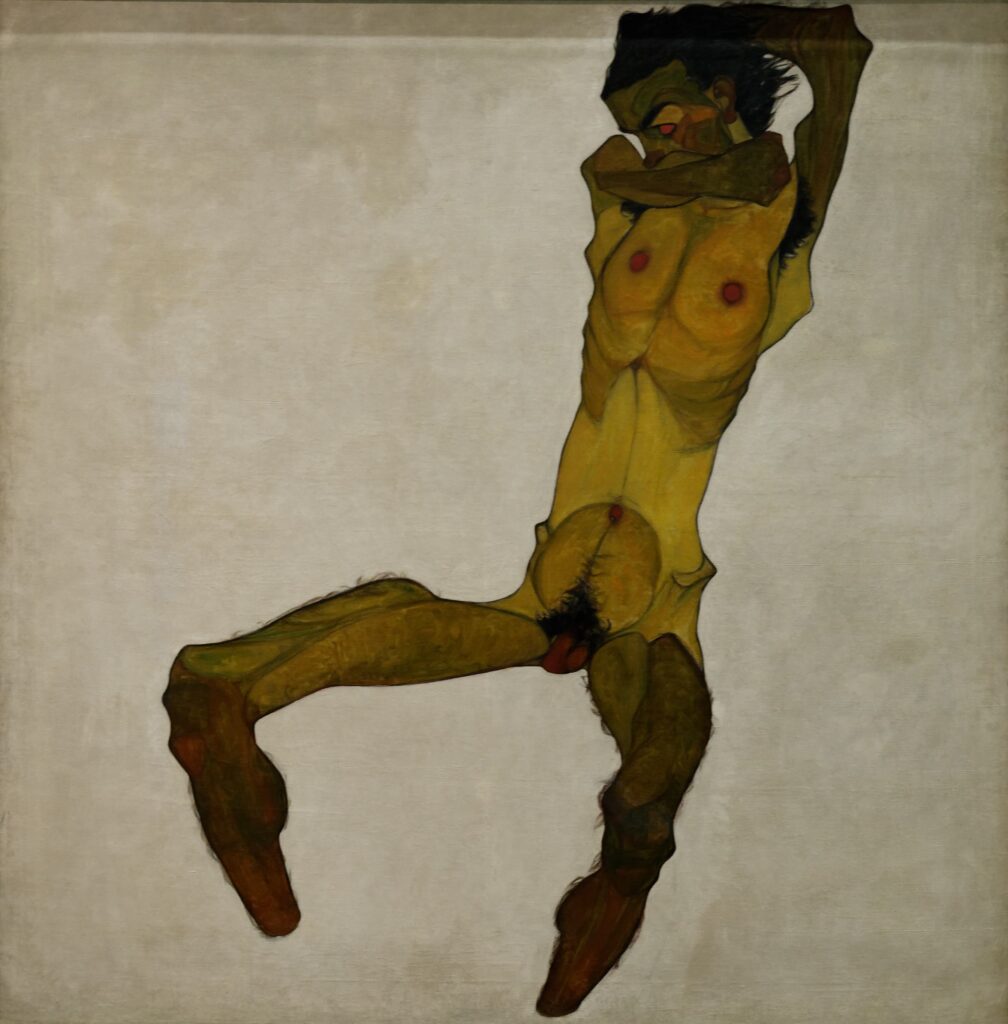
Egon Schiele — The Body Lay Bare →A naked body, alone, suspended in the void against a white background. No setting, no chair, no story: just a man, exposed in raw nudity, his body emaciated, his flesh mottled with red, his hands and feet as if amputated, his face contorted into a defiant grimace. This man is Egon Schiele himself, who was only twenty years old when he painted this *Seated Male Nude* in 1910—one of the most radical and unsettling self-portraits in the entire history of art.
This work is a manifesto. By depicting himself naked, flayed, reduced to a suffering and vulnerable body exposed without the slightest artifice, Schiele makes a brutal break with centuries of tradition. In Western art, the nude had been the embodiment of ideal beauty, harmonious proportions, and the celebration of the body. Schiele transforms it into something entirely different: an instrument of psychological exploration, a record of the human condition’s anguish and vulnerability. The body is no longer beautiful: it is real, raw, and raw to the bone.
Painted the very year Schiele developed his style, this *Seated Male Nude* marks the birth of his most personal art. In it, he already displays all the elements that would become his signature: sharp lines, an emaciated and contorted body, non-naturalistic colors, an empty background that isolates the figure, and psychological intensity taken to the extreme. This is the birth of the Schiele we know—the painter of the raw, unflinching body, the uncompromising explorer of the human condition.
This article explores the secrets of this radical work—what it represents, the way Schiele treats the body as if it were flayed, the meaning of the nude self-portrait and the vulnerability it exposes, the role of the void surrounding the figure, the radical nature of this image for its time, and the work’s place in the emergence of Viennese Expressionism. As is always the case with nudes of this boldness, we will approach it from a strictly art-historical perspective.
The Painting — What It Depicts
*Seated Male Nude (Self-Portrait) * is a large-scale oil and gouache on canvas: 152.5 centimeters high by 150 centimeters wide. This square, almost monumental format is unusual and striking: it isolates the figure in the center of a vast space, giving it a commanding presence.
The work depicts Schiele himself, nude, in a seated—or rather, suspended—pose. The body is seen from the front, stretched diagonally across the canvas. But this body is rendered in a radically anti-naturalistic manner. It is emaciated, angular, reduced to its tendons, muscles, and bones, which protrude beneath the skin as if the body had been flayed—like an anatomical model laid out on a dissection table. The extremities appear as if amputated: the feet are cut off, out of frame, or absent, and the hands are so clenched, so folded in on themselves, that they vanish, as if concealed. All that remains is the head, the torso, and the limbs—the body stripped of the parts that allow it to grasp the world and stand upright.
The colors further distort the figure’s natural appearance. The flesh is not rendered in realistic tones, but in sickly, morbid yellows and greens, far removed from any natural skin tone. Against this pale body stand out distinctive, bright red marks: the eyes, nipples, navel, and genitals are highlighted with this garish color, which draws the eye and accentuates the strangeness of the image. Finally, the face is contorted into a grimace, an expression of tension or defiance.
All around the figure, the background is empty: a monochromatic white, barely nuanced, without any decoration or support. The body rests on nothing; it floats, levitating, in an indeterminate space, without place or context. This absence of any environment focuses all attention on the body alone—exposed and vulnerable. The man is there, naked, suspended in the void, defenselessly exposed to the viewer’s gaze. It is an image of a rawness and intensity that few works had achieved before it.
A mutilated body
What immediately strikes the viewer in this work—and what makes it so radical—is the treatment of the body as if it were flayed—a body whose sensitive surface, the skin, seems to have been torn away to reveal its internal structure: tendons, muscles, and bones. This approach breaks with the entire tradition of the nude.
In Western art, the nude celebrated the beauty of the body—its smooth, harmonious surface, the softness of the flesh, and the perfection of its proportions. Schiele does the opposite. He is not interested in the sensual surface of the body, but in what lies beneath: the framework, the skeleton, the musculature, the anatomical structure. He accentuates the protrusions of the bones, the hollows, and the tendons, giving his figures the appearance of flayed bodies, like those anatomical charts that show the body stripped of its skin. The body is no longer an object of desire or aesthetic contemplation: it is an object of study, analysis, almost dissection.
The colors reinforce this impression. By painting her flesh in sickly shades of yellow and green—far removed from any natural skin tone—Schiele makes her appear ill, decayed, and morbid. The body seems marked by suffering, illness, perhaps even death. This chromatic distortion is not arbitrary: it expresses a vision of the body as a place of vulnerability and finitude, haunted by illness and death. Some have seen in this an echo of Schiele’s family history, marked by his father’s illness. But beyond the anecdote, what is expressed is a general vision of the human condition: the body as something fragile, perishable, and suffering.
The truncated body—deprived of feet and hands—further reinforces this sense of vulnerability and mutilation. Without feet to stand on, without hands to act and grasp, the body is reduced to powerlessness, passivity, and sheer exposure. It can neither stand nor defend itself nor act upon the world: it is simply there, exposed, vulnerable, reduced to nothing but its suffering presence. This symbolic amputation makes the body an image of human powerlessness and fragility. Schiele’s flayed and truncated body is a raw meditation on the vulnerability of the human being.
The Self-Portrait as a Form of Self-Revelation
The fact that this work is a self-portrait—that Schiele depicts himself in this raw, raw-edged nudity—gives it an additional dimension: that of a psychological as well as physical exposure.
The self-portrait occupies a central place in Schiele’s work; he depicted himself countless times. But for him, it was never a matter of capturing a flattering likeness or a social image. On the contrary: Schiele uses the self-portrait as a tool for self-exploration, a plunge into the depths of his being, a laying bare of his inner truth. In painting himself, he does not seek to show off, but to scrutinize himself, to analyze himself, to lay bare what is most intimate and vulnerable within him. For him, the self-portrait is an act of radical truth.
By depicting himself naked, flayed, and exposed against an empty background, Schiele takes this logic to its extreme. The naked body becomes a metaphor for the soul laid bare, stripped of all social masks, all defenses, and all artifice. Physical nudity conveys psychological nudity: the exposure of the self in its rawest, most vulnerable truth. Schiele offers himself to the gaze without protection, like a being subjected to analysis—a psychological document rather than a portrait. The grimace on his face and the tension in his body convey this laying bare of his inner self—the anguish, turmoil, and anxiety of the human being.
This practice of self-portraiture as a form of self-revelation was part of the intellectual climate of Vienna in 1900—the Vienna of Freud and the birth of psychoanalysis. At the very time that Freud was exploring the depths of the unconscious, using introspection and self-analysis as the tools of a new science of the soul, Schiele was scrutinizing his own body and face to extract a psychological truth from them. Without necessarily being familiar with Freudian theories, he shared this desire to explore the depths of being, to go beyond appearances and social conventions to reach a rawer and deeper truth. Schiele’s nude self-portrait is, in this sense, a work that is profoundly Viennese and profoundly modern—the body and the face as gateways to the soul.
Emptiness and Vulnerability
A key element of this work’s power is the void surrounding the figure: that white, monochromatic background—devoid of any decor or support—in which the body seems to float. This void is not merely a formal choice; it conveys a significant part of the work’s meaning.
By eliminating all setting, all context, and all support, Schiele radically isolates the figure. The body rests on no chair, no floor, no surface; it is suspended in an indeterminate space, without a place or anchor. This absence of support has an immediate effect: it gives the body an impression of levitation, of weightlessness, but also of instability and precariousness. The man floats in a void, with nothing to hold him or support him. He is left to his own devices, alone, in an abstract space that could be that of consciousness or anxiety.
This emptiness greatly heightens the sense of vulnerability and loneliness. With no setting to situate it, no context to explain it, the body is exposed in its most absolute nakedness, defenseless before the viewer’s gaze. Nothing softens or mediates this exposure: the face-to-face encounter with the naked, suffering body is direct, brutal, and unavoidable. The emptiness forces the viewer to confront the figure with no escape, to endure its raw and unsettling presence. It is a direct confrontation, without the slightest barrier.
This use of empty background is one of Schiele’s great innovations, and it would become a constant feature of his art. By isolating his figures in abstract, empty spaces, he strips them of any narrative or social context, reducing them to their pure physical and psychological presence. His bodies exist outside the world, in the bare space of the canvas, like apparitions of being in its most stripped-down truth. For Schiele, the void is the site of the absolute exposure of being—without setting, without story, without mask. He makes solitude and vulnerability the very conditions of the existence he depicts.
The Radical Movement of 1910
To appreciate the boldness of this work, it must be placed in its historical context. In 1910, depicting oneself in this way—naked, flayed, truncated, grimacing, against an empty background—was an act of almost unheard-of radicalism. Schiele was bringing about a major breakthrough in painting.
For centuries, Western art history had depicted the human body in a complete, harmonious, and reverent manner. The nude was a noble genre, celebrating the ideal beauty inherited from antiquity. Even the most realistic depictions respected the integrity and dignity of the body. The first major break with this tradition came from sculpture, with Auguste Rodin, who dared to fragment, distort, and mutilate the body to draw out a new expressiveness. But what Rodin had done in sculpture—while still drawing on ancient fragments—Schiele did in painting in 1910, with unprecedented brutality.
Schiele’s radicalism stems from several simultaneous breaks with convention. He breaks with the beauty of the nude by depicting a flayed, morbid, suffering body. He breaks with the body’s integrity by truncating it and amputating its extremities. He breaks with color naturalism by painting yellow-green flesh marked with red. He breaks with the narrative context by isolating the figure in a void. And he breaks with the social function of the self-portrait by showing himself not as he wishes to appear, but in a raw and unsettling truth. Each of these breaks was daring; their combination makes the work one of the most radical of its time.
This radicalism places Schiele among the pioneers of modern art. At the age of twenty, he brought about a revolution: transforming the body from an object of beauty into a means of exploring and expressing inner life, anguish, and the psychological truth of being. This idea—that distortion and raw expression can convey a deeper truth than beauty and naturalism—lies at the heart of Expressionism and, more broadly, of modern art. The Seated Male Nude from 1910 is thus one of the seminal works of Viennese modernity, the birth of Schiele’s genius, and one of the milestones of the revolution that, at the beginning of the 20th century, radically transformed the representation of the body and the human being.
The Raw Body — Eros and Anxiety
This work marks the first expression of what would become Schiele’s central theme: the raw, exposed body, the place where the fundamental forces of existence—desire, anxiety, vulnerability, and death—find expression. It lays the foundation for all his future art.
In Schiele’s work, the body is never neutral or at peace: it is the stage for the deepest impulses and anxieties. In this Seated Male Nude, the body’s tension, its contortion, its grimace, and its exposed nudity express unease, anxiety, and existential suffering. The body is not at rest: it is tense, rigid, as if torn by conflicting forces. Sexuality is present here, but without idealization or seduction—raw, anxious, mingled with anguish. Schiele’s body is a body that desires and suffers, caught between Eros and anguish, between desire and the awareness of finitude.
This view of the body is characteristic of the sensibility of Vienna in 1900, that city of crisis and modernity where new ways of conceiving the human being were being invented. It was the city of Freud, who explored the links between sexuality, anxiety, and the unconscious; the city of Klimt, who had made Eros the central theme of his art; the city of a bourgeoisie constrained by social conventions, beneath which repressed impulses seethed. Schiele, in his raw depictions of the human form, gives a striking expression to these tensions. He shows human beings grappling with their bodies, their desires, their anxieties, and their finitude, without the veil of social conventions and idealization.
It is this uncompromising exploration of the body and the human condition that defines Schiele’s greatness and modernity, and this *Seated Male Nude* from 1910 serves as its starting point. His entire subsequent body of work—the self-portraits, the nudes, the embraces, right up to the major compositions of his mature period such as *Death and the Maiden* or *The Family* —would develop this theme of the body as the seat of truth in human existence. The raw, unflinching body, exposed in its vulnerability and unvarnished truth, is Schiele’s great discovery, his major contribution to 20th-century art. And it is in this radical self-portrait, painted when he was twenty, that he lays the groundwork for it for the first time.
From the Collector to the Leopold Museum
The journey of this work—from the young Schiele’s studio to the Leopold Museum—sheds light on the gradual recognition of his genius.
As soon as it was created, the work found a buyer in Carl Reininghaus, a Viennese collector with an interest in the avant-garde who supported several modernist artists. The fact that such a radical work found a buyer as early as 1910 attests to the existence, in Vienna at that time, of an enlightened circle capable of recognizing the audacity and genius of the young Schiele, despite the unsettling nature of his art.
The work then passed through various hands throughout the 20th century before being acquired by Rudolf Leopold in the 1950s. This passionate collector, an ophthalmologist by profession, assembled the world’s largest collection of Schiele’s works over the course of his life, at a time when the artist was still relatively underappreciated. Leopold’s discernment and tenacity made it possible to assemble an exceptional collection, which would go on to become the core of a museum.
In 1994, Rudolf Leopold’s collection was transferred to a foundation and subsequently put on public display at the Leopold Museum, which opened in 2001 in the heart of Vienna’s Museum Quarter. It is there that the Seated Male Nude is now housed, among the masterpieces of Schiele and Viennese modernism. Now one of the museum’s most iconic works, this radical self-portrait from 1910 is recognized as a pinnacle of Schiele’s art and a milestone in the history of modern art. Its influence extends even beyond the confines of museums: its image has left an indelible mark on culture, inspiring filmmakers and musicians. The young Schiele’s emaciated body has become an icon of modernity.
How to View the Work Today
*Seated Male Nude (Self-Portrait) * is housed at the Leopold Museum in Vienna, which holds the world’s largest collection of works by Schiele. The museum, located in the heart of the MuseumsQuartier, is the premier destination for discovering the artist’s full range of work.
Seeing the work in person allows one to appreciate its striking presence: the large square format, the figure’s isolation in the void, the strangeness of the colors, and the raw, flayed body. It is a work that leaves no one indifferent, so powerfully does it lay bare the vulnerability and intensity of human existence. More than a century after its creation, its radical nature retains all its power to unsettle.
The Leopold Museum houses other masterpieces by Schiele—self-portraits, landscapes, and portraits—as well as works by Klimt and the great artists of turn-of-the-century Vienna. To round out the experience, the Belvedere (which houses *Death and the Maiden* and *The Family*) and the Albertina (which boasts a rich collection of Schiele’s drawings) also offer remarkable collections in Vienna. The Austrian capital remains the premier destination for discovering this genius of Expressionism.
Further Reading
Institutional sources cited
- Leopold Museum, Vienna, entry for *Seated Male Nude (Self-Portrait) * (*Sitzender männlicher Akt*).
- Smarthistory / Khan Academy, analysis of *Seated Male Nude (Self-Portrait)*.
- Kallir Research Institute, Schiele’s catalog raisonné.
Sources and Reference Studies
- Jane Kallir, Egon Schiele: The Complete Works, a catalogue raisonné.
- Tobias G. Natter, Egon Schiele: Complete Paintings, 1909–1918, Cologne, 2017.
- Catalogs of the Schiele retrospectives (Leopold Museum).
Institutional Documentation
- Leopold Museum, Vienna — the institution that houses the work.
- Belvedere, Vienna — other masterpieces by Schiele.
See also on Hors Cadre
- Egon Schiele — The Raw Body — A Portrait of the Artist, His Life, and His Art.
- Death and the Maiden—Schiele’s heart-wrenching farewell —the body and death entwined, five years after this self-portrait.
- Vincent van Gogh — painting from life — another master of the self-portrait as a form of self-exploration.
— M