Musée de l’Orangerie — What to See, Hours, Tickets
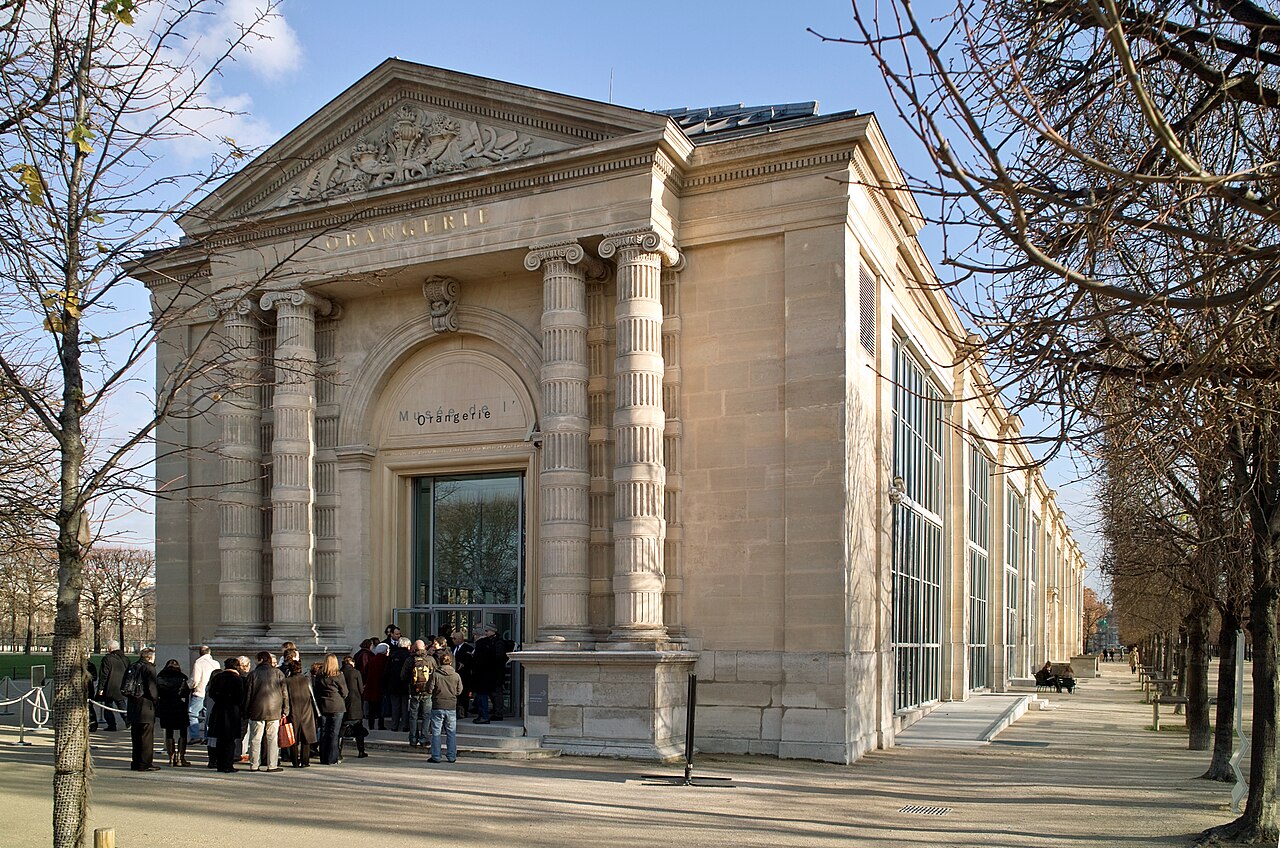
At the western corner of the Tuileries Garden, between Place de la Concorde and the Seine, a low, unassuming building houses one of the most striking works of art in all of Western art. The Musée de l’Orangerie is famous for its eight large compositions from Claude Monet’s Water Lilies series, displayed in two oval rooms designed by the painter himself to envelop the visitor. You don’t look at the Water Lilies the way you look at a painting: you step inside, sit down, and let yourself be immersed in a horizon of water, sky, and reflections. Long before contemporary immersive art, Monet had envisioned here a total environment—a veritable chapel of Impressionism.
But the Orangerie is more than just the *Water Lilies*. On the lower level, the Jean Walter–Paul Guillaume Collection brings together one of the finest private collections of modern art ever assembled—some 150 works by Cézanne, Renoir, Soutine, Derain, Matisse, Picasso, Modigliani, Le Douanier Rousseau, and many others, tracing the evolution of painting from late Impressionism to the avant-garde movements of the early 20th century.
This article serves as a guide to your visit to the Musée de l’Orangerie: the unique history of this building, originally designed to house orange trees and now the home of the *Water Lilies*; the must-see works; 2026 hours and admission prices; practical tips (including the mandatory time-slot reservation); temporary exhibitions, frequently asked questions, and the surrounding area—including the Musée d’Orsay, just a ten-minute walk away, for a full day of Impressionist art.
The Musée de l’Orangerie at a Glance
| Address | Tuileries Garden, on the Seine side, Place de la Concorde, 75001 Paris |
| Subway | Concorde Metro Station (Lines 1, 8, 12), a 3-minute walk away |
| Hours | Every day except Tuesday, 9 a.m.–6 p.m. |
| Rates | €12.50 (collections + Water Lilies); combined Orsay + Orangerie ticket: €20; free on the first Sunday of the month |
| Official Website | musee-orangerie.fr |
History — From Napoleon III’s Orangery to Monet’s Donation
The Musée de l’Orangerie lives up to its name: the building was constructed in 1852, during the Second Empire, to serve as an orangery for the Tuileries Garden. Its primary function was to house, during the winter, the orange trees and other potted shrubs that adorned the garden during the warmer months. A utilitarian structure, facing due south along the Seine to capture the light, it had no artistic purpose at the time.
Everything changed in the aftermath of World War I, thanks to the meeting of two men: the painter Claude Monet and the statesman Georges Clemenceau. The two friends had known each other for a long time. In the aftermath of the war, Monet, living in seclusion in his garden in Giverny, had been working for years on a monumental series of large-scale murals dedicated to his water lily pond. He dreamed of donating this collection to France as a monument to peace in the wake of the conflict.
It was Clemenceau, then a leading figure in French political life, who championed the project and secured the government’s acceptance of Monet’s donation. After lengthy discussions about the location, the Orangerie des Tuileries was chosen and renovated to house the large canvases. Monet himself oversaw the design of the spaces: he wanted two oval rooms, illuminated by natural light from above, where the panels would unfold seamlessly to completely envelop the visitor.
Monet died in December 1926, before the museum’s opening. The *Water Lilies* were installed, and the museum opened its doors in 1927, in accordance with the painter’s wishes. For several decades, however, the collection remained relatively unknown to the general public. It was not until the 1950s and 1960s that the Water Lilies were truly rediscovered—particularly by American Abstract Expressionist painters, who saw in these immense, colorful, and quasi-abstract surfaces a striking foreshadowing of their own artistic exploration.
Another major milestone in the museum’s history was the acquisition of the Jean Walter–Paul Guillaume collection. Assembled by art dealer Paul Guillaume and later by industrialist Jean Walter, this exceptional collection of modern art was bequeathed to the French government by Domenica Walter, the widow of both men, in 1960, on the express condition that it be displayed at the Orangerie. Installed beginning in 1966 and then remarkably showcased following the museum’s renovation, which was completed in 2006, the collection today makes the Orangerie a dual-purpose space: a sanctuary for the *Water Lilies* on the upper level and a panorama of modern art on the lower level.
The Water Lilies — The Immersive Experience
The two oval “Water Lilies” galleries form the heart of the museum and offer one of the most unique experiences in Western art. Eight large compositions, painted by Monet in his garden in Giverny, are displayed along the curved walls of two elliptical galleries that follow one another.
The dimensions are monumental: the canvases are approximately two meters high, with lengths ranging from six to seventeen meters. When placed end to end, they form a continuous cycle of nearly one hundred meters of painting. The panels bear evocative titles— Morning by the Willows, Clouds, Reflections of Trees, Sunset, The Two Willows —which capture the variations in light on the water lily pond throughout the day, from morning to dusk.
Monet’s major innovation is not merely pictorial—it is spatial. By designing oval rooms without corners, bathed in natural light streaming from the ceiling, the painter sought to eliminate any distance between the artwork and the viewer. There is no longer a frame, no wall, no clear boundary: the painting envelops the visitor 360 degrees, literally immersing them within the pond at Giverny. Monet wanted visitors to be able to sit in the center of the rooms and let themselves be absorbed by this horizon of water and sky, in slow, silent contemplation.
It is in this sense that the Orangerie can be considered the first truly immersive space in the history of art—long before contemporary immersive installations. Clemenceau referred to it as the “Sistine Chapel of Impressionism,” drawing an analogy with Michelangelo’s Sistine Chapel: a place where painting, by covering the entire space, becomes an enveloping and almost spiritual experience. The silence that generally reigns in these rooms adds to their meditative atmosphere.
In the final years of Monet’s career, marked by vision impaired by cataracts, he moved toward an increasingly free style of painting, in which water lilies, reflections, and the sky dissolved into almost abstract patches of color. It is precisely this freedom that would fascinate 20th-century abstract painters and make the Water Lilies a pivotal work between Impressionism and modern art.
The Walter-Guillaume Collection – Must-See Works
On the lower level, the Jean Walter–Paul Guillaume Collection features approximately 150 works created between 1860 and 1930. It is a collection of rare coherence and quality that traces the evolution of modern painting. Here are the highlights.
1. Paul Cézanne
The collection includes about fifteen works by Cézanne—still lifes, portraits, and landscapes—that offer insight into the use of color to build form and the exploration of structure so characteristic of the master from Aix. Among them are still lifes of apples and other fruits, which exemplify his quest for solidity.
2. Auguste Renoir
Renoir is the most widely represented painter in the collection, with about twenty paintings. The collection features his female figures, portraits of children, and nudes with pearly skin, all rendered in the artist’s late, warm, and sensual style. Notably, a version of *Young Girls at the Piano* is included.
3. Chaim Soutine
The Orangerie houses an exceptional collection of works by Soutine—some twenty pieces—one of the largest in the world. Turbulent landscapes, portraits of people in humble trades (pastry chefs, bellboys, altar boys), and Expressionist still lifes: Soutine’s convulsive and passionate paintings are prominently featured here.
4. Le Douanier Rousseau
Henri Rousseau, known as “Le Douanier,” is featured with several iconic paintings that exemplify his naïve and dreamlike style—portraits, strange scenes, and imaginary vegetation that captivated the avant-garde artists of the early 20th century.
5. André Derain
The collection features a particularly large number of works by Derain (about thirty), spanning from his Fauvist period to his return to a more restrained classicism—portraits, landscapes, and still lifes.
6. Amedeo Modigliani
Several portraits by Modigliani—recognizable by their elongated faces, slender necks, and melancholic elegance—are among the highlights of the collection.
7. Henri Matisse and Pablo Picasso
The collection also features works by Matisse (colorful figures and interiors) and Picasso (from the Blue Period to his later compositions), which place the collection within the broader narrative of the avant-garde movements.
8. Marie Laurencin, Utrillo, Sisley
Other painters round out this overview: Marie Laurencin and her pastel-hued portraits of women, Maurice Utrillo and his streets of Montmartre, and Alfred Sisley and his Impressionist landscapes.
How to Visit the Museum
Recommended duration: Allow 1 to 1.5 hours for a complete tour. The museum is small, but the Water Lilies galleries are worth spending some time in: plan to sit there for a few minutes to fully experience the immersive atmosphere Monet intended. Allow extra time if there’s a temporary exhibition on.
Best time to visit
On weekdays at opening time (9 a.m.), the Water Lilies galleries are nearly empty, which makes the experience much more intense. The Friday evening opening (during exhibition periods) also offers a quiet, intimate atmosphere. Best to avoid: weekends and afternoons during peak season, when crowds can disrupt the contemplative atmosphere of the oval galleries.
Hours
Every day except Tuesday, from 9 a.m. to 6 p.m. Late-night hours on Fridays during exhibition periods (check the official website for specific hours and admission prices). Closed on May 1, the morning of January 1, and December 25. Last admission is approximately 45 minutes before closing.
2026 Rates
(Please check the official website before your visit):
- Full-price ticket: €12.50 (includes admission to *The Water Lilies*, the permanent collection, and the temporary exhibition)
- Orsay + Orangerie Combo Ticket: €20, to visit both complementary museums
- Reduced evening rate on Friday nights during exhibition periods
- Free admission on the first Sunday of every month for visitors under 18 and those aged 18–25 who are residents of the European Union
Reservation
Reserving a time slot is required for all visitors, including those eligible for free admission and Paris Museum Pass holders. During peak season (April–October), spots fill up quickly: be sure to book at least one week in advance on the official website.
Accessibility
The museum is accessible to people with limited mobility (elevators serve both levels). Facilities are available for visitors with disabilities. Details are available on the official website.
Photography
Photography without a flash is permitted in the permanent collections (but is often prohibited in temporary exhibitions).
Current Exhibitions
The Musée de l’Orangerie regularly presents high-quality temporary exhibitions, often related to Impressionism, modern art, or the museum’s collections, as well as “contemporary counterpoints” that create a dialogue between a contemporary artist and the *Water Lilies*.
As of the time of this writing (June 2026), the exhibition *Henri Rousseau: The Ambition of Painting*, dedicated to the famous naïve painter, is on view through July 20, 2026. This fall, to mark the centennial of Claude Monet’s death, the museum is announcing a major exhibition, “Monet and Time ” (September 30, 2026, through March 29, 2027), exploring how the painter depicted the moment, the passage of time, and the transformation of the landscape, culminating in the ” Water Lilies” series.
Check the official website, musee-orangerie.fr, for the current schedule at the time of your visit. Since exhibitions at the Orangerie are often sold out, it’s best to book early.
Frequently Asked Questions
How long does it take to visit the Musée de l’Orangerie?
Allow 1 to 1.5 hours for a complete tour of the *Water Lilies* and the Walter-Guillaume Collection. The museum is modest in size and can easily be explored in half a day. Be sure to set aside a few minutes to sit in the oval rooms housing the Water Lilies to fully enjoy the immersive experience. Add about an hour if a temporary exhibition is on view.
Where can you see Monet’s *Water Lilies* in Paris?
Claude Monet’s great “Water Lilies” cycle—eight monumental compositions displayed in two oval rooms—is housed at the Musée de l’Orangerie in the Tuileries Garden (1st arrondissement). This is the collection that Monet specifically designed and donated to the French government. Other smaller-scale Water Lilies can be seen at the Marmottan Monet Museum (16th arrondissement) and the Musée d’Orsay, but the Orangerie is the only place where visitors can experience the large, immersive series as the painter intended.
Do I need to make a reservation for the Musée de l’Orangerie?
Yes. All visitors, including those eligible for free admission and Paris Museum Pass holders, must reserve a time slot. During peak season, spots are limited and fill up quickly; we recommend booking at least one week in advance on the official website.
What is the difference between the Musée de l’Orangerie and the Musée d’Orsay?
The two museums complement each other and are located close to one another (a 10-minute walk through the Tuileries). The Orsay offers a comprehensive overview of 19th-century art, featuring major works by all the Impressionists. The Orangerie is more intimate: it focuses on Monet’s immersive “Water Lilies” series and the Walter-Guillaume collection of modern art. A combined Orsay + Orangerie ticket allows you to visit both on the same day.
Does the Orangerie ticket include admission to the temporary exhibition?
Yes, a standard admission ticket generally grants access to the Water Lilies, the permanent collection, and the current temporary exhibition. Since conditions may change, please check the details on the official website at the time of booking.
Is the Musée de l’Orangerie suitable for children?
Yes. Its modest size, the spectacular and immersive atmosphere of the large *Water Lilies* galleries, and the vivid colors of the paintings make it a visit that’s accessible to children. The short duration (1 hour to 1 hour and 30 minutes) helps prevent boredom. The Tuileries Garden, right outside the museum, offers a pleasant way to extend your family outing.
Why is the museum called the “Orangerie”?
Because the building was constructed in 1852 to serve as an orangery for the Tuileries Garden: it housed the garden’s orange trees and shrubs, which were kept in boxes during the winter. This function explains its low, elongated architecture, oriented southward along the Seine to capture the light. The building did not become a museum until 1927, with the installation of the *Water Lilies*.
How do I get to the Musée de l’Orangerie?
The museum is located in the Tuileries Garden, on the Seine side, near Place de la Concorde (75001 Paris). By metro, get off at the Concorde station (lines 1, 8, and 12); it’s a 3-minute walk from there. Several bus lines serve the Concorde. On foot, the museum is about a ten-minute walk from the Louvre and the Musée d’Orsay (across the Solférino footbridge).
Around the Museum
The Musée de l’Orangerie is located in one of the most central and prestigious spots in Paris, at the intersection of the Tuileries, the Place de la Concorde, and the Seine. Several attractions can be easily combined into a single visit:
- Tuileries Garden (on-site) — the large French-style garden that connects the Louvre to the Place de la Concorde, perfect for a stroll before or after your visit.
- Musée d’Orsay (a 10-minute walk via the Solférino footbridge) — the perfect way to round out a day dedicated to Impressionism; a combined ticket is available.
- Place de la Concorde (3 minutes) — the largest square in Paris, featuring its obelisk, at the entrance to the Champs-Élysées.
- Louvre Museum (10-minute walk) — at the other end of the Tuileries.
- Musée du Jeu de Paume (just a short walk away, in the Tuileries) — a center dedicated to photography and the visual arts.
- Place Vendôme and Rue de Rivoli (5–10 minutes) — for shopping and classical architecture.
An ideal day exploring Monet: start at the Orangerie in the morning (right when it opens, to enjoy the *Water Lilies* in peace), lunch at the Tuileries or on Rue de Rivoli, then head to the Musée d’Orsay in the afternoon—or, for a day entirely devoted to Monet, continue on to the Musée Marmottan Monet in the 16th arrondissement.
— M