La Belle Angèle — the portrait that its subject rejected but that Degas hailed as a masterpiece
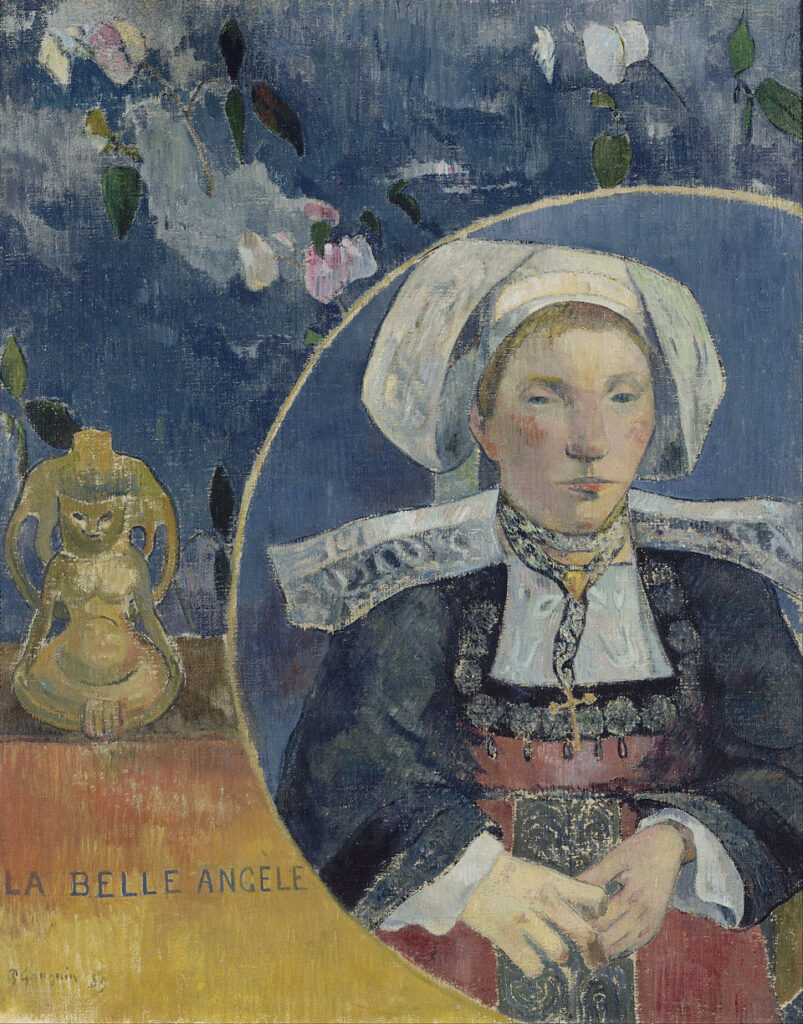
Paul Gauguin — His Art Is Admired, but He Is a Controversial Figure →Pont-Aven, summer 1889. In his studio at the Buvette de la Plage, located in the home of stonemason Marie-Henry, Paul Gauguin was finishing a portrait that he immediately considered one of his finest works. The model is Marie-Angélique Satre, twenty-one years old, one of the three famous innkeepers of Pont-Aven—a small village in the Finistère region of Brittany that has been home to an international colony of artists since the 1860s. She is posed in traditional Breton costume, wearing a white lace headdress, her hands clasped on her knees. Gauguin inscribed her name in capital letters directly on the canvas: “LA BELLE ANGÈLE.”
When the painter showed Angèle the painting, she looked at it for a few moments. Then, in front of the artist, she uttered a phrase that would go down in history:
“How awful!”
And she asks Gauguin to take the painting away. She doesn’t want it.
Two years later, in 1891, Edgar Degas —painter of dancers and absinthe, one of the five greatest living Impressionist painters, and one of the most discerning collectors of French painting—saw the painting in a Parisian art dealer’s studio. He immediately declared it a masterpiece. He bought it on the spot.
This article recounts the extraordinary story of this painting: the circumstances of its creation in Pont-Aven in 1889, the revolutionary Synthetist techniques Gauguin employed in it, the model’s rejection of it, its purchase by Degas, Ambroise Vollard’s donation to the Louvre in 1927, and its current location at the Musée d’Orsay, where it is now one of Gauguin’s most admired works.
Pont-Aven, Summer 1889 — The Maturity of Synthetism
In the summer of 1889, Paul Gauguin was forty-one years old. He had been living in Brittany since February, in the small village of Pont-Aven (population 1,500) and in the nearby hamlet of Le Pouldu, fifteen kilometers south along the coast. This was his third stay in Brittany since 1886.
These years in Brittany marked the height of Gauguin’s artistic maturity. Together with Émile Bernard, a twenty-year-old painter he met in Pont-Aven in 1888, he developed a new style known as Synthetism. Its principles are simple yet radical:
- Simplified forms —no superfluous details; forms reduced to their geometric essence
- Subjective colors —color no longer describes observed reality; it expresses emotion or an idea
- Dark circles under the eyes—each shape is outlined by a distinct border, like in medieval stained-glass windows
- Decorative composition — the arrangement of the canvas takes precedence over perspective depth
- Multiple sources of inspiration —primitive, Japanese, medieval, and folk
During the summer and fall of 1889, Gauguin painted in Pont-Aven and Le Pouldu the most accomplished works of Synthetism: *The Yellow Christ* (now at the Albright-Knox Art Gallery in Buffalo), Hello, Mr. Gauguin (National Gallery, Prague), Breton Women at the Calvary (Ny Carlsberg Glyptotek, Copenhagen), and specifically from this period: The Beautiful Angèle.
Gauguin summarized his artistic vision in a famous letter to his friend Émile Schuffenecker dated 1888, which became his personal manifesto:
“A word of advice: don’t copy too closely from nature; art is an abstraction—draw it from nature by gazing at it dreamily.”
— Paul Gauguin to Émile Schuffenecker, letter from 1888, quoted in the Correspondence edited by Maurice Malingue, 1946
This sentence sheds light on exactly what he would do a year later with *La Belle Angèle*. Not to copy the young hotelier as she appears to him. To distill an abstraction from the model —a portrait that resembles Angèle Satre less than a pictorial idea of Angèle Satre, a synthesis of Brittany rather than an individualized face.
Marie-Angélique Satre, hotelier from Pont-Aven
Marie-Angélique Satre, born on February 6, 1868, in Pont-Aven, was one of the village’s three famous innkeepers. Along with “Mère Gloanec ” (Marie-Jeanne Gloanec, who ran the boarding house where Gauguin had been staying since 1886) and Mademoiselle Julia Guillou (Hôtel des Voyageurs), Marie-Angélique formed the trio of women who enlivened the daily lives of foreign artists in Pont-Aven.
In 1889, at the age of twenty-one, Marie-Angélique had just married Hervé Satre. Together, they ran an inn in Pont-Aven. According to the official entry in the Musée d’Orsay’s database, she “was considered one of the most beautiful women in the country.”
Gauguin had known Angèle well since his first stays in Pont-Aven. He was a regular at her inn. He would chat with her and her husband. He offered several times to paint a portrait of Hervé Satre’s wife. According to Angèle’s own account from 1920 (recorded by the first historians of Gauguin and preserved in the archives of the Musée d’Orsay), Gauguin was at that time “very gentle and very miserable.” He wasn’t selling his paintings. He was living on credit. His wife, Mette, was in Copenhagen with their five children. Hervé Satre eventually agreed to let Gauguin paint his wife’s portrait, as a friendly favor to an artist friend who was down on his luck.
Gauguin began the sitting in the summer of 1889. According to institutional sources, Angèle posed for several days, motionless, in her traditional Breton costume—a white lace headdress, a fichu, and a dark ceremonial dress. The painting took shape.
The Painting — What It Depicts
*La Belle Angèle* is an oil on canvas measuring 92 centimeters high by 73 centimeters wide. It is a vertical format, slightly taller than it is wide. Signed and dated “P. Gauguin 89” in the lower left corner.
The composition is radically original. It is divided into two distinct areas separated by a circular border:
Within the circle, occupying the lower three-quarters of the canvas: a portrait of Angèle. She is depicted from the waist up, dressed in her traditional Breton costume—a white lace headdress standing upright, a white scarf around her neck, and a black dress adorned with buttons and a large white pleated collar. Her hands are folded in her lap. Her face is bathed in light, viewed head-on, and almost motionless. Her eyes look slightly to the side, avoiding the viewer’s gaze.
Outside the circle, occupying the upper quarter and the background: a decorative background rendered entirely like a tapestry or wallpaper. Stylized flowers in green and red on a cobalt blue background fill the space, with no sense of perspective. On the left, a Peruvian-inspired anthropomorphic statuette —a ceramic figure placed at the same level as the model, as if it were engaging in conversation with Angèle.
In the upper left corner, in black capital letters on a blue background: the inscription “LA BELLE ANGÈLE.” This is the title of the painting, written directly on the canvas, like a caption or a dedication. In this way, Gauguin transforms the portrait into a votive object or a poster —a pictorial convention that was entirely unprecedented for a European portrait at the time.
The Japanese-style technique — composition within a circle
The most radical innovation in *La Belle Angèle* is its circular composition. According to the official description from the Musée d’Orsay:
“Using a technique borrowed from Japanese prints, [Gauguin] frames the portrait of Angélique Satre with a circle against a primarily decorative background.”
Japanese ukiyo-e —a school of woodblock prints that reached its peak in the 18th and 19th centuries with Hokusai, Hiroshige, Utamaro — frequently employs this technique: a solitary figure set within a circular or oval frame, placed against a decorative background that has no perspectival relationship to the figure. This allows the subject to be set apart from its surroundings, to be elevated to a monumental scale, and for the background to be treated as a motif in its own right.
Japonism was then at its peak in Paris. Japanese prints had been circulating in all the avant-garde studios since the 1867 World’s Fair. Van Gogh collected and copied Hokusai’s works. Manet, Degas, Whistler, and Monet drew inspiration from them. In May 1888, one year before *La Belle Angèle*,the Paris World’s Fair inaugurated a Japanese pavilion that made a profound impression on Parisian artists.
Gauguin was thoroughly familiar with Japanese tradition. He had seen numerous examples of it among Parisian dealers and among his friends. But with *La Belle Angèle*, he did something unprecedented: he applied the Japanese technique to a traditional European subject —a portrait of a Breton woman in regional costume. It was this cultural transposition that produced the strange and disconcerting effect Angèle would experience in 1889.
Cloisonnism—black outlines around each shape, flat areas of color without gradations—stems from his collaboration with Émile Bernard beginning in 1888. Bernard had theorized it based on medieval stained-glass windows. Gauguin took it to extremes. In *La Belle Angèle*, each form is delineated by a dark line—the outline of the headdress, the shawl, the face, the hands, and the Peruvian statuette. This technique reinforces the flatness of the image, reverses traditional perspective, and brings the portrait closer to Byzantine icons or Gothic stained-glass windows.
The Peruvian Idol — A Childhood Memory
To the left of the portrait, partially obscured by the circle, an anthropomorphic statuette appears at the same level as the model. According to the official entry from the Musée d’Orsay:
“On the left, Gauguin includes an anthropomorphic ceramic figure, inspired by Peruvian art, which reinforces the symbolic nature of the composition and appears as an exotic version of the Breton idol.”
This statuette is not a decorative accessory. It is a pictorial commentary on Angèle. To understand this, one must remember that Gauguin spent his childhood in Peru (1849–1855, from age one to seven). In Lima, at the home of his great-uncle Don Pío de Tristán y Moscoso, he saw collections of pre-Columbian ceramics —figurines from the Moche, Chimú, Inca, and Nazca cultures. These forms—stocky bodies, flat heads, stylized features, and fixed gazes—left a deep imprint on Gauguin’s visual memory.
Throughout his life, he would associate these Peruvian statuettes with the idea of authentic primitivism. In *La Belle Angèle*, he draws a parallel between Angèle’s Breton costume and a Peruvian figurine. The traditional costume of Pont-Aven thus becomes, in Gauguin’s view, the cultural equivalent of a pre-Columbian statuette —both represent forms of pre-industrial, non-modern Western civilization, rooted in an ancestral relationship with the sacred.
That is exactly what Gauguin was looking for in Brittany. He wrote this himself to Schuffenecker in February 1888: “I love Brittany; there I find the wild, the primitive. ” For him, Brittany served as a kind of “Peru close to home” —a place where industrial modernity had not yet wiped everything away, wherethe old world still survived in traditional costumes, religious ceremonies, granite, and headdresses. Angèle Satre, in her ceremonial costume from Pont-Aven, is, in Gauguin’s eyes, a primitive figure on par with a Peruvian statuette. This comparison—which likely did not please the young innkeeper—is central to the painter’s thinking.
“How awful!” — the rejection of the model
When the portrait was completed, in late summer or early fall of 1889, Gauguin summoned Angèle and Hervé Satre to show them the painting. According to the account that Marie-Angélique herself would give around 1920 —that is, thirty-one years after the event, when she was 52 and Gauguin had been dead for 17 years—an account recorded by the first scholars of Gauguin and preserved in the archives of the Musée d’Orsay:
“Gauguin was very gentle and very miserable. He was always telling my husband that he wanted to paint my portrait, so one day he started on it. But when he showed it to me, I told him, ‘It’s horrible!’ and that he could just take it back. Gauguin was very sad and said, quite disappointed, that he had never painted a portrait as well as that one.”
— Marie-Angélique Satre, testimony from around 1920, Musée d’Orsay archives
The rejection is brutal. Angèle doesn’t understand what Gauguin has painted. To her, a portrait is supposed to bear a resemblance —to show her as the young woman she is, with her smile (if she has one), her complexion, and her eyes in their true color. But Gauguin did something entirely different: he painted a rigid, almost hieratic figure against a background of decorative tapestry, next to an incomprehensible pre-Columbian statuette. It doesn’t look like her. It is “horrible” in the literal sense—terrifying to the untrained eye of a young woman from rural Brittany.
According to the Musée d’Orsay’s entry:
“It is hardly surprising that viewers find this portrait difficult to understand. Gauguin, who had decided to ‘dare everything,’ broke with traditional conventions of perspective and spatial unity.”
Marie-Angélique is not an isolated case. The entire Parisian art critics’ community in 1889 would find Gauguin’s Synthetist paintings “horrible,” “monstrous,” and “incomprehensible.” Angèle’s rejection was simply the direct and familiar expression of a rejection that would remain widespread for another ten years. The general public would not come to understand Gauguinuntil after his death in 1903 —beginning with the Vollard retrospectives of 1903 and the major exhibition at the Salon d’Automne in 1906.
Gauguin kept the painting. He took it with him. He kept it in his Paris studio upon his return to Paris in November 1889. It was never sold to Angèle or her husband. But Gauguin remained convinced that it was one of his finest paintings. The only time he contradicted himself was in a letter to Daniel de Monfreid dated February 1898, in which he wrote: “Where Do We Come From? What Are We? Where Are We Going?” — a painting he then considered the only one superior to all his previous works.
1891 — Edgar Degas Recognizes a Masterpiece
Edgar Degas (1834–1917), at age 57, was one of the greatest living French painters in 1891. A founding member of the Impressionist group, he was also one of the most discerning collectors of 19th-century French painting. His personal collection, which was dispersed after his death in 1918, included works by Ingres, Delacroix, Manet, Cézanne, Pissarro, Van Gogh, and Cassatt —the very essence of modern art of his time.
In February 1891, in Paris, Gauguin was preparing for his first trip to Tahiti. He needed money. He put thirty paintings up for public auction at the Hôtel Drouot to finance the trip. The critic Octave Mirbeau published an article in support of the auction in *L’Écho de Paris* on February 16, 1891. The sale on February 23, 1891, brought in 9,860 francs —a considerable and unexpected sum.
Among the paintings sold is *La Belle Angèle*. Edgar Degas purchased it personally. According to several corroborating sources (the Wildenstein catalog, the Musée d’Orsay entry, and the 1989 Grand Palais Gauguin catalog), Degas was immediately struck by the quality of the painting. He considered it a masterpiece.
This historical detail is crucial. Degas, whose conservative taste typically rejected the most radical experiments (he criticized Seurat, would reject Van Gogh, and viewed Gauguin with caution), personally purchased *La Belle Angèle*. The verdict of the greatest Impressionist collector, in a sense, overturned Marie-Angélique Satre’s rejection. The painting was not horrible. It was ahead of its time—including the time of the model it depicted.
Degas kept the painting in his private collection for a few years, then sold it in the early 1900s to Parisian dealers. It subsequently entered the collection of Ambroise Vollard —the legendary Parisian art dealer and longtime patron of Gauguin, Cézanne, and Picasso.
1927 — The Vollard Donation to the Louvre
Ambroise Vollard (1866–1939) was one of the greatest art dealers of the first half of the 20th century. He introduced Cézanne to the whole of France in 1895. He supported Gauguin as early as 1898 by paying him a monthly stipend in exchange for his paintings. He discovered Picasso in 1901. He published the most valuable artists’ books of the century (Rouault, Bonnard, Picasso, Chagall).
Vollard acquired *La Belle Angèle* in the early 20th century, after it left the Degas collection. He kept the painting for more than twenty years in his gallery on Rue Laffitte and later on Rue de Martignac in Paris.
In 1927, at the age of 61, Vollard decided to donate several major works from his collection to the French government. *La Belle Angèle* is one of these works. It entered the Louvre as part of the Vollard donation that year— twenty-four years after Gauguin’s death and thirty-eight years after it was painted in Pont-Aven.
The painting was exhibited at the Musée du Luxembourg (dedicated to contemporary art), then at the Musée des Impressionnistes at the Jeu de Paume in the 1940s and 1950s, and finally at the Musée d’Orsay since the institution opened on December 9, 1986.
Marie-Angélique Satre, the innkeeper who had found her own likeness “horrible” in 1889, died in 1932. She never knew that her portrait—which she had refused to display in her inn— had been added to the Louvre’s collection five years before her death. Nor did she know that it would become one of the most admired works of French painting from the late 19th century.
How to View the Work Today
“La Belle Angèle ” is housed at the Musée d’Orsay in Paris, in the Gauguin Gallery (middle level, room dedicated to the Pont-Aven School and Synthetism). Practical information:
- Address: 1 rue de la Légion d’Honneur, 75007 Paris
- Subway: Solférino (Line 12) or RER C (Musée d’Orsay)
- Reservations recommended: limited time slots, online tickets
- Admission: around €16 for general admission; free for EU residents under 26; free on the first Sunday of every month
- Inventory Number: RF 2617
Other highlights to see on the same day at the Musée d’Orsay:
- Women of Tahiti (1891), Paul Gauguin—first stay in Tahiti
- And the gold of their bodies (1901), Paul Gauguin—late period
- The Meal (The Bananas) (1891), Paul Gauguin — another major Tahitian painting
- Horsemen on the Beach (1902), Paul Gauguin — his last painting of the Marquesas Islands
A one-hour tour of the Musée d’Orsay focused on Gauguin’s artistic career can be planned as follows: La Belle Angèle (Pont-Aven, 1889) → Women of Tahiti (1891) → And the Gold of Their Bodies (1901) → Riders on the Beach (1902). This allows visitors to trace the painter’s entire artistic evolution, from Brittany to the Marquesas Islands.
To get to Pont-Aven: the village still exists, 5 km from Concarneau in Finistère. The inn where Marie-Angélique Satre lived is no longer there, but you can visit the Pont-Aven Museum (https://www.museepontaven.fr), which traces the history of the artists’ colony from 1860 to 1900. The mill where Gauguin painted can still be seen along the Aven River.
Further Reading
Institutional sources cited in this article
- Musée d’Orsay, official entry for *La Belle Angèle*. Inventory number RF 2617. Primary source.
- Wildenstein Plattner Institute, Gauguin: Catalogue Raisonné of the Paintings (1889–1903), Wildenstein Institute. A continuously updated catalogue raisonné.
- Georges Wildenstein, *Gauguin. 1*, Catalog, Paris, Les Beaux-Arts, 1964, no. 315.
- Gauguin the Alchemist, exhibition catalog, Galeries nationales du Grand Palais, 2017–2018, edited by Claire Bernardi and Ophélie Ferlier-Bouat, Réunion des musées nationaux.
- Gauguin, exhibition catalog, National Galleries of the Grand Palais, 1989.
Gauguin’s Primary Sources
- Maurice Malingue (ed.), Letters from Gauguin to His Wife and Friends, Paris, 1946 (multiple reprints).
- Victor Merlhès (ed.), *The Correspondence of Paul Gauguin: Documents and Testimonies*, Paris, 1984.
- Letter from Paul Gauguin to Émile Schuffenecker, August 14, 1888.
Firsthand Account by Angèle Satre
- Testimony by Marie-Angélique Satre, circa 1920, recorded by the first historians of Gauguin and preserved in the archives of the Musée d’Orsay.
Modern Studies
- Françoise Cachin, *Gauguin*, Flammarion, Paris, 1988.
- Daniel Wildenstein (with Sylvie Crussard and Martine Heudron), *Gauguin: A Savage in the Making, Catalogue Raisonné of the Paintings (1873–1888)*, Wildenstein Institute / Skira, 2001–2002.
Institutional Documentation
- Musée d’Orsay, Paris — institution that has owned it since 1986.
See also on Hors Cadre
- Paul Gauguin—His Admired Art, His Controversial Life —A Portrait of the Painter.
- Where do we come from? What are we? Where are we going? — the work a man painted so he could die — Gauguin’s other major work on *Hors Cadre*.
— M