David—Michelangelo’s marble hero
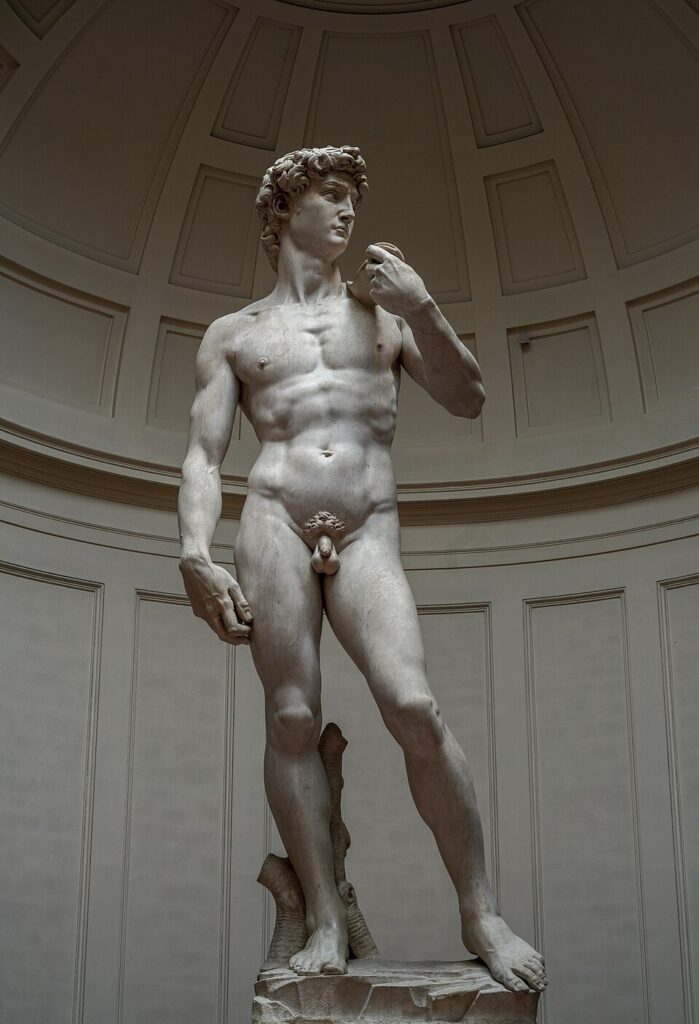
Michelangelo — Power and the Sublime →It stands, colossal and perfect, more than five meters of white marble carved to perfection. A naked young man with a heroic physique stands with a sling over his shoulder, his gaze turned toward the distance, his brow furrowed, his entire being focused in the concentration that precedes battle. This is Michelangelo’s David —one of the world’s most famous sculptures, the symbol of Florence, and one of the absolute pinnacles of all Western art.
Created between 1501 and 1504, when Michelangelo was not yet thirty, the David was born out of a challenge that no one had dared to take on: carving a statue from an enormous block of difficult marble that had been abandoned for decades. From this unyielding material, the young sculptor brought forth a figure of dazzling perfection, commanding everyone’s admiration and cementing his fame. The David established Michelangelo as the foremost sculptor of his time.
The work depicts David, the biblical hero, before his battle against the giant Goliath. But Michelangelo took an original approach: instead of depicting the hero triumphant, brandishing the head of the vanquished giant, as tradition dictated, he shows him in the moment of tension and concentration that precedes the action. This choice gives the statue a psychological intensity and dramatic power that set it apart from all previous depictions. The David is not merely a perfect body: he is an awakened spirit, a will poised for action.
This article explores the secrets of this masterpiece—what it represents, the history of the “cursed block” from which it was carved, the decisive moment that Michelangelo chose to depict, the beauty of the heroic figure, and the symbolic significance of a work that has become the emblem of Florentine freedom.
The Statue: What It Depicts
The David is a colossal marble statue: it stands over five meters tall. Carved from a single block of white Carrara marble, it depicts a naked young man standing in a pose that is both natural and heroic. Its superhuman size and formal perfection make it a work of striking presence.
The young man stands in a posture of subtle balance. His weight rests on one leg, while the other is slightly bent, giving his entire body a slight sway, a supple and lively twist—what is known as contrapposto, a technique inherited from ancient sculpture. One hand hangs at his side, holding a stone; the other, raised toward his shoulder, holds the sling that runs across his back. His head is turned to the left, his gaze directed into the distance, intense and focused. His entire body expresses both apparent calm and inner tension, stillness and the imminence of action.
David’s body is of admirable beauty and perfection. Michelangelo displays his full mastery of anatomy here: the powerful and precise musculature, the veins protruding beneath the skin, the tension and relaxation of the muscles—everything is rendered with astonishing accuracy and vitality. The marble seems to become flesh, so vivid is the modeling. This is the heroic nude in its highest expression—an idealized body yet vibrant with life, possessing both classical beauty and a deeply personal intensity. Here we recognize the mark of Michelangelo’s genius, his unparalleled mastery of the human body.
Certain details catch the attentive observer’s eye. David’s head and hands are slightly larger than natural proportions would suggest. This disproportion is not a mistake—it is intentional. Since the statue was meant to be viewed from below and from a distance, Michelangelo emphasized these parts so that they would retain their expressive power when viewed from that angle. The hands, in particular—powerful and intricately detailed—capture the viewer’s attention and suggest the hero’s strength. These adjustments attest to the sculptor’s intelligence and his concern for the effect the work would have on the viewer. Nothing in the David is left to chance.
The Cursed Block
The story of *David* begins with that of a block of marble—a block said to be cursed, abandoned for decades, which Michelangelo, alone, dared to tackle and transform into a masterpiece. This feat is inextricably linked to the legend of the work.
The block of marble from which the *David* was carved had a long and unfortunate history. Quarried in Carrara decades earlier, it was intended to adorn the Florence Cathedral. But several sculptors had attempted to work on it before giving up, deeming the stone to be of poor quality, too narrow, poorly proportioned, and already marred by clumsy chisel marks. The block, half-hewn and abandoned, had long lain in the cathedral courtyard, like wasted material, a challenge that no one could meet. It was said to be almost impossible to work with.
It was this stubborn block that Michelangelo, with the audacity of a genius, agreed to tackle. The cathedral’s officials, finally seeking to make use of this unused marble, entrusted the task to the young sculptor, whose reputation was on the rise. Michelangelo rose to the challenge. The difficulty was immense: the block, narrow and already partially carved, left no room for error; he had to work around its flaws, its limitations, and its constrained shape. Michelangelo studied the stone at length, conceived his figure according to the block’s constraints, and then set to work with fierce determination, keeping his project secret behind a palisade.
The result astounded Florence. From this block that everyone had deemed a lost cause, Michelangelo had fashioned a statue of dazzling perfection—a vivid, powerful figure that seemed to have always been trapped within the marble, waiting to be set free. This triumph over an unyielding material—this ability to see and bring forth beauty where others had seen only a worthless block—appeared to be a prodigious, almost miraculous feat. It cemented Michelangelo’s genius and gave the David a special aura—that of a masterpiece wrested from the impossible. The legend of the cursed block that became a masterpiece is inseparable from the glory of the work itself.
The Moment Before the Fight
Michelangelo’s genius in *David* lay in choosing a specific and original moment—the one just before the fight—and making it the driving force behind the statue’s entire expression. This choice sets his *David* apart from all previous depictions.
Before Michelangelo, tradition generally depicted David after his victory: the young, triumphant hero, his foot resting on the severed head of the giant Goliath whom he had just vanquished, in an image of glory and triumph. Michelangelo broke with this tradition. He chose to depict David not after, but before the battle—in the moment of tension and concentration that precedes the confrontation. David has not yet thrown his stone; he observes his opponent in the distance, assesses the danger, and gathers his strength and resolve. It is this suspended moment, laden with all that is to come, that Michelangelo captured.
This choice transforms the meaning of the work. Instead of an image of triumph already achieved, Michelangelo creates an image of tension, determination, and will at work. The entire statue expresses this inner state: the intense gaze fixed on the enemy, the brow furrowed in concentration, the body seemingly at rest yet filled with contained tension, ready to spring into action. Beneath the stillness, one senses the imminence of action; beneath the apparent calm, energy ready to burst forth. This psychological tension, this inner life, give the David a rare depth and intensity. It is not merely a beautiful body: it is a being caught up in a dramatic situation, a human will facing danger.
This approach reflects Michelangelo’s new conception of sculpture. For him, a statue should express not only the beauty of the body, but also the life of the soul, inner movements, and the tensions of the mind. By choosing the moment just before the battle, he was able to convey the hero’s concentration, courage, and determination—moral, inner qualities expressed through the body’s posture and facial expression. The David thus becomes a portrait of a state of mind as much as of a body, an image of human will in the face of adversity. It is this psychological depth, combined with formal perfection, that accounts for the work’s unparalleled greatness.
The Heroic Body
The David is one of the most beautiful nudes in the history of art, a pinnacle of the depiction of the heroic human body. In it, Michelangelo achieves a synthesis of classical beauty and his own expressive power.
Michelangelo, who revered the human body and had studied it with unparalleled passion, displays his full anatomical expertise in *David *. The young hero’s body is rendered with astonishing precision and vitality: the powerful, harmonious musculature, the tension in the muscles, the protruding veins, the structure of the bones beneath the skin—everything attests to an intimate knowledge of the human body. But this anatomical accuracy is never cold or mechanical: it serves life, expression, and beauty. David’s body radiates extraordinary energy and presence; it seems alive, animated by an inner breath.
This depiction is rooted in the legacy of antiquity, which Michelangelo admired and had studied at length. The heroic nude, the idealized body, virile beauty, and colossal stature evoke the statues of the gods and heroes of ancient Greece and Rome. Michelangelo revives this ancient ideal of physical beauty, while at the same time transcending it. For his David is not a mere imitation of antiquity: he adds to it an intensity, a tension, and a psychological depth that are unique to his genius. David’s heroic body thus unites the serene perfection of the ancients with Michelangelo’s dramatic power.
In Michelangelo’s work, the nude is never gratuitous: it is a vehicle for expression, a means of conveying the greatness of humankind. By depicting David nude, in all the beauty and strength of his body, Michelangelo celebrates the dignity, nobility, and power of the human being. The body becomes an expression of the soul, of will, and of courage. This is one of Michelangelo’s greatest contributions to art: making the human body—exalted and idealized—the vehicle for the highest moral and spiritual meanings. Through its beauty and power, the David embodies this ideal of the heroic man, worthy of the gods—an image of human greatness brought to perfection.
The Symbol of Florence
Beyond its beauty, the *David* immediately took on major political and civic significance: it became a symbol of Florence, of its freedom, and of its resistance to those in power. This symbolic dimension is essential to understanding the work.
In Michelangelo’s time, Florence was a proud republic, fiercely protective of its independence, which was often threatened by powers greater than itself—princes, kings, and emperors. In the young David facing the giant Goliath, the Florentines recognized a reflection of their own situation: that of a relatively small but courageous and determined city, standing up to the giants that threatened it. David, the weak who triumphs over the strong through courage, skill, and the justice of his cause, became the emblem of the Florentine Republic and its freedom. The statue thus took on political significance, serving as a symbol of civic virtue and the defense of liberty.
That is why city officials decided to place the David not on the cathedral, as originally planned, but in Piazza della Signoria, in front of the Palazzo Vecchio, the seat of government—the political heart of Florence. Placed in this highly symbolic location, the David became the guardian of the city, the emblem of its freedom, and a warning to all who might threaten the republic. His gaze, directed in a certain direction, was even said by some to be turned toward Rome, from where threats might come. The statue was no longer merely a work of art: it was a political manifesto, a symbol of Florence’s identity and values.
This symbolic dimension contributed to the David’s immediate fame and its status as an emblem of the city. The Florentines identified with this figure of courage and freedom, which embodied their civic ideal. Even today, the David remains inseparable from the image of Florence, of which it is one of the most famous symbols. A copy still stands in its original location, in Piazza della Signoria, while the original is carefully preserved in the museum. Thus, five centuries later, David remains Florence’s marble hero, the embodiment of its pride and freedom—a masterpiece where beauty and meaning, art and the city, come together.
How to View the Work Today
Michelangelo’s original *David* is housed at the Galleria dell’Accademia—the Academy Gallery—in Florence, Italy, where it was moved in the 19th century to protect it from the elements and damage. It is displayed there as the museum’s crown jewel.
Seeing the David in person is a striking experience. The statue, situated at the end of a gallery beneath a dome that bathes it in light, commands attention with its colossal size and perfection. Visitors can walk around it, appreciate its sculptural form from every angle, and take in its power and beauty. The emotion of standing before this masterpiece—whose image we know from countless reproductions—is profound: the presence of the original, its size, the quality of the marble, and the life that animates the figure surpass anything that reproductions can convey. The gallery also houses Michelangelo’s unfinished Slaves, in which the figures seem to emerge from the raw marble—a fascinating complement to the experience of discovering the David.
A copy of the David still stands outdoors in Piazza della Signoria, on the spot where the original was installed, allowing visitors to imagine the effect the statue made in its original setting. To continue exploring Michelangelo’s work, Florence offers many other treasures—the Medici tombs, in particular—and Rome allows visitors to admire the ceiling of the Sistine Chapel and the Pietà. From Florence to Rome, you can thus trace the journey of this titan of the Renaissance and appreciate the full extent of his genius.
Further Reading
Institutional sources cited
- Galleria dell’Accademia, Florence, description of the David.
- Giorgio Vasari, *The Lives of the Most Excellent Painters* (1568).
Sources and Reference Studies
- Antonio Forcellino, Michelangelo: A Restless Life.
- Documentation from the Galleria dell’Accademia on the restoration of the David.
Institutional Documentation
- Galleria dell’Accademia, Florence — the institution that houses the work.
See also on Hors Cadre
- Michelangelo—Power and the Sublime —A Portrait of the Artist, His Life, and His Art.
- Leonardo da Vinci—the universal genius —Michelangelo’s great Florentine rival.
- Raphael—grace and harmony —the third giant of the High Renaissance.
— M