Van Gogh’s Irises — a garden in the first days at the asylum
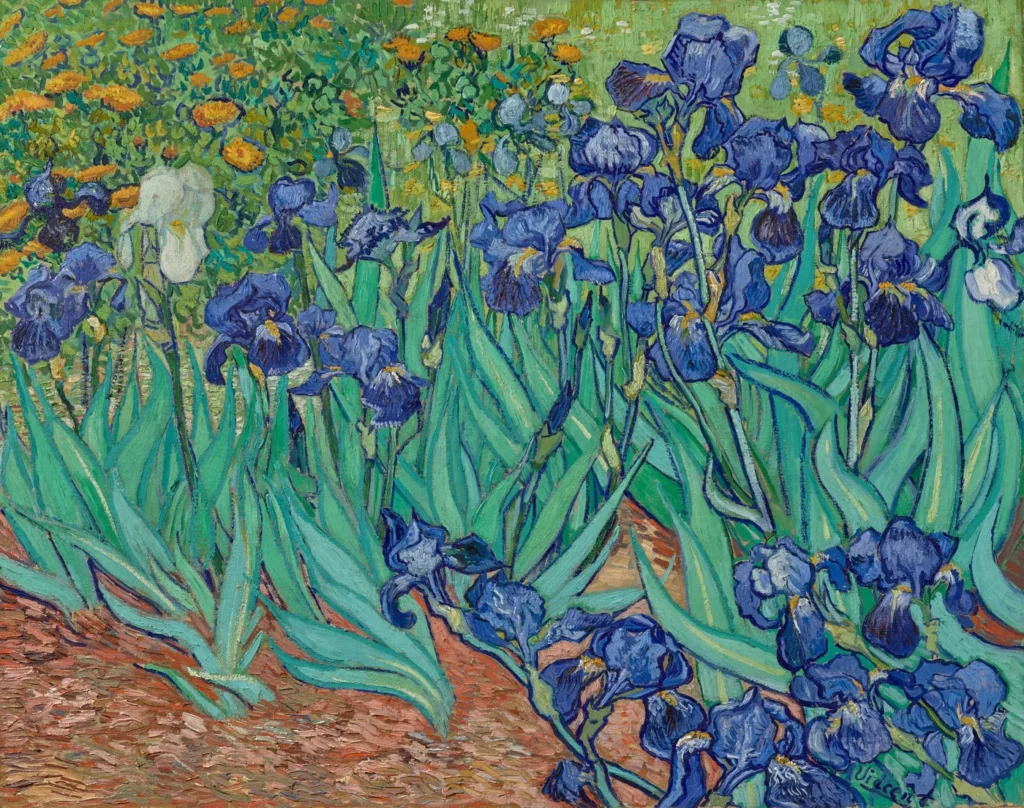
Vincent van Gogh — the artist who wrote as much as he painted →A wave of blue flowers surges across the full width of the canvas. Long leaves, sharp as blades, cross and tangle; petals twist, unfurl, droop. Along the top, a bed of orange blooms; along the bottom, the red earth of the garden. And on the left, alone among the crowd of blue, a single white iris.
Vincent van Gogh painted it in May 1889, in the garden of the Saint-Paul-de-Mausole asylum at Saint-Rémy-de-Provence, where he had just committed himself. It is one of his very first canvases there, and one of his calmest.
A century later, Van Gogh’s irises would become the most expensive painting ever sold at auction. Today it hangs at the Getty Center, high in the hills above Los Angeles.
Saint-Rémy, May 1889
The winter had been brutal. In late December 1888, in Arles, after a violent quarrel with Gauguin, Van Gogh cut off part of his ear. Several hospital stays followed, then a petition from neighbors against him, and growing isolation. In the spring he chose to enter the asylum at Saint-Rémy, a former monastery at the foot of the Alpilles hills.
The director, Dr. Peyron, allowed him to paint in the institution’s walled garden, and Van Gogh got to work at once. In a letter to his brother Theo written right after he arrived, he reported two canvases already under way: a lilac bush and some “violet irises.” The lilacs are now in the Hermitage in St. Petersburg; the irises ended up in California.
He added that the other patients came to watch him work. A few weeks later he wrote that life went on mostly in the garden, so it was “not so sad.”
The violet that faded
What we see today is not quite what Van Gogh painted. He called them violet irises, and the Getty’s technical studies confirm it: to mix that violet, he combined blue with a red called geranium lake, a fragile pigment that fades in light.
Over time most of the red has disappeared, and the flowers have shifted to blue. Other passages have lost their brilliance too: some dull browns were once a vivid orange.
The painting, then, was even more strongly contrasted when it left the easel. Getty curator Scott Allan points to its “play of complementaries”: violet against yellow, orange against blue, the red of the soil against the green of the leaves.
A painting with no sky
Van Gogh planted himself right up against the flower bed, almost at ground level, and kept nothing else. No sky, no horizon, no wall or path: the flowers spill out on every side, cropped by the edges of the canvas, as if the frame could not hold them.
The composition reads in three bands. At the bottom, red earth, combed with parallel strokes; in the middle, the mass of leaves and flowers; at the top, a green ground dotted with orange blooms. The leaves tie it all together, each one laid down in a single thick stroke and outlined in a darker line.
That tight framing, which owes a great deal to the Japanese prints he collected, gives the canvas a rare decorative force. No preparatory drawings are known, and Van Gogh himself thought of the picture as no more than a study.
One white flower
On the left, one bloom stands apart from all the rest. The only white iris among dozens of blue ones, it holds itself slightly aside, gently bowed. It catches the eye at first glance, and you find it again every time you return to the canvas.
Many viewers have read it as a self-portrait: the artist, different, isolated among his fellows, in an asylum he has only just entered. Nothing in Van Gogh’s letters confirms that reading. But it says something about how this seemingly bright and peaceful picture has been looked at for more than a century.
Paris, September 1889
Theo chose Irises for the Salon des Indépendants in Paris in September 1889, alongside Starry Night over the Rhône, now at the Musée d’Orsay. Vincent stayed behind in Saint-Rémy and never saw the installation.
On September 5, Theo wrote to his brother that the picture was “a beautiful study full of air and life.” The critic Félix Fénéon noticed it as well: in the review La Vogue, he described irises whose violet petals tear themselves apart on sword-shaped leaves.
Less than a year later, in July 1890, Van Gogh died at Auvers-sur-Oise.
Mirbeau, Payson, Bond, the Getty
Irises was among the first of Van Gogh’s paintings to find a buyer after his death. In 1892 the writer and critic Octave Mirbeau bought it from the color merchant Julien Tanguy, known as Père Tanguy. Monet, seeing Mirbeau’s Van Goghs, is said to have wondered how a man who had loved flowers and light so much could have been so unhappy.
The couturier and collector Jacques Doucet acquired it in 1925, and the New York heiress Joan Whitney Payson in 1947. In November 1987 her heirs consigned it to Sotheby’s in New York. The Australian businessman Alan Bond won it for about $54 million, a world record at the time, but he could not pay, and the auction house remained tied to the ownership.
In 1990 the J. Paul Getty Museum bought it privately, for a sum that was never disclosed. It has been the museum’s signature painting ever since.
Van Gogh’s Irises at the Getty Center
The painting belongs to the J. Paul Getty Museum, at the Getty Center in Los Angeles. The canvas measures 29 1/4 by 37 1/8 inches (74.3 × 94.3 cm), and the paint is laid on so thickly that the ridges of each stroke catch the gallery light.
Admission is free, with a timed reservation. Galleries sometimes change, so the GettyGuide app shows where the painting hangs on the day of your visit. The Getty also shares a high-resolution image through its Open Content Program.
Further Reading
Institutional Documentation
- Irises — J. Paul Getty Museum — the museum’s record, starting point for its “A Closer Look” study.
- Photo Credit : Getty Center Los Angeles
See also on Hors Cadre
- The Getty Center in Los Angeles — what to see, hours, reservations — the tram, reservations, the gardens, and the paintings not to miss.
- Vincent van Gogh — the artist who wrote as much as he painted — his life, from Holland to Auvers-sur-Oise, told through his letters.
— M