The Metropolitan Museum of Art — what to see, hours, tickets
The story begins in Paris. In 1866 a group of Americans gathered in the French capital agreed it was time to give the United States a “national institution and gallery of art.” Four years later, on April 13, 1870, the Metropolitan Museum of Art was incorporated in New York. Its first acquisition would be a Roman sarcophagus.
A century and a half later, the Met has become one of the greatest museums in the world. Its main building on the edge of Central Park covers some two million square feet and gathers five thousand years of art from every continent: Egyptian temples and samurai armor, Dutch masters and Impressionists, musical instruments, costumes, photographs. In fiscal year 2025 it welcomed more than 5.7 million visitors.
For a visitor coming from Paris, the Met holds another surprise: a good part of the story of European art can be told here as well as in the Louvre. The first Vermeer to enter an American collection hangs here, as do David’s The Death of Socrates and the portrait that scandalized the 1884 Paris Salon, Madame X.
The Met at a glance
| Address | 1000 Fifth Avenue, New York, NY 10028 (at 82nd Street) |
| Subway | 4, 5 or 6 train to 86th Street, then about a 10-minute walk west |
| Hours | Sunday, Monday, Tuesday and Thursday: 10 am–5 pm; Friday and Saturday: 10 am–9 pm |
| Closed | Wednesdays, plus Thanksgiving Day, December 25, January 1 and the first Monday in May |
| Adults | 30 $ |
| Reduced | $22 (seniors 65 and over); $17 (students) |
| Free admission | Children 12 and under, members; pay-what-you-wish for New York State residents and New York, New Jersey and Connecticut students |
| Official Website | metmuseum.org |
A ticket covers same-day entry to The Met Fifth Avenue, its exhibitions, and The Met Cloisters, the museum’s branch devoted to medieval art in northern Manhattan. Advance booking is not required, but a ticket bought online lets you walk straight in at any entrance.
From Paris to Fifth Avenue
The Met’s founders had neither a building nor a collection. The museum first opened in the Dodworth Building on Fifth Avenue, then moved briefly to a mansion on West 14th Street. As early as 1871, 174 European paintings entered its collection.
On March 30, 1880, the Met opened its first building on its current site at the edge of Central Park. That original Gothic Revival structure, designed by Calvert Vaux and Jacob Wrey Mould, has been swallowed up by later additions: its west facade can still be seen today inside the Robert Lehman Wing.
The monumental facade on Fifth Avenue came later. Designed in the Beaux-Arts style by Richard Morris Hunt, an architect trained in Paris, it opened along with the Great Hall in December 1902. The great glass-walled wings around it are the work of Kevin Roche John Dinkeloo and Associates, whose master plan, approved in 1971, was completed in 1991: the Robert Lehman Wing, the Temple of Dendur wing, the American Wing, the Michael C. Rockefeller Wing.
The museum has never stopped changing. In 1938 it opened The Met Cloisters in Fort Tryon Park, thanks to John D. Rockefeller Jr. More recently, on May 31, 2025, the Michael C. Rockefeller Wing, devoted to the arts of Africa, the Ancient Americas and Oceania, reopened after a sweeping renovation.
Must-See Works
The Met is far too big to see in a day. The nine works below, spread across the museum, make for a coherent route from ancient Egypt to nineteenth-century America. Gallery numbers are given as a guide: installations change, and the museum’s interactive map lets you check where each work is on the day of your visit.
1. The Temple of Dendur (about 15 B.C.)
An entire Egyptian temple in sandstone, set in a vast glass-walled hall overlooking Central Park: it is the Met’s most spectacular sight. Built under the Roman emperor Augustus in Nubia, on the banks of the Nile, it honors the goddess Isis and two deified sons of a local ruler. Threatened by the lake created by the Aswan High Dam, it was given by Egypt to the United States in 1965, in thanks for American help in rescuing Nubian monuments, and awarded to the Met in 1967. An entire wing was built to house it. Gallery 131.
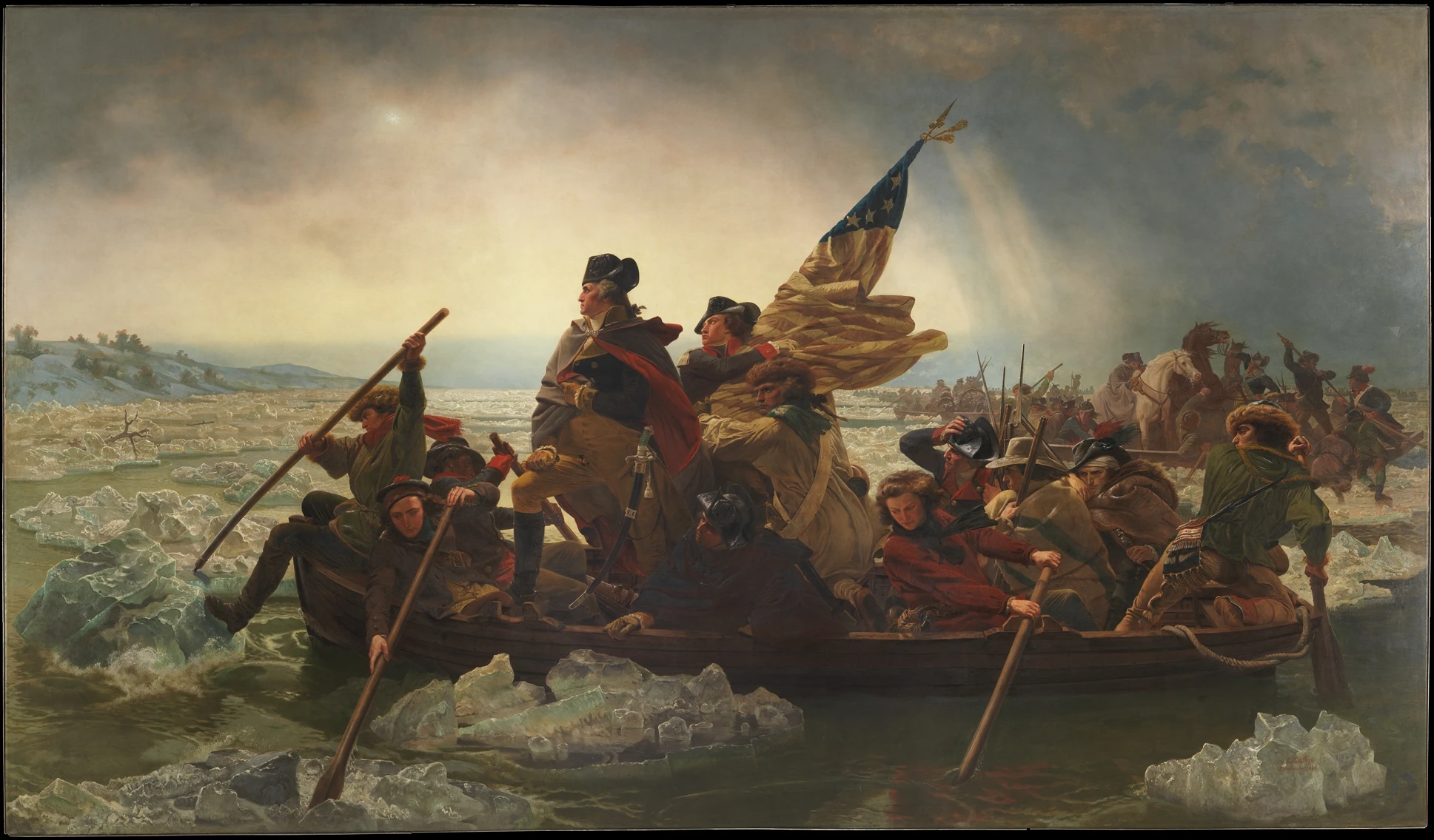
2. Washington Crossing the Delaware, Emanuel Leutze (1851)
More than twelve feet high and twenty-one feet wide, the American Wing’s most famous painting shows George Washington standing in a boat, crossing the ice-choked Delaware River on Christmas night 1776, before the victory at Trenton. Its painter, Emanuel Leutze, was born in Germany and raised in the United States before returning to Düsseldorf, where he painted this image that became a national icon. The picture was given to the Met in 1897. Gallery 760.
3. Young Woman with a Water Pitcher, Johannes Vermeer (about 1662)
A young woman opens a window with one hand and holds a pitcher resting on a silver basin with the other. All of Vermeer’s magic is here: a cool, soft light, blue reflections on metal, a suspended moment. Given in 1889 by Henry G. Marquand, it was the first painting by Vermeer to enter an American collection. It measures just 18 by 16 inches. Gallery 614.
4. Aristotle with a Bust of Homer, Rembrandt (1653)
The philosopher, dressed in black with a broad golden sleeve, rests his hand on a bust of Homer, while a gold chain carries a portrait of Alexander the Great, his pupil. Three figures, three ideas of fame. Rembrandt painted the canvas for a Sicilian nobleman, Antonio Ruffo, who had it shipped from Amsterdam to Messina in 1654. The Met’s purchase of it in 1961 was a major event. Gallery 616.
5. The Harvesters, Pieter Bruegel the Elder (1565)
Peasants nap in the shade of a pear tree while others cut a field of blazing yellow wheat, and the landscape stretches all the way to the sea. The painting belonged to a six-part cycle of the seasons commissioned by an Antwerp merchant for the dining room of his country house. The Met acquired it in 1919, at a very low price, on an art market that had collapsed during World War I. Gallery 638.
6. The Death of Socrates, Jacques-Louis David (1787)
Condemned to drink hemlock, Socrates reaches for the cup without ceasing to teach, his finger raised to the sky, while his disciples collapse around him. Two years before the French Revolution, David delivered a manifesto of Neoclassicism: a frieze-like composition, crisp light, a lesson in moral courage. The painting entered the Met in 1931. Gallery 634.
7. Wheat Field with Cypresses, Vincent van Gogh (1889)
Painted at Saint-Rémy-de-Provence in the summer of 1889, this windswept wheat field, dominated by a dark cypress beneath a sky of swirling clouds, is one of the landscapes Van Gogh considered among his best of that summer. He sent drawings of it to his brother Theo on July 2, then painted two more versions in the studio, one of which is in the National Gallery in London. Gallery 822.
8. Madame X, John Singer Sargent (1883-84)
The portrait of Virginie Gautreau, an American in Paris, in a low-cut black gown, caused a scandal at the 1884 Salon; soon afterward Sargent settled in London. He kept the picture for more than thirty years before selling it to the Met in 1916. Today it is one of the stars of the American Wing. Gallery 771.
9. The Gulf Stream, Winslow Homer (1899)
A lone sailor on a dismasted boat, sharks circling, a waterspout on the horizon: Homer’s great canvas is one of the most debated images in American art. The Met bought it in 1906, in the painter’s lifetime, a rare consecration. Gallery 767.
How to visit the Met
How long does it take to visit the Met?
Allow at least three to four hours for the route above, and several days for an overview of the whole museum. It is best to choose two or three departments and accept leaving the rest for another visit.
When is the best time to avoid the crowds?
Mornings, right at the 10 am opening, and Friday and Saturday evenings, until 9 pm, are usually the quietest times.
What day is the Met closed?
The museum is closed every Wednesday, a classic trap for visitors in town for only a few days, as well as on Thanksgiving Day, December 25, January 1 and the first Monday in May.
Is the Met free?
No, except for children 12 and under. An adult ticket costs $30. Pay-what-you-wish, often mentioned in guidebooks, applies only to New York State residents and to New York, New Jersey and Connecticut students, with proof: out-of-state visitors pay full price. The ticket includes exhibitions and same-day entry to The Met Cloisters.
Is The Met Cloisters worth a visit?
For lovers of medieval art, yes. Set in Fort Tryon Park in northern Manhattan, it gathers about two thousand European works in a setting of cloisters and chapels rebuilt stone by stone. Half a day is enough, ideally on a different day from your main visit.
Are there guided tours?
The museum offers free tours led by art experts, and a free digital guide on the Bloomberg Connects app.
Is the Met wheelchair accessible?
Yes. Step-free entrances are at 81st Street and Fifth Avenue, and through the parking garage at 80th Street. Wheelchairs are available free of charge at the 81st Street entrance, first come, first served.
Where can you eat at the Met?
The museum has several cafés and restaurants, listed with current hours on its website.
Around the Museum
The Met is the anchor of Museum Mile, the stretch of Fifth Avenue along Central Park lined with major museums. Heading north, you reach in a few minutes the Neue Galerie, devoted to early twentieth-century German and Austrian art, then the Guggenheim and its famous spiral ramp by Frank Lloyd Wright.
To the south, the Frick Collection shows old masters in the former mansion of the industrialist Henry Clay Frick. And right behind the museum, Central Park offers the best possible break after hours of looking: the Great Lawn and Belvedere Castle are a few minutes’ walk away.
Further Reading
Institutional Documentation
- Plan Your Visit — The Metropolitan Museum of Art — current hours, admission and directions.
- History of The Met — The Metropolitan Museum of Art — the museum’s history told by the institution.
- Photo Credit : Metroplitan Museum of Art
See also on Hors Cadre
- Madame X — John Singer Sargent’s scandal — the story of the portrait that drove Sargent out of Paris.
- The Gulf Stream — Winslow Homer’s lone man at sea — the most debated painting in the American Wing.
— M