The Peacock Room — Whistler’s peacock
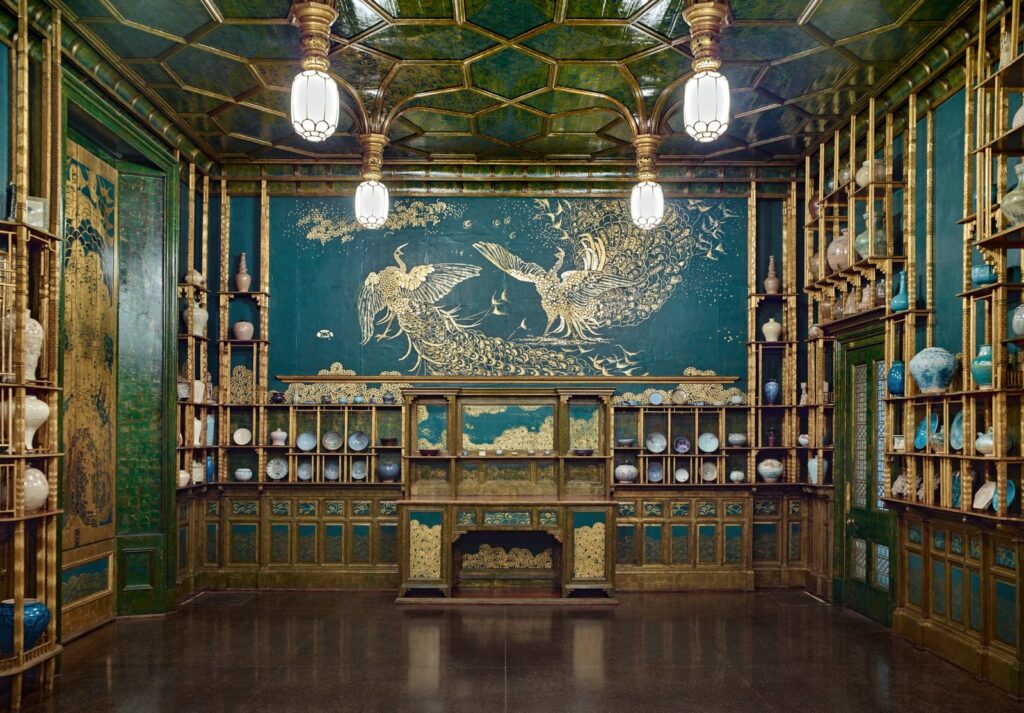
James McNeill Whistler — the American who painted like a composer →You step into a room that is dark and yet glittering. The walls, a deep Prussian blue, are lined with dozens of gilded shelves, delicate as lace, holding vases and dishes of porcelain. Overhead, patterns of peacock feathers gleam in the half-light. On the shutters, great golden peacocks spread their tails. Above the fireplace, a young woman in a kimono gazes out over the room. And on the opposite wall, two peacocks face off, ready to fight.
This is not a painting but an entire room: the former dining room of a Liverpool shipowner in London, which James McNeill Whistler transformed in 1876 and 1877 into a total work of art. He gave it a musical title, Harmony in Blue and Gold: The Peacock Room.
It is also the story of a feud, of revenge painted on a wall, and of a long journey. Taken apart, shipped across the ocean, reassembled in Detroit and then in Washington, the Peacock Room is today one of the treasures of the Freer Gallery of Art on the National Mall.
A dining room for porcelain
It all begins with Frederick Richards Leyland, a wealthy Liverpool shipowner and Whistler’s leading patron. In 1869 he bought a house in London, at 49 Princes Gate, and set about decorating it.
Leyland collected Chinese blue-and-white porcelain, mostly from the Kangxi era (1662-1722). The fashion was so widespread in London that the popular press called it “Chinamania.” To display his collection, Leyland turned to the architect Thomas Jeckyll, who designed for the dining room an intricate lattice of walnut shelving. The walls were hung with antique Dutch gilt leather decorated with roses.
The decor, precious and ornate, was conceived as a setting for the porcelain. It was never meant to become famous.
The princess above the fireplace
Above the fireplace Leyland had hung a picture he bought from Whistler around 1872: The Princess from the Land of Porcelain, painted between 1863 and 1865. The model, Christina Spartali, poses in a kimono, a fan in her hand, before a screen.
Whistler felt the room’s colors clashed with those of his painting. When Jeckyll fell ill and had to abandon the project in 1876, and the architect asked his advice on painting the shutters and doors, Whistler seized the opportunity. Leyland was away from London. The painter went to work.
“The gorgeous surprise”
What was meant to be a touch-up became a complete transformation. Whistler began by retouching the roses on the leather in yellow. Then he added a wave pattern, covered the ceiling with imitation gold leaf and a peacock-feather design, gilded Jeckyll’s shelving, and painted great peacocks on the inside panels of the shutters. To imitate the sheen of Japanese lacquer, he laid transparent green glazes over the gold.
He came to think of the room as a painting in three dimensions. Every surface, every molding, every shelf now played its part in a single harmony of color.
When Leyland returned, he found a room he had never ordered. He refused to pay in full for what the museum calls “the gorgeous surprise.” Whistler asked for two thousand guineas; he received only half.
Art and Money
Whistler’s answer was a work of art. He covered the precious gilt leather with Prussian blue, sacrificing the original decor, and on the wall facing the Princess he painted two peacocks squaring off.
No one could miss the meaning. The furious bird on the right wears silver throat feathers that recall Leyland’s white ruffled shirts. The calmer bird on the left sports a silver crest feather, like the white forelock that was Whistler’s trademark. The painter titled the scene Art and Money; or, The Story of the Room.
The break between the two men was final. Jeckyll never recovered from his illness and died in 1881. As for the room, it stayed at Princes Gate until Leyland’s death in 1892.
A lady of extraordinary changeableness
After Leyland died, the Princess was sold to a Glasgow dealer, and in 1894 the house passed to Blanche Watney. The porcelain collection did not go with the sale.
In 1903 the American industrialist Charles Lang Freer, Whistler’s friend and great collector, bought The Princess from the Land of Porcelain. The following year Mrs. Watney decided to part with the room. She changed her mind so often that the dealers handling the sale, Obach & Co., described her as “a lady of extraordinary changeableness.” The final offer came to 8,500 guineas, dismantling and packing included, and the sale to Freer was concluded on May 16, 1904. Whistler had died the previous summer.
Freer admitted he bought it partly out of a sense of duty to his old friend. He built an addition to his house in Detroit, at 33 Ferry Avenue, to reassemble it. He did not fill it with Leyland’s blue-and-white porcelain but with more than 250 ceramics in green and gray glazes from China, Japan, Korea, Iran and Syria — a way of setting Whistler’s art in conversation with the art of Asia.
Washington, the most visited gallery
Under a deed of gift signed as early as 1906, Freer had given his collections to the Smithsonian Institution. After his death in 1919, the Peacock Room was dismantled once more and installed in the new Freer Gallery of Art, whose doors opened in 1923. Live peacocks were even kept for a time in the museum’s courtyard, and the room became its most visited gallery.
Renovated notably in 1947, it has seen its shelves change contents several times, between blue-and-white porcelain as in Leyland’s day and the ceramics Freer chose. Today it is presented under the title The Peacock Room in Blue and White.
Look up
Inside the room, the eye does not know at first where to settle. Three things are worth pausing over.
First, the ceiling: under the imitation gold leaf, the peacock-feather design runs between the light fixtures Jeckyll designed. Then the shelving: the walnut lattice built for Leyland’s porcelain, which Whistler covered in gold, remains the backbone of the whole room.
Finally, the face-off. On one side, above the fireplace, the Princess, the picture with which it all began. On the other, the two rival peacocks, with which it all ended. Between those two walls the room’s entire story can be read.
Where to see the painting
The Peacock Room is at the Freer Gallery of Art on the National Mall in Washington, in Gallery 12 of the West Building. Together with the neighboring Sackler Gallery, the Freer forms the Smithsonian’s National Museum of Asian Art, and admission is free.
The room measures about 13 feet 10 inches high, 20 feet 1 inch wide and 33 feet 8 inches long (421.6 × 613.4 × 1026.2 cm). Its most famous scene, the two peacocks of Art and Money, fills the wall opposite the fireplace and the Princess, which still hangs where Whistler meant it to.
The Smithsonian releases images of the room under a CC0 license, free to reuse.
Further Reading
Institutional Documentation
- Harmony in Blue and Gold: The Peacock Room — National Museum of Asian Art, Smithsonian — the object record and open access images.
- Making the Peacock Room — National Museum of Asian Art — the museum’s account of how the room was created.
- Photo Credit : Freer Gallery of Art (Smithsonian)
See also on Hors Cadre
- James McNeill Whistler — the American who painted like a composer — a portrait of the painter, from Lowell to Paris.
- Whistler’s Nocturnes — painting the night — the night pictures that landed Whistler in court against Ruskin, right after the Peacock Room.
— M