The Disrobing of Christ — El Greco’s Espolio
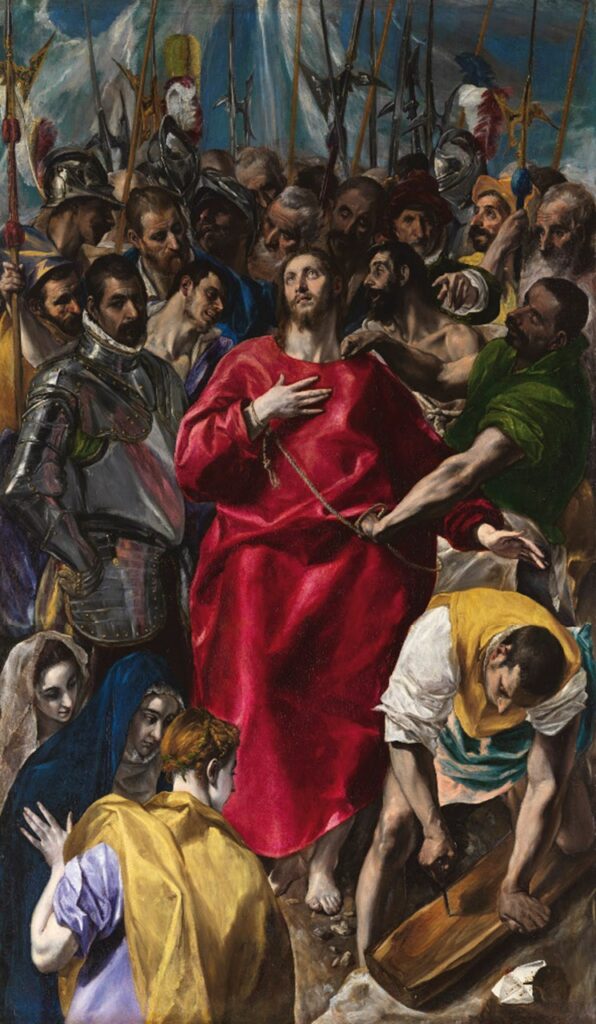
El Greco — the Visionary of Toledo →A compact mass of faces and weapons presses in around a single patch of colour: Christ’s red robe, blazing in the surrounding shadow. Bodies touch, eyes converge, one executioner pulls at the cloth while another bores a hole in the wood of the cross. And at the centre of the scrum, Christ lifts his eyes with complete serenity, as though none of it reached him. The Disrobing of Christ — El Espolio, as it is known in Spain — is El Greco’s first great Spanish painting, and one of his most powerful.
It is also the work with which everything begins. The document recording the commission, dated 2 July 1577, is the earliest trace of the painter’s presence in Spain. He had just arrived in Toledo, and it was through the friendship formed in Rome with Luis de Castilla, son of the dean of the cathedral chapter, that he obtained this prestigious job: a large painting for the cathedral sacristy, completed in the spring of 1579.
The work immediately earned him a memorable quarrel with the chapter, which contested his price and reproached him with two liberties taken with the text of the Gospels. El Greco lost the argument over money, but conceded nothing about the painting: the disputed figures are still there, four and a half centuries later, in the same place.
This article looks at the commission and the dispute, describes the unusual construction of this painting without depth, explains the place it occupies in the painter’s career, and says how to see it in Toledo.
The first Spanish commission
When El Greco reached Toledo in the spring of 1577, he was a painter of thirty-six with no Spanish reputation, an Italian career behind him and no commission in hand. He had to establish himself quickly, and in the most demanding city in Spain where religious art was concerned.
His network did the rest. In Rome the painter had become close to Luis de Castilla, whose father, Diego de Castilla, was dean of the cathedral chapter of Toledo. That friendship opened two major projects to him almost simultaneously: the altarpiece of the church of Santo Domingo el Antiguo and this large painting destined for the cathedral sacristy, the institutional heart of Spanish Catholicism. For a newcomer, it was a spectacular entrance.
The chosen subject was not the most common one. Rather than a Crucifixion or a Deposition, the chapter commissioned the episode of the disrobing: the moment on Golgotha when the soldiers strip Christ of his tunic before nailing him to the cross. A moment of pure humiliation, without the usual pathos of the Passion, which required the painter to make both the brutality of the crowd and the solitude of its victim perceptible.
El Greco worked for nearly two years on this canvas of 285 by 173 centimetres, a vertical format that would determine the whole approach to the composition. The result resembled nothing Toledo had seen before, and his patrons noticed.
A painting without space
The first thing that strikes a viewer before the Espolio is the sense of suffocation. There is no air in this painting, almost no ground, no horizon: nothing but a wall of bodies pressed against one another, filling the whole surface right to the edge.
El Greco deliberately suppressed depth. The figures are stacked vertically rather than distributed through a measurable space, the heads align into a continuous mass, halberds and weapons streak the background. The compression produces an immediate physical effect: you feel the pressure of the crowd on Christ before you have worked out the subject. Where an Italian Renaissance painter would have built a clear scene in a measurable setting, El Greco chose saturation.
In the middle of that dark grey mass, Christ’s red robe bursts out like a wound. It is the only unmixed chord in the canvas, and everything leads back to it. The painter placed it precisely at the centre, at eye level, and painted it in a vibrant, glaze-laden paint inherited from his Venetian years. Nothing competes with that colour, which makes the garment about to be torn away the painting’s true subject.
The faces around it form a repertory of expressions. The executioner in green holding the rope, the man in yellow boring into the wood of the cross with a carpenter’s diligence, the helmeted soldiers, the eyes fixed on Christ or turned away: El Greco paints the banality of violence, the professional indifference of those carrying it out. Christ looks at none of them. Eyes raised, hands open, he is already elsewhere, and that dissociation between the tumult and his calm is the work’s real spiritual subject.
The dispute with the chapter
When the painting was delivered in 1579, admiration was not the chapter’s first reaction. What followed is one of the best-documented episodes in the painter’s career.
The dispute was first of all about money. The appraiser appointed by El Greco valued the painting at 950 ducats; the chapter refused that valuation and, at the end of the arbitration, the painter received only 350. It was a clear defeat, and it foreshadowed others: El Greco spent a good part of his Spanish life in litigation to be paid for his work, convinced — rightly — that it was not being paid what it was worth.
But the chapter also raised two properly iconographic objections, revealing of the Counter-Reformation climate. The painter was reproached for placing the heads of the tormentors higher than Christ’s, which offended decorum, and for including the three Marys in the foreground, whom the Gospels do not mention in this scene. After the Council of Trent, accuracy in sacred subjects had become a serious matter.
El Greco changed nothing. He absorbed the financial loss, kept his figures, and time has vindicated him: the contested heads and the three Marys are still there, and no one today would imagine the painting otherwise. That refusal to correct says a great deal about his character — the same pride that cost him Philip II’s favour allowed him to remain entirely himself.
A composition that became a model
The paradox of the affair is that the contested work immediately became one of the painter’s greatest successes, to the point of forming a substantial part of his workshop’s activity.
More than seventeen versions and variants of the Espolio are recorded today, including two reduced paintings generally attributed to El Greco’s own hand, and further examples in Lyon, Oslo, Munich and England. A composition repeated that often is a composition that pleased: patrons in Toledo and across Spain wanted in their own homes the image the chapter had received with reservations.
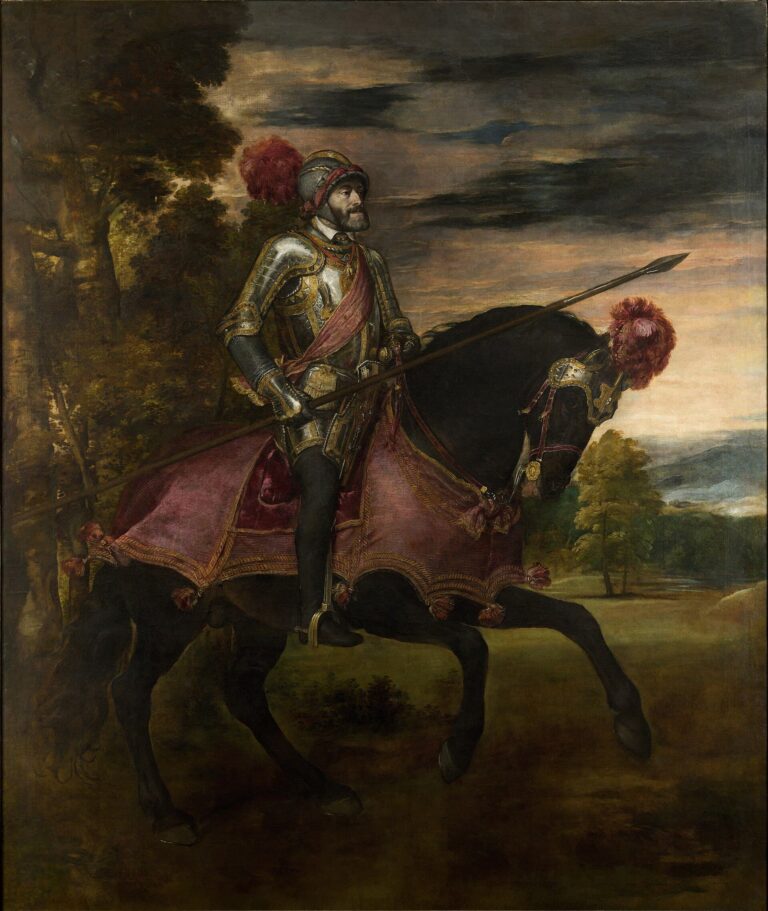
This diffusion also tells us how the painter’s workshop functioned. El Greco kept a shop in Toledo, with his son Jorge Manuel and assistants, and reworked his successful formulas in reduced formats suited to private devotion. This should not be read as commercial dilution but as the normal mode of production for a painter of his time — Titian, whose workshop he had seen, worked no differently.
Even so, the original retains an intensity the replicas never reach. It is in the cathedral’s large vertical format, with its near life-size figures pressing in on the viewer, that the choice of compression makes full sense. The painting was made for that wall, and it takes that wall to feel it.
Where to see the artwork
The Disrobing of Christ has never left Toledo Cathedral. It is seen in the sacristy, the great room the chapter turned into a genuine picture gallery.
The sacristy is indeed one of the finest ensembles of paintings in Spain: besides the Espolio, which occupies its altar wall, it holds a series of apostles by El Greco and works by Titian, Van Dyck, Goya and Velázquez. The vault carries a fresco by Luca Giordano. Access is included in the cathedral visitor ticket, which also covers the choir, the treasury and the chapter house.
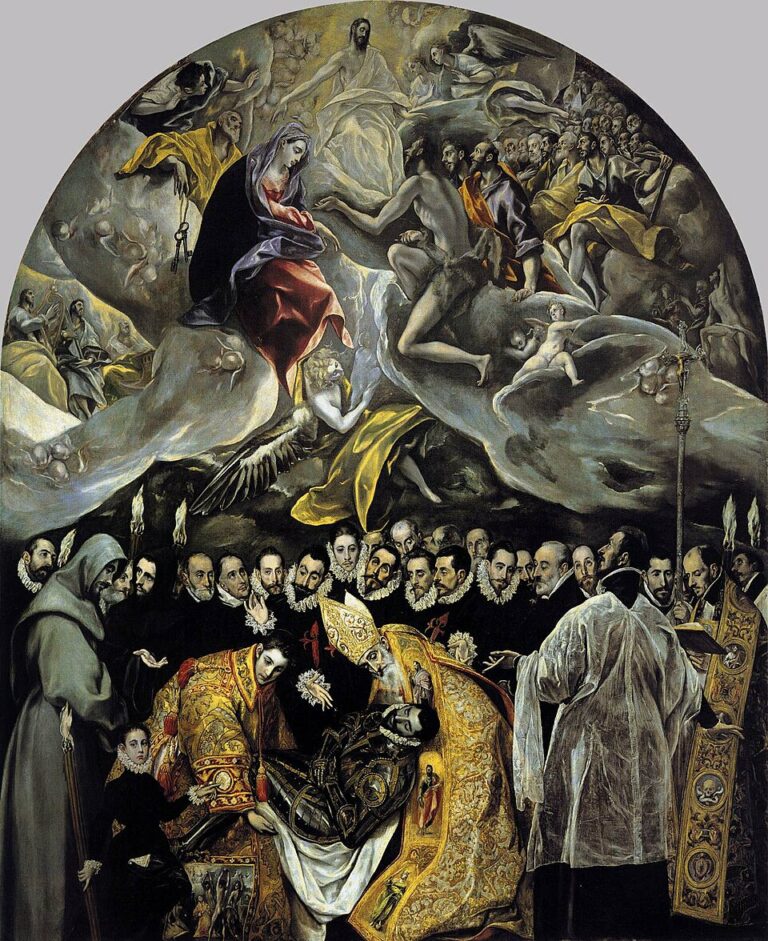
For anyone coming to Toledo on the painter’s trail, the day arranges itself: the cathedral for the Espolio and the apostles, the church of Santo Tomé for the great Orgaz painting, then the Museo del Greco and the Museo de Santa Cruz in the Jewish quarter. All of it lies within a few streets, and walking between them makes it clear why the painter never wanted to leave.
One piece of advice: start with the cathedral early in the morning, before the groups arrive. The sacristy is an enclosed room where crowds are quickly felt, and the Espolio needs to be approached — it is from close up that the substance of the red robe reveals itself.
Further Reading
Institutional Documentation
- Catedral Primada de Toledo — the official site of the cathedral and its sacristy.
- Museo del Prado, Madrid — the largest group of works by El Greco.
See also on Hors Cadre
- El Greco — the Visionary of Toledo — a portrait of the painter, from Crete to Toledo.
- The Burial of the Count of Orgaz — his masterpiece, another Toledan commission still in its original place.
— M