View of Toledo — El Greco’s visionary landscape
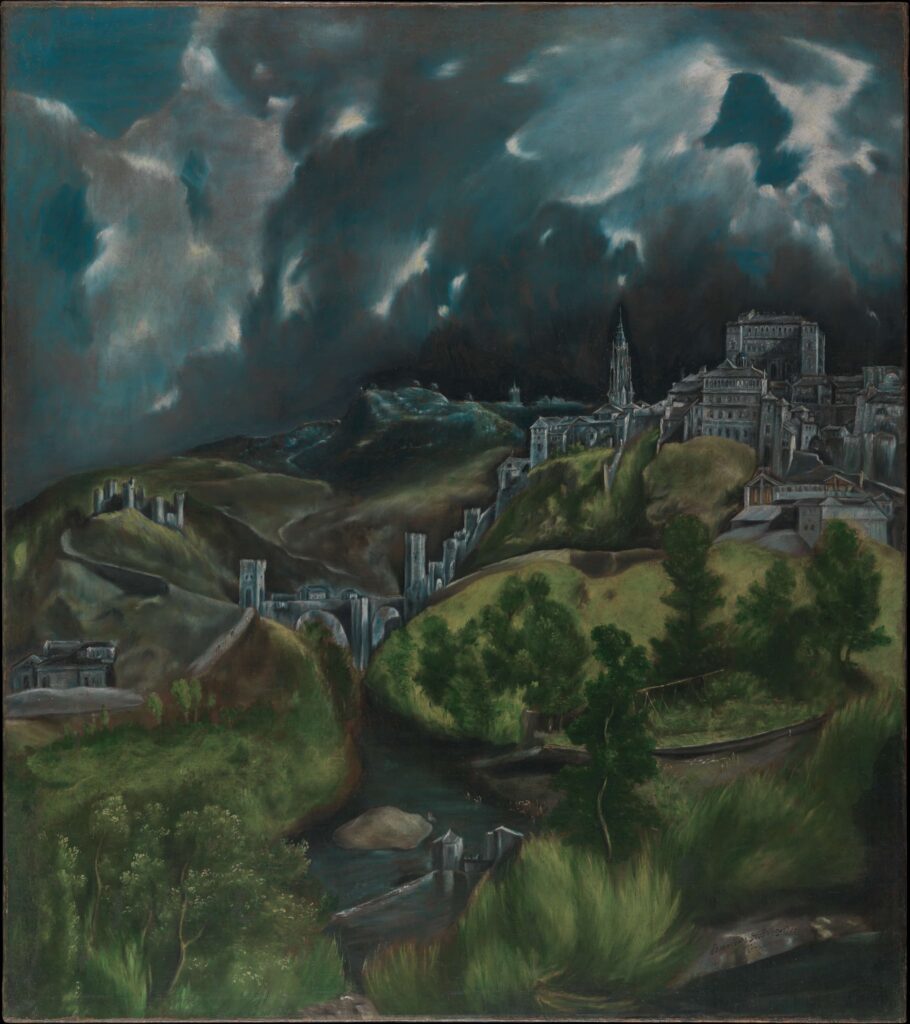
El Greco — the Visionary of Toledo →A black and blue sky, torn open by white cloud, presses down on a city perched on its hill. Below, the Tagus runs between banks of an acid, almost phosphorescent green. Roofs, towers and walls seem struck by a light that comes from nowhere. There is not a single human figure in this painting, and yet it is one of the most intensely inhabited images in all of early European art. View of Toledo, painted around 1600, is El Greco’s great landscape — and one of the most singular landscapes ever painted.
The work is all the more striking for being almost unique in his output. El Greco was a painter of religious compositions and portraits; independent landscapes, in his case, can be counted on one hand. Only two by his hand have come down to us: this one, and a more descriptive View and Plan of Toledo that remained in the city. That rarity makes the Metropolitan Museum canvas a kind of departure, an isolated exercise in which the painter allowed himself something he never repeated.
It is not a portrait of a city in any documentary sense. El Greco moved monuments about, enlarged certain volumes, and set one building floating on a cloud. He was not after topographical accuracy but a truth of another order: the truth of what Toledo had become for him after more than twenty years inside its walls.
This article describes the canvas and its light, explains how the painter recomposed the city, follows the work’s journey to New York, and shows why the moderns recognised in it one of the very first expressive landscapes in the history of art.
A city under a storm
Everything in this canvas of 121 by 109 centimetres is organised by the sky. It occupies nearly half the surface and sets the painting’s whole climate.
This is the sky of a storm gathering, or moving off: dark masses of night blue and slate grey, between which luminous white rifts open. Nothing here is stable. The clouds have the density and movement of those that swirl through the celestial registers of his church paintings — El Greco did not change his language to paint a landscape, he applied the sky of his visions to the sky above Toledo.
Under this storm light, city and vegetation take on improbable colours. The greens along the banks of the Tagus tend towards an acid yellow-green, almost poisonous, of the kind a shaft of sunlight under a black sky can actually produce. The stone of the walls and towers is lit with a cold whiteness that cuts it out against the dark ground. These dissonant chords, deep blues against electric greens, are the painter’s chromatic signature.
The composition, finally, is an ascent. In the foreground, the river and its bridge; above, the steep slope bristling with buildings; at the summit, the Alcázar and the cathedral; and over everything, the sky. The eye rises from the water towards the clouds exactly as it rises from the tomb towards Christ in his great religious compositions. The city is treated as a vision.
A rearranged topography
A visitor to Toledo trying to find this viewpoint from the bank of the Tagus would be disconcerted: the panorama exists, but it does not match the painting. That is deliberate.
El Greco chose to reorganise his city. He drew closer together and raised up the two monuments that mattered to him, the Alcázar — the royal palace standing at the highest point — and the cathedral, whose silhouette he shifted so that it stands clear instead of being lost in the urban fabric. These two masses, power and Church, thus dominate the city with an obviousness they do not possess in reality.
Stranger still: a large building outside the walls, in the left foreground, is shown resting on a cloud, as though floating. Commentators identify it as the Hospital de Tavera, which the painter evidently wanted to include without disrupting the reading of the whole. He therefore chose to show it as a model carried on a cloud — a solution of disconcerting freedom for a painting of 1600.
These liberties reveal the work’s intention. The point was not to inventory a city but to give the truest image of it, in the sense in which a portrait is true: by accentuating what defines it. El Greco paints Toledo as he paints a face, seeking presence rather than likeness. It is an emotive vision rather than a survey, and that is precisely what makes it unforgettable.
El Greco and his city
The canvas is inseparable from the forty-year bond between the painter and Toledo. He arrived in 1577, after his court ambitions had failed, and never left.
Toledo was no longer the political capital of Spain — Madrid was becoming that — but it remained the seat of the Primate, a city of clergy, convents, scholars and mystics, animated by the fervour of the Counter-Reformation. It was also a city heavy with history, a former Visigothic capital, a place where three cultures had met. El Greco lived there as an independent and cultivated painter, surrounded by poets and theologians, and found there both his patrons and his spiritual climate.
The Metropolitan’s landscape is therefore the portrait of a chosen place. There is no one in the painting, yet the city is a character in it: upright, closed, mineral, offered up to a sky that seems to judge it. That absence of figures, rare at the time, strengthens the impression of a presence. Nothing distracts the eye from what matters, which is the confrontation between the city and the storm.
It is easy to see why writers seized on this image. When the Generation of ’98 looked in Spain for a symbol of the Castilian soul, and when Maurice Barrès published his book on the secret of Toledo in 1910, it was this Toledo they had in mind: El Greco’s city, the one in the painting rather than the one in the guidebooks.
From Toledo to New York
The canvas’s fate is that of many Spanish masterpieces rediscovered at the turn of the twentieth century: it left Spain at the very moment its value was beginning to be recognised.
The work entered the collection of Henry Osborne Havemeyer and his wife Louisine, American industrialists and collectors of remarkable daring, advised by the painter Mary Cassatt. The Havemeyers bought Impressionists while they were still contested and, in the same movement, bought El Grecos while that painter still passed for a curiosity. The pairing was no accident: it was an eye trained on modern painting that made El Greco legible again.
On Louisine Havemeyer’s death the collection was bequeathed to the Metropolitan Museum of Art. View of Toledo entered the museum in 1929 and has since been among its most famous paintings, hanging in the European painting galleries. It keeps company with other works by the master, of which the museum holds a notable group.
That New York presence has done a great deal for the work’s fame. Displayed in one of the most visited museums in the world, the canvas has become the image of Toledo for millions of visitors who have never seen the city — to the point that the painting is now better known than the real panorama behind it.
The invention of the expressive landscape
The painting’s posterity rests on an intuition that took three centuries to become commonplace: that a landscape can express an inner state instead of describing a place.
In the sixteenth century the independent landscape was a novelty, and it was generally descriptive: a city view, a veduta, a cartographic background. Nothing in that tradition prepared anyone for a painting in which the light is unreal, the colours dissonant, the topography reworked and the sky charged with an almost dramatic tension. El Greco here treats a landscape with the means he reserved for the supernatural.
This is why the moderns recognised an ancestor in him. The Romantics had opened the way to the landscape of mood; the Expressionists of the twentieth century, seeking to charge nature with their own disquiet, found a predecessor in this city under a storm. The canvas is regularly cited as one of the first expressive landscapes in the history of Western painting, three centuries before the term existed.
The paradox is that El Greco barely practised the genre. Once, or very nearly once, he turned his gaze towards a place rather than a body or a face — and that single attempt was enough to open a path. That too is a mark of painters of the first rank: what they invent in passing.
Further Reading
Institutional Documentation
- The Metropolitan Museum of Art, New York — the museum’s catalogue entry for the painting.
- Museo del Prado, Madrid — the largest group of works by El Greco.
See also on Hors Cadre
- El Greco — the Visionary of Toledo — a portrait of the painter, from Crete to Toledo.
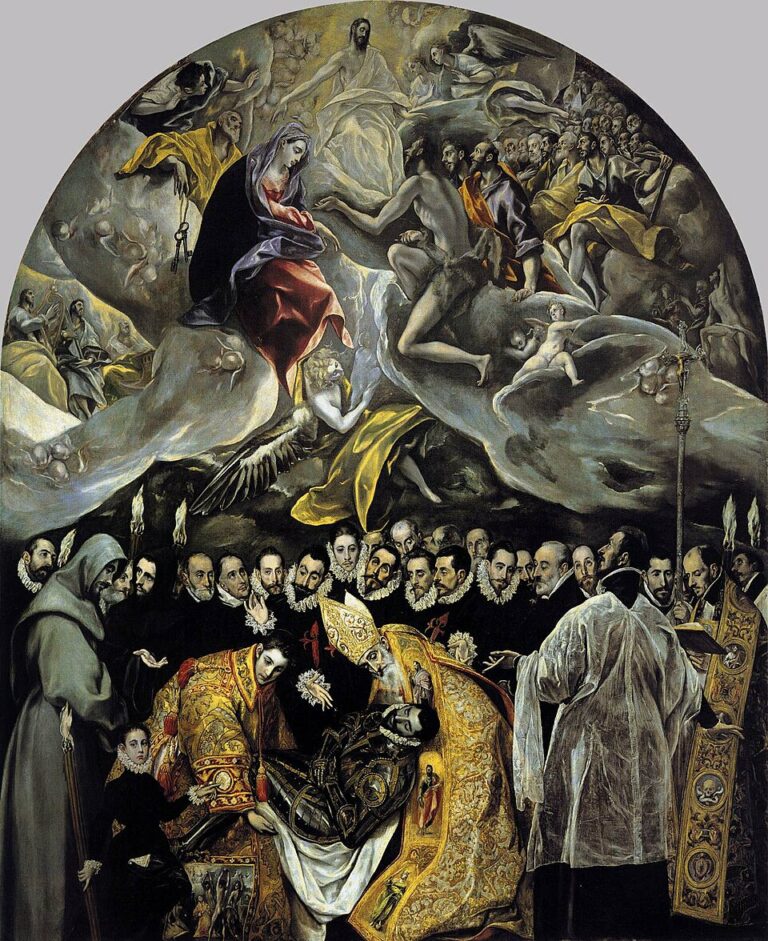
- The Burial of the Count of Orgaz — his masterpiece, still in the Toledan church for which it was painted.
— M