Poppies — the painting in which Monet took his first step toward abstraction
Claude Monet — the painter who pursued light for sixty years →On the Musée d’Orsay website, in the scholarly entry dedicated to Claude Monet’s *Poppies*, there is a sentence that stands out. The painting, created in 1873 near Argenteuil and donated to the French government in 1906 by Étienne Moreau-Nélaton, has, according to the museum, become one of the works in which “a first step toward abstraction was taken.” This phrasing is rare in standard literature on Impressionism. It appears in almost no French-language articles aimed at the general public. Yet it comes from the very museum that houses the work.
This article takes this institutional assertion seriously. What does “a first step toward abstraction” mean for a painting from 1873, painted fifty years before Mondrian, Malevich, or Kandinsky? What exactly do we see when we stop in front of *Poppies* at the Musée d’Orsay and look at the painting for what it is, rather than as the “pretty Impressionist scene” that reproductions have come to portray it as?
This is what the museum’s official entry and Daniel Wildenstein’s catalogue raisonné make clear. Without speculation. Without added interpretation. Only the factual evidence and the analysis provided by the institution that owns the work.
Argenteuil, 1873
In the fall of 1871, after his exile in London—forced by the Franco-Prussian War—Claude Monet returned to France and settled with his family in Argenteuil, a small town on the Seine ten kilometers northwest of Paris. He would remain there for seven years, until 1878.
According to the Musée d’Orsay’s entry, these years in Argenteuil “marked a period of creative flourishing” for the painter. Monet was supported financially by the art dealer Paul Durand-Ruel. He lived with his first wife, Camille Doncieux (whom he married in 1870), and their son, Jean Monet, born on August 8, 1867. The family rented a house on Rue Pierre-Guienne, near the Seine.
It was during this period, in the immediate surroundings of Argenteuil—the banks of the Seine, the metal bridge, the regattas, the gardens, and the surrounding fields—that Monet produced many of the works that would definitively establish his Impressionist style. *Poppies* was painted in 1873 and is signed and dated “Claude Monet 73” in the lower left corner.
The work was first presented to the public a year later, in the spring of 1874, at photographer Nadar’s studio in Paris.
The Painting — What It Depicts
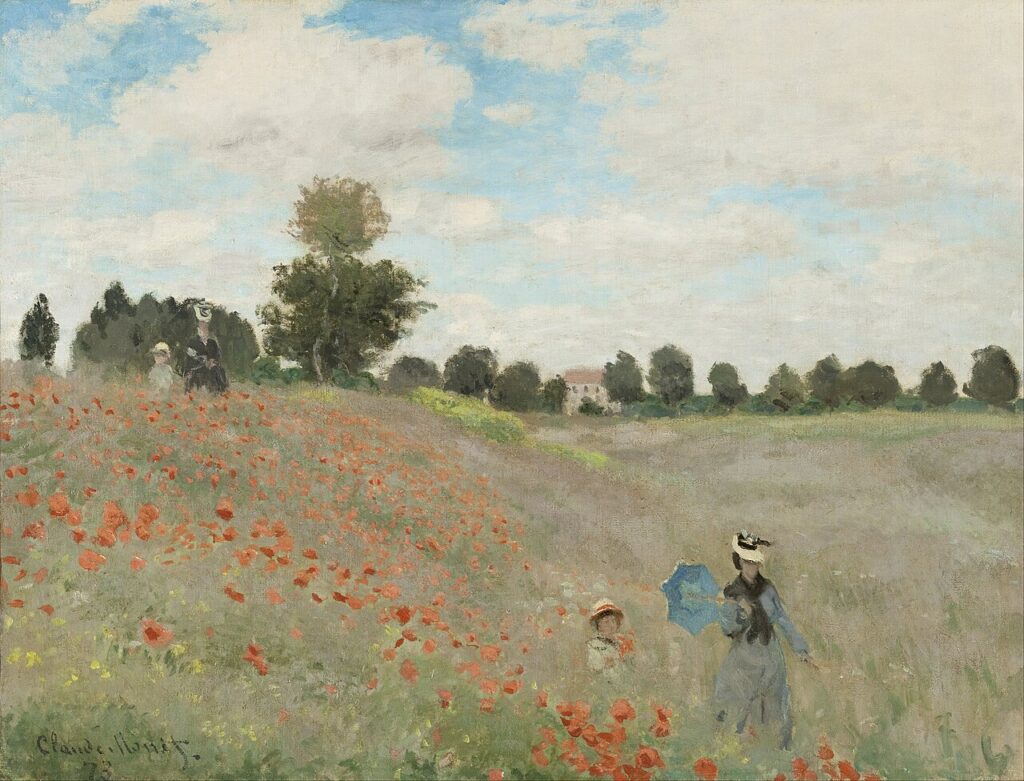
*Poppies* is an oil on canvas measuring 50 centimeters high by 65.3 centimeters wide (official dimensions from the Musée d’Orsay; with the frame, 99 × 84 cm). Landscape format. Signed lower left.
The composition is divided by a diagonal line running from the upper right corner to the lower left corner. This diagonal line divides the canvas into two distinct areas, as noted in the Musée d’Orsay’s entry: “one dominated by red, the other by a bluish green.”
In the foreground, on the right side of the composition, a woman holding a green parasol is walking into the frame. A child is walking ahead of her, closest to the viewer, half-hidden in the tall grass, his straw hat barely visible above the vegetation.
In the background, higher up the slope, a second mother-and-child pair is also walking into the frame. The woman is also holding a hat or a parasol; the child is close to her. The two groups—the one in the foreground and the one in the background—are visually connected by the diagonal line of the composition.
The left half of the canvas is dotted with red spots: these are poppies. The Musée d’Orsay notes that the flowers are painted as “spots whose oversized scale, in the foreground, highlights the primacy given to visual impact.”
The horizon, in the background, is bordered by a row of trees standing almost horizontally, separating the field from the sky. Between the trees, on the left, a house with a red roof can be seen—a one-story home with several visible windows.
The sky, at the top of the painting, takes up about one-third of the canvas. It is filled with large white cumulus clouds against a pale blue background.
A Diagonal Composition
The Musée d’Orsay’s artwork description is explicit about the composition of the painting: “The two mother-and-child pairs in the foreground and middle ground are merely a pretext for establishing a diagonal line that structures the painting.”
This statement is important because it overturns the conventional interpretation of the painting. According to the Musée d’Orsay, the human figures are not the subject of *Poppies*. They are a compositional device —a tool for structuring the pictorial space. The true subject of the painting is the colors arranged along this diagonal, the patches distributed across the surface, and the visual sensation produced by this arrangement.
The two mother-child pairs thus function as two landmarks set along the diagonal—one at the top, one at the bottom—which guide the viewer’s gaze as it moves from the background to the foreground, and give the painting its depth and balance.
According to the Musée d’Orsay, it is this subordination of the human figure to pure composition that constitutes one of the elements of the “first step toward abstraction.”
Two figures not formally identified
The identification of the two figures in the foreground has been the subject of several hypotheses in the critical literature. The official entry for the work on the Musée d’Orsay’s website offers the following interpretation, couched in cautious terms:
“The young woman with the parasol and the child in the foreground are likely Camille, the artist’s wife, and their son Jean.”
— Musée d’Orsay, official entry for the work
The institution says “undoubtedly.” Not “are.” This use of the conditional is important: no document, no letter from Monet, and no contemporary account formally confirms the identification. It is based on:
- Biographical consistency: In 1873, Monet was living in Argenteuil with Camille (who was 29 at the time) and their son Jean (who was 6).
- Iconographic consistency: Monet regularly painted Camille during his years in Argenteuil, in similar poses and settings (notably Woman with a Parasol—Madame Monet and Her Son painted in 1875, now in the collection of the National Gallery of Art in Washington)
- The absence of other plausible candidates: there were no other women or children who were regularly present in Monet’s immediate circle in 1873
But the second pair of figures, those in the background, remains an unsolved iconographic mystery. Several interpretations coexist in the critical literature:
- Reading 1: The same people (Camille and Jean) are depicted twice, at two different points along the walk—a pictorial technique reminiscent of the medieval motif of the repeated figure in narrative compositions
- Interpretation 2: These are different people, perhaps other figures from the Monets’ circle in Argenteuil
The museum does not take a definitive stance. The official description mentions both couples without specifying their respective identities. It is this ambiguity that the work retains to this day—not a secret to be unraveled, but an indeterminacy embraced by the very institution that houses the painting.
“A First Step Toward Abstraction”
It is here that the Musée d’Orsay’s scientific fact sheet states the central claim that gives this article its title:
“A first step toward abstraction has been taken.”
— Musée d’Orsay, official entry for *Coquelicots*
The institution explains this interpretation by pointing to three identifiable pictorial elements in the painting:
Feature No. 1 — Blurred Outlines. According to the fact sheet, “Monet blurs the outlines” in this work. Specifically, the figures, trees, houses, and clouds are no longer delineated by distinct lines. Each shape gradually blends into the surrounding color through a succession of quick brushstrokes that suggest rather than describe. This style of painting, in 1873, marked an explicit break with the academic tradition of drawn contours that then dominated the Paris Salon.
Feature No. 2 — Poppies as “disproportionate spots.” The Musée d’Orsay points out that the poppies in the foreground are painted as “spots whose disproportionate size […] highlights the primacy given to visual impression.” Specifically, some of the red patches are disproportionate to the actual size of a poppy flower as seen from the depicted distance. Monet does not paint the flowers as they are, but as the eye perceives them —that is , enlarged, vibrant, and dominant in the field of vision because they are luminous and contrast sharply with the green surrounding them.
Technique No. 3 — Construction through juxtaposed patches. Instead of modeling volumes with tonal gradations, Monet juxtaposes patches of pure color which, when placed side by side, produce the overall visual effect. This technique—which would later be theorized by Seurat and the Neo-Impressionists—is in its infancy here. The Musée d’Orsay refers to it as “color rhythm.”
These three characteristics—blurred contours, oversized patches, and composition through juxtaposition—are, according to the institution, the precursors of what would become, fifty years later, pure abstraction. *Poppies* is not an abstract painting. It is a figurative work that clearly depicts a field, flowers, and figures. But it is a work in whichthe autonomy of color and brushstroke relative to the depicted subject begins to assert itself.
It is this emerging autonomy that the Musée d’Orsay calls “a first step toward abstraction.”
From Nadar to Orsay
*Poppies* was first shown to the public at the first Impressionist exhibition, held in photographer Nadar’s studios at 35 Boulevard des Capucines in Paris, from April 15 to May 15, 1874. The work is listed in the catalog under no. 95, titled simply *Poppies*.
That same exhibition was also where Claude Monet presented, under number 98, his seascape of Le Havre titled Impression, Sunrise. The two works were displayed together in the same room. The painting that would give its name to an entire movement and the one that would mark a first step toward abstraction were, that spring, hung just a few meters apart. This detail is rarely mentioned in articles aimed at the general public.
After the exhibition closed in May 1874, *Poppies* passed through several successive private collections. The painting notably came into the possession of the art dealer Paul Durand-Ruel, the Impressionists’ chief commercial patron, who is said to have acquired it sometime between the 1870s and the 1880s.
At the turn of the 20th century, the work came into the possession ofÉtienne Moreau-Nélaton (1859–1927), himself a painter, a leading collector, and one of the great French biographers of the 19th century—it was he who published, in 1921, the seminal monograph on Jean-François Millet (Millet raconté par lui-même, 3 volumes).
In 1906, Moreau-Nélaton donated his entire collection, including *Poppies*, to the French government. The donation included hundreds of works: paintings by Manet, Corot, Delacroix, Daubigny, and several by Monet from his Argenteuil period. *Coquelicots* was subsequently exhibited:
- At the Louvre Museum (beginning in 1906)
- At the Museum of Decorative Arts
- At the Jeu de Paume Museum (until 1986)
- On view at the Musée d’Orsay since the museum opened on December 9, 1986
The painting has been on permanent display at the Musée d’Orsay since that time.
How to View the Work Today
“Poppies ” is housed at the Musée d’Orsay in Paris, in the Impressionist gallery on the 5th floor, where Monet’s major works from the period 1870–1890 are displayed. Practical information:
- Address: 1 rue de la Légion d’Honneur, 75007 Paris
- Subway: Solférino (Line 12) or RER C (Musée d’Orsay)
- Reservations recommended: limited time slots; tickets available online on the official website
- Admission: around €16 for general admission; free for EU residents under 26; free on the first Sunday of every month
- Gallery: 5th floor, a space dedicated to Monet and the Impressionists
- Helpful tip: The gallery also contains *The Magpie* (1868–1869), Regattas at Argenteuil (1872), and several other works from that period. Allow at least an hour to explore this space.
Also worth seeing on the same day at the Musée d’Orsay: *Camille on Her Deathbed* (1879), painted by Monet six years after *Poppies*. The same Camille Doncieux, mother of the same Jean, who died at age 32. For anyone who wants to grasp just how quickly a painter’s life can change, viewing these two works within the same hour is a striking experience.
Further Reading
Institutional sources cited
- Musée d’Orsay, official entry for *Coquelicots*. Primary source for the analysis presented in this article.
- Daniel Wildenstein, *Claude Monet: Biography and Catalog Raisonné*, 5 volumes, La Bibliothèque des arts, Lausanne/Paris, 1974–1991. The definitive edition.
Leading Modern Studies
- Sylvie Patin, *Monet*, Musée d’Orsay / Skira / Flammarion, Paris, 2011.
- Guy Cogeval (ed.), The Musée d’Orsay in 360 Degrees, Skira / Flammarion / Musée d’Orsay, Paris, 2013.
Also check out on Hors Cadre
- Claude Monet—the painter who pursued light for sixty years —a portrait of the painter.
- Impression, Sunrise—the painting that mockingly gave its name to an entire century —Monet’s other major work on display at the same Nadar exhibition in 1874.
— M