The Fourteen-Year-Old Little Dancer — The Ultimate Scandal in Modern Sculpture
Edgar Degas — the painter of frozen movement →Paris, early April 1881, 35 Boulevard des Capucines. The 6th Impressionist Exhibition opens its doors inthe former studio of the photographer Nadar. Edgar Degas, who was supposed to present a pigmented wax sculpture there, did not deliver his work on time. The glass display case intended to hold it remained empty for two weeks. Visitors wondered what had happened. Critics grew impatient. The title appeared in the catalog— “Little Dancer Aged Fourteen” —but the work itself was nowhere to be found.
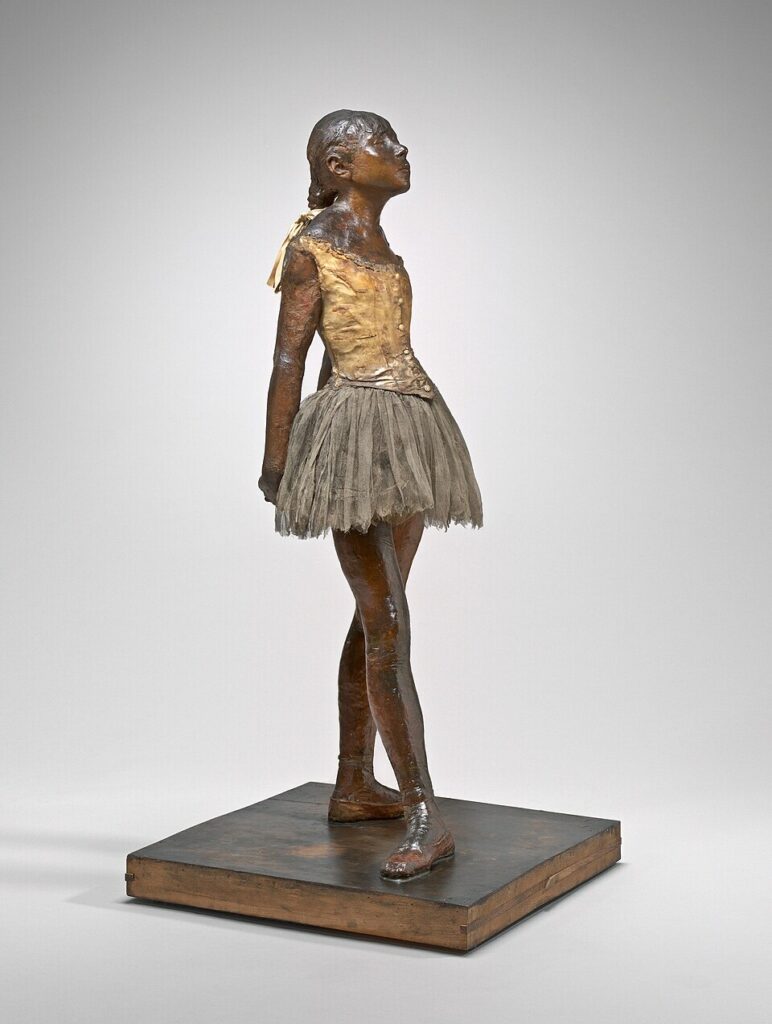
Late April 1881. Degas finally delivered his sculpture. Ninety-eight centimeters tall. Pigmented wax in natural colors. Authentic cotton tulle tutu. Fabric bodice. Satin ballet slippers. A wig made of human hair, tied with a satin ribbon. The figurine depicts a young ballerina, standing in the classical fourth position, hands clasped behind her back, torso leaning slightly backward, head tilted upward, gaze directed toward a distant point.
The public outcry was immediate. Critics spoke of “the epitome of precocious depravity, ” a “face marked by the loathsome promise of every vice, ” and comparisons “to a monkey” or “to an Aztec.” An anonymous critic exclaimed , “What an ugly creature she is!” Another saw the statuette as “a specimen of natural history” rather than a work of art. Only Joris-Karl Huysmans, the future naturalist writer, publicly defended the sculpture, seeing it as “the only truly modern attempt” in the exhibition.
The scandal was so great that Degas, deeply hurt, removed the statuette at the end of the exhibition and never displayed it again. For thirty-six years, it remained in his studio, hidden from the public. It was the only sculpture Edgar Degas ever exhibited during his lifetime. Upon his death in 1917, one hundred and fifty other models were discovered in his studio—secret sculptures that no one had ever seen.
This article recounts the genesis of this seminal work in modern Western sculpture, the tragic fate of Marie van Goethem—a fourteen-year-old Belgian girl who posed for Degas and whose real life was turned upside down shortly after the sculpture was created— the absolute formal break represented by the use of mixed media (wax, real fabrics, and human hair) in European artistic sculpture, the posthumous legacy of the Hébrard bronzes beginning in 1919, andthe conceptual foreshadowing of kinetic sculpture that Degas achieved here—thirty years before Alexander Calder, without realizing it.
Marie van Goethem — the Belgian girl in the 9th arrondissement
The identity of the sculpture’s model has been accurately documented by recent historical research—notably the study by writer Camille Laurens, published in 2017 under the title *La Petite Danseuse de quatorze ans* (Éditions Stock).
Marie Geneviève van Goethem was born on June 7, 1865, in Paris, to a family of Belgian immigrants living in the 9th arrondissement. Her father, Antoine van Goethem, was a tailor. Her mother, Catherine Marie Joséphine Mertens, was a laundress. The family lived in relative poverty, typical of Belgian immigrants who settled in Paris in the 1860s and 1870s—a large community that had fled the rural and industrial poverty of Flanders at that time.
Marie is the second of the three van Goethem sisters. The eldest is Antoinette (born in 1861), and the youngest is Louise-Joséphine (born in 1870). The three sisters lived on Rue de Douai, near Pigalle. Their father died when Marie was about ten years old, around 1875. Their widowed mother, a laundress, had to support her three daughters on her own.
The typical social solution of the time for working-class families in Paris was to enroll their daughters inthe Paris Opera’s dance school. This school, established by imperial decree under Napoleon I, recruited exclusively from working-class backgrounds. It offered children free technical training, a student stipend (a few francs a week), and the promise of a career in the corps de ballet. For poor families, it meant one less mouth to feed and an immediate source of income.
Around 1875–1878, Catherine Marie Joséphine Mertens enrolled her three daughters in the Opera’s dance school. Antoinette and Louise remained there—Antoinette became a prostitute in the 1880s (according to police records), while Louise-Joséphine became a dance teacher in the early 20th century.
Marie van Goethem entered the Paris Opera School in 1878, at the age of thirteen. In accordance with the rules for “petits rats” at the time, she received daily training under the guidance of ballet masters and class instructors. The discipline was rigorous: technical classes in the morning, rehearsals in the afternoon, and, for the most advanced students, appearing as extras in public performances in the evening.
It was in that same year, 1878, that Marie began posing for Edgar Degas in his studio on Rue Pigalle. According to surviving records, she earned five to six francs for a four-hour modeling session —a significant sum for a family of modest means, which supplemented her salary as a student at the Opera.
1875–1880 — five years of sculpting
According to various institutional sources (Wikipedia, Encyclopédie Universalis, Histoires-de-Paris, Panorama de l’art), Edgar Degas began modeling his sculpture around 1875–1879 and completed it around 1880. The exact date when work began is a matter of debate—some sources place the earliest modeling as early as 1875, while others cite 1879. The consensus is that the final version was completed in 1880, in preparation forthe exhibition scheduled for 1881.
What is certain is that the creative process was a long one —at least two years, probably more than five. Degas produced several preparatory drawings (now in the collection of the Musée d’Orsay), explored different poses, studied the young dancer’s anatomy, and observed her movements at the Opéra school and in his studio.
The technique used was unusual for serious sculpture of the time. Degas modeled his work in pigmented wax mixed with tallow (animal fat that makes the wax more pliable and malleable). For the internal structure, he used a wire-and-wood framework —a technical skeleton that supported the weight of the wax. These materials are ephemeral and fragile. The wax warps in the heat, cracks in the cold, and tarnishes in the light. No serious sculptor of the time used such materials for a work intended for public display.
Degas took this material transgression even further. He dressed his sculpture in real fabrics: a fabric bodice, a tutu skirt made of gauze (cotton or silk tulle), and real satin ballet slippers. He tops the figurine’s head with a wig made of human hair (probably purchased from a doll shop, according to several sources). He ties the wig with a green or pink satin ribbon.
No sculpture exhibited in a serious artistic context in the 19th century had, until then, used such real props. The only figures dressed in real fabrics existed in:
- Popular wax museums (Madame Tussaud’s in London, which opened in 1835; the Musée Grévin in Paris, which opened in 1882)
- Ethnographic Models in Natural History Museums (Trocadéro)
- Religious statues of the Virgin Mary in full attire found in some Catholic churches
Degas blurred the line between fine art sculpture (using noble materials such as marble, bronze, and plaster) and popular figurines (made of wax and fabric). This blurring of boundaries would, in fact, be the main focus of the critical scandal of 1881.
Sculpture: What It Depicts
The 14-Year-Old Little Dancer is 98 centimeters tall —about three-quarters the height of a typical 14-year-old girl. This smaller-than-life scale already creates a distance from reality.
The pose has been carefully studied. Marie van Goethem is depicted:
- Standing still, in a resting position between two exercises
- Feet turned out, forming the classic fourth position in ballet (right foot forward, left foot back, heels apart)
- Hands clasped behind his back, fingers intertwined
- Upper body slightly upright, almost arched, leaning backward
- Head tilted back, chin raised, gaze fixed on a distant point on the horizon
This specific posture corresponds to a precise moment in the process of learning to dance: the pause between two exercises, with the arms positioned correctly behind the back so as not to slump, the torso held upright to maintain physical discipline, and the head held high to stay focused. This isn’t a pose —it’s a moment captured in the involuntary posture of a tired teenage girl.
Clothing and accessories:
- Fitted bodice, bare arms
- Flat gauze tutu that falls to the knees
- Light-colored cotton socks
- Satin pointe shoes with ankle ribbons
- Hair tied up in a tight bun (real wig)
- A ribbon tied on the side of the head, made of colored satin
The patinas (on the bronze) or pigments (on the original wax) create natural colors: rosy skin, dark brown hair, and a colorful ribbon. This polychromy is unusual for 19th-century artistic sculpture. Serious sculpture of the period was monochromatic: the white of marble, the bronze-green of metal castings, the grayish-brown of plaster. Degas pigmented his wax to simulate skin, hair, and fabric. Everything simulates the living presence of Marie van Goethem.
The glass display case in which the sculpture was presented at the 1881 exhibition was a deliberate choice by Degas. According to contemporary reviews (and as confirmed by institutional sources), Degas wanted to isolate his sculpture, protect it from being touched by the public, and also assert its status as a work of art in a context where it might be mistaken for an ethnographic mannequin or a carnival automaton.
But paradoxically, the display case has the opposite effect. Several critics noted that the sculpture, enclosed in glass, looked exactly like a natural history specimen —like the children’s skeletons or fetuses in jars found in 19th-century anatomy museums. This association fueled the critical scandal.
April 1881 — The Scandal of the 6th Impressionist Exhibition
The 6th Impressionist exhibition opened on April 2, 1881, at 35 Boulevard des Capucines, in the former studio of the photographer Nadar (the same venue as the first Impressionist exhibition in 1874). Thirty artists exhibited there, including Camille Pissarro, Berthe Morisot, Mary Cassatt, Paul Gauguin, and Edgar Degas.
In the catalog , Degas announced the presentation of a “wax statue of a dancer.” The glass display case was set up in the center of a separate room, intended to house the sculpture. But Degas did not deliver his work on time. The display case remained empty for the first two weeks of the exhibition. Several critics visiting the Salon notedthe absence and publicly expressed their frustration. Rumors ran rampant: Had Degas given up? Had the sculpture been destroyed? Stolen?
Around April 15–16, 1881, Degas finally delivered his sculpture. The display case filled up. Marie van Goethem was revealed to the Parisian public, frozen in wax, dressed in real fabrics, her gaze turned upward.
The critical reactions were immediate and scathing. Here are a few verified quotes:
“It’s simply hideous, this terrible and unsettling statuette.”
— Joris-Karl Huysmans, *Modern Art*, 1881*
But Huysmans adds—and this is what makes his critique valuable—that the statuette “challenges every preconceived notion.” Huysmans defends the work as the “only truly modern attempt” in the exhibition.
Other critics are far more scathing. Paul Mantz, a critic for *Le Temps*, describes it as “a flower of precocious depravity, its face marked by the loathsome promise of every vice.” The sculpture is compared to a “monkey, ” an “Aztec,” and a “circus freak.” The critic Élie de Mont, writing in *La Civilisation* , states that Degas has “taken his love of the ugly to the point of cynicism.”
All these comments have one thing in common: they project onto Marie van Goethem’s face a moral dimension —depravity, vice, inner ugliness—that goes far beyond the formal dimension of the work. The face of the weary Belgian teenager is interpreted by bourgeois Parisian critics as a sign of her despised social status.
A few voices defended the sculpture. Pierre-Auguste Renoir, in particular—a friend and colleague of Degas—considered the work a particularly innovative attempt at realism. Mary Cassatt, who was present at the exhibition (she was participating in the 6th Impressionist Exhibition with seven works), supported her mentor’s approach. But these minority voices were drowned out by the overwhelming critical backlash.
At the end of the exhibition, Degas withdrew his sculpture. Deeply hurt by the criticism—his touchy nature was well known—he decided never again to exhibit a sculpture publicly. He kept his word: during the thirty-six years he had left to live (1881–1917), none of Degas’s sculptures were shown to the public.
The Fate of Marie van Goethem — When the Model Disappears
The story of Marie van Goethem after 1881 is a deeply moving chapter that art critics have long overlooked, but which recent historical research (notably by Camille Laurens, 2017) has brought to light.
1882: One year after the sculpture was exhibited, Marie van Goethem was expelled from the Paris Opera School for missing eleven consecutive classes. The school’s discipline is strict —students at the dance school are expelled after a certain numberof unexcused absences. Marie was officially expelled from the school.
Why did Marie miss those classes? The records do not allow us to answer this with certainty. But the living conditions of the time suggest several possibilities: illness (a common occurrence among poor, malnourished young girls), family complications (her mother, a laundress, had to work long hours), or a side job as a model (for Degas, but also for other Parisian painters).
At age 17 (that is, in 1882–1883), according to corroborating biographical sources, Marie van Goethem reportedly began posing for other painters and frequenting less respectable circles. Her older sister Antoinette was already known to the Parisian police as a prostitute. The archives of the “vice squads” of the time mention the “Opera girls” as targets of older male regulars who prowled the backstage areas of the Opera and offered financial or romantic arrangements to the youngest students.
Marie van Goethem disappears from official records around 1885–1890. No marriage, birth, or death certificate bearing her name has been clearly identified in the Paris civil registry archives. Several biographical sources mention her premature death around 1901, though there is no formal proof. Others suggest she left for Belgium or disappeared into the anonymity of Parisian poverty.
This tragic fate of the sculpture’s model—which stands in stark contrast to the work’s immortal legacy —is an integral part ofthe history of *The Little Dancer Aged Fourteen*. The subject is addressed, without excessive activism, in recent exhibitions and publications devoted to the work. Degas’s sculpture preserves, in its very stillness, the memory of a teenage girl whose real-life trace was subsequently erased from history.
1881–1917 — thirty-six years of sculptural silence
After the scandal of April–June 1881, Edgar Degas brought his sculpture back to his studio on Rue Victor-Massé (where he had been working since 1872). The statuette remained in that studio for thirty-six years.
A few select visitors will see it—close friends, familiar art critics, and collectors who were close to him. But no new public exhibition will take place. No period photographs of the sculpture have even been preserved in its original state (before the wax began to deteriorate following Degas’s death).
During this quiet half-century, Degas continued to sculpt —but only for himself, in the privacy of his studio. None of them would ever be exhibited. None would ever be publicly photographed. None would be sold. Degas sculpted for his own pleasure and as preparatory studies for his paintings and pastels. The three-dimensional models allowed him to better understand the movements of the dancers, horses, and bathers he depicted on canvas.
This sculptural silence would last until the artist’s death on September 27, 1917. When it came time to liquidate Degas’s studio —a task entrusted to Hébrard and several experts —the heirs discovered, in the closets and on the shelves at the studio on Rue Victor-Massé, approximately 150 sculptures made of wax or clay. Many are in poor condition —the wax has deteriorated over the decades, the internal frames are rusting, and the clothing on the clothed sculptures (particularly that of the Little Dancer) is damaged or has been eaten away by moths.
Seventy-three sculptures can still be saved in a condition suitable for casting.
1919–1932 — the Hébrard bronzes
Degas’s heirs—his niece Jeanne Fevre and his nephew Henri Fevre —decided to have the salvageable sculptures cast in bronze. The commission was entrusted to the foundryman Adrien Hébrard (1865–1937), a renowned art foundryman based at 8 Avenue de Versailles in Paris.
Hébrard spent thirteen years casting Degas’s wax models in bronze. Each sculpture had to be cast separately —a delicate process that involved making a negative mold from the fragile wax and then pouring bronze into that mold. The work was time-consuming, costly, and technically complex.
For *The Fourteen-Year-Old Dancer* in particular, Hébrard produced approximately twenty-eight bronze casts between 1922 and 1932. Each cast is numbered and bears the stamp “CIRE PERDUE A.A. HÉBRARD.” The sculptures are hand-patinated to reproduce the original colors of the pigmented wax. For the tutu skirt and ribbon, modern casts use new fabrics (gauze for the skirt, satin for the ribbon), which museums replace regularly to preserve the original appearance.
The Hébrard copies of *La Petite Danseuse* are now scattered among major international museums:
- Musée d’Orsay, Paris — copy held under catalog number RF 2137
- Metropolitan Museum of Art, New York
- Tate Britain, London
- Ny Carlsberg Glyptotek, Copenhagen
- Art Institute of Chicago
- Joslyn Art Museum, Omaha
- Norton Simon Museum, Pasadena
- The Hermitage, Saint Petersburg
- Several other international public and private collections
The original wax model from 1881, which remained in the Hébrard family after the foundryman’s death, was purchased in 1985 by Paul Mellon (an American collector and benefactor of the National Gallery). Mellon immediately donated it to the National Gallery of Art in Washington. The original wax model has therefore been housed in Washington since 1985—the one-of-a-kind version created by Degas, as opposed to the twenty-eight Hébrard bronzes scattered around the world.
Reversed symbolism:the original is in the United States, while the copies are in Europe and elsewhere. To see Degas’s true *Little Dancer* in its original material (pigmented wax), you have to go to Washington. In Paris, you see a patinated bronze from 1922, which is more durable but was never touched by Degas’s own hands.
Posthumous Legacy — Before Calder: The Invention of Sculptural Movement
The influence of *La Petite Danseuse de quatorze ans* on modern Western sculpture is, in fact, considerable—although it is largely underestimated by French-speaking art critics.
Three formal innovations introduced by Degas in this work would have a lasting impact:
Break 1 — Mixed Media
Before Degas, serious sculpture used only noble materials: marble, bronze, plaster, and, more rarely, terracotta or carved wood. No combination of materials was tolerated in major artistic sculpture. *The Little Dancer* introduces three different materials into the same work: pigmented wax, real fabric, and human hair.
This mix of materials would be taken up again in the 20th century by Picasso’s assemblages (beginning in 1912 with his Cubist sculptures combining wood, sheet metal, ropes, and newspaper), by Méret Oppenheim’s Surrealist objects (The Fur Lunch, 1936), and more generally by the entire tradition of assemblage sculpture in the 20th and 21st centuries. Degas was, without realizing it, the pioneer of this artistic language.
Break 2 — Polychromy
Modern Western sculpture, since the Renaissance, has been monochromatic. The white of marble or the brownish-green of bronze is enough to convey dignity. Polychromy is reserved for folk sculptures (painted Catholic Madonnas), ethnographic museum figures, and carnival automatons. *The Little Dancer* restores polychromy to the heart of artistic sculpture—the rosy skin, chestnut hair, and colorful ribbon make the work a living object, not an idealized one.
This use of color was revived in the 20th century by Henri Matisse (painted sculptures), Niki de Saint Phalle (colorful “Nanas”), and Jeff Koons (lacquered sculptures). Degas was a pioneer of this return of color to Western sculpture.
Break 3 — Movement Captured in an Unlikely Moment
Before Degas, sculpture depicted movement through idealized poses —the heroic momentum of Michelangelo’s David, the theatrical twist of Michelangelo’s Slaves, the suspended leap of Giambologna’s Mercury. These were always climactic moments that captured an instant of peak power.
Degas, on the other hand, captures Marie van Goethem in a moment of rest, of waiting, of restrained fatigue. A teenager between two exercises, maintaining her posture out of discipline, staring into space out of weariness. No power. No heroization. Movement is frozen in its most ordinary state.
This concept of frozen movement would be taken up by Auguste Rodin in some of his works, by Aristide Maillol, and thirty years later by Alexander Calder in his kinetic sculptures —although no direct connection has been documented between Calder and Degas. Beginning in 1930, Calder invented sculpture that actually moves in space. Butthe idea that a sculpture could represent movement in its contingent reality —rather than in its ideal monumentality —had already been anticipated by Degas in 1881. “La Petite Danseuse ” is, conceptually, the distant ancestor of Calder’s mobiles.
As art historian Anne Pingeot, a curator specializing in 19th-century sculpture at the Musée d’Orsay, wrote in her seminal study on Degas the sculptor (1986):
“Degas invented—without naming it—modern kinetic sculpture. He saw movement as no sculptor before him had ever seen it.”
— Anne Pingeot, *Degas Sculptures*, RMN, 1986*
How to View the Work Today
In Paris
Musée d’Orsay — houses a patinated bronze copy of the Hébrard cast (1922), with the tutu and ribbon made of fabric replaced regularly. Inventory number RF 2137. On permanent display on the middle level, in the Degas Room, behind a glass case (as it was originally in 1881). It is the most visited version of *The Little Dancer* in the world.
Practical Information:
- Address: 1 Rue de la Légion d’Honneur, 75007 Paris
- Subway: Solférino (Line 12) or RER C (Musée d’Orsay)
- Prices and hours: see the article ” Musée d’Orsay—What to See, Hours, Tickets ” on Hors Cadre
In the United States
National Gallery of Art, Washington — houses the original wax model from 1881, donated by Paul Mellon in 1985. It is the only version created directly by Degas in his studio. Since the original tutu had deteriorated, the museum displays the work with a reconstructed period tutu based on descriptions from 1881. The only copy in the world.
Address: West Building, 6th and Constitution Avenue NW, Washington, D.C. Free admission (the NGA offers free admission to all visitors).
Other international editions of *Hébrard*:
- Metropolitan Museum of Art, New York
- Tate Britain, London
- Ny Carlsberg Glyptotek, Copenhagen
- Art Institute of Chicago
- Norton Simon Museum, Pasadena
- The Hermitage, Saint Petersburg
- Joslyn Art Museum, Omaha
- Several international public and private collections
Further Reading
Institutional sources cited
- Musée d’Orsay, official entry on Degas’s sculptures.
- Encyclopædia Universalis, article “Edgar Degas (1834–1917).”
- National Gallery of Art, Washington, official description of the original wax sculpture.
- Panorama de l’art (RMN), analysis of *The 14-Year-Old Dancer*.
- Stories of Paris, a biographical profile of Marie van Goethem.
Primary sources cited
- Joris-Karl Huysmans, review of the Impressionist exhibition, *L’Art moderne*, 1881.
- Paul Mantz, critic, *Le Temps*, 1881.
- Anne Pingeot, *Degas Sculptures*, RMN, 1986. A definitive study of Degas’s sculptural work.
Leading Modern Studies
- Camille Laurens, *La Petite Danseuse de quatorze ans* (The Fourteen-Year-Old Ballerina), Éditions Stock, Paris, 2017. A seminal investigative account of Marie van Goethem.
- Richard Kendall, *Degas and the Little Dancer*, Yale University Press, New Haven, 1998.
- Anne Pingeot, *Degas Sculptures*, Réunion des musées nationaux, Paris, 1986.
- Lemoisne’s Catalogue Raisonné, *Degas and His Work*, 4 volumes, Paris, 1946–1949.
Institutional Documentation
- Musée d’Orsay, Paris — a patinated bronze version.
- National Gallery of Art, Washington — original wax model from 1881.
See also on Hors Cadre
- Edgar Degas—the painter of frozen movement —a portrait of the artist, with a comprehensive overview of his secret sculptural career.
- Mary Cassatt—the American heir to Berthe Morisot —a friend and witness to the 6th Impressionist Exhibition of 1881, where Degas unveiled *The Little Dancer*.
- Musée d’Orsay—what to see, hours, tickets —a complete guide to the museum that houses the bronze version.
— M