The Portrait of Félix Fénéon — Signac’s Boldness
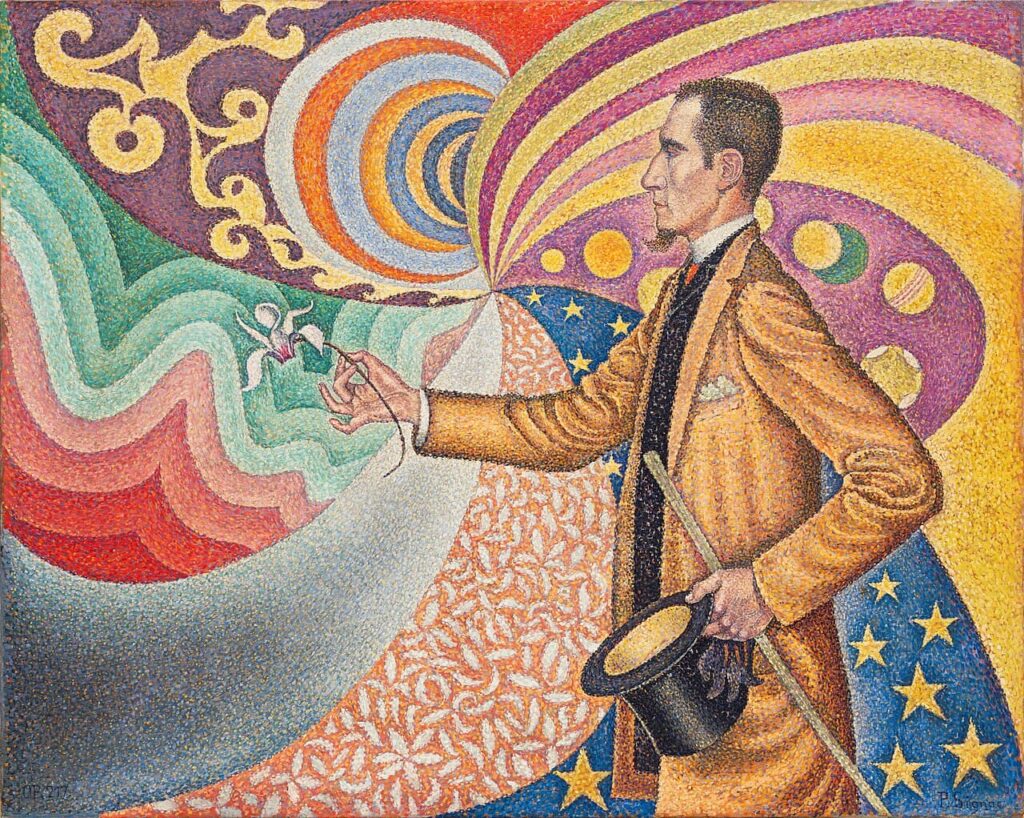
Paul Signac — The Pioneer of Neo-Impressionism →A man stands in profile, wearing a frock coat, with a pointed goatee, a top hat, and a cane in one hand. With his other hand, he delicately holds out a flower, like a magician or a conjurer performing a trick. But it is not the figure that first catches the eye: it is the background. Behind him swirls an extraordinary whirlwind of colors, spirals, stars, and patterns, which seems to burst forth from a central point and envelop the figure in a psychedelic haze. The year is 1890, and Paul Signac has just painted one of the most daring and perplexing works in the entire Neo-Impressionist movement: the Portrait of Félix Fénéon.
This painting, now in the collection of the Museum of Modern Art in New York, is unique among Signac’s works. Although he primarily painted landscapes and harbors, here he creates a portrait of a new kind, blending the precise figure of a man with an entirely abstract and decorative background. It is a tribute: Fénéon was the art critic who had coined the term “Neo-Impressionism” and championed the movement—a friend and comrade-in-arms. But it is also a radical artistic experiment, bordering on abstraction, which anticipated the developments in modern art by several decades.
The contrast between the rigor of the profile and the explosion of the background creates a fascinating tension. The figure, frozen in a pose that is nonetheless dynamic, stands out against a background that is no longer realistic: a kaleidoscope of colorful stripes, spirals, and symbols, inspired by Japanese woodblock prints, occultism, and scientific theories on color and emotion. This work is a manifesto, a game, a provocation, and a pinnacle of inventiveness.
This article explores the secrets behind this extraordinary portrait—who Félix Fénéon was and why Signac paid him this tribute, what the strange flower he is holding signifies, what lies hidden in the swirling background, the sources of this imagery, the meaning of its enigmatic title, and how this perplexing work eventually became one of the treasures of the world’s greatest museum of modern art.
The Painting — What It Depicts
The Portrait of Félix Fénéon is a medium-sized oil on canvas: 73.5 centimeters high by 92.5 centimeters wide. It is in a horizontal format, which is unusual for a portrait and gives the decorative background a considerable sense of scale.
In the foreground, on the right, stands Félix Fénéon, seen in left-side profile. He is depicted in a partial full-length pose, elegantly dressed in a three-piece suit, wearing—or rather holding—a top hat. His silhouette is immediately recognizable thanks to his characteristic pointed goatee, which gave him the air of an American or a theatrical character. In his left hand, he holds his hat, gloves, and cane; with his right hand, he carefully extends a flower—a cyclamen or a lily—toward an unseen recipient outside the frame. His pose suggests movement, elegance, and a form of gallant ceremony, as if he were offering the flower in a theatrical gesture.
But the figure, despite this dynamic pose, appears strangely still, frozen, almost like a cut-out silhouette. And it is the contrast with the background that creates the entire effect of the work. For behind Fénéon unfolds an extraordinary background: a great whirlwind of colorful patterns that seems to emanate from a point behind the figure, spreading out in spirals, fans, and undulating bands of vivid colors. One can make out star-shaped forms, spheres, and geometric and floral patterns, in a dazzling range of purples, greens, oranges, pinks, and yellows.
The entire work is painted using the Divisionist technique, with small, juxtaposed strokes of pure color. But here, Signac applies it to a subject that is anything but a landscape: a portrait set against a purely decorative and abstract background. In 1890, this combination was an absolute novelty.
Who was Félix Fénéon?
To understand this portrait, one must be familiar with its subject, one of the most fascinating figures in late 19th-century Parisian artistic circles: Félix Fénéon (1861–1944).
Fénéon was an art critic, but also a writer, publisher, art dealer, collector, and anarchist activist—a multifaceted and elusive figure at the heart of the progressive cultural life of his time. As a critic, he played a decisive role in art history: it was he who, in 1886, standing before Seurat’s *La Grande Jatte* and the works of his friends, coined the term “Neo-Impressionism” to describe this new movement. It was he who, through his brilliant and insightful articles, defended and helped people understand the paintings of Seurat and Signac, theorized their principles, and ensured their recognition. Without Fénéon, Neo-Impressionism would not have had its spokesperson.
Fénéon shared much more with Signac than just an interest in painting: the two men were bound by friendship and shared political convictions. Both sympathized with the anarchist movement in the bustling Paris of the fin de siècle. In fact, in 1894, Fénéon was arrested and put on trial during the famous “Trial of the Thirty,” which targeted anarchist circles—he was acquitted, and his wit and biting irony in the face of the judges remain legendary.
A man of refined and enigmatic sensibilities, Fénéon was also an exceptional writer. He is notably known for his famous “Three-Line Stories,” brief news items rewritten with consummate artistry in conciseness and irony. An enigmatic dandy, with a studied elegance and a spare way with words, he fascinated his contemporaries. In painting his portrait, Signac immortalized not only a friend and ally, but one of the sharpest and most original minds of his time—the godfather, so to speak, of the movement to which they both belonged.
The Dandy and the Flower
The figure of Fénéon, as depicted by Signac, is anything but a conventional portrait. The painter has captured the essence of the character: his elegance, his mystery, and his theatrical and elusive nature.
The clean profile, reminiscent of a medallion or an ancient effigy, lends Fénéon an almost hieratic dignity. His pointed goatee, his lanky build, and his impeccable attire make him an instantly recognizable figure—almost an elegant caricature. Signac plays on this physical distinctiveness to create a memorable image, in which the subject is recognizable at first glance.
But it is the gesture that intrigues us most: Fénéon extends a flower, with studied delicacy, toward a recipient we cannot see. There is something ceremonial and gallant about this gesture, but also something theatrical, almost magical. Some commentators have compared Fénéon to a magician performing a trick, or to a master of ceremonies. The flower, a symbol of tenderness and irony, contrasts with the character’s sternness and introduces a touch of poetic strangeness. It has even been suggested that this gesture—through which the critic seems to present or “inaugurate” the colorful whirlwind surrounding him—made Fénéon a sort of high priest of Neo-Impressionism, pointing to the new style of painting with a single gesture.
This ambiguity is deliberate. Signac does not paint a traditional psychological portrait: he creates an emblematic image, halfway between a portrait, a poster, and an allegory. Fénéon is not merely a man: he is a figure, a symbol, the representative of a world—that of the avant-garde, of enlightened criticism, of fin-de-siècle refinement. The dandy with the flower becomes the icon of an era and a movement.
The Swirling Depths — The Science of Charles Henry
The true highlight of the work—what makes it so unique and so modern—is its background. Far from being mere decoration, this whirlwind of colors and patterns is the result of precise theoretical research linked to the scientific ideas about color and emotion that fascinated Signac and his circle.
The primary source for this is the work of Charles Henry, a theorist of aesthetics and optics and a friend of Signac and Fénéon. In 1888, Henry published a book titled *Cercle chromatique*, in which he developed theories about the correspondences between the properties of shapes, colors, and directions, on the one hand, and the expression of emotions, on the other. According to him, certain lines, certain colors, and certain orientations produce specific sensations—cheerfulness, sadness, calm, and excitement. This is what came to be known as his theory of “dynamogeny.”
Signac and Fénéon were passionate about these ideas, which promised to ground art in a scientific foundation. Signac even collaborated with Charles Henry, illustrating some of his publications. The background of the portrait is an application—or a playful homage—to these theories: the swirl of colors, curved lines, and patterns is constructed according to the principles of correspondence between forms, colors, and emotions. Every direction and every hue is said to have its own expressive value. The background is therefore not a decorative whim: it is a visual demonstration of the science of color and sensation.
This theoretical dimension links the portrait to the work of Seurat, who, in his later works such as *Le Cirque*, also applied Charles Henry’s theories on lines and emotions. Signac and Seurat shared this same fascination with a scientific aesthetic, in which art would no longer be a matter of intuition alone, but of laws that could be mastered. The Portrait of Fénéon is, in this sense, the most spectacular manifestation of this ambition.
Japonism and Occultism
While Charles Henry’s theory provides the underlying framework, his imagery draws on other sources, which further enrich its uniqueness. Signac weaves together multiple references, characteristic of the rich visual culture of the late 19th century.
The first source is Japonism, that passion for Japanese art that permeated all of Western art at the time. The background of the portrait is clearly inspired by the decorative motifs found on Japanese prints and textiles, which were very fashionable at the time: kimonos, fans, and undulating, stylized patterns. Certain elements of the background, such as the colorful motifs to the left of the figure, directly evoke these Japanese sources. Signac transposes these Eastern decorative motifs into a swirling composition that is entirely his own.
The second, more unexpected source is occultism and mysticism, which were then in vogue in certain Symbolist circles. The globes, celestial bodies, and star-like forms that revolve around Fénéon evoke a cosmic, esoteric, almost astrological imagery. These “astral globes” revolving around the figure lend the work a mysterious dimension, as if Fénéon were at the center of a moving cosmic system. Charles Henry’s scientific rationalism thus paradoxically blends with a mystical imagination.
This combination of influences—science, Japonism, and occultism—makes the composition a work of remarkable richness and strangeness. In it, Signac synthesizes several artistic movements of his time into a unique vision that is at once scholarly and whimsical, rigorous and dreamlike. The result is an image that, through its decorative abstraction and freedom, seems to anticipate Art Nouveau—which would flourish a few years later—and even certain developments in 20th-century abstract art.
A manifesto-style title
The strangeness of the work extends to its title, one of the most curious and longest in the entire history of painting. Signac did not simply title his painting “Portrait of Félix Fénéon”; he gave it a poetic and scholarly title that, in and of itself, constitutes a statement of intent.
The full title of the work is: Opus 217. Set against an enamel backdrop of rhythmic patterns of measures and angles, tones and hues, a portrait of Mr. Félix Fénéon in 1890. Every word deserves attention. The term “Opus,” borrowed from musical vocabulary, suggests that Signac conceived of his paintings much as a composer conceives of his works—numbered and ordered—a way of affirming the abstract and structured nature of his painting, akin to music. The musical reference was dear to the Neo-Impressionists, who dreamed of a form of painting as rigorous and harmonious as music.
The rest of the title—“on the enamel of a rhythmic backdrop of measures and angles, tones and hues”—precisely describes the backdrop of the work in the vocabulary of Charles Henry’s theory. “Measures,” “angles,” “tones,” and “hues” are the very elements of this science of correspondences between forms, colors, and emotions. The title thus serves as a key to understanding the work: it indicates that the background is constructed according to precise rhythmic and chromatic principles, like a visual score.
This manifesto-like title reveals Signac’s ambition. This is not merely a portrait, but an aesthetic demonstration—a work-theory that puts into practice the most advanced ideas of his time on color and sensation. By giving his painting this scholarly and poetic title, Signac affirms the radical modernity of his approach and places his tribute to Fénéon within the broader project of Neo-Impressionism: to establish a new, rigorous, and luminous art.
A unique and perplexing work
The Portrait of Félix Fénéon holds a unique place, not only in Signac’s body of work but in the entire art world of his time. With its boldness, it baffled his contemporaries just as much as it fascinates us today.
When the work was exhibited at the Salon des Indépendants in 1891, it was not well received by most critics. The main criticism centered on the imbalance between the figure and the background: it was felt that the swirling background dominated—or even overwhelmed—the portrait of the subject, thereby violating the conventions of the genre. To eyes accustomed to traditional portraits, in which the background remained discreet and subordinate to the figure, this decorative explosion seemed incongruous, excessive, and disconcerting. Fénéon himself, it is said, did not much appreciate this portrait, perhaps finding it too fanciful.
Yet it is precisely this boldness that today defines the work’s value and modernity. By daring to treat the background as an autonomous abstract composition—almost independent of the figure—Signac anticipated major developments in 20th-century art. The background of the Portrait of Fénéon is, in many respects, one of the first major forays in Western painting toward decorative abstraction. Its formal freedom, its rhythmic use of color, and its rejection of imitation foreshadow Art Nouveau and, beyond that, certain abstract explorations.
This unique work reveals a little-known side of Signac: not only the sailor-painter of harbors and the theorist of Divisionism, but also the daring experimenter, capable of pushing his artistic exploration to the very frontiers of abstraction. The Portrait of Félix Fénéon is undoubtedly his most inventive, most surprising, and most ahead-of-its-time painting—striking proof that the champion of Neo-Impressionism was also a true innovator.
From Fénéon to MoMA
The work’s journey—from Signac’s studio to the world’s largest museum of modern art—mirrors that of its subject: unique and revealing.
After painting and exhibiting it, Signac gave the portrait to his friend Félix Fénéon. The critic kept the work his entire life, until his death in 1944. This gesture sealed the friendship and intellectual bond between the two men: the painting remained in the hands of the man it celebrated, the guardian of both the portrait and the memory of the movement he had named.
Upon Fénéon’s death, his collection was dispersed. The works from his estate were sold at the Hôtel Drouot in Paris in 1947. A touching detail: his widow used the proceeds from this sale to establish the Prix Fénéon, a literary and artistic award designed to support young creators—a way of carrying on, even after his death, the spirit of patronage and advocacy for emerging talent that had driven the critic throughout his life.
The Portrait of Félix Fénéon then made its way to America. It entered the collection of the Museum of Modern Art (MoMA) in New York in 1991, thanks to a donation from Peggy and David Rockefeller. This major New York museum, a temple of modern art, thus welcomed one of the most daring and pioneering works of modern painting. The portrait of the anarchist critic, the godfather of Neo-Impressionism, now takes its place among the seminal masterpieces of 20th-century art—a fitting tribute to a work that, as early as 1890, was already looking far ahead.
How to View the Work Today
The Portrait of Félix Fénéon is housed at the Museum of Modern Art (MoMA) in New York, United States, where it is displayed among the seminal works of modern art. It is there, and there alone, that one can admire the original and fully appreciate the brilliance of its colors and the strangeness of its swirling background.
To explore Signac’s work in Paris, the Musée d’Orsay houses several of his pieces, and the Musée de l’Annonciade in Saint-Tropez features a fine collection of Neo-Impressionist works. But for this specific portrait, you’ll have to travel across the Atlantic—or make do, in Paris, with reproductions and temporary exhibitions where the work is sometimes on loan, as was the case during a major MoMA exhibition at the Louis Vuitton Foundation in 2017–2018.
To further explore Neo-Impressionism and its theoretical context, one might turn to the works of Seurat, particularly *Le Cirque* at the Musée d’Orsay, which applies Charles Henry’s theories on lines and emotion. The dialogue between the two friends who founded the movement, Seurat and Signac, unfolds there in all its richness.
Further Reading
Institutional sources cited
- Museum of Modern Art (MoMA), New York, entry for *Portrait of Félix Fénéon*.
- Encyclopædia Universalis and Larousse, entries on “Paul Signac” and “Neo-Impressionism.”
Sources and Reference Studies
- Charles Henry, *Chromatic Circle* (1888) and *Introduction to a Scientific Aesthetics* (1885).
- Félix Fénéon, *Beyond Impressionism* and Critical Writings (1886 and later).
- Françoise Cachin, *Signac: A Catalog Raisonné of His Paintings*, Gallimard, 2000.
Institutional Documentation
- Museum of Modern Art (MoMA), New York — the institution that houses the work.
- Musée d’Orsay, Paris — to see more works by Signac.
See also on Hors Cadre
- Paul Signac—the Pioneer of Neo-Impressionism —a portrait of the artist, his life, and his role as a pioneer.
- Georges Seurat—the master of color— the friend and founder of the movement, which Fénéon championed and named.
- *The Circus*—Seurat’s final, unfinished work —is another major application of Charles Henry’s theories on lines and emotion.
— M