The Portrait of Monsieur Bertin — Ingres’s Triumphant Bourgeois
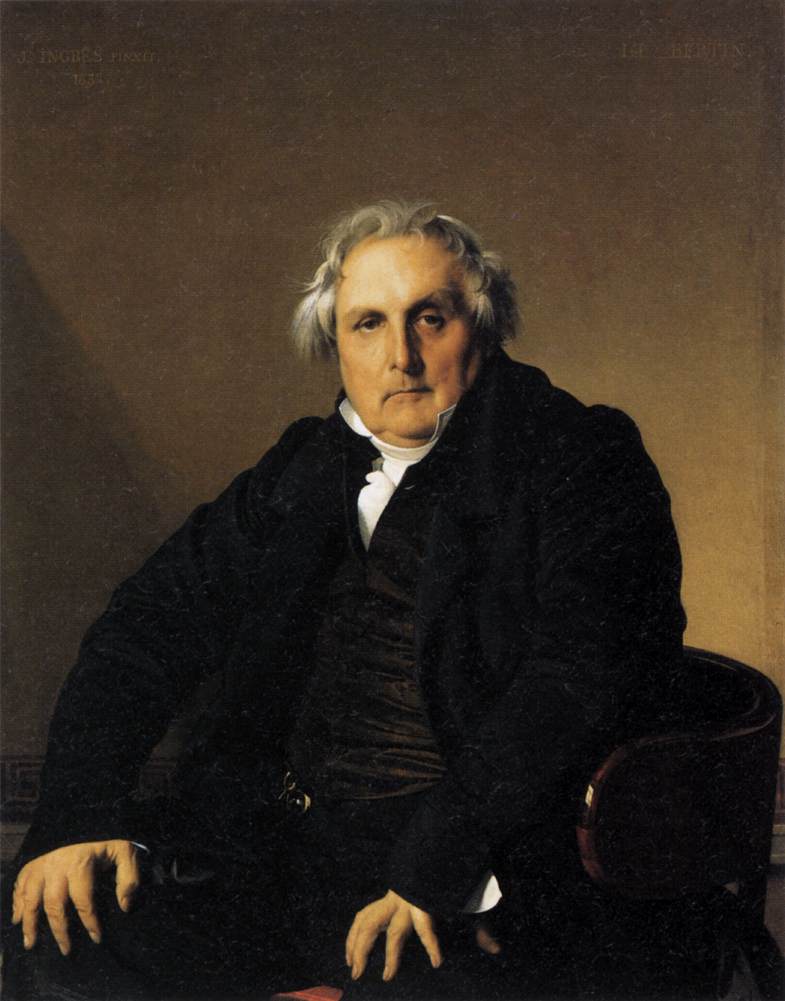
Ingres — The Cult of the Line →An elderly man is sitting across from us, leaning slightly forward, his two powerful hands resting on his widely spread thighs. He stares at us with a direct, piercing gaze, full of confidence and authority. Everything about his posture speaks of strength, confidence, and power: he is a man who knows his worth, who dominates his era, and who never looks down on anyone. This man is Louis-François Bertin, an all-powerful newspaper magnate—and this portrait, painted by Ingres in 1832, is one of the greatest in the entire history of painting.
The Portrait of Monsieur Bertin has become an icon, a symbolic painting: the very image of the triumphant 19th-century bourgeoisie. Through this self-assured and affable gentleman, Ingres captured an entire social type, an entire era—that of the bourgeoisie’s rise to power under the July Monarchy. The painter Édouard Manet summed it up in a famous phrase: Bertin is the Buddha of the sated, affluent, triumphant bourgeoisie. In a single figure, Ingres painted the portrait of a class and an era.
What is so fascinating about this work is its powerful presence. Bertin seems alive, right there before us, with his imposing stature, his gnarled and expressive hands, his piercing gaze, and his tousled gray hair. Far from the smooth idealization of his odalisques, Ingres achieves here a striking, almost raw realism that captures not only the model’s features but also her personality, energy, and very soul. The master of ideal beauty proves himself to be the master of human truth as well.
This article explores the secrets of this masterpiece—who Monsieur Bertin was and what he embodied, the long and difficult process of finding the right pose, the role of the hands and the gaze, the work’s significance as a social symbol, the paradox of its realism, its legacy from the old masters, and the considerable influence of this portrait, which inspired even Picasso.
The Painting — What It Depicts
*Portrait of Monsieur Bertin* is an oil on canvas measuring 116 centimeters high by 95 centimeters wide. The vertical format, focused closely on the face, draws all attention to the subject and his presence.
Bertin is depicted seated, in a three-quarter profile, but with his head almost facing forward, his gaze directed toward the viewer. He is seated in a mahogany office chair, whose varnished armrest captures—in a striking detail—the reflection of a window. His stocky body, weighed down by his corpulence, dominates the space of the painting. He leans slightly forward, both hands resting on his spread thighs, his arms rounded, in a posture that is at once natural, familiar, and imposing. It is the demeanor of a self-assured man, firmly established, who commands the situation.
The composition is rigorously structured in the shape of a pyramid: Bertin’s massive body forms a stable triangle, with the lower body and hands at the base and the head at the apex. This pyramidal structure, rooted in the great classical tradition, lends the figure an imposing monumentality and stability. Bertin appears unshakable, firmly rooted, and monumental, like a statue.
The color palette is understated, almost monochromatic: browns, blacks, and dark shades for the clothing (the frock coat, the satin vest), harmonizing with the beige-brown background. Within this restrained color scheme, two light areas catch the eye: the face, illuminated by a golden light coming from the left and highlighted by the white of the shirt collar, and the hands, the only light spots at the bottom of the painting. Ingres thus focuses all attention on the two essential elements of the portrait: the face and the hands. A few precise details—a gold watch peeking out of a pocket, the reflection of the window on the armrest, the inscription of the name, and the dated signature—complete this image of admirable precision.
Who was Mr. Bertin?
To understand the significance of this portrait, one must know its subject, one of the most powerful figures in Paris at the time: Louis-François Bertin, known as Bertin the Elder.
Born in 1766, Bertin was a newspaper publisher and one of the most influential men of the first half of the 19th century. In 1799, together with his brother, he purchased a modest newspaper, *Le Journal des débats politiques et littéraires*, which he transformed into one of the most powerful and widely read newspapers in France. At a time when the press was becoming a major political force, Bertin held in his hands an instrument of considerable influence, capable of making and breaking reputations and of supporting or opposing governments.
His political career mirrored the ups and downs of French history. A staunch opponent of the Empire—to the point of being exiled for a time by Napoleon—and a supporter of a constitutional and moderate monarchy, he welcomed the Restoration, before distancing himself from the authoritarianism of Charles X. During the Three Glorious Days of 1830, he rallied to Louis-Philippe’s side. Under the July Monarchy, *Le Journal des débats* became the regime’s chief defender and the voice of the business community and the ruling bourgeoisie.
Ingres thus painted a man at the height of his powers, aged sixty-six, in 1832. The painter had been introduced to Bertin through his son Édouard, who was his student, and the critic Delécluze, a friend of Ingres’s and a contributor to the newspaper. Bertin was not merely a model: he embodied a social and political force—the power of the press and the triumphant bourgeoisie. By painting him, Ingres would, perhaps without fully intending to, create the emblematic portrait of an entire class and an entire era.
The Quest for the Perfect Pose
One of the most fascinating aspects of the history of this portrait is the difficulty Ingres had in creating it—and particularly in finding the right pose. This long and agonizing quest reveals the painter’s demands and torments.
Ingres hated painting portraits. He, who dreamed of becoming a history painter, viewed every portrait commission as a chore, a distraction from his true calling. Each time, he wrote to his friends about the despair this work plunged him into. The portrait of Bertin was no exception: Ingres labored over it for a long time, hesitating, doubting, and despairing. He searched for the right pose through numerous preparatory drawings—at least seven studies survive, some of which show Bertin standing in different poses. Ingres even used collages, cutting out and pasting together faces and poses to find the right composition.
The story goes that it was ultimately the model himself who comforted the despairing painter, and that the perfect pose came from a spontaneous observation. According to one account, Ingres caught Bertin sitting in a natural pose during a lively conversation and exclaimed that he had found the portrait. According to another version, it was in Bertin’s parlor, during a lively discussion between the host and his sons about business, that the painter captured the definitive pose. Whatever the truth may be, the anecdote captures the essence: Bertin’s masterful pose, so natural and powerful, arose from the observation of life, not from an academic formula.
Once the pose was decided upon, the execution went relatively quickly—about a month’s work, during which Ingres visited Bertin’s estate several times. This difficult creative process sheds light on the result: if the final pose seems so obvious, so accurate, so lifelike, it is because it was the result of a long search, a relentless effort to capture, beyond mere resemblance, the character’s profound truth. The portrait’s naturalness is the result of considerable work.
The Hands and the Gaze
The full power of *Portrait of Monsieur Bertin* is concentrated in two elements—the two points of light in the painting: the hands and the gaze. It is through them that Ingres conveys the presence, strength, and vitality of his subject.
First, the hands. Resting on his thighs—broad, fleshy, with fingers that are both thick and tapered—they have an extraordinary presence. Far from being a mere detail, they embody much of the portrait’s expressiveness. They convey the man’s strength, power, and authority; they seem to grip his knees with restrained energy, ready to rise, to act, to seize. These gnarled, lifelike hands, rendered with striking realism, are one of the most admired elements of the painting. They alone embody Bertin’s power and vitality.
Next, the gaze. Bertin’s face, bathed in golden light, faces us, and his eyes fix on us with remarkable intensity. This piercing, direct, scrutinizing gaze—full of confidence and intelligence—engages the viewer, almost challenging him. It expresses the personality of a man accustomed to commanding, judging, and dominating. In it we see power, but also insight, quick wit, and perhaps a hint of irony. This gaze makes Bertin a vivid presence, who seems to be observing us just as much as we are observing him.
Ingres’s art lies in his ability to focus all our attention on these two focal points. By immersing the body in a dark palette and concentrating the light on the face and hands, he directs our gaze toward what is essential: expression and gesture, soul and strength. The rest—the clothing, the armchair, the background—is there solely to support and highlight these two focal points. It is through this masterful focus that Ingres achieves such an intense sense of presence.
The Triumphant Bourgeois
“The Portrait of Monsieur Bertin ” has transcended the specific case of its subject to become a symbol: the very image of the triumphant 19th-century bourgeoisie. This is what makes it, beyond its pictorial quality, a major historical and social document.
Bertin is not merely an individual: he embodies an entire social class—that of the upper middle class, which rose to power under the July Monarchy after 1830. This was the era when the bourgeoisie—in business, the press, and finance—became the ruling class, supplanting the old aristocracy. The reign of Louis-Philippe, the “bourgeois king,” was that of this self-assured, prosperous, and triumphant class. And Bertin, a powerful and wealthy media magnate, is an ideal representative of this class. In painting him, Ingres captured, through a single man, the spirit of a class and an era.
This is what Manet expressed in his now-famous statement: “Bertin is the Buddha of the sated, affluent, triumphant bourgeoisie.” The comparison with the Buddha highlights the figure’s imposing massiveness, impassive self-assurance, and quiet power. Bertin sits enthroned, like an idol of the new bourgeois religion—that of money, power, and success. The portrait thus becomes an icon of an era, the quintessential image of a class at the height of its power.
A telling detail: Bertin’s own family was initially concerned about this portrait, perceiving it as a caricature. The unflinching realism of Ingres—who had not idealized the subject but had depicted him in all his good-natured bulk—could indeed seem unflattering. But time has transformed this feared “caricature” into a celebrated masterpiece. For Ingres had not sought to exaggerate or flatter: he had sought to capture the truth of a man and an era. And this truth, more powerful than any flattery, is what makes the work so great today.
A Realistic Portrait — The Paradox of Ingres
“The Portrait of Monsieur Bertin ” contains a fascinating paradox that sheds light on the full complexity of Ingres’s art: this master of idealization, this painter of odalisques with reinvented bodies, achieves here a realism of striking, almost raw truth.
We know Ingres for his idealized nudes, his odalisques with their sublime anatomies, and his figures of pure beauty in which reality is altered in the name of the ideal. Yet in the portrait of Bertin, it is quite the opposite. Ingres corrects nothing, idealizes nothing: he shows Bertin as he is, with his portly figure, his disheveled gray hair, his wrinkles, his loose tie, his thick hands, and his body weighed down by age. Far from erasing imperfections, he paints them with scrupulous, almost merciless precision. It is an uncompromising realism that captures the physical and moral truth of the subject.
How can this realism be reconciled with the pursuit of the ideal that guided Ingres? The fact is that, for Ingres, portraiture follows a different logic than that of the nude or history painting. In portraiture, the goal is not to achieve ideal beauty, but to capture the truth of an individual—their presence and character. And here, Ingres’s genius—his precision as a draftsman, his sense of form, his keen eye for observation—is put at the service of truth rather than the ideal. The same artist who elongated the odalisque’s back paints here, with absolute fidelity, Bertin’s actual body.
This realism in portraiture does not, however, preclude formal mastery. The rigor of the pyramidal composition, the purity of the drawing, the perfection of the brushwork, and the sense of texture are all clearly present, this time in the service of truth. Ingres thus demonstrates the full extent of his genius: capable of idealizing the female form in his nudes, he is also capable of capturing, in his portraits, the most concrete truth of a person. This duality—the ideal and the real, beauty and truth—is one of the deepest riches of his art. And it is this that, paradoxically, brings this portrait closer to the concerns of Realism, which would soon flourish with Courbet.
The Legacy of the Masters
“The Portrait of Monsieur Bertin,” for all its striking realism, is also a profoundly erudite work, drawing on the knowledge of the great masters of the past. Ingres, heir to the entire tradition of portraiture, brings together several prestigious influences in this painting.
Ingres’s most constant point of reference was Raphael, whom he revered above all else. The almost monochromatic color palette of the portrait of Bertin—its browns and blacks set against a muted background—is reminiscent of Raphael’s famous Portrait of Balthazar Castiglione, the model of a noble and understated portrait. The composition, the figure’s dignity, and the attention to psychological detail all stem from this Raphaelesque legacy.
But Ingres also drew inspiration from other sources. First, from the masters of the Northern Renaissance: the Flemish Primitives, Van Eyck, Memling, and Holbein, whose meticulousness and precision in rendering textures and details he admired. The famous reflection of the window on the armrest of the chair is a direct reference to these Flemish painters, who were masters of this kind of detail. The realism of the portrait and the meticulous attention to the textures of the skin and fabrics are reminiscent of their art. Critics of the time, in fact, compared Bertin to Holbein’s portraits, one of which was on display at the Louvre. Finally, Titian, the Venetian master of portraiture, is another possible source, particularly regarding the model’s pose and physical presence.
This erudition is never heavy-handed. Ingres absorbs his sources, assimilates them, and fuses them into a personal creation of perfect originality. The portrait of Bertin is not a scholarly pastiche: it is a living work that continues the great tradition of European portraiture while enriching it. By combining the nobility of Raphael, the meticulousness of the Flemish, and the presence of the Venetians, Ingres creates the definitive portrait of his time—a masterpiece that rivals those of the old masters he admired.
Posterity — From Bertin to Picasso
“The Portrait of Monsieur Bertin ” had a considerable influence on the art that followed it, becoming a model for portrait artists and inspiring even the greatest masters of the modern era.
Even in its day, when it was exhibited at the 1833 Salon, the portrait was a great success and cemented Ingres’s reputation as one of the greatest portraitists of his time. It became a model for the academic painters of the next generation, such as Léon Bonnat, who drew inspiration from it for their own portraits of prominent figures, adopting this style of depicting a powerful figure filling the entire space.
But the most remarkable—and most unexpected—influence was that exerted by Bertin’s portrait on modern art—and particularly on Pablo Picasso. Fascinated by the composition and presence of Ingres’s portraits, Picasso drew on them on several occasions. In his famous Portrait of Gertrude Stein (1905–1906), he adopts the three-quarter pose, the pyramidal composition, and the emphasis on the face and hands—all elements directly inherited from Bertin. And even at the height of his Cubist period, in his *Portrait of Kahnweiler*, we find this same pyramidal structure and focus on the figure. The powerful art dealer depicted seated by Picasso is the distant heir to the newspaper magnate painted by Ingres.
This legacy illustrates the paradox of Ingres’s art, one already encountered in connection with *La Grande Odalisque*: the classical painter, a defender of tradition, turns out to be one of the inspirations for modernity. His approach to constructing a figure, positioning it in space, and focusing attention on the essential has fueled the explorations of modern artists. The Portrait of Monsieur Bertin, an image of the triumphant bourgeoisie of 1830, has thus become a model for the modern portrait, from Bonnat to Picasso. The truth of an era has become a lesson for the centuries to come.
From the Bertin Family to the Louvre
The journey of the *Portrait of Monsieur Bertin*, from its commission to its display on the walls of the Louvre, remained a family affair for a long time before it became a national treasure.
The portrait had been commissioned and paid for by Bertin himself in 1832. Upon his death in 1841, the work remained in his family, passed down from generation to generation. It first passed to his daughter, Louise Bertin, a woman of letters and a talented composer. It then passed to a niece, Marie Bertin, wife of Jules Bapst, who was himself editor-in-chief of the *Journal des débats* —thus keeping the portrait linked to the newspaper Bertin had founded. Finally, it passed to their daughter, Cécile, the last member of the family to own it.
It was not until 1897 that the portrait left the Bertin family and entered a public collection: Cécile sold it to the Louvre Museum. The great Parisian museum thus acquired one of the finest portraits in all of French painting, which has been on permanent display there ever since, among the masterpieces of the 19th-century French school.
Since its arrival at the Louvre, the *Portrait of Monsieur Bertin* has never ceased to fascinate visitors and inspire artists. An iconic painting, a symbol of the triumphant bourgeoisie, and the pinnacle of portraiture, it is today considered Ingres’s finest male portrait and one of the greatest in the entire history of art. Standing before this imposing figure with his piercing gaze, the 21st-century visitor still feels the living presence of this man of power, immortalized for eternity by Ingres’s genius.
How to View the Work Today
The Portrait of Monsieur Bertin is housed at the Louvre Museum in Paris, where it is on display among the 19th-century French paintings. The Louvre’s main entrance provides access to these galleries; since the museum is so crowded, it’s best to book your ticket in advance and visit during off-peak hours.
Seeing the work in person allows one to appreciate what is lost in reproductions: the figure’s physical presence, the golden light on the face and hands, the subtlety of the dark monochromatic tones, and the precision of the details—the gold watch, the reflection of the window on the armrest. It is in this direct encounter that Bertin’s gaze reveals its full power and that we understand why this portrait is considered a masterpiece.
To further explore Ingres’s work, the Louvre houses his other masterpieces— *The Grande Odalisque*, *The Turkish Bath*, *The Valpinçon Bather*, and *The Apotheosis of Homer*. Comparing Bertin’s portrait with the odalisques reveals the full extent of Ingres’s genius: the master of reality and the master of the ideal brought together in a single museum. And the Ingres-Bourdelle Museum in Montauban houses several preparatory studies for the portrait of Bertin, which allow visitors to trace the evolution of the pose.
Further Reading
Institutional sources cited
- Louvre Museum, “The Portrait of Monsieur Bertin” exhibition.
- History of the Arts (Ministry of Culture), Louis-François Bertin: A Closer Look at His Work.
- Ingres-Bourdelle Museum, Montauban (preparatory studies).
Sources and Reference Studies
- Charles Blanc, *Ingres: His Life and Works*, 1870.
- Adrien Goetz, *Ingres Collages*, Musée Ingres, 2006.
- Uwe Fleckner, *Image and Abstraction: The Art of the Portrait in the Work of J.-A.-D. Ingres*.
Institutional Documentation
- Louvre Museum, Paris — the institution that houses the work.
- Ingres-Bourdelle Museum, Montauban — preparatory studies for the portrait.
See also on Hors Cadre
- Ingres—The Cult of the Line —A Portrait of the Artist, His Life, and His Art.
- The Grande Odalisque—Ingres’s “ideal line”— the other side of Ingres’s genius: the idealization of the nude, as opposed to the realism of portraiture.
- Gustave Courbet—the scandal of reality —the master of realism, whose portrayal of the bourgeoisie echoes that of Bertin.
— M