The Pietà — Michelangelo’s early masterpiece
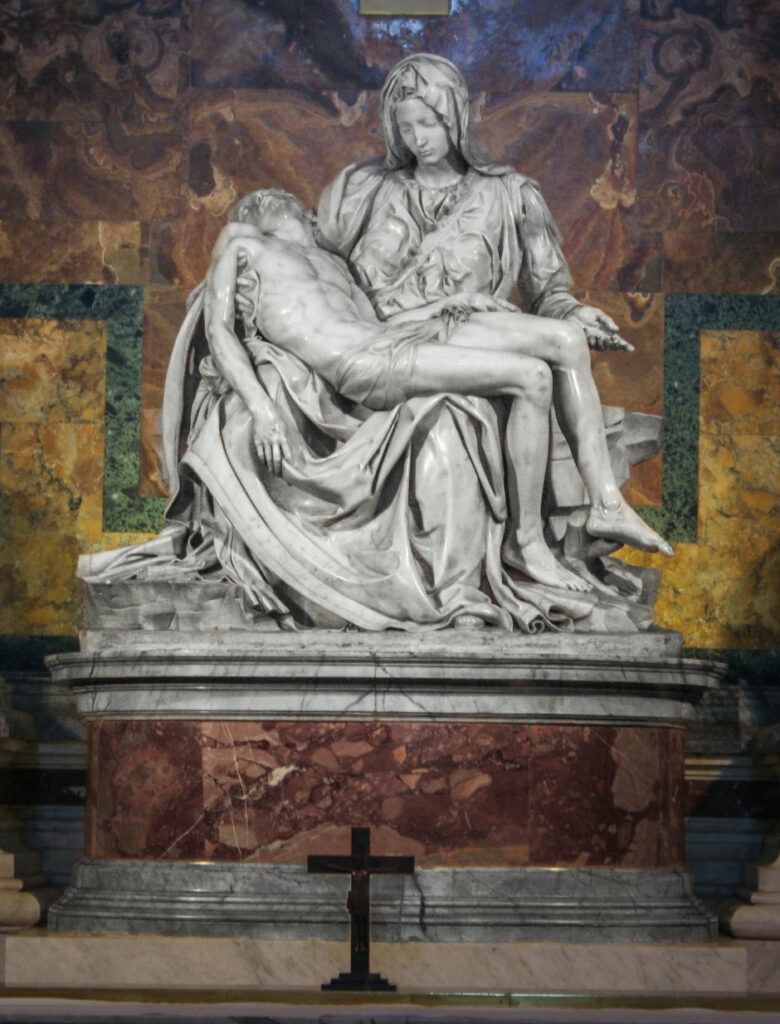
Michelangelo — Power and the Sublime →A young woman sits with her head bowed, holding her son’s lifeless body on her lap. The marble is so polished that it seems to have retained the softness of the skin, the suppleness of the cloth, and the stillness of the dead flesh. Nothing screams, nothing is torn apart: the pain here is all restraint and silence. This is Michelangelo’s Pietà —one of the most perfect sculptures ever carved, and the work of an artist who was not yet twenty-five years old.
Sculpted in Rome between 1498 and 1499, it depicts the Virgin Mary holding Christ after he was taken down from the Cross, before his burial. It was a commissioned work, intended for the funerary monument of a French cardinal, and its subject originates from northern Europe, where this devotional image had long been widespread. Michelangelo took this image and transformed it: he created a composition of supreme balance, in which classical beauty is united with the most intimate emotion.
The work immediately established its creator’s reputation. It also has a unique feature unmatched in his career: it is the only sculpture Michelangelo ever signed, engraving his name on the sash across the Virgin’s chest—a gesture of pride that has been preserved in legend.
This article explores the secrets of this masterpiece—what it depicts, the commission that led to its creation, the artistry of its composition, the mystery surrounding Mary’s youth, the story behind the signature, and the fate of a work now protected behind a glass panel.
Sculpture: What It Depicts
The Pietà is a sculpture carved from a single block of white Carrara marble; the seated figures are slightly larger than life-size. It depicts the theme of the Sorrowful Virgin—the Mater dolorosa—holding the body of Christ on her lap, between the Descent from the Cross and the Entombment.
Mary is seated, draped in a loose-fitting garment whose folds spread out widely around her, forming a sort of living pedestal. Her head is tilted toward her son, her face lowered, her eyelids heavy. Her right hand passes under Christ’s shoulder and supports him, her fingers gently sinking into the flesh beneath his arm—a detail of deeply moving accuracy that conveys both the tenderness of the gesture and the weight of the dead body. Her left hand, open with the palm facing upward, extends in a gesture of offering and helplessness, as if she were presenting her son to the world while acknowledging that there is nothing she can do.
The body of Christ rests diagonally across his mother’s lap. He is naked, except for a cloth, and his state of utter abandonment is complete: his head thrown back, his right arm hanging down to the base, his legs crossed—everything conveys the weight of death. Michelangelo renders with admirable precision the way a lifeless body sags, the way gravity affects every limb. And yet, this tortured body bears almost no trace of violence: the wounds are subtle, the face serene. Death is present, but stripped of its horror.
What is truly striking, finally, is the polish of the marble. Michelangelo worked on it for weeks with pumice stone until he achieved a surface that catches the light and makes the difference between the materials perceptible: the softness of the skin, the dryness of the hair, the heaviness of the fabrics, the firmness of the bones beneath the flesh. Rarely has marble appeared so lifelike.
A French Commission in Rome
The work was created in response to a specific commission, in a context that partly explains its subject matter and treatment—and serves as a reminder that this Italian masterpiece owes its existence to a French prelate.
The patron was Cardinal Jean de Bilhères-Lagraulas, abbot of Saint-Denis and the King of France’s ambassador to the pope. Based in Rome, he wanted a sculpted group for his funerary monument in a chapel adjoining the ancient St. Peter’s Basilica. The contract was signed in 1498, through the mediation of a Roman banker who was a patron of the young artist, and stipulated a substantial fee as well as a one-year deadline. Michelangelo, who was only in his twenties at the time, secured a major commission.
The subject itself originates from northern Europe. The Pietà—the Virgin holding her son’s body on her lap—had long been a widespread motif of devotion in France and the Germanic countries, where it was often depicted in an expressive, even brutal manner, emphasizing the wounds and suffering. It was, however, uncommon in Italy. The choice of a French patron therefore explains this import: Michelangelo was given a theme foreign to his tradition and had to adapt it to the Italian ideal.
That is precisely where his stroke of genius lies. Whereas Northern Pietàs sought to captivate the viewer through pathos and horror, Michelangelo chose serenity, beauty, and restraint. He preserves the emotional power of the subject but transposes it into the language of the High Renaissance: balance of forms, idealization of the body, and nobility of posture. The pain is not shown; it is contained—and becomes all the more poignant for it.
The work was moved several times during the construction projects that saw the old St. Peter’s Basilica give way to the new one. In the 18th century, it was placed in the chapel where it can be seen today—the first one on the right as you enter the basilica. When viewing it from a distance, it is important to remember that it was designed to be seen up close, next to a tomb, in the contemplative atmosphere of a funeral chapel.
The Science of Composition
Beneath its apparent emotion, the *Pietà* is based on a structure of admirable precision, which solves a problem that sculptors before Michelangelo had never been able to tackle with such ease.
The problem was this: how could the body of a grown man be placed on the lap of a seated woman without making the composition appear unstable, disproportionate, or grotesque? Northern artists often solved this by stiffening the figure of Christ, reducing his size, and treating him like a puppet. Michelangelo, on the other hand, considerably enlarged the figure of Mary beneath the drapery: her garment, with its ample, deep folds, creates a broad and solid base on which the body can rest naturally. The volume of the fabric conceals this intentional disproportion and gives the group its stability.
The composition forms an almost perfect triangle, with the Virgin’s tilted head at its apex and the expanse of the drapery at its base. This geometric figure—a stable, harmonious form cherished during the Renaissance—unifies the two figures and lends the scene its monumental calm. Many have also seen in it a symbol of the Trinity. The diagonal line formed by Christ’s body cuts across this structure and animates it, preventing the composition from becoming static.
The contrast between materials and postures does the rest. The naked, smooth body of Christ, in a state of abandonment, stands out against the turbulent drapery of his mother; the horizontal line of death intersects with the vertical line of the one who remains alive. In this way, Michelangelo creates, within a perfectly balanced composition, a constant tension between abandonment and support, death and life.
Such mastery in an artist in his twenties borders on the miraculous. It explains the work’s immediate impact: the Romans discovered that a very young man had just solved, with supreme elegance, a problem that his elders had been unable to overcome. The Pietà made him a master overnight.
The Mystery of Mary’s Youth
One detail intrigues anyone who looks closely at the work: the Virgin appears younger than her son. This apparent incongruity has been the subject of much discussion and sheds light on Michelangelo’s thinking.
Mary’s face is that of a very young woman, almost a teenager: smooth features, wrinkle-free skin, and an expression of unspoiled freshness. Yet she has the body of a thirty-three-year-old man. The contradiction is striking, and it was noted even at the time: the sculptor was questioned about this choice, which seemed to defy plausibility.
The answer traditionally attributed to him is as much a matter of theology as it is of aesthetics. Michelangelo is said to have explained that purity protects against the ravages of time: Mary’s virginity and holiness justified her being spared from aging, her youth making her state of grace visible. This conception, rooted in the Neoplatonism he had absorbed among the Medici, makes physical beauty the tangible reflection of spiritual perfection. Mary’s youth is not an error of observation: it is a theological statement rendered in marble.
There is another reason, one that is more strictly artistic. By giving Mary this timeless face, Michelangelo elevates her above the anecdotal. She is no longer merely a mother at a specific moment in history; she becomes a universal figure of grief and acceptance. Her youth suspends time, just as the serenity of her face suspends the cry. This is what gives the work its timeless significance.
For that is precisely where the emotion of the Pietà lies: in what it does not show. Mary does not scream, does not wring her hands, does not raise her eyes to heaven. She lowers her gaze toward her child, and her entire grief is contained in that tilt of her head, in that open hand that moves away. Michelangelo understood that restrained suffering touches us more deeply than suffering on full display. It is the expression, as has been written, of resigned acceptance of pain—and that is what, five centuries later, continues to move visitors.
The only signed work
The Pietà is unique among Michelangelo’s works: it is the only one he ever signed. The story behind this signature, as recounted by his biographers, speaks volumes about the man’s character.
Across the strip of fabric that runs diagonally across the Virgin’s chest is a Latin inscription: “Michelangelo Buonarroti, a Florentine, made this.” It is visible to anyone who approaches and follows the ribbon with their eyes. None of his other sculptures bears his name.
According to Vasari’s account, shortly after the work was installed, Michelangelo reportedly caught a group of visitors attributing it to a Lombard sculptor who was then in vogue. Furious that his masterpiece was being credited to someone else, he is said to have returned to the chapel at night, with his tools and a lantern, to engrave his name on the ribbon. The anecdote may be embellished, but it fits the artist’s character well: proud, self-assured, and unable to bear having what was rightfully his disputed.
What is most revealing is what happened next. Michelangelo, it is said, later regretted this act of vanity and decided never to sign any of his works again. His style would become his signature; its power alone would be enough to identify him. In fact, the David, the Sistine Chapel frescoes, the Moses, and the Medici tombs bear no name—and no one has ever needed to be told who created them.
This unique signature sets the *Pietà* apart: it marks the precise moment when a very young man became aware of his genius and claimed it as his own. It marks the beginning of the most impressive career of the Renaissance.
The Fate of a Masterpiece
Like so many famous works of art, the Pietà has survived the centuries through a series of relocations, risks, and a dramatic episode that forever changed the way it is viewed.
For two and a half centuries, the sculpture followed the transformations of the Vatican, being moved as the old basilica was demolished and the new one was built. In 1749, it found its current location in the first chapel of the right aisle, where it remains to this day. Its fame had only grown, and it had become one of the main attractions for visitors to St. Peter’s.
In 1972, a man managed to get close to the sculpture and struck it with a hammer, severely damaging the Virgin’s arm and face. The incident caused a worldwide outcry. A long and meticulous restoration process restored the sculpture’s apparent integrity by reusing the recovered fragments. Since then, the Pietà has been protected by a wall of bulletproof glass and can now only be viewed from a distance—a necessary measure, but one that deprives visitors of the intimacy for which the work was originally intended.
This tragedy marked a turning point in how masterpieces on display in places of worship and museums are protected, at a time when visitor numbers were skyrocketing. It also serves as a reminder of the fragility of these objects that we believe to be eternal: it took only a few seconds to jeopardize five centuries of history.
The Pietà remains, nonetheless, one of the most admired sculptures in the world. An early work by an artist who would live another sixty-five years, it already foreshadows everything he would become—absolute mastery of marble, a celebration of the body, spiritual depth—in a gentle style that he would later abandon in favor of power. Michelangelo would return to the subject toward the end of his life, in late, deeply moving Pietàs, left unfinished, where the roughly hewn marble conveys an entirely different kind of despair. Between the serenity of this one and the torment of those lies an artist’s entire life.
How to View the Work Today
The Pietà is located in St. Peter’s Basilica in the Vatican, Rome, in the first chapel on the right as you enter. It can be viewed during the basilica’s hours of operation, and admission is free.
Keep in mind that viewing takes place from a distance, behind a protective glass partition, and often amid a dense crowd: the chapel is one of the first stops for visitors. It’s best to arrive early in the morning, right when it opens, to enjoy some peace and quiet. Access to the basilica requires passing through a security check and adhering to a dress code that requires shoulders and knees to be covered.
Despite these limitations, the emotional impact remains undiminished. The quality of the marble, the polished surface, the balance of the group, and the gentleness of Mary’s face are striking even from a distance. One must take the time to look for the young sculptor’s signature on the ribbon across the Virgin’s chest.
A visit to St. Peter’s is naturally complemented by a visit to the nearby Vatican Museums, where the Sistine Chapel offers a glimpse into another facet of Michelangelo’s genius—that of the painter. And in Florence, the Galleria dell’Accademia houses the David, as well as the unfinished Slaves. From Rome to Florence, you can thus explore the entire body of work by this titan of the Renaissance.
Further Reading
Institutional sources cited
- St. Peter’s Basilica in the Vatican, description of the Pietà.
- Giorgio Vasari, *The Lives of the Most Excellent Painters* (1568).
Sources and Reference Studies
- Antonio Forcellino, Michelangelo: A Restless Life.
- Vatican documentation on the restoration of the Pietà.
Institutional Documentation
- Vatican Museums — information about visiting the Vatican.
See also on Hors Cadre
- Michelangelo—Power and the Sublime —A Portrait of the Artist, His Life, and His Art.
- The David—Michelangelo’s marble hero —the sculptural masterpiece that followed the Pietà and brought him fame in Florence.
- The ceiling of the Sistine Chapel—Michelangelo’s “Heaven “—the other side of his genius, that of the painter.
— M