The Birth of Venus — Botticelli’s Pagan Dream
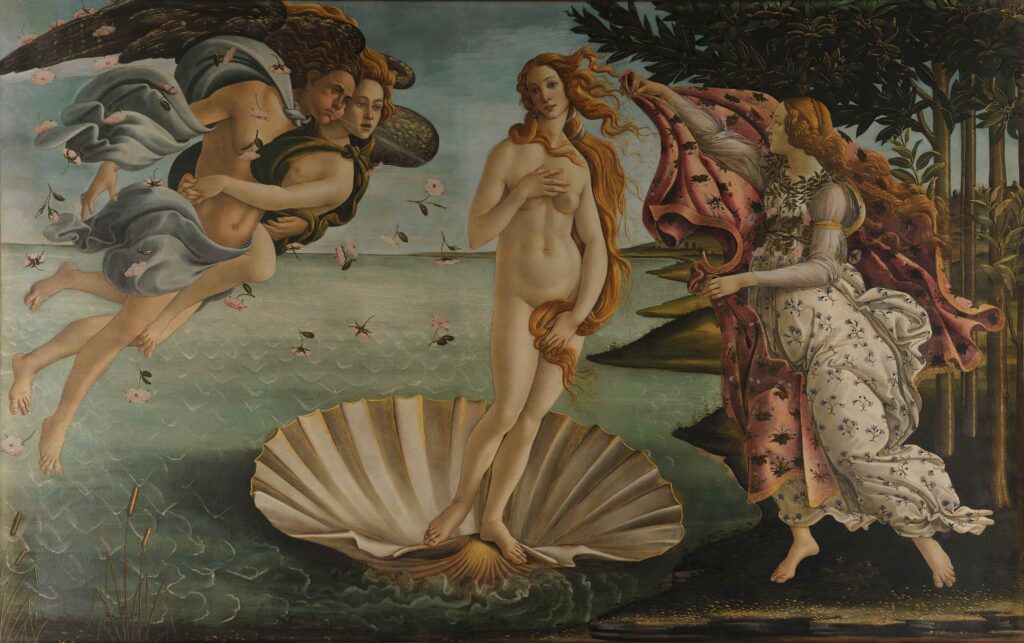
Botticelli — Line and Melancholy →She has just emerged from the foam, and already she is looking at us. Standing on a huge seashell drifting toward the shore, the naked goddess modestly sweeps her long hair in front of her, her head tilted, her gaze unfocused and distant. On the left, two winged figures entwined are blowing the wind that carries her toward the land, amid a shower of roses. On the right, a young woman steps forward to drape a flowered cloak over her. This is Sandro Botticelli’s *The Birth of Venus* —one of the most famous images in the world, and one of the most beautiful dreams that painting has ever produced.
Painted around 1485 for a Medici villa, this large canvas marks a decisive moment: for the first time since antiquity, a painter depicted a life-size nude female figure without a biblical pretext. This is no longer Eve expelled from Paradise; it is a pagan goddess, celebrated for her beauty alone. To dare to do this in the Christian Florence of the Quattrocento required the protection of the Medici and the endorsement of scholarly philosophy.
The painting also represents the pinnacle of Botticelli’s art. Everything in it is line, rhythm, and arabesque: the flowing hair, the billowing drapery, the bodies outlined with incomparable purity. Nothing in it is realistic—Venus’s neck is too long, her shoulders impossible, the shell floats weightlessly—yet everything is just right, with a poetic accuracy that defies the rules.
This article explores the secrets of this masterpiece—what it depicts, the commission that gave rise to it, the boldness of this rediscovered nude, the artistry of its lines, the meanings that have been ascribed to it, and the universal fame of an image that has become an emblem of the Renaissance.
The Painting — What It Depicts
*The Birth of Venus* is a large tempera painting on canvas—an unusual medium at the time in Florence, where artists typically painted on wood—measuring approximately 172.5 centimeters high by 278.5 centimeters wide. This horizontal, almost panoramic format is well-suited to a scene that unfolds from the sea toward the shore.
In the center, Venus stands on a large scallop shell, which serves as her boat. She is nude, in a pose inspired by ancient statuary: one hand resting on her chest, the other holding the long mass of her blond hair in front of her. Her body curves gently, her weight resting on one leg, her hip shifted to the side. Her head tilts slightly, and her face expresses a dreamy, somewhat sad solemnity, as if she were not quite present in the scene.
On the left, two winged figures entwined are flying above the waves: Zephyr, the west wind, puffing out his cheeks to blow, and a companion—a nymph or the personification of a breeze—clinging to him. Their breath, depicted as lines, pushes the shell toward the shore, while a shower of roses falls around them. The intertwined bodies of this couple form one of the most admirable motifs in the painting, full of twists and flowing drapery.
On the right, on the shore, a young woman runs toward the goddess, her feet barely touching the grass, her flowered gown billowing in the wind. She holds out a loose-fitting red cloak embroidered with flowers, ready to wrap around the goddess. She is generally identified as one of the Hours, the deities of the seasons—specifically, the Hour of Spring. Behind her, a grove of orange trees with dark trunks frames the composition.
The sea, however, is not a real sea: it is a pale green surface streaked with small, stylized V-shaped waves, lacking both depth and transparency. The sky is a light-colored, almost abstract background. Botticelli is not seeking to create any illusion: he is composing a poetic theatrical setting, where the beauty of the forms is all that matters.
A commission for a Medici villa
The painting was not commissioned by a government or religious institution, but was created in a private and refined setting, which largely explains its boldness.
The painting was commissioned for Lorenzo di Pierfrancesco de’ Medici, a cousin of Lorenzo the Magnificent, a cultured young man with close ties to the circle of Florentine philosophers. It was intended for a country villa belonging to the family, where, according to Vasari—who saw them together there in the mid-16th century—it hung alongside Botticelli’s *Spring *. The two paintings thus formed, if not a pair conceived from the outset, at least a coherent decorative ensemble.
This private setting is crucial. A nude Venus two meters fifty wide, displayed in a church or a public palace, would have been inconceivable. In a villa, reserved for the family and a few cultured acquaintances, it became possible. The painting was intended for a select audience, one capable of appreciating its classical references and deciphering its philosophical allusions.
The subject itself comes from specific literary sources. The myth of Venus’s birth—emerging from the sea foam and landing on Cyprus—was recounted by ancient authors. But Botticelli drew his inspiration above all from a contemporary poem: the verses of Angelo Politiano, a poet at the Medici court, who described the goddess carried by the winds, the shell, the flowers, and her welcome on the shore. The painter thus worked in direct dialogue with the poets of his circle.
One mystery remains: unlike *The Spring*, *The Birth of Venus* does not appear in the inventories of the Medici’s possessions from the late 15th and early 16th centuries. Its exact status and location during those years therefore remain unknown. The painting, now so famous, went through a long period with no documented records before it became part of Florence’s public collections.
The Boldness of a Nude
What this painting achieves—and what gives it its historical significance—is the return of the secular female nude to Western painting—after nearly a thousand years of absence.
Throughout the Middle Ages, a nude woman could appear in a painting only in a biblical context: Eve in the Garden of Eden, the damned in the Last Judgment, and a few female martyrs. Nudity was associated with sin, shame, or punishment. Depicting a female body solely for its beauty, without any religious justification, was unthinkable.
Botticelli breaks with this tradition. His Venus is neither a sinner nor a damned soul: she is celebrated. Her nudity evokes neither shame nor condemnation, but admiration. Life-size and occupying the exact center of the composition, she presents herself to the viewer as an object of aesthetic and philosophical contemplation. This is a significant shift, one that paved the way for the entire tradition of the nude in the Renaissance and the centuries that followed.
The pose itself explicitly references antiquity. Venus adopts the pose of the *Venus pudica*—the “modest Venus”—a well-known type of Greek statuary, of which the Medici owned a Roman replica in their collections. By referencing this ancient model, Botticelli places his painting within a prestigious tradition: he is not creating a scandalous innovation, but rather reviving a lost art form. This scholarly reference justifies his boldness.
The gesture of modesty is, in fact, ambiguous, and that is what makes it so subtle. Venus covers herself, but this gesture draws the eye just as much as it diverts it; her hand and her hair conceal without truly hiding. This tension between modesty and exposure, between restraint and offering, would become one of the enduring themes of Western nude art.
The Science of the Line
Technically, the painting is a manifesto of everything Botticelli stands for in opposition to the artistic trends of his time—and that is what gives it its unique charm.
Contour reigns supreme. Every form is outlined by a continuous, precise, elegant line that sets it apart from the background. Venus’s hair, in particular, is a marvel: long, wavy locks, interwoven with golden threads, that unfurl in arabesques in the wind and become an ornament in their own right, almost abstract. The drapery follows the same principle: it does not fall under the force of gravity; rather, it forms shapes.
Botticelli deliberately eschews depth. While his Florentine contemporaries were fascinated by perspective and the construction of space, he flattens his scene, reduces the sea to a decorative motif, and places his figures almost on the same plane. He also rejected three-dimensional modeling: his bodies have little shading and are illuminated by an even light that creates no depth. Nothing should disturb the purity of the outline.
The anatomical distortions reflect the same artistic choice. Venus’s neck is clearly too long, her shoulders too slumped, her left arm positioned in an impossible way, and her posture on the shell unstable. These artistic liberties are not signs of a lack of skill on the artist’s part—Botticelli knew how to draw the human form. They are deliberate choices: he elongates, curves, and softens the lines to achieve the most musical composition, even if it means deviating from anatomical accuracy. Beauty takes precedence over accuracy.
The result is this sense of weightlessness that defines the painting. No one has any weight: Venus isn’t really leaning on her shell, Time barely touches the ground, and the winds float. Everything is suspended, as in a dream where the laws of matter have been abolished. This is precisely what makes the image unforgettable—and what sets it radically apart from the artistic revolution that Leonardo and Michelangelo would bring about a generation later.
What does this table mean?
Few works have given rise to so many interpretations. This very abundance says something about the nature of the painting: conceived for a circle of initiates, it was imbued from the outset with a meaning that went beyond a mere illustration of the myth.
The Neoplatonic interpretation is the most traditional. According to the philosophy of Marsilio Ficino, who was a leading figure in the Medici circle, there are two Venuses: the celestial Venus, born without a mother from the foam, who embodies spiritual love and divine beauty; and the terrestrial Venus, who presides over physical love and procreation. The nude Venus in *The Birth* is said to be the celestial Venus, whose very nudity signifies purity—the stripping away of all matter. Her sadness is explained by this spiritual nature, alien to the world into which she enters.
Some have suggested seeing in it a broader birth: that of *Humanitas*, of humanity itself, as it ascends to culture and beauty. Venus emerging from the waters would then be an allegory of the human spirit coming into the world, welcomed by nature and soon clothed—that is, civilized.
Others have pointed out a possible Christian resonance, which would be nothing out of the ordinary in this milieu, where people sought to reconcile Plato and the Gospel. The figure emerging from the waters is said to evoke the soul being born through baptism; some have even noted the compositional similarities to certain depictions of the baptism of Christ. In this interpretation, Venus would foreshadow the Virgin Mary—one born of the foam, the other of mystery.
Finally, the connection with *Le Printemps* lends itself to a holistic interpretation. Since the two paintings were brought together in the same villa, attempts have been made to interpret them as a sequence: *The Birth* would represent the earlier moment—the arrival of the goddess—while *Spring* would show her settled in her garden, reigning over love. Venus appears nude in one and clothed in the other—the two poles of the same figure.
None of these interpretations is absolutely definitive, and Botticelli left no explanation. This is perhaps the best proof of the painting’s success: it continues to provoke thought, without ever allowing itself to be reduced to a single interpretation.
The Glory of an Image
“The Birth of Venus ” had a two-part history: three centuries of indifference, followed by worldwide fame that has never waned.
After Botticelli’s death, the painting fell into obscurity along with its creator. It remained in the Medici collection, rarely seen, seldom discussed, and overlooked by art lovers who preferred the masters of the High Renaissance. It entered the Uffizi’s collections in the 19th century, just as perceptions of Botticelli were beginning to change.
This rediscovery came from the English Pre-Raphaelites and the critics associated with them. They saw in the *Venus* everything they were looking for: purity of line, melancholic beauty, and art predating academicism. The passionate writings Walter Pater devoted to it did much to establish its fame. Within a few decades, the painting rose from obscurity to the status of an icon.
The 20th century brought the movement to a close, to the point of saturation. Venus’s face, her pose, and the shell have become universally recognizable motifs, featured in advertising, design, fashion, film, and parodies. Few works have been subjected to such widespread exposure—with the risk, as with the *Mona Lisa*, that excessive reproduction might ultimately prevent people from seeing the painting itself.
So, when standing before the original, we must make the effort to forget what we think we know. The painting’s size is surprising, as are its pale colors and golden background—and above all, that strangeness that no reproduction can convey: Venus’s face does not look happy. In this celebration of beauty and birth, the goddess looks away, with a sad solemnity. All of Botticelli’s melancholy is there, at the heart of his most radiant work.
How to View the Work Today
“The Birth of Venus ” is housed at the Uffizi Gallery in Florence, where it is on display in the same room as “Spring” —allowing visitors to directly compare the two masterpieces.
The Uffizi is one of Italy’s most visited museums, and the Botticelli Room is one of its most crowded areas. Booking a time slot is highly recommended, several weeks in advance during peak season. Arriving right when the museum opens or at the end of the day allows you to enjoy a little more peace and quiet in front of the painting.
The experience is worth the effort of organizing this exhibition. Seeing the work in person reveals what reproductions fail to capture: the delicacy of the gold highlights in the hair, the subtlety of the scattered flowers, the texture of the tempera, and the true colors—paler and more delicate than one might imagine. And that facial expression—you have to see it up close to understand it.
This room and the ones that follow showcase the Uffizi’s entire Botticelli collection: *Spring*, *The Adoration of the Magi*, *The Slander of Apelles*, *Pallas and the Centaur*, and several Madonnas. It is the world’s most extensive collection dedicated to the artist, and one of the greatest experiences a museum has to offer.
Further Reading
Institutional sources cited
- Uffizi Gallery, Florence, description of *The Birth of Venus*.
- Giorgio Vasari, *The Lives of the Most Excellent Painters* (1568).
- Ange Politien, *Stanze per la giostra*.
Sources and Reference Studies
- Ernst Gombrich, *The Mythologies of Botticelli* (1945).
- Erwin Panofsky, *The Renaissance and the Renaissances in Western Art*.
- Giulio Carlo Argan, *Botticelli* (1957).
Institutional Documentation
- Uffizi Gallery, Florence — the institution that houses the artwork.
See also on Hors Cadre
- Botticelli—Line and Melancholy —A Portrait of the Artist, His Life, and His Art.
- “Spring” — “The Garden of Venus ” — the painting associated with it in the Villa dei Medici.
- Leonardo da Vinci—the universal genius— was trained at the same time in Florence, in Verrocchio’s workshop.
— M