The Rokeby Venus — Velázquez’s only nude
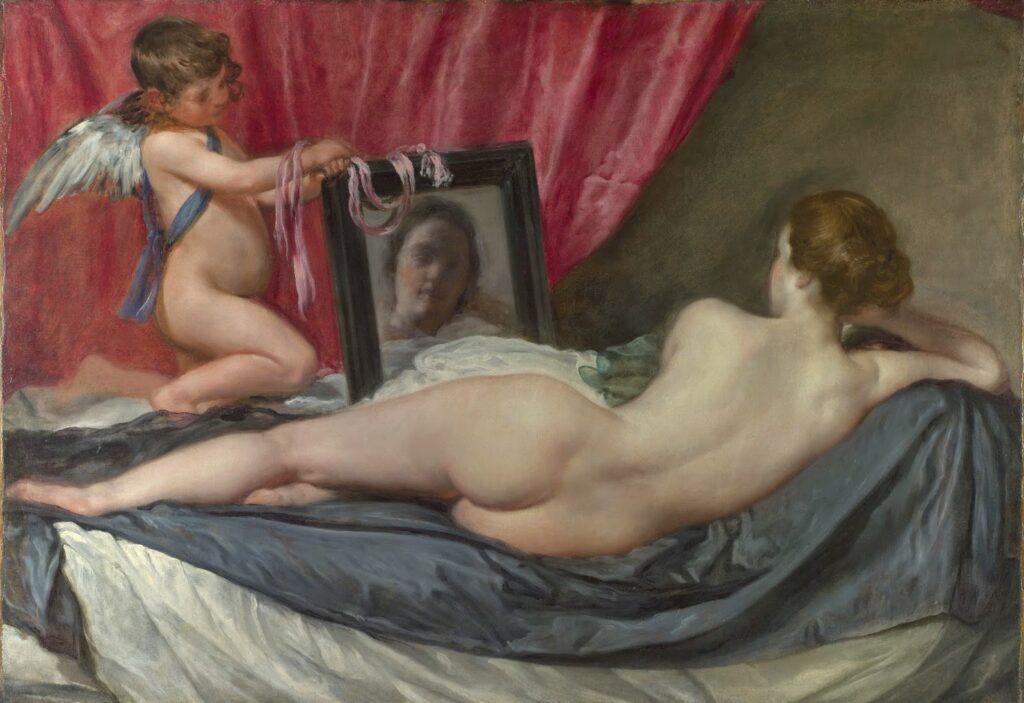
Velázquez — the painter of painters →A young woman lies with her back to us on a blue-grey sheet, her head resting on her arm. The line of her body, from shoulder to ankle, traces a curve of perfect purity. Before her, a small winged Cupid holds a black-framed mirror, tied with pink silk ribbons. In the mirror we glimpse a face, blurred, that seems to look not at the young woman herself, but at us. The Rokeby Venus, painted by Velázquez between 1647 and 1651, is one of the most famous nudes in European painting.
It is also an absolute exception. In the work of Velázquez, which numbers little more than a hundred pictures, it is the only female nude to have survived. In seventeenth-century Spain, where the Inquisition kept a close watch on images deemed indecent, painting a naked woman came close to the forbidden. The few nudes owned by great Spanish collectors mostly came from Italy.
The painting now hangs in the National Gallery in London, which acquired it in 1906. The British call it the Rokeby Venus, after the Yorkshire house where it was kept for nearly a century; its official title is The Toilet of Venus. It is also one of the most attacked paintings in history: slashed by a suffragette in 1914, struck by climate activists in 2023.
For a picture so often reproduced, it keeps a surprising share of secrets: we do not know who posed, where it was painted, or what its mirror really shows.
A nude in the Spain of the Inquisition
To appreciate the daring of this picture, we need to remember its context. The Spain of Philip IV was a kingdom where religious morality weighed heavily on the arts. Treatises on painting, starting with that of Pacheco, Velázquez’s father-in-law, advised against the nude, and the Inquisition could sanction works it judged lascivious.
Nudes were not absent from Spanish collections, however. The king himself owned the great mythological poesie that Titian had painted for his grandfather Philip II, and a few aristocrats collected Venetian nudes. But these works were kept in private rooms, sometimes hidden behind curtains, and they came from elsewhere. For a Spanish painter — and the king’s painter at that — to paint one himself was far rarer.
Seventeenth-century inventories mention other nudes by Velázquez, now lost. The Rokeby Venus is the only one to survive. Its first known owner was Gaspar Méndez de Haro, Marquis of Carpio, son of Philip IV’s chief minister and a great lover of painting, in whose inventory it appears in 1651. The picture was therefore probably painted for a private collector of very high rank, protected by his position.
Historians still debate where it was painted. Some believe it was done in Madrid shortly before the second journey to Italy; others that it was made in Rome, where Velázquez stayed from 1649 to 1651 and where there was greater freedom. Nothing allows a definite answer.
A Venus seen from behind
What strikes us first is the choice of pose. The tradition of the reclining nude, established by the Venetians, showed the goddess from the front, offered to the viewer’s gaze. Velázquez shows her from behind.
This reversal changes everything. The body is no longer displayed: it is contemplated, almost caught in a private moment. The pose sets off the long line of the back, the curve of the hip and the slender waist, in a silhouette of thoroughly aristocratic elegance, far removed from the ample Venuses of Rubens or Titian. The pearly pink flesh stands out against the blue-grey of the sheet and the deep red of the curtain behind.
The painting itself is very free. The sheet is brushed in broad strokes; the red curtain is suggested rather than described; Cupid’s wings are just a few touches. Only the body is modelled with a continuous softness, almost without outlines, light gliding over the skin as over a living surface. Pentimenti visible to the naked eye show that Velázquez changed the position of the arm and shoulder as he worked.
The picture has often been compared with Titian’s Venus of Urbino, painted a century earlier, which Velázquez knew from the royal collections. The two works share their theme and their ambiguity — goddess or real woman? — but everything sets them apart in manner: the Venetian’s sensual frontality is answered by the restraint of the painter from Seville.
The riddle of the mirror
The heart of the picture is the mirror. And here Velázquez, as in Las Meninas, plays with the viewer’s gaze.
Logically, if Venus is looking at her reflection, the mirror should show her face seen from the front, roughly at the height of her head. Yet the reflection we see is too large, too distant, and above all it seems turned towards us. It is not Venus looking at herself: it is Venus watching us watch her. Perception scientists have even given a name to this impossible optical effect, often called the “Venus effect”.
The reflected face is, moreover, barely sketched: a few blurred touches, without any detail. Its features cannot be made out, and this is surely intentional. Velázquez refuses to give his model an identity. The woman remains anonymous, and the goddess remains an idea, an image of beauty rather than a portrait.
The mirror turns the picture into a meditation on looking, beauty and representation. The pink ribbons tied to the frame, which Cupid holds in his hands, may not be there merely as decoration: some have read them as an allusion to love enchained by beauty. And the mirror itself points to painting, which only ever delivers a reflection.
From Madrid to Rokeby Park
The picture’s fate is that of a work that passed from hand to hand before leaving Spain.
After the Marquis of Carpio, it entered the collections of the House of Alba, then, at the beginning of the nineteenth century, those of Manuel Godoy, the all-powerful favourite of King Charles IV. Godoy also owned Goya’s two Majas, and the two works have often been compared: the Naked Maja probably owes something to Velázquez’s Venus.
In 1813, in the midst of the Napoleonic Wars, the painting was bought by an English collector, John Morritt, who hung it in his house at Rokeby Park in Yorkshire. It remained there for nearly a century, hence the name by which it is known in Britain.
In 1906 the threat of a sale abroad prompted a major public subscription campaign, led by a then very young organisation, the National Art Collections Fund, now the Art Fund. Thanks to it, the painting was presented to the National Gallery. It was one of the first great successes of public mobilisation in favour of Britain’s artistic heritage.
A painting under attack
The Rokeby Venus owes part of its fame to two attacks more than a century apart.
On 10 March 1914, a Canadian-born suffragette, Mary Richardson, walked into the National Gallery with a meat cleaver hidden under her coat and struck the canvas seven times. She wanted to protest against the arrest the day before of Emmeline Pankhurst, leader of the women’s suffrage movement. She later explained that she had also targeted a picture she felt male visitors gazed at too complacently. The cuts were repaired so skilfully that they are barely visible today.
On 6 November 2023, two Just Stop Oil activists struck the glass protecting the painting with hammers, to protest against the granting of new oil and gas licences in the UK. The glass absorbed most of the blows, and the canvas suffered only superficial damage, which was treated by the gallery’s conservators.
These two acts, so different in their causes, say the same thing: the symbolic power of an image that has become one of the icons of female beauty in Western painting — and therefore a target for anyone who wants to be heard.
Where to see the artwork
The Rokeby Venus is in the National Gallery in London, on Trafalgar Square, where it hangs in the galleries devoted to Spanish painting.
Admission to the National Gallery’s permanent collection is free, as at most of Britain’s great national museums. Only temporary exhibitions are ticketed. Before you go, check which room the painting is in, as hangs can change.
A tip: first stand facing the mirror, a few metres away, and look for the gaze of the reflected face. Then move closer to see how the body is painted, with almost no outlines, and the pentimenti around the arm and shoulder.
The National Gallery holds other works by Velázquez, including Christ in the House of Martha and Mary, painted in Seville in his youth, and portraits of Philip IV. A visit lets you follow the painter from his Seville beginnings to his maturity.
Further Reading
Institutional Documentation
- The Rokeby Venus — National Gallery, London — the catalogue entry and a high-definition image.
- Museo del Prado, Madrid — the largest group of works by Velázquez in the world.
See also on Hors Cadre
- Velázquez — the painter of painters — a portrait of the painter, from Seville to the court of Philip IV.
- The Venus of Urbino by Titian — the great Venetian nude, known to Velázquez from the royal collections, to which his Venus replies a century later.
— M