The Getty Center in Los Angeles — what to see, hours, reservations
First, you have to go up. From the parking garage at the foot of the Santa Monica Mountains, a small white tram winds its way to the summit, and the city slowly comes into view, vast, all the way to the ocean. At the top: pavilions of pale stone, fountains, terraced gardens. The Getty Center is as much a lookout and an acropolis as a museum.
It is the flagship of the foundation created from the fortune of J. Paul Getty, the oil tycoon and passionate collector who died in 1976. Designed by the architect Richard Meier and opened in December 1997, the Getty Center has welcomed more than twenty million visitors since. It houses the J. Paul Getty Museum, devoted to European art from the Middle Ages to the early twentieth century, along with research and conservation institutes.
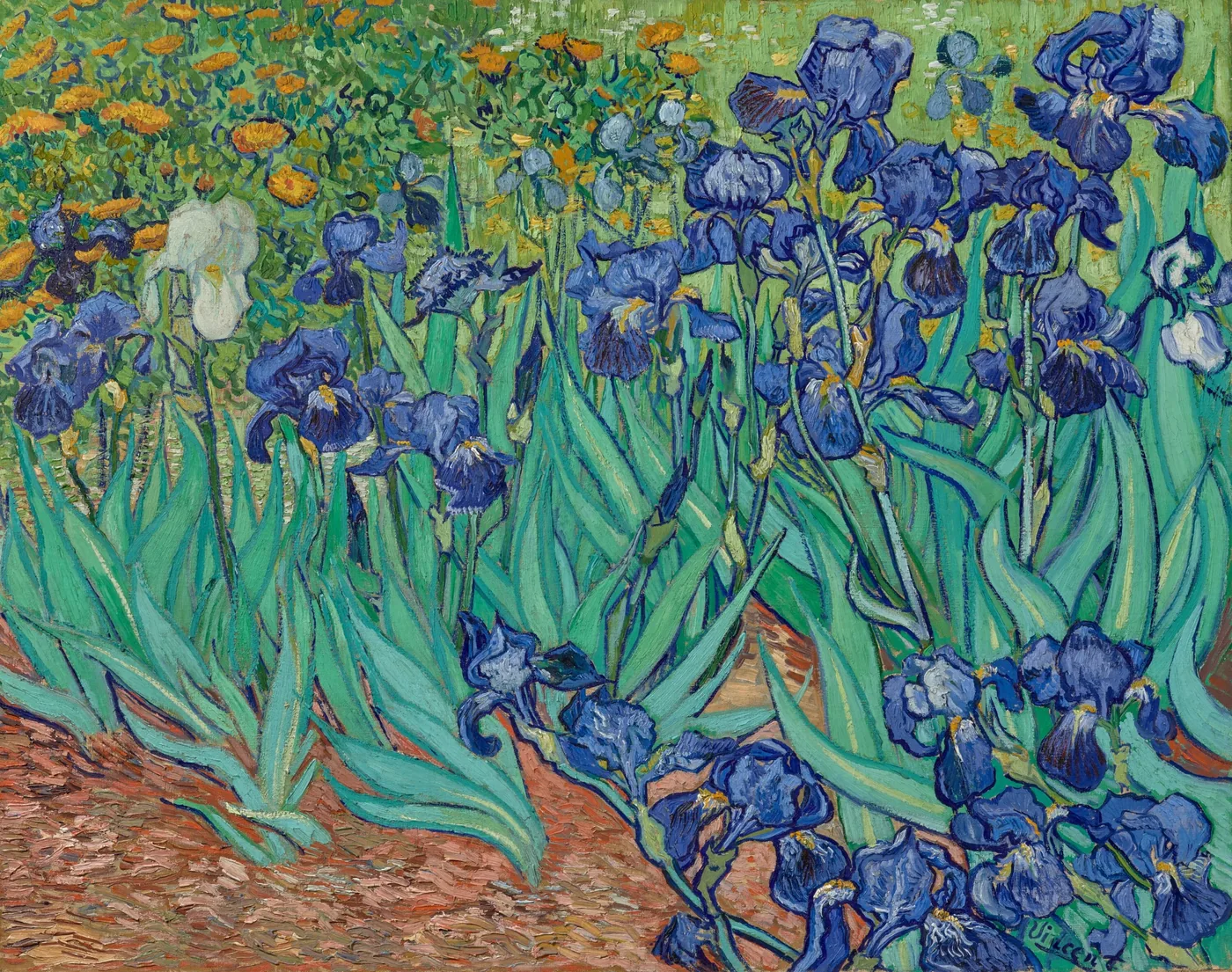
The Getty also holds some unexpected Parisian encounters: Manet’s Jeanne, shown at the 1882 Salon, a Monet wheatstack in the snow and, above all, the Irises Van Gogh painted in Provence in the spring of 1889. Admission is free.
The Getty Center at a glance
| Address | 1200 Getty Center Drive, Los Angeles, CA 90049 |
| Access | By car via the 405 freeway (parking at the foot of the hill, then a tram to the museum); Metro bus from central Los Angeles |
| Hours | Tuesday – Friday and Sunday: 10 am–6:30 pm; Saturday: 10 am–9 pm |
| Closed | Mondays, plus New Year’s Day, Independence Day, Thanksgiving Day and Christmas Day |
| Admission | Free, with a timed-entry reservation |
| Parking | $25 per vehicle; $15 after 3 pm; $10 after 6 pm; free on Saturdays after 6 pm |
| Official Website | getty.edu |
A timed-entry reservation is required, online or by phone, even though admission costs nothing. Parking is paid and cashless. Some galleries in the South, East and North Pavilions are closed for renovation, so the works on view may change.
A museum on a hill
J. Paul Getty first opened his collection to the public in the 1950s, in his own house in Malibu, and later in a re-creation of a Roman villa built on the Pacific coast, the Getty Villa. When he died in 1976, he left most of his fortune to the trust that bears his name, which became one of the wealthiest art institutions in the world.
To give it a home on that scale, the Getty chose a hilltop in the Santa Monica Mountains above Brentwood and hired the New York architect Richard Meier. Construction took many years. The Getty Center opened in December 1997.
The campus covers about 110 acres, 86 of them gardens and terraces, surrounded by 600 acres left in their natural state. To clad the buildings, Meier brought in 290,000 blocks of travertine from Bagni di Tivoli, near Rome, some 16,000 tons of stone, some of which show fossils and leaf imprints on the surface.
The museum’s collections are spread across five two-story pavilions grouped around an open courtyard. Between the buildings, the gardens, pools and views over Los Angeles are as much a part of the visit as the paintings.
Must-See Works
The Getty is not the size of the Met or the Louvre, and that is a blessing: you can see it without exhaustion. The paintings below hang in the painting galleries of the various pavilions; the free GettyGuide app shows where each work is on the day of your visit.
1. Irises, Vincent van Gogh (1889)
A mass of blue irises, a single white one, pale green leaves against reddish earth: Van Gogh painted this picture in May 1889, the day after entering the Saint-Paul-de-Mausole asylum at Saint-Rémy-de-Provence, in the garden where his doctor allowed him to work. Getty curator Scott Allan highlights “the play of complementaries.” Yet these irises were violet: Getty research has shown that some pigments changed color over time. The painting was shown in Paris as early as September 1889, at the Salon des Indépendants. Sold at Sotheby’s in 1987 for nearly $54 million, then a record, to a buyer who could never pay for it in full, it was acquired by the Getty in 1990.
2. Jeanne (Spring), Édouard Manet (1881)
A young Parisian woman in profile, in a flowered dress and trimmed hat, stands out against a background of foliage, parasol in hand. Manet had planned a series of four elegant women embodying the seasons; he died before finishing it. Shown at the 1882 Salon as Jeanne, the painting was praised by critics and bought that same year by his friend Antonin Proust. The Getty acquired it in 2014.
3. Wheatstacks, Snow Effect, Morning, Claude Monet (1891)
A stack of wheat in a snowy field at Giverny, under low morning light. Monet made them a series in 1890–91: the same motif, observed day after day, to capture the air and light that envelop it. The Getty’s version, all blues, pinks and whites, is one of the most delicate in the series.
4. The Abduction of Europa, Rembrandt (1632)
On the shore, Europa’s companions cry out as the white bull, Jupiter in disguise, carries the princess off into the water. Rembrandt was twenty-six and had just settled in Amsterdam, and this small painting on panel, as precise as a goldsmith’s work in its fabrics and reflections, shows off all his youthful virtuosity.
5. Portrait of a Halberdier, Pontormo (about 1528–30)
A young man in a red doublet, halberd in hand, looks at the viewer with a slightly distant self-assurance. The sitter is probably Francesco Guardi, a young Florentine whom Pontormo portrayed as a soldier during the siege of Florence, according to Vasari. For the art historian Elizabeth Cropper, in the study published by the Getty, it is the painter’s masterpiece.
6. Modern Rome — Campo Vaccino, J. M. W. Turner (1839)
The Roman Forum bathed in golden light, the moon rising, ruins dissolving into the atmosphere: one of Turner’s last great Italian paintings. The Getty bought it at auction in London in 2010 for nearly $45 million, one of the greatest acquisitions in its history.
7. The Farewell of Telemachus and Eucharis, Jacques-Louis David (1818)
Two adolescents embrace before parting: Telemachus, son of Ulysses, must leave the nymph Eucharis to continue his journey. David, exiled in Brussels after Napoleon’s fall, painted this scene from Fénelon’s novel with a tenderness and intimacy unexpected from the painter of The Oath of the Horatii.
8. The Central Garden, Robert Irwin (1997)
The last work to see is not in the galleries. Designed by the American artist Robert Irwin as a work of art in its own right, the Central Garden covers 134,000 square feet at the heart of the site: a path zigzags down along a stream to a pool where a maze of azaleas floats. The plantings change with the seasons, so the garden is never the same twice.
How to visit the Getty Center
How long does it take to visit the Getty Center?
Three hours let you see the main paintings, stroll through the Central Garden and take in the view. Half a day is ideal, counting the tram ride and a break.
Do you need a reservation to visit the Getty?
Yes. Admission is free, but a timed-entry reservation is required, online or by phone at (310) 440-7300.
Is the Getty Center free?
Admission is, for everyone. Only parking costs money: $25 per vehicle, $15 after 3 pm, $10 after 6 pm, and free on Saturday evenings after 6 pm.
What day is the Getty Center closed?
Mondays, plus New Year’s Day, Independence Day, Thanksgiving Day and Christmas Day. The museum closes early on December 24 and 31.
When is the best time to enjoy the view?
On Saturdays the museum stays open until 9 pm: late afternoon lets you watch the sun set over Los Angeles and the Pacific from the terraces, with cheaper parking.
Can you picnic and take photos?
Yes. Picnicking is welcome in outdoor seating areas, but not in the galleries. Photos are allowed without flash, at least 18 inches from the works; tripods are not allowed, and selfie sticks are welcome only outdoors.
Is the Getty Villa worth a visit too?
For lovers of antiquity, yes. Set in Pacific Palisades by the ocean, in a re-creation of a Roman villa, it houses the Getty’s Greek, Roman and Etruscan collections. It is open daily from 10 am to 5 pm, except Tuesdays.
Around the Museum
The Getty Center overlooks Brentwood and the Sepulveda Pass on the west side of Los Angeles, an area best explored by car. The UCLA campus and Westwood are about ten minutes’ drive away, as are the shops of Brentwood.
To keep exploring art in Los Angeles, LACMA, the largest art museum in the western United States, is on Wilshire Boulevard, about twenty minutes’ drive away outside rush hour. And the Getty Villa, by the ocean, rounds out the visit with a day devoted to antiquity.
Further Reading
Institutional Documentation
- Admission, Hours, Location — Getty — current hours, reservations and parking.
- Visitors’ Frequently Asked Questions — Getty — the museum’s answers to practical questions.
- Photo Credit : Getty Center
See also on Hors Cadre
- Vincent van Gogh — the artist who wrote as much as he painted — a portrait of the painter of Irises.
- Édouard Manet — from the Déjeuner scandal to his last canvas — a portrait of the painter of Jeanne.
— M