The Wedding at Cana — Veronese
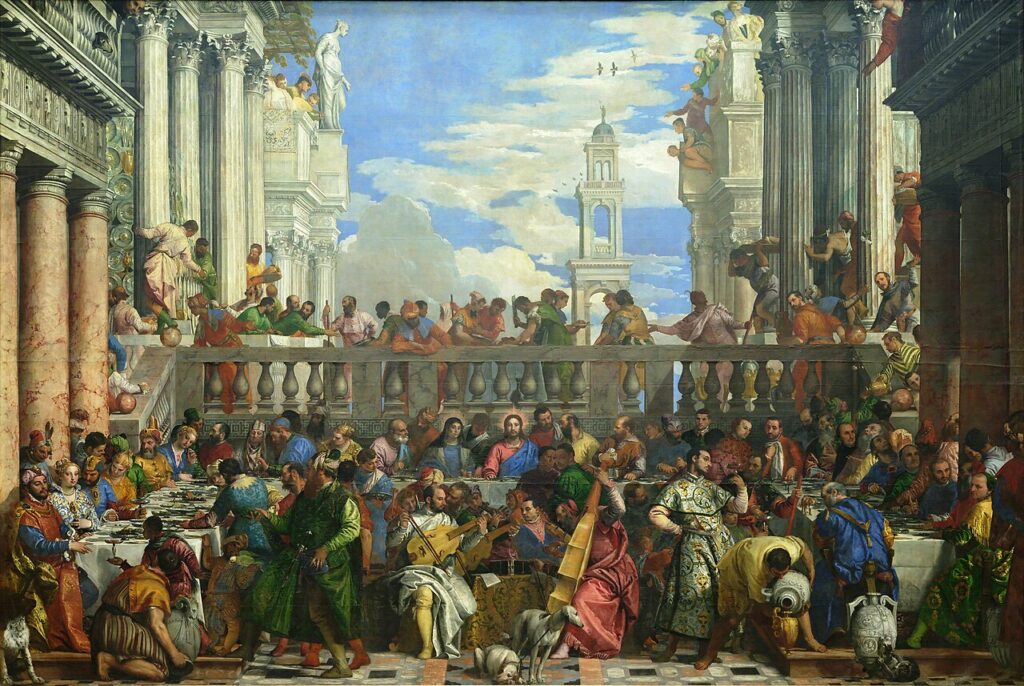
Veronese — the Splendour of Venice →Nearly ten metres wide, one hundred and thirty-two figures, a sumptuous banquet in a setting of classical architecture: Veronese’s Wedding at Cana is the largest canvas in the Louvre, and one of the absolute masterpieces of Venetian painting. Facing the Mona Lisa, in the most visited room in the world, this immense composition unfolds all the splendour, colour and joy of living that make its author’s genius.
Painted between 1562 and 1563 for the refectory of a Venetian monastery, the work depicts Christ’s first miracle — the turning of water into wine at a wedding feast. But under Veronese’s brush, the biblical scene becomes a dazzling Venetian celebration, peopled with an elegant crowd, in majestic architecture. A masterpiece of the painter’s maturity, the work has had an eventful history, from the Venetian refectory for which it was conceived to the halls of the Louvre, which it reached as spoils of war.
This article offers an analysis of this exceptional work: its subject, its monumental composition, the way Veronese transforms the sacred scene into a Venetian feast, and the eventful history that carried it from Venice to Paris.
The subject — Christ’s first miracle
Contrary to what is sometimes believed, The Wedding at Cana does not depict the Last Supper, Christ’s final meal, but a quite different episode: the first miracle of Jesus, recounted in the Gospel of John.
The episode is as follows: Jesus, his mother Mary and his disciples are invited to a wedding feast in the village of Cana, in Galilee. During the celebration the wine runs out, threatening to spoil the wedding. Mary points this out to her son. Jesus then has six great stone jars filled with water, and the water is miraculously turned into wine — an excellent wine, even better than the first. This first miracle, through which Christ manifests his divine power, marks the beginning of his public life. It also celebrates abundance, joy and divine generosity, within the festive setting of a wedding meal.
This subject suited Veronese’s temperament and the place for which the work was intended admirably. For the painting was commissioned for the refectory of a monastery — the room where the monks took their meals. Depicting a biblical banquet in a dining hall was a tradition, and the miracle at Cana, with its feast and its wine, lent itself perfectly. The subject also allowed the painter to deploy all his art of the banquet scene, of splendour and abundance, in keeping with the festive and generous character of the miracle depicted.
Veronese chose to focus the depicted moment not on the precise instant of the miracle but on the banquet itself, in all its scale and splendour. At the centre, Christ, haloed, presides over the scene, surrounded by his mother and his disciples; all around unfolds the feast, with its guests, servants and musicians. Below, one makes out the jars and the serving of wine, a discreet allusion to the miracle taking place. The painter thus makes of this Gospel episode the pretext for a dazzling visual celebration, in which the sacred and the festive come together.
A monumental banquet
The Wedding at Cana strikes one first by its scale and by the multitude it contains. Veronese unfolds a banquet of extraordinary richness and monumentality, orchestrated with sovereign mastery.
The canvas brings together one hundred and thirty-two figures, depicted life-size, in a composition of extraordinary scale. At the centre of the long table, Christ, the only one to wear a halo, occupies the place of honour, with the Virgin Mary at his side; they form the still, sacred heart of the scene. Around them presses an immense and colourful crowd: the bride and groom, the elegantly dressed guests, the bustling servants, the musicians in the foreground. On a terrace at the back, other servants carve the meats and prepare the dishes. At the lower right, one glimpses the serving of the wine, with the jars and the cupbearers, evoking the miracle.
The setting of the scene is a sumptuous classical architecture. Colonnades, balustrades and majestic buildings frame the banquet and open onto a luminous sky. This architecture is not a mere backdrop: it structures the composition, gives it its monumentality and depth, and pays homage to the great architect Andrea Palladio, a friend of Veronese, who had designed the refectory for which the work was intended, as well as the whole monastery. Veronese’s painted architecture thus dialogues with Palladio’s real architecture, in a refined play.
The scale of the undertaking matched that of the work. Veronese took some fifteen months to paint this immense canvas, probably helped by his brother and the members of his workshop. The commission contract specified that he could paint as many figures as he could fit in — an invitation to profusion that the painter magnificently took up. The result is a composition of inexhaustible richness of detail, which the eye never tires of exploring, endlessly discovering new figures, new gestures, new details. This mastered abundance is one of the marks of Veronese’s genius.
A Venetian wedding
What makes the charm and singularity of The Wedding at Cana is the way Veronese transposes the biblical scene into the setting of the lavish Venice of his time. The wedding at Cana becomes a sumptuous Venetian feast of the sixteenth century.
With the exception of Christ and the Virgin, all the figures in the painting are dressed and adorned in the fashion of Veronese’s contemporary Venice. The guests wear sumptuous costumes, precious fabrics, sparkling jewels, like the Venetian aristocracy at its great receptions. The architecture, the objects, the service, the atmosphere — everything evokes the luxury and refinement of the Serenissima at its height. Veronese does not seek a historical reconstruction of ancient Palestine: he transposes the sacred episode into his own world, that of the Venetian feast, with its splendour and elegance. This mingling of the sacred and the profane, without one sacrificing the other, is characteristic of his art.
A famous detail illustrates this dimension: the group of musicians set in the foreground, at the centre, playing instruments of Veronese’s time. According to an old tradition, these musicians are portraits of contemporary Venetian painters. The one dressed in white, playing the viol, is said to be a self-portrait of Veronese himself; his neighbour, in red, is said to have the features of the great Titian. Other figures of Venetian painters are said to have been slipped in. Whether accurate or legendary, this identification captures well the way Veronese inscribed his own world, his own time, his own friends, at the heart of the sacred scene.
This transposition takes nothing away from the religious dimension of the work, but it gives it extraordinary life, immediacy and human richness. The miracle at Cana is not relegated to a distant, abstract past: it unfolds, before our eyes, in a recognisable, living, sumptuous world. This way of making the sacred present and alive, of embodying it in contemporary reality while celebrating the beauty and abundance of the world, is at the heart of Veronese’s art. It also explains the lasting fascination this work exerts, in which anyone can immerse themselves as in a sumptuous feast.
Composition, colour and architecture
Beyond its scale and splendour, The Wedding at Cana is a masterpiece of composition, colour and organisation of space. Veronese deploys all his skill here, with a mastery that compels admiration.
The composition, despite the multitude of figures, is of remarkable clarity and balance. Veronese organises this immense crowd according to a rigorous, symmetrical structure, ordered by the architecture. The long table cuts horizontally across the scene; the monumental architecture frames and gives rhythm to the space; Christ, placed at the exact centre, forms the focal point towards which everything converges. Despite the abundance of figures and details, the whole remains legible, harmonious, balanced. This ability to master a composition of such complexity, to bring order and clarity to it, is one of Veronese’s great strengths.
The colour, of course, is dazzling. Veronese deploys here all the richness of his palette: blues, reds, golds, greens, silvery whites, pinks, in a sumptuous and luminous harmony. The shimmering fabrics, the flesh tones, the materials, all shine with a brilliance that makes the canvas a veritable feast for the eyes. The light, clear and golden, bathes the scene evenly, without the dramatic contrasts of shadow dear to Tintoretto; it makes the colours sing and gives the whole its atmosphere of serene splendour. This mastery of colour and light places Veronese among the greatest colourists in history.
One detail, often noted, adds to the work’s richness of meaning. At the centre of the composition, just above Christ, on the terrace, a servant carves meat; and on the musicians’ table, in the foreground, there is an hourglass. This discreet hourglass introduces a grave note into this festive scene: it recalls the passing of time, the brevity of life, the death that will come. This presence of the memento mori, at the very heart of the celebration, shows that beneath the apparent splendour Veronese does not forget the depth of the sacred subject. The miracle at Cana, Christ’s first sign, already foretells, for those who can see, the sacrifice to come and the mystery of the Eucharist.
From the Venetian refectory to the Louvre
The Wedding at Cana has had an eventful history, which carried it from the Venetian refectory for which it was painted to the halls of the Louvre, where it is found today. This history is inseparable from the work.
The painting was commissioned in 1562 by the Benedictine monks of the monastery of San Giorgio Maggiore in Venice, to adorn their refectory, which the great architect Palladio had just renovated. For more than two centuries the work remained in this place, filling an entire wall of the monks’ dining hall, in harmony with Palladio’s architecture. It was in this setting, for this precise place, that Veronese had conceived his composition, playing on the dialogue between the painted architecture and the real architecture. The work and its setting formed an ensemble conceived as a whole.
This bond was brutally broken at the end of the eighteenth century. In 1797, during the Italian campaigns, the French army of Napoleon Bonaparte confiscated the work as spoils of war, under a treaty imposed on Venice. To transport it, the immense canvas was cut into several strips, rolled up, and taken to Paris, where it was rejoined. In 1798 it entered the Louvre, then called the Central Museum of the Arts. After Napoleon’s fall, Italy demanded the work’s return, but the Louvre authorities argued that the fragility and dimensions of the canvas made its transport too risky; another painting was given in exchange, and The Wedding at Cana remained in Paris.
Today the work is displayed in the Louvre, in the Salle des États, where it faces the Mona Lisa by Leonardo da Vinci — the museum’s largest canvas facing its most famous. This proximity creates a striking contrast between Veronese’s immense festive canvas and Leonardo’s small, enigmatic portrait. In Venice, in the original refectory, a faithful copy, made using the most modern digital techniques, has been installed in the work’s place, restoring the intended harmony between the painting and Palladio’s architecture. The campaigns for the return of the original to Venice, though well publicised, have not succeeded. The work thus remains the witness of an eventful history, between Venice and Paris.
Where to see the artwork
The Wedding at Cana is held in the Musée du Louvre in Paris, in the Salle des États, the same room as the Mona Lisa, which it faces from one end of the room to the other. It is one of the most imposing works in the museum, impossible to miss for its dimensions. The great number of visitors drawn by the Mona Lisa allows many to discover, often by surprise, the immense masterpiece by Veronese facing it. In Venice, one can see a faithful copy of the work in its original place, in the refectory of San Giorgio Maggiore, restored to its architectural harmony. To plan a visit, it is helpful to consult the official website of the Musée du Louvre.
Further Reading
Institutional Documentation
- Musée du Louvre, Paris — the museum where the work is held, Salle des États.
- Veronese, reference monographs and catalogues.
See also on Hors Cadre
- Veronese — the Splendour of Venice — the painter’s portrait, to set the work within his career.
- The Feast in the House of Levi — another great banquet, that of the Inquisition trial (cluster work, to activate).
- The Triumph of Venice — the lavish allegory of the Doge’s Palace (cluster work, to activate).
- The Last Supper — Tintoretto’s Last Supper, painted for the same church, San Giorgio Maggiore.
— M