The Angelus — How a 55-cm Painting Turned the French Art Market on Its Head
Jean-François Millet — the painter of peasants →Paris, July 1889. At the auction house on Rue Drouot, a painting measuring fifty-five centimeters high by sixty-six centimeters wide has just been sold. The purchase price sent shockwaves through the room: more than five hundred fifty thousand francs. This was an all-time record at the time for a painting by a 19th-century French artist. The painting is titled *L’Angélus*; its artist had died fourteen years earlier in Barbizon in relative poverty, and the painting is now on its way to the United States.
The French press picked up the story. Journalists called it a “patriotic scandal.” A national fundraising campaign was launched to buy the painting back from the Americans. It failed. *The Angelus* set sail. It wasn’t until the following year that a wealthy French industrialist, Alfred Chauchard, founder of the Grands Magasins du Louvre, bought it from the American Art Association for eight hundred thousand francs —a new record—and brought it back to Paris.
This story is one of the most extraordinary in the history of the 19th-century French art market. And it begins thirty-two years earlier, in Barbizon, with a commission that would never come to fruition.
An Order That Doesn’t Go Through
In 1857, Thomas Gold Appleton was a wealthy man. Born in Boston and the heir to a vast American fortune, he dreamed of becoming a painter, divided his time between France and the United States, and collected works by contemporary French artists. In Barbizon, he became interested in Jean-François Millet, whose reputation was beginning to grow following the relative success of *The Gleaners* at the 1857 Salon.
Appleton commissioned Millet to paint a scene of the potato harvest. The painting, intended to be small in size, was to be delivered to Boston. According to the Musée d’Orsay’s records, the painting’s original title was *Prayer for the Potato Harvest*. It is a simple, rural scene, consistent with the painter’s style.
The painting was completed sometime in 1859. Appleton, for reasons that history has not recorded, never came to pick it up. The painting remained in Barbizon, in Millet’s possession.
The painter then reworked the composition. He added a detail that changed everything: in the background, bathed in the golden light of twilight, he sketched a bell tower —that of Saint-Paul Church in Chailly-en-Bière, the village neighboring Barbizon. The scene is no longer simply a moment of work. The bell tower rings the Angelus, the evening prayer. The two peasants pause. The painting’s title changes. It becomes *The Angelus*.
The painting—what it depicts
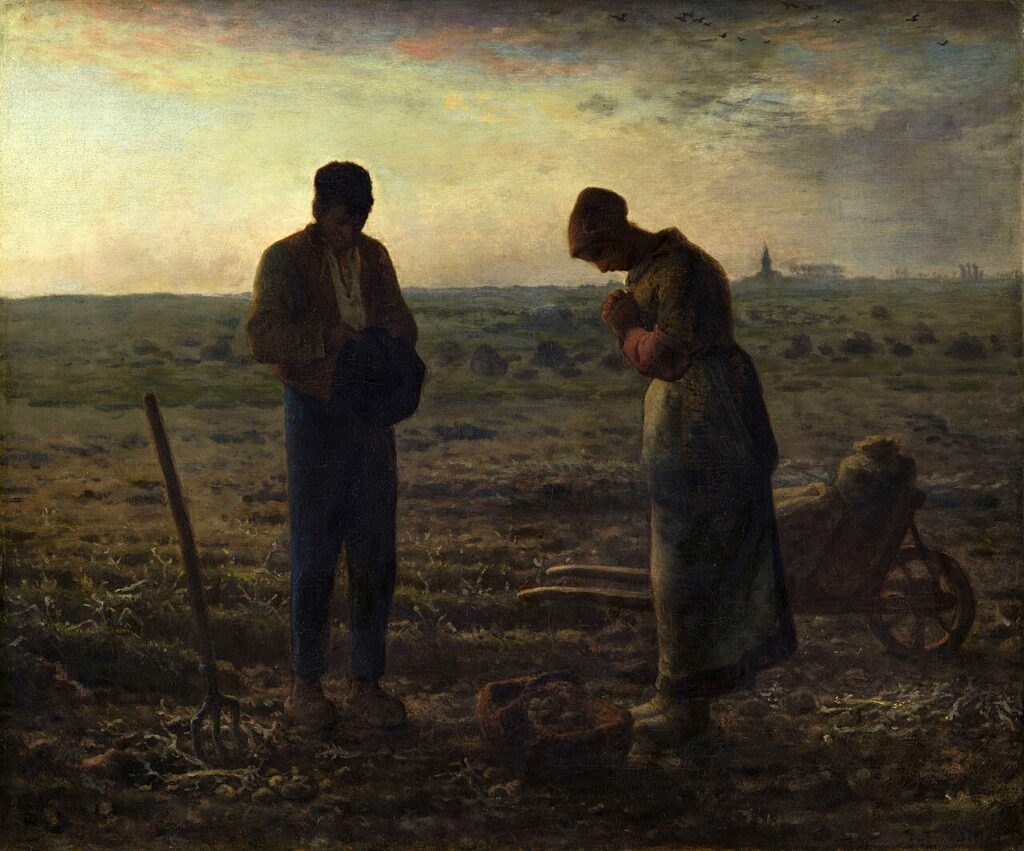
*The Angelus* is an oil on canvas measuring 55.5 centimeters high by 66 centimeters wide. It is a landscape-format painting, intimate in scale, almost like an easel painting. Housed at the Musée d’Orsay in Paris, it is on permanent display on the ground floor, in Gallery 4.
The painting depicts two farmers, a man and a woman, standing in the middle of a vast plain. The man is on the left, his hat removed and held with both hands against his chest. The woman is on the right, her hands clasped, her head bowed. Between them and in the foreground are a pitchfork stuck in the ground, a basket of potatoes, two sacks resting on the ground, and a wheelbarrow—all the tools of their interrupted work.
In the background, on the horizon, the bell tower of Saint-Paul Church in Chailly-en-Bière stands out against the yellow and pink light of the setting sun. It is this bell that rings the Angelus, the Catholic prayer recited three times a day—at dawn, noon, and dusk—to celebrate the Annunciation to Mary.
The composition is extremely simple. No other figures. No village, no farm, no animals. Just two full-length figures standing in a vast, deserted plain. As the Musée d’Orsay notes in its official description, “the peasant couple takes on a monumental appearance, despite the small size of the canvas.”
The color palette is warm and limited: ochres, browns, the muted green of the fields, the orange-red of the sky, and the black of the figures. The faces are left in shadow—they are not really distinguishable. What is striking is the posture of the bodies, their contemplative stillness, their immobility. Millet does not paint identifiable individuals. He paints an archetype.
“The Angelus for these poor dead”
The meaning of the painting, as Millet himself intended it, is not what one might think.
In a note sent to Alfred Sensier, his friend and first biographer, Millet explains the origin of the painting. Sensier quotes this account in his posthumous biography, *La Vie et l’œuvre de Jean-François Millet*(The Life and Work of Jean-François Millet), published in 1881. In it, Millet states that this painting is a childhood memory. When he was working in the fields in Gruchy, his paternal grandmother would always stop work at the sound of the evening bell and have the Angelus recited.
But Millet specifies for whom:
“The Angelus for these poor souls.”
— Jean-François Millet on the origins of the painting, quoted in Alfred Sensier, *The Life and Work of Jean-François Millet*, 1881*
This distinction is crucial. In the Catholic liturgy, the Angelus is a prayer that celebrates the Annunciation to Mary—the announcement of Christ’s future birth. A prayer of life. But in Millet’s memory—in the image of his paternal grandmother who recited it with him in the fields—the Angelus has become a prayer for the dead. For the farmers who fell while plowing, for the children taken too young, for the long line of humble souls who have passed away.
The Musée d’Orsay confirms in its official description: “It was, therefore, a childhood memory that inspired the painting, not a desire to exalt any religious sentiment. Millet, incidentally, was not a practicing Catholic.”
This nuance changes the way we interpret the painting. *The Angelus* is not a work of popular piety. It is a work of remembrance —the memory of a childhood in Normandy, and behind it, the memory of all the peasants who died in the silence of the fields. The prayer is not addressed to Mary. It is addressed to those who are no longer with us.
An Extraordinary Fortune
The commercial history of *L’Angélus* is one of the most striking in the entire 19th-century French art market. In thirty years, its price has increased more than four hundredfold.
In 1860, Millet sold the painting to a man named Alfred Feydeau for 1,800 francs. It was a decent but modest sum—Millet was struggling financially, with nine children to feed, and every sale counted. The painting then passed through the hands of several successive owners: Pierre Blanc in 1870 for 3,000 francs, Arthur Stevens in Brussels, Émile Gavet, Victor Papeleu, and the gallery owner Paul Durand-Ruel.
In 1881, six years after Millet’s death, the painting was put up for public auction. A French industrialist, Eugène Secrétan, won it in a drawing of lots for 160,000 francs. The sum caused a sensation at the time. But that was only the beginning.
In July 1889, Eugène Secrétan, ruined by the speculative crash of the copper market, was forced to sell off his collection. *The Angelus* was put up for auction at the Hôtel Drouot. The auction hall was packed. The bids soared. The painting was ultimately sold to James F. Sutton, president ofthe American Art Association, for a sum that varies depending on the source between 553,000 and 580,000 francs.
The incident sparked a national scandal in France. The press called it a “patriotic disgrace.” A national fundraising campaign was launched to buy back the painting. It failed. *The Angelus* was shipped to the United States, where it was exhibited for a year, drawing huge crowds.
In 1890, the painting returned to France. Alfred Chauchard, founder of the Grands Magasins du Louvre and one of the wealthiest men in France at the time, purchased it from the American Art Association for 800,000 francs. The French press celebrated. *The Angelus* has returned.
Chauchard died in 1909. In his will, he bequeathed *The Angelus* —along with his entire collection—to the Louvre. The painting was transferred to the Musée d’Orsay in 1986, when this new institution dedicated to 19th-century art was established.
The Origins of the Resale Right
The Secrétan-Sutton-Chauchard affair had a major legal consequence that few art histories mention.
In 1889, when *L’Angélus* was sold to the United States for 553,000 francs, Millet’s heirs —his widow Catherine Lemaire and their nine children—were living in modest, even precarious circumstances. Millet had not made a fortune during his lifetime. At the height of the frenzied speculation surrounding his paintings, his family received absolutely nothing from it.
This contrast shocked the French art and legal communities. How could it be acceptable for a painter to die in poverty while his works, sold a few years later, enriched collectors and dealers? The debate over the creation of a mechanism to protect artists and their heirs emerged in the last decade of the 19th century, spurred directly by the case of *L’Angélus*.
The legal provision was enacted in France by the law of May 20, 1920. It established the resale right, a principle whereby the author of a work of graphic or visual art—or his or her heirs for seventy years after his or her death—receives a percentage of the price upon each public resale of the work. This right is inalienable: the artist cannot waive it.
The resale right was extended to the entire European Union by the directive of September 27, 2001, which was incorporated into French law by an ordinance in 2006. Today, throughout Europe, when a Picasso, a Dalí, or a Soulages is resold at auction, a percentage of the price automatically goes to the artist’s heirs. This is the direct legal legacy of the 1889 Secrétan sale.
Millet’s *The Angelus* is therefore not just an iconic painting. It is the work that gave rise to the resale right in France.
Dalí and the Tragic Myth
In the 20th century, the story of *L’Angélus* took on a new life—this time, a surreal one.
Salvador Dalí has been obsessed with the painting since childhood. According to his own writings, he saw a reproduction of *The Angelus* hanging on the wall as early as elementary school in Figueres, and the painting deeply unsettled him, though he did not know why. This obsession would never leave him.
In the 1930s, Dalí made it one of the central motifs of his “paranoiac-critical method.” Three famous paintings resulted from this:
- Millet’s “Architectural Angelus” (1933, Reina Sofía Museum, Madrid)
- Archaeological Echo of Millet’s *Angelus* (1935, Salvador Dalí Museum, St. Petersburg, Florida)
- Gala and Millet’s *Angelus* Ahead of the Imminent Arrival of Conic Anamorphoses (1933)
In 1963, Dalí published a book with Pauvert devoted entirely to the painting: The Tragic Myth of Millet’s Angelus. In it, Dalí develops his theory: the two peasants are not praying the prayer of the Annunciation. They are paying their respects before a coffin. The basket of potatoes at their feet, he argues, conceals a baby’s coffin that Millet had originally painted but later covered up.
At Dalí’s insistence, the Louvre agreed to X-ray the painting. The X-ray revealed a rectangular geometric shape where the basket should be, which did not exactly match the final painting.
But this discovery does not validate Dalí’s interpretation. The rectangular shape could just as easily be a technical correction —an early version of the basket that Millet might have revised as he worked, which was a common practice among 19th-century painters. The scientific community has never validated the baby coffin hypothesis. The Musée d’Orsay remains cautious on this issue.
What is documented, however, is that Dalí transformed *The Angelus* into one of the most interpreted works of the 20th century. The X-ray has been taken. The rectangular form exists. Its meaning remains open to interpretation.
The Torn Work
In 1932, *The Angelus* was on display at the Louvre Museum. A mentally unstable visitor approached the painting and slashed it with a sharp object. The precise details of the incident remain poorly documented in public archives, but the fact is attested to by the Musée d’Orsay in the work’s official record.
The painting was immediately removed and restored by the Louvre’s conservators. The restoration was a complete success, leaving virtually no trace visible to the naked eye. This incident illustrates the iconic status that *The Angelus* had attained in the first half of the 20th century: a painting so recognizable, so laden with patriotic and religious symbols, that it could elicit extreme reactions—from veneration to aggression—in some viewers.
Today, *L’Angélus* is on display behind a protective glass case in Room 4 on the ground floor of the Musée d’Orsay. Strict conservation conditions are in place—controlled lighting, monitored humidity levels, and round-the-clock security.
How to View the Work Today
The Angelus is housed at the Musée d’Orsay in Paris, the museum dedicated to 19th-century French art. Practical information:
- Address: 1 rue de la Légion d’Honneur, 75007 Paris
- Room: ground floor, Room 4
- Reservations recommended: limited time slots; tickets available online on the official website
- Admission: around €16 for general admission (free for EU residents under 26; free on the first Sunday of every month)
- Helpful tip: Room 4 also features *The Gleaners* (1857) and several other works by Millet. Allow half an hour in this room alone to see the museum’s entire Millet collection.
- Least crowded times: early mornings on weekdays, outside the tourist season
To learn more about Millet in Paris: The Musée d’Orsay houses the largest collection of Millet’s works in France, but other important works can be seen at the Petit Palais and the Bibliothèque nationale de France (prints and drawings).
Further Reading
Primary sources cited
- Alfred Sensier, *The Life and Work of Jean-François Millet*, Paris, 1881 (published posthumously after Sensier’s death in 1877). A definitive edition of Millet’s writings and accounts, compiled by the man who was his friend and art dealer for twenty-five years.
- Salvador Dalí, *The Tragic Myth of Millet’s *Angélus***, Pauvert, Paris, 1963. The book in which Dalí develops his surrealist interpretation of the painting.
Institutional Documentation
- Official Museum d’Orsay Entry on *The Angelus*—provenance, exhibitions, scholarly sources.
- Millet/Van Gogh, exhibition catalog, Musée d’Orsay and Van Gogh Museum, Amsterdam.
Also check out on Hors Cadre
- Jean-François Millet—the painter of peasants —a portrait of the painter.
- The Sower — the painting by Millet that Van Gogh painted throughout his life
— M