“La Bergère” — the Pissarro painting that took twenty-nine years to sell
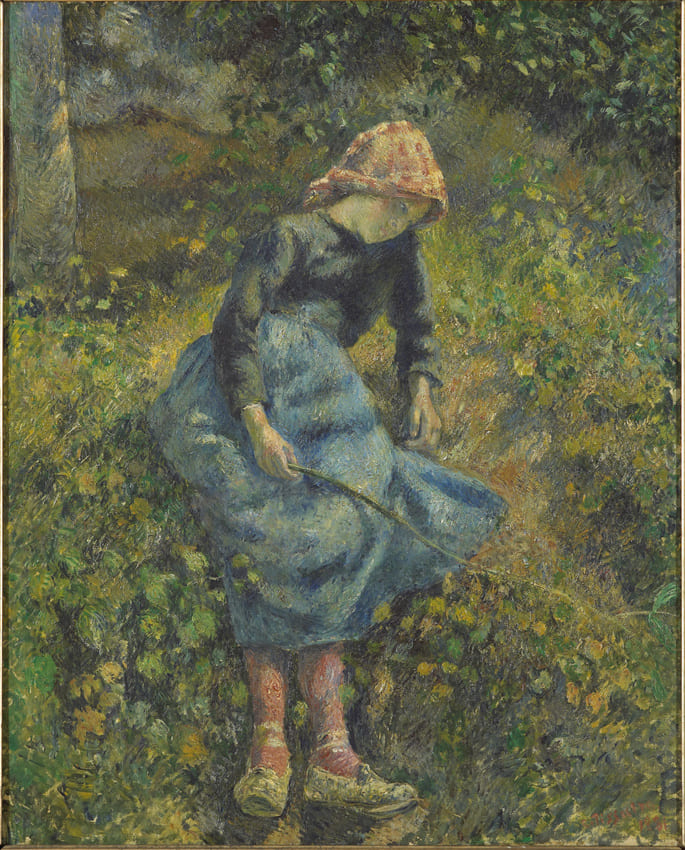
Camille Pissarro — the unassuming master who shaped an entire generation →Paris, February 16, 1910. At Paul Durand-Ruel’s gallery on Rue Laffitte, Isaac de Camondo —a banker of Ottoman origin living in Paris and one of the greatest European collectors of his time—purchased a painting created by Camille Pissarro twenty-nine years earlier, in 1881. The painting is titled *La Bergère*. It depicts a young peasant girl seated, her headscarf tied, wearing an apron, a stick in her hand, her gaze fixed downward.
Camille Pissarro died on November 13, 1903. He has been buried at Père-Lachaise Cemetery for seven years. He never knew that his *Bergère*, which had been deposited at Durand-Ruel’s gallery the very year it was created and had traveled between Paris and New York for eighteen years, had finally found a buyer. Nor did he ever know thata year later, in 1911, that buyer would bequeath the work to the French government upon his death, bringing *La Bergère* into the national collections—first to the Louvre, then to the Musée du Jeu de Paume, and today to the Musée d’Orsay.
This article recounts the extraordinary history of this painting: the circumstances of its creation in Pontoise in 1881, Degas’s advice that encouraged Pissarro to paint figures, the twenty-nine-year wait at the Durand-Ruel galleries, and the Camondo bequest that brought it into France’s national heritage.
Pontoise, 1881
In the summer of 1881, Camille Pissarro was fifty-one years old. He had been living in Pontoise for nine consecutive years, in the house on Rue de l’Hermitage where he had settled with his family—his wife Julie Vellay and their six surviving children. Cézanne, his friend and disciple, came regularly to paint alongside him. Paul Gauguin, whom he had taken off the dole, also painted with him that summer, as did Armand Guillaumin.
For the Impressionist movement, 1881 was a year of crisis. The sixth Impressionist exhibition, held in Paris in April, marked the departure of Monet, Renoir, and Sisley —who preferred to return to exhibiting at the official Salon for commercial reasons. Pissarro, however, remained loyal to the collective principle. He participated in the exhibition. As always, he would be the only painter to remain a constant presence.
It was against this backdrop that Pissarro began to steer his painting in a new direction. During the 1860s and 1870s, he had painted almost exclusively landscapes —the countryside around Pontoise, the Oise River, vegetable gardens, orchards, and country roads. Beginning in 1881, he started placing figures of peasant men and women in the foreground of his compositions. *La Bergère* is one of the first works in this new vein—and probably the most accomplished of that first year of transition.
The Painting — What It Depicts
La Bergère — also known by the titles Young Girl with a Wand and Seated Peasant Woman according to the official catalog entries of the Musée d’Orsay—is an oil on canvas measuring 81 centimeters high by 64.8 centimeters wide (with its frame, 101.2 × 85.7 cm). Vertical format. Signed and dated “C. Pissarro 1881” in the lower right corner.
In the center of the composition, a young peasant girl is seated on a hillside at the Hermitage or in the immediate vicinity of Pontoise. She is wearing a dark dress, a light-colored apron tied at the waist, and a headscarf, and is holding a shepherd’s staff in her right hand—the traditional attribute of a shepherdess guiding her flock. According to the catalog raisonné by Joachim Pissarro and Claire Durand-Ruel Snollaerts, the model has not been formally identified. The Musée d’Orsay simply states that she is a local girl, perhaps one of the many peasant women from Pontoise who posed for Pissarro during those years.
The young woman’s gaze is directed downward, to the left of the painting. The left half of her face is lit, while the right half is in shadow. The Musée d’Orsay’s official entry summarizes her posture with two words in its thematic index: “pensive” and “solitude.”
The background is rendered in a palette of dark greens and earthy browns. Indistinct vegetation—tall grasses, branches, foliage—surrounds the figure without situating her in a recognizable landscape. No horizon. No sky. No other figures. The peasant woman occupies almost the entire pictorial space. She—and she alone—is the subject.
This frontal positioning of the human subject—this subordination of the landscape to the figure—was a departure for Pissarro in 1881. For twenty years, his paintings had placed the landscape in the foreground and human figures in the background. With *La Bergère*, this relationship is definitively reversed.
Degas’s Advice
Pissarro’s shift toward figure painting in 1881 was no accident. It was a direct result of advice he received from Edgar Degas in 1879–1880.
In the definitive catalog raisonné published in 2005 by Joachim Pissarro, the painter’s great-grandson, and Claire Durand-Ruel Snollaerts, a descendant of Paul Durand-Ruel, we find this valuable analysis:
“Contrary to a long-standing cliché, Pissarro—largely following Degas’s lead—cultivated the altered effect produced by memory; that is, he allowed time to pass before returning to his memories of immediate visual perceptions.”
— Joachim Pissarro and Claire Durand-Ruel Snollaerts, *Pissarro: A Critical Catalog of Paintings*, 2005*
This observation is crucial. Pissarro, who until then had been a painter of immediate plein air scenes (painting what one sees while seeing it), shifted in 1880 toward a more complex approach under the influence of Degas: painting from memory, allowing time to distort and refine visual impressions. It was this method that allowed Pissarro to paint peasant women posing in his studio in Pontoise, drawing on memories and sketches made at various times, rather than requiring a shepherdess to remain motionless outdoors for hours on end.
Degas, a leading painter of the Impressionist movement but with more classical aesthetic convictions than Monet or Renoir, had long advocated for the primacy of drawing and the human figure over landscape. He himself painted dancers, washerwomen, and horses—figures in motion captured in a single moment. He saw that Pissarro, the quintessential peasant painter, could bring a radically new perspective to this tradition of the human figure: that of the rural world treated with the monumental dignity that academic painters reserved for mythological scenes.
Pissarro took this advice to heart. Beginning in 1881, at least half of his output was devoted to depictions of peasant women, peasants, washerwomen, and market vendors. *La Bergère* is one of the earliest and most powerful works in this new vein.
A Peasant Woman at Rest
We should pause to consider one aspect of the painting that few popular articles highlight: the young shepherdess is not working. She is resting, motionless, seated, almost in a meditative state. This is a formal fact that can be observed directly in the composition.
However, until 1881, 19th-century French rural painting—drawing particularly on the legacy of Jean-François Millet —almost always depicted peasants at work: bent over the land, sowing, mowing, gleaning, washing, and hauling. Rural labor was treated as a permanent, almost ontological state. In Millet’s work, the peasant is his labor.
Pissarro reverses this portrayal. In his work from the 1880s, and particularly in *La Bergère*, the peasant is depicted in his moments of leisure —at rest, at a standstill, taking a break. This is a political vision of rural life, consistent with Pissarro’s anarchist convictions, which shape his entire body of work. For him, work is not a perpetual curse: it is a human activity that must be balanced by times of rest, reflection, and leisure. The shepherdess gazing into the distance, her staff resting by her side, is not a decorative figure of idleness—she is an affirmation that the peasant, like any human being, has a right to moments of his own.
This philosophical divergence from Millet has been documented by modern art historians. But Pissarro does not express it in terms of opposition—he simply embodies it in his painting. And *La Bergère*(1881) is the most accomplished expression of this in his early period.
Twenty-nine Years at the Durand-Ruel Galleries
Pissarro entrusted *La Bergère* to his regular dealer, Paul Durand-Ruel (1831–1922), almost as soon as the painting was completed. The official entry in the Musée d’Orsay’s catalog provides the complete provenance:
- From 1881 to 1888: Galerie Durand-Ruel, Paris (Rue Laffitte, then Rue Le Peletier)
- From 1888 to 1899: Durand-Ruel Gallery, New York (Durand-Ruel opened his New York gallery in 1888 to break into the American market)
- From 1899 to 1910: Galerie Durand-Ruel, Paris (the work returned to France after 11 years in the United States)
- February 16, 1910: Purchased by Count Isaac de Camondo
This journey is striking for several reasons.
First observation: the painting never left Durand-Ruel’s gallery between 1881 and 1910. It is not a work that circulated among collectors. It is a work that the dealer was unable to sell for twenty-nine years, despite all his commercial efforts across two continents.
Second observation: La Bergère left for New York in 1888. At that time, Pissarro was 58 years old and living in precarious circumstances—the Parisian Durand-Ruel Gallery, his main commercial outlet, was itself in trouble following the financial crisis of 1882 (the collapse of the Union Générale). Pissarro sent his works to the United States in the hope that the younger, more dynamic American market would buy his painting. The American market did not buy *La Bergère*. The painting returned to Paris in 1899 without having found a buyer.
Third observation: By the time the painting was finally sold in 1910, Pissarro had been dead for seven years. He never received a single cent from the sale of this work. The profit from the sale went to Durand-Ruel (who held the sales rights). The Pissarro family—Julie Vellay and her children—received nothing.
This commercial story, with its time lag between creation and recognition, resembles that of Millet’s *The Angelus* (1857–1859), which sold for 1,000 francs and was resold for 553,000 francs after the painter’s death. It was this recurring injustice that inspired the creation of the resale right in French law in 1920—a principle whereby the artist or the artist’s heirs receive a percentage of the proceeds from each public resale of the work.
The Camondo Legacy
The man who purchased *La Bergère* in February 1910 was one of the most distinctive figures in Parisian art collecting during the Belle Époque. Isaac de Camondo (1851–1911) came from a family of Sephardic Jewish bankers of Ottoman origin, who had originally settled in Constantinople and then moved to Paris in the 1860s. The Camondos financed railroads, industry, and real estate credit—they were among the wealthiest financial families in France at the end of the 19th century.
Isaac de Camondo had no children. His passion wasart: 18th-century French painting, the French Impressionists, and Japanese prints (his Japanese collection was one of the largest in Europe). He bought works from Durand-Ruel, Bernheim-Jeune, and Vollard. He socialized with Degas, Monet, and Pissarro. He lived in a townhouse at 82 Avenue des Champs-Élysées, which he had transformed into a private museum.
When he purchased La Bergère in February 1910, Isaac de Camondo had only one year left to live. He died on April 7, 1911. In his will, he bequeathed his entire collection —comprising several hundred major works—to the French government.
The Camondo bequest was accepted by decree on November 23, 1911. It greatly enriched the national collections: works by Manet, Degas, Monet, Pissarro, Cézanne, Renoir, and Sisley, as well as a large portion of the collection of Japanese prints that would later form the core of the Guimet Museum’s holdings. *La Bergère* entered the Louvre as part of this bequest. It remained there until its transfer to the Jeu de Paume in the 1940s and 1950s, and then to the Musée d’Orsay when it opened in December 1986.
A tragic historical detail: the Camondo family would suffer a terrible fate in the 20th century. Isaac’s nephew, Moïse de Camondo, in turn bequeathed his collection to the French government (forming the Nissim-de-Camondo Museum in Paris). His daughter Béatrice, his son-in-law, and his grandchildren were deported to Auschwitz in 1944 and never returned. The Camondo line in France came to an end during the Holocaust. But the works that Isaac had purchased between 1880 and 1910, including Pissarro’s *La Bergère*, have remained and continue to be part of French public collections.
How to View the Work Today
*La Bergère* is housed at the Musée d’Orsay in Paris, in Gallery 32 on the upper level, where several major works by Camille Pissarro and the Impressionists of the 1880s are on display.
Practical Information:
- Address: 1 rue de la Légion d’Honneur, 75007 Paris
- Subway: Solférino (Line 12) or RER C (Musée d’Orsay)
- Reservations recommended: limited time slots; tickets available online on the official website
- Admission: around €16 for general admission; free for EU residents under 26; free on the first Sunday of every month
- Room: Upper level, Room 32 (to be confirmed on the museum map on the day of the visit, as the layout of the rooms may change)
Other highlights at the Musée d’Orsay on the same day:
- Red Roofs, Village Corner, Winter (1877), another major work by Pissarro from his Pontoise period
- Poppies (1873), Claude Monet — a work from the Argenteuil period
- The Angelus (1857–1859), Jean-François Millet—to whom Pissarro responds formally with his depiction of peasants at rest
- The Sower (second version), Jean-François Millet — a seminal work of French rural painting
A tour focused on “19th-century French peasant painting” can be organized at the Musée d’Orsay in an hour: Millet → Pissarro → compare the two perspectives on rural labor. This is probably the most informative itinerary one can follow on this subject in a French museum.
Further Reading
Institutional sources cited
- Musée d’Orsay, official entry for *La Bergère*. Inventory number RF 2013. Primary source for dimensions, provenance, and subject indexing.
- Joachim Pissarro and Claire Durand-Ruel Snollaerts, *Pissarro: Critical Catalog of Paintings*, 3 volumes, Wildenstein Institute / Skira, Paris/Milan, 2005. The definitive catalog raisonné.
Leading Modern Studies
- Janine Bailly-Herzberg (ed.), Correspondence of Camille Pissarro, 5 volumes, PUF / Éditions du Valhermeil, Paris, 1980–1991. A critical edition of Pissarro’s letters.
- Richard Brettell and Joachim Pissarro, *Pissarro and Pontoise: The Painter in a Landscape*, Yale University Press, 1990.
- Pissarro, the First of the Impressionists, exhibition catalog from the Musée Marmottan Monet, 2017, edited by Claire Durand-Ruel Snollaerts and Christophe Duvivier.
Institutional Documentation
- Musée d’Orsay, Paris — the institution that has owned the work since 1986.
Also check out on Hors Cadre
- Camille Pissarro—the unassuming master who trained an entire generation —a portrait of the painter.
- Jean-François Millet—the painter of peasants —is a historical figure in French rural painting, to whom Pissarro responds stylistically.
- “The Angelus” — how a 55-cm painting turned the French art market on its head — another work from the Musée d’Orsay whose unusual commercial fate inspired the creation of the resale right under French law.
- Boulevard Montmartre, a Winter Morning— How Pissarro’s Eye Condition Inspired His Urban Paintings
— M