Bathing the Child — Motherhood Reimagined Through Japanese Prints
Mary Cassatt — Berthe Morisot's American Heiress →Paris, Durand-Ruel Galleries, November 1893. Mary Cassatt opened her first major solo exhibition in Paris. Forty-nine works were hung on the gallery walls at the dealer’s space on Rue Le Peletier in the 9th arrondissement. Among them is a previously unseen vertical oil-on-canvas painting, measuring 100.3 centimeters high by 66.1 centimeters wide. The title on the label reads *La Toilette de l’enfant*. It is catalog number 1 and serves as the opening work of the exhibition.
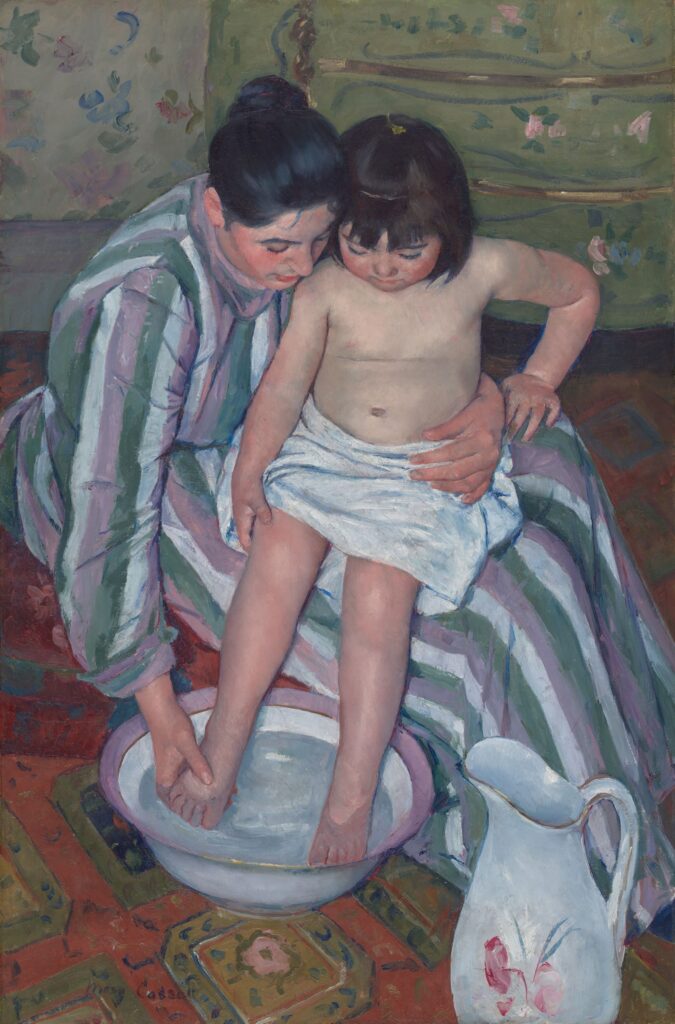
The painting depicts an intimate scene: a young woman, seen in a three-quarter view from behind, wearing a dress with vertical white and lavender stripes, is holding a naked little girl on her lap. The mother leans her face toward the child. With her right hand, she dips a sponge into a white porcelain basin. With her left hand, she holds the child’s right foot. The child, completely absorbed, looks down at her own foot in the water, fascinated by the gesture.
The work is viewed from above —a bird’s-eye view that places the viewer above the scene, as if suspended in midair. The limited color palette combines off-whites (the child’s skin, the basin), olive greens (the floral-patterned carpet), lavender tones (the striped dress), and pale pinks (a bouquet). All the predictable sentimentality of the subject —the mother bathing her daughter—is carefully avoided by the composition.
This article traces the origins ofMary Cassatt’s most famous work,the decisive influence of Japanese prints on its conception, the public health context of the Parisian hygiene campaigns of the 1880s and 1890s—which explain why bathing became a modern subject in painting—its legacy in 20th-century Western mother-and-child painting, and the museum journey that took *The Child’s Bath* from Cassatt’s Paris studio to the Art Institute of Chicago, where it has been housed since 1910.
1893 — Mary Cassatt, age 49, at the height of her artistic career
By 1893, Mary Cassatt had reached the height of her artistic maturity. She was forty-nine years old. She had been living in Paris for twenty years. She had participated in four of the eight Impressionist exhibitions (1879, 1880, 1881, 1886). She was recognized by her peers—Edgar Degas, Camille Pissarro, and Berthe Morisot. She had forged close relationships with Parisian art dealers, notably Paul Durand-Ruel, who had been championing Impressionism for twenty years.
But 1893 was also a turning point in her personal life. Her sister Lydia Cassatt, her favorite model in the 1870s and 1880s, had died eleven years earlier (1882). Her parents had also passed away (Robert Simpson Cassatt in 1891, and Katherine Kelso Cassatt a little earlier). Mary now lived alone in Paris, dividing her time between her apartment at 10 rue de Marignan (8th arrondissement, where she had lived since 1887) and the Château de Beaufresne in Mesnil-Théribus, which she had purchased the previous year.
She never married. She never had children. A historical paradox: the painter who devoted most of her work to depicting motherhood was not a mother herself. She painted what she observed—her nieces, her sisters-in-law, her friends’ children, and the professional models she paid.
Three years earlier, in the spring of 1890, a fateful visit transformed her painting.The exhibition of Japanese prints held atthe École nationale des Beaux-Arts in Paris was a major aesthetic shock for Mary Cassatt. More than a thousand prints by the masters ofukiyo-e —Utamaro, Toyokuni, Hokusai, Hiroshige, and Sharaku—were on display there. Cassatt visited the exhibition several times, accompanied notably by Berthe Morisot and Eugène Manet. According to a letter she wrote to Berthe Morisot shortly afterward:
“Those of you who want to create color prints couldn’t possibly imagine anything more beautiful… You absolutely must see the Japanese.”
— Mary Cassatt, letter to Berthe Morisot, 1890
This quote is valuable for two reasons. First, it confirms a direct correspondence between the only two women of the Impressionist movement—Morisot and Cassatt truly wrote to one another, discussed art, and shared their enthusiasm. Second, it marks the turning point in Cassatt’s artistic practice toward a new aesthetic—one that would culminate, three years later, in *The Child’s Bath*.
The Painting — What It Depicts
The Child’s Bath is an oil on canvas measuring 100.3 × 66.1 centimeters — a slender, vertical format. This format is not insignificant: it precisely echoes the verticality of the Japanese prints that Cassatt had been collecting and studying for three years.
The composition is built around three elements arranged in a visual triangle:
In the center-left, the mother (an unidentified model—perhaps one of Cassatt’s maids) is seated on a low chair, seen in a three-quarter rear view. She is wearing a dress with vertical white and lavender stripes, of a simple, contemporary bourgeois cut—it is not a domestic negligee but an outfit for daytime wear. Her right arm reaches down toward the basin. Her left arm holds the child.
In the center-right,the child (a girl, about 2–3 years old) is seated on her mother’s lap; the mother stands naked, with her right foot submerged in the basin and her left foot folded over her other knee. Her white, simply modeled body contrasts sharply with the ornamental motifs surrounding her. The little girl tilts her head to look at her own foot in the water.
In the foreground, at the bottom, is a round white porcelain basin, resting on a floral-patterned carpet. The water is barely suggested by a few touches of bluish-gray. The mother’s gesture— the sponge dipped in, water scooped up —is captured in its immediacy.
The color palette is intentionally limited and harmonious:
- Off-whites: the mother’s skin, the child’s skin, the basin, the light-colored parts of the dress
- Dull olive greens: patterned carpet
- Light lavender and violet: striped dress, decorative accents
- Very pale roses: bouquet of flowers in the upper left corner, spots on the skin
- Grayish blues: the water in the basin, shadows in the folds
No deep blacks. No harsh contrasts. The entire composition relies on the subtlety of the transitions between similar tones.
The perspective is the most radical element of the work. Cassatt places the viewpoint high above —as if the viewer were looking down at the scene from an upper gallery or a window high above. This bird’s-eye view does not exist in traditional Western painting, which, since the Renaissance, has favored a viewpoint at eye level. It comes directly from the Japanese prints that Cassatt studied.
The effect of this perspective is paradoxical. It allows us to observe the scene, but it prevents us from participating in it. The viewer looks down from above —like an invisible witness, a household god, an attentive painter. No intimacy is violated. No sentimentality is indulged. Mary Cassatt makes possible what 19th-century maternal painting had until then refused: a respectful distance in the gaze.
Japanese Influence — Perspective, Motifs, Vertical Composition
The Influence of Japanese Ukiyo-e Prints on *The Child’s Bath* is, according to the official entry from the Art Institute of Chicago, direct and well-documented. The museum writes:
“Captivated by a major exhibition of Japanese prints in Paris in 1890, Cassatt set out to produce a series of color prints influenced by Japanese aesthetics. She then continued her exploration of the medium, culminating in this bold composition.”
— Art Institute of Chicago, official entry for *The Bath of the Child*
Several features of the painting are directly derived from Japanese prints:
1. The slender vertical format (100 × 66 cm, 3:2 aspect ratio) replicates the ōban tate-e of Japanese woodblock prints—the standard format used by Kitagawa Utamaro and Kitagawa Toyokuni, the two masters of 18th-century Japanese woodblock printing.
2. The overhead perspective, known as the “bird’s-eye view ” (tori no me), is typical of Japanese interior prints. It allows for the simultaneous depiction of floors, low furniture, and seated figures without resorting to Western Albertian perspective.
3. The juxtaposition of decorative motifs — floral carpeting, a striped dress, an ornate basin —creates swaths of color and patterns that interact with one another. This decorative aspect is foreign to traditional Western painting; it stems from the printed kimonos and ukiyo-e prints.
4. The outlined figure —the child and the mother have silhouettes clearly defined by almost unbroken lines. This technique of strong outlines (kuro-mawashi in Japanese) is characteristic of all ukiyo-e prints.
5. The flattening of space. Traditional Italian perspective creates an illusion of depth. Cassatt, following the Japanese, flattens the space —the carpet, the dress, and the back wall are all on the same visual plane.
6. The subject itself — a mother and child in the intimacy of the bath —is a recurring motif in Utamaro’s work; he devoted several famous prints to the theme of Yamauba and Kintarō (the wild mother and her son in nature).
Cassatt did not simply imitate the Japanese. She assimilated their visual language and transposed it into Western oil painting. No American or European painter had, by 1893, achieved such a coherent synthesis between Western painting and the aesthetics of ukiyo-e. Toulouse-Lautrec, Bonnard, Vuillard, and later Van Gogh in Auvers would explore parallel paths—but *The Child’s Bath* chronologically predates most of their most accomplished Japan-inspired works.
Why Bathing? The Public Health Context of the 1880s and 1890s
The choice of the bath as a subject for painting warrants an explanation that goes beyondJapanese influence. It is rooted in a specific public health context of the late 19th century, which has been extensively documented by historians of hygiene.
The 1880s: France and Europe were struck by several major cholera epidemics. Marseille, 1884: 1,600 deaths. Paris, 1884 and 1892: epidemics followed by unprecedented public health campaigns. Louis Pasteur ’s theories on microbial contagion (1860s–1880s) transformed the medical understanding of disease. Regular handwashing is now recognized as an essential means of prevention.
In this context, health authorities and women’s magazines in the 1880s and 1890s launched massive campaigns to encourage:
- Bathing children regularly (at least once a week, ideally more often)
- The direct role of mothers in hygiene care, rather than that of nannies or wet nurses
- Modern hygiene practices (warm water, Marseille soap, thorough drying)
Among the Parisian bourgeoisie of the 1890s, bathing a child thus became a ritualized part of domestic life. It reflected social status (having the space, hot water, and time) and parental modernity (following health recommendations).
Mary Cassatt observed this social transformation and turned it into a modern subject for her paintings. In 1893, she painted not eternal motherhood (a religious or allegorical motif), but the contemporary motherhood of her time —a bourgeois mother of the 1890s who personally attended to her child’s daily hygiene.
This historic inscription distinguishes The Bathing of the Child from Renaissance “Madonnas with the Child” and the maternal allegories of 19th-century academic art. It is a contemporary, dated, and sociologically precise scene. This is what makes it, in fact, one of the first paintings of modern motherhood in the strict sense.
The Berthe Morisot Tradition and the Cassatt Innovation
The Child’s Bath is part of a specific historical tradition —that of modern maternal painting, pioneered in 1872 by Berthe Morisot with *The Cradle* (Musée d’Orsay).
Continuity: Like Morisot, Cassatt paints the contemporary bourgeois mother inthe intimacy of her home, without mythology or drama. Like Morisot, she uses a light color palette, loose brushstrokes, and an asymmetrical composition. Like Morisot, she explores the maternal bond as a major pictorial subject, on par with great historical compositions.
But Cassatt surpasses Morisot in several ways:
1. The physicality of the gesture. Morisot’s *The Cradle* depicts a mother watching over her sleeping child—a passive, contemplative gesture. Cassatt’s *The Child’s Bath* depicts a mother interacting with the child’s body —an active, tactile gesture. The hand holding the foot, the arm plunging into the water, and the child’s naked body convey a maternal physicality absent from *The Cradle*.
2. Perspective. *Le Berceau* adheres to traditional perspective at eye level. *Le Bain* adopts the Japanese bird’s-eye view —a radical formal departure.
3. The presence of decorative motifs. *Le Berceau* favorsa minimalist color palette (deep blacks and whites, few patterns). *Le Bain* features a variety of patterns (floral carpet, striped dress, ornate basin) in a Japanese-inspired style.
4. Latent eroticism. *The Cradle* depicts a sleeping child, seeming distant. *The Bath* depicts a naked child’s body, fully present in all its physicality. Cassatt takes the risk of depicting a naked child’s body, which, at the time, was a sensitive subject in Western painting.
According to several historians (notably Anne Higonnet, Morisot’s biographer and a specialist in maternal painting), it is precisely this tactile physicality that makes Cassatt the inventor of modern maternal painting in the strict sense. Morisot pioneered the subject. Cassatt invented its physical grammar.
This connection between Morisot and Cassatt is not explicitly stated by the two painters themselves. But it is evidenced by the chronology: *The Cradle* in 1872, exhibited at the first Impressionist exhibition in 1874 (Cassatt had been living in Paris since 1873) → twenty years later, *The Child’s Bath*, which takes the subject to its fullest expression.
From Paris to Chicago — The Material History of the Painting
The physical history of *The Child’s Bath* is, as is often the case with Cassatt, scattered between France and the United States.
1893: Cassatt completed the painting in her Paris studio. She exhibited it in November–December 1893 at the Durand-Ruel Gallery, 11 rue Le Peletier in Paris, under the title The Child’s Toilette. It was catalog number 1 in the catalog for her solo exhibition in Paris —the opening work, and thus the piece considered the most important by both Cassatt and her dealer.
1895: The painting crosses the Atlantic. Paul Durand-Ruel exhibited it at his New York gallery, 315 Fifth Avenue, as part of the exhibition *Exhibition of Paintings, Pastels, and Etchings by Miss Mary Cassatt* (April 16–30, 1895). This was its first showing in the United States.
1895–1910: The painting traveled between Paris and New York as part of the Durand-Ruel exhibitions. It was exhibited at the Pennsylvania Academy of the Fine Arts (Philadelphia, 1898), the Cincinnati Museum (1900), and the Durand-Ruel Galleries in New York (1903). Cassatt herself followed its progress closely—she corresponded with Durand-Ruel regarding display conditions and potential sales.
1910:The Art Institute of Chicago acquired the painting from Durand-Ruel. The purchase was historically significant. Mary Cassatt was still alive (she was 66 at the time, and her progressive blindness was beginning). It was one of the first major acquisitions of a work by Cassatt by a major American museum. The Art Institute thus became, during the artist’s lifetime, the owner of one of her most iconic works.
1910–present: The Child’s Bath remains on permanent display at the Art Institute of Chicago, in Gallery 273 on the second floor (American Art). According to the museum itself, it has become one of the most popular works in the collection. It is widely reproduced in art history textbooks, traveling exhibitions, and catalogs raisonnés. It is a nearly universal image of modern Impressionist motherhood.
Notable fact: Unlike several of Cassatt’s other American works, this painting has never left the Art Institute for a retrospective exhibition in France. Due to the risks involved in transatlantic transport andthe painting’scentral importance to the permanent collection, Chicago no longer loans it out. To view *The Child’s Bath*, you have to go to Chicago.
Posterity—the source of all maternal painting of the 20th century
TheInfluence of the “Bain de l’enfant” on 20th-century Western painting is, in fact, enormous—though its true significance is rarely acknowledged to the extent it deserves.
Three lines of influence have been documented:
Line 1 — The Nabis and French Intimism
Édouard Vuillard (1868–1940) and Pierre Bonnard (1867–1947) became familiar with Cassatt’s work between 1893 and 1895. Vuillard personally collected several Japanese prints and several engravings by Cassatt. His series of Interiors, painted between 1893 and 1900, directly continues the visual language of *The Child’s Bath*: domestic interiors observed from an elevated vantage point, an abundance of decorative motifs, and the presence of everyday women.
Line 2 — German Expressionism
Paula Modersohn-Becker (1876–1907), a German painter, saw *The Child’s Bath* in Paris during her study trips (1900–1907). Her works depicting motherhood (notably *Kneeling Mother Nursing Her Child*, 1907, Folkwang Museum, Essen) clearly show her connection to Cassatt— maternal physicality, a downward gaze, and simplified forms.
Line 3 — 20th-Century American Painting
Through her work and her influence on the Havemeyer Collection (later the Metropolitan Museum), Mary Cassatt established an American artistic tradition centered on women’s domestic life. Cecilia Beaux (1855–1942), Lilla Cabot Perry (1848–1933), Anna Klumpke (1856–1942), and several other American female painters of the next generation were direct heirs to Cassatt’s legacy.
Beyond direct family ties, *The Bathing of the Child* has become an iconic image of modern motherhood in Western culture. Reproduced on posters, postcards, and baby product packaging —it has left the museum and enteredthe collective imagination.
More importantly: before Cassatt, Western painting depicted motherhood as a sacred mystery (Madonnas with the Child) or a moral allegory (Charity, the Family). After Cassatt, motherhood became an observable contemporary subject that could be painted as a still life, a landscape, or a portrait —without hierarchy or ceremony. This positive normalization of motherhood in painting is Cassatt’s defining achievement.
As art critic Pamela Ivinski wrote in the catalog for the Cassatt exhibition at the Musée Jacquemart-André in 2018:
“Cassatt freed the theme of motherhood from the age-old conventions of religious and allegorical painting. She brought it into everyday life.”
— Pamela Ivinski, catalog for the Cassatt exhibition, Musée Jacquemart-André, 2018
How to View the Work Today
“The Child’s Bath” is housed at the Art Institute of Chicago. Practical information:
- Address: 111 South Michigan Avenue, Chicago, Illinois 60603, United States
- Subway: Line L (red, blue, brown, orange, purple, green) — Monroe or Adams station
- Gallery: Gallery 273, second floor, American Art section
- Hours: Thursday through Monday, 11 a.m.–5 p.m.; Friday until 8 p.m.; closed Tuesday and Wednesday
- Price: $32 full price, $26 for Illinois residents, free for Illinois youth <, and 14 years old
- Reservations: Online reservations are recommended (limited time slots)
The work has been on permanent display since 1910 and is no longer loaned out for traveling exhibitions (in accordance with the museum’s internal conservation policy).
Also on view in Gallery 273 of the Art Institute (Mary Cassatt and American Art Gallery):
- Several other early works by Cassatt, including pastels and etchings
- Works by John Singer Sargent, James McNeill Whistler, and William Merritt Chase — the other generation of American artists active in Paris during the same period
- Works by Winslow Homer and Thomas Eakins (American independent painting)
To see more of Mary Cassatt’s early works in France:
- Musée d’Orsay, Paris — Woman Sewing in a Garden (1880–1882), Portrait of Mademoiselle Louise-Aurore Villeboeuf (1901, pastel)
- Petit Palais, Paris — several engravings and pastels from the 1890–1891 Japanese-inspired series
To see other works by Mary Cassatt in the United States:
- National Gallery of Art, Washington — Mother and Child (c. 1888), the world’s premier Cassatt collection
- Metropolitan Museum of Art, New York — Havemeyer Collection, several works
- Detroit Institute of Arts — Mother and Child with Red Hair (1898)
- Toledo Museum of Art — Mother and Child with an Orange (1893)
Further Reading
Institutional sources cited
- Art Institute of Chicago, official entry for *The Child’s Bath*. Inventory number 1910.2.
- Encyclopædia Britannica, article “The Child’s Bath.”
- National Gallery of Art, Washington, official catalog entries for Cassatt’s works depicting motherhood.
- Exhibition catalog: *Mary Cassatt, an American Impressionist in Paris*, Musée Jacquemart-André, 2018.
Primary sources cited
- Mary Cassatt, letter to Berthe Morisot, 1890.
- Pamela Ivinski, essay from the 2018 Jacquemart-André catalog.
Modern Studies
- Anne Higonnet, Berthe Morisot, Adam Biro, Paris, 1989 — chapter on modern maternal painting.
- Nancy Mowll Mathews, *Mary Cassatt: A Life*, Yale University Press, 1994. A definitive biography.
- Frederick A. Sweet, *Miss Mary Cassatt: Impressionist from Pennsylvania*, University of Oklahoma Press, 1966.
- Adelyn Dohme Breeskin, *Mary Cassatt: A Catalogue Raisonné of the Graphic Work*, Smithsonian Institution Press, 1979.
Institutional Documentation
- Art Institute of Chicago — owned by the institution since 1910.
- Musée d’Orsay, Paris — French works by Cassatt.
See also on Hors Cadre
- Mary Cassatt — the American heir to Berthe Morisot — a portrait of the artist.
- *The Cradle*—the “first mother” of Impressionism —the seminal work of the Impressionist maternal theme, created twenty years before *The Child’s Bath*, and whose stylistic language Cassatt carries forward.
- Berthe Morisot—the painter who influenced Manet’s work —was the older sister and friend of Cassatt, the other woman of Impressionism.
— M