Where do we come from? What are we? Where are we going? — the work a man painted so he could die
Paul Gauguin — His Art Is Admired, but He Is a Controversial Figure →Punaauia, Tahiti, December 1897. In a wooden hut he built himself on the edge of the lagoon, a forty-nine-year-old man is setting up a large piece of burlap —the only material available on the island, since there is no linen. The rectangle he is preparing measures one meter forty-one high by four meters eleven long. His name is Paul Gauguin. He is ill—he has had syphilis for ten years, purulent eczema on his left leg, and chronic conjunctivitis. He is ruined—Mallarmé and Vollard in Paris are struggling to sell his paintings. Eight months earlier, he had just received word of the death of his twenty-year-old daughter, Aline, who had succumbed to pneumonia in Copenhagen. Aline was the child he had named in honor of his mother. For this lost child, he wrote a *Cahier pour Aline*, which he kept for years.
Gauguin made a decision. He’s going to kill himself. He set the date: December 1897. But before he died, he wanted to paint a large canvas he had in mind. For an entire month, he painted day and night, in what he himself called “an unprecedented fever.” Four meters and eleven centimeters of canvas to cover. The cycle of life from right to left: birth, adulthood, death. A blue idol from the afterlife in the background. A white bird on the ground representing, in his own words, “the futility of words.”
When the painting was finished, in January 1898, Gauguin went up into the mountains above Punaauia with a massive doseof arsenic. He swallowed it. He lay down on the red earth to die.
He survives.
This article recounts the creation of this work—arguably Gauguin’s most powerful and one of the most profound in all of late 19th-century European painting—from the news of Aline’s death to his failed suicide attempt. All the facts are corroborated by the letters Gauguin wrote to his friend Daniel de Monfreid in the months that followed, which are now preserved in Paris in the Department of Graphic Arts at the Louvre Museum.
April 1897 — Aline’s death
On March 6, 1897, in Copenhagen, Mette Gauguin wrote to her husband to tell him that their daughter Aline had fallen ill with severe pneumonia. Aline was twenty years old. She was the second child of the Gauguin-Gad couple, born in December 1877. She had been living with her mother and brothers since Paul abandoned the family in 1885.
Aline died on January 19, 1897, in Copenhagen—but Gauguin, who was in Tahiti, did not learn of her death until late March 1897. It took the telegram several weeks to cross two oceans. The detailed letter arrived in April.
To Gauguin, Aline was his favorite child. In previous years, he had begun compiling a manuscript for her that he called the “Cahier pour Aline”, a collection of thoughts, stories, sketches, and fragments intended to convey to his daughter his views on the world. The notebook is now housed at the Bibliothèque nationale de France. He had named her Aline in honor of his own mother, Aline-Marie Chazal, who died too young in 1867 when Paul was nineteen.
His daughter’s death marked a turning point in the final years of Gauguin’s life. He would later write to several correspondents that Aline’s death was “the blow that finished him off.” His physical health, already precarious, deteriorated rapidly. His depression, which had been latent for several years, became severe. The decision to take his own life began to take shape in the months that followed.
December 1897 — Paint Before I Die
During the summer and fall of 1897, Gauguin tried to continue painting—he completed a few minor works and wrote for *Le Sourire*, which he had been editing in Papeete since the summer of 1899… but his mind was made up. He had set the date: December 1897.
Before taking his own life, he wanted to do one last thing: paint a large canvas—one that would encapsulate all his thoughts, all his art, and all his quest. A month later, in February 1898, he would recount everything in a letter to his closest French friend, Daniel de Monfreid —a Catalan painter and sculptor who had been managing his business affairs from Paris since 1893. This letter is now preserved in the Department of Graphic Arts at the Louvre (Musée d’Orsay), along with an original drawing by Gauguin:
“I must tell you that I had firmly resolved to do this in December. So, before I died, I wanted to paint a large canvas that I had in mind, and throughout the entire month I worked day and night with incredible fervor.”
— Paul Gauguin to Daniel de Monfreid, letter dated February 1898 (Musée d’Orsay, Department of Graphic Arts at the Louvre)
Gauguin set up his canvas in his hut. He didn’t have an easel large enough for a four-meter-eleven canvas. The canvas was probably laid out on the floor or stretched against a wall. The support is not a traditional canvas but jute —a coarse fabric of Indian origin that is more economical and rougher in texture. Gauguin uses it for lack of a better option: in Tahiti in 1897, European art supplies were scarce, expensive, and of uneven quality.
For an entire month —roughly twenty to thirty days, depending on the exact dates—Gauguin painted “day and night.” He slept little, ate little, and never left his hut. According to the account of Pau’ura a Tai, his Polynesian vahine who was living with him in Punaauia at the time, he would not tolerate anyone in his studio during this period. The painting took shape amid solitude and feverish intensity.
The Painting — What It Depicts
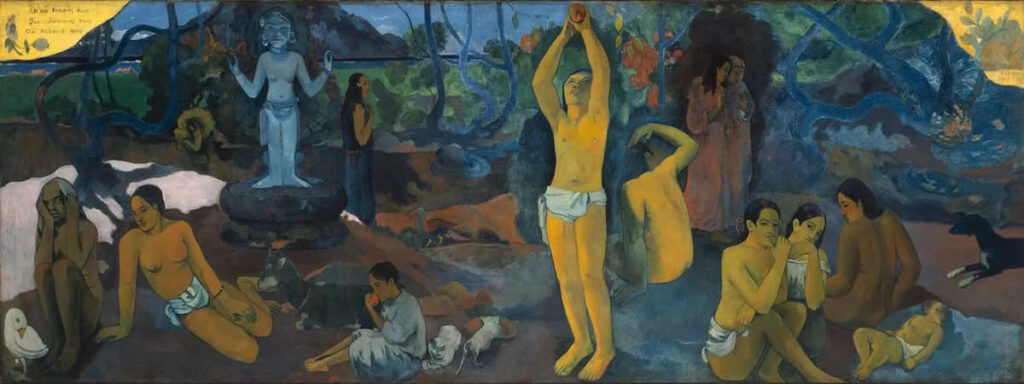
“Where Do We Come From? What Are We? Where Are We Going? ” is an oil on jute measuring 141 centimeters high by 411 centimeters wide. It isone of Gauguin’s largest canvases and one of the most monumental works in allof Post-Impressionist painting. It has an extremely elongated panoramic format (ratio of 1:2.9), which is unusual for a work painted on an easel.
In the upper left corner of the canvas, Gauguin inscribed the full title directly in French against a golden-yellow background: “Where Do We Come From? What Are We? Where Are We Going?” According to the Museum of Fine Arts in Boston, which houses the work, this inscription is not a conventional title —it is a philosophical statement integrated into the artwork. The question does not end with the painting; itenvelops it.
The composition is read from right to left (the opposite of the usual Western reading direction) and depicts the cycle of human life. According to Gauguin’s own comments in several letters:
On the right — birth: three women crouching and a child sleeping on the ground. This is the beginning, innocence, purity before consciousness.
In the center — adulthood: a standing figure, bare-legged, with an arm raised to pluck a fruit from a tree. Gauguin explains in a letter to André Fontainas that this isa depiction of Eve plucking the forbidden fruit. A young girl sitting next to her is eating a fruit —sensuality, experience, and the Polynesian original sin.
On the left — death: an old woman crouching, her hands pressed against her head, “approaching death and appearing reconciled and resigned to her thoughts,” according to Gauguin himself. At her feet, a white bird holding a lizard in its beak—Gauguin writes that it “represents the futility of words” or “the futility of empty words.”
In the upper left, in deep blue: a mysterious figure with raised arms, resembling an idol. Gauguin identifies it as “the Hereafter” —not the Christian heaven, not Buddhist nirvana, but a visual representation of the mystery of transcendence that the questions in the title cannot resolve.
Together, the three groups—birth, adulthood, and death—depict the complete cycle of human life in a composition punctuated by trees, foliage, rivers, anda Polynesian backdrop that lends a sense of space to the philosophical meditation.
A work that encapsulates his entire body of work
It is worth noting an aspect that is rarely highlighted in articles aimed at the general public: *Where Do We Come From?* is not a work composed of new motifs. It is a comprehensive synthesis of figures that Gauguin had painted over the previous ten years.
Several identifications have been confirmed by art historians and through iconographic comparisons:
The old woman on the left explicitly echoes the figureof “Breton Eve” painted by Gauguin in 1889 during his stay in Le Pouldu. She has the same crouching posture, with her hands pressed against her temples. Gauguin even retained the sprawling roots that encircled the head of the “Breton Eve”—direct evidence of self-reference.
The central standing figure is an allegorical version of “The Man with the Axe,” painted in 1891 during Gauguin’s first months in Tahiti. The same posture, the same proportions, the same raised arm. The subject has changed (the man becomes a woman picking fruit), but the compositional structure is identical.
The child in the center eating a piece of fruit is from *Jours délicieux* (1896). Same pose. Same fruit. The kitten licking next to the child—a seemingly insignificant but remarkably precise detail—is in the same position with the same bowl as in a small painting from 1888 and on a fan also from 1888.
This summarizing aspect is essential to understanding the project. Gauguin is not merely painting “before he dies” —he is painting a summary of his entire body of work. He brings his figures together, like a painter gathering all his paintings into a final room before falling silent. This retrospective synthesis is as rare as it is powerful: it is likelythe only example in 19th-century European painting of an artist who, aware that he was dying, summarized his own body of work in a single piece.
January 1898 — the suicide attempt
By the end of January 1898, the painting was completed. Gauguin signed it in the lower left corner. He photographed the work—entrusting this task to Henry Lemasson, a photographer in Papeete—and enhanced it with pastels to achieve better contrast. The photograph is preserved today in the archives of the Ministry of Culture in Tahiti.
Then Gauguin acted on the resolution he had made in December. He climbed into the mountains above Punaauia, where the tropical forests meet the island’s volcanic heights. He carried a massive doseof arsenic —a substance that was readily available at the time as rat poison in all colonial pharmacies.
He swallows the dose. He lies down to die.
In his own words, in a later letter to Charles Morice, he endured “a night of terrible suffering.” But he did not die. The dose was probably too high—a known pharmacological effect of very high doses of arsenic is to induce vomiting rather than absorption, paradoxically sparing the life of whoever has taken too much. Gauguin came down from the mountain in the morning, sick, drained, but alive.
This failed attempt is documented by several sources: the letter to Monfreid from February 1898 (which explicitly mentions it), the letter to Charles Morice from the same period, and the account by Pau’ura a Tai, later recorded by Bengt Danielsson. Gauguin did not stage his act for dramatic effect. He really did it. He really wanted to die. He really failed to die.
He would live another five years —until his natural death in the Marquesas Islands on May 8, 1903.
“I’ll never make a better one.”
In the same letter to Daniel de Monfreid dated February 1898, after recounting his failed suicide attempt, Gauguin assesses his own work. It is the most definitive self-assessment he ever wrote about his own work:
“I believe that not only does this painting surpass all my previous ones in value, but also that I will never paint one better or even one like it.”
— Paul Gauguin to Daniel de Monfreid, letter dated February 1898
This statement is extraordinary in many ways. Gauguin himself ranked this painting above all his earlier works —including *Vision After the Sermon* (1888), *The Yellow Christ* (1889), and *Manao Tupapau* (1892). And he prophesied that he would never paint a better one. The five years that followed, until his death in 1903, proved him right: *Where Do We Come From?* remains the most monumental and profound work of all that Gauguin ever painted.
What is even more remarkable is that this sentence was written immediately after a suicide attempt. A man who had just narrowly escaped death—who likely had nothing left to lose, who could have written any number of modest remarks befitting the circumstances—chose instead to clearly affirm the greatness of what he had just done. It is probably, in this awkward modesty, the purest truth Gauguin ever spoke about himself.
November 1898 — exhibition at Vollard’s in Paris
In July 1898, Gauguin shipped the painting to Daniel de Monfreid in Paris, along with eight other smaller Tahitian paintings. The instructions were clear: the large painting was to be exhibited at a Parisian art dealer’s gallery and an attempt made to sell it.
Monfreid approached the art dealer Ambroise Vollard, who agreed to sign Gauguin to a contract a year later, in 1900. In November 1898, Vollard exhibited nine of Gauguin’s Tahitian works in his gallery on Rue Laffitte in Paris, including the large canvas in the center. This was the first public exhibition of *Where Do We Come From?* in France.
According to the catalog for the 2003–2004 Orsay exhibition, art critic Thadée Natanson (co-founder of *La Revue blanche*) describes the eight other paintings as “fragments, replicas, or studies” of the large painting. This interpretation is valuable: it confirms that, for contemporary critics, *Where Do We Come From?* isthe central work around which the other Tahitian paintings revolve.
The reception was mixed. Stéphane Mallarmé, one of Gauguin’s supporters from the very beginning, was moved. André Fontainas, a critic for *Le Mercure de France*, published a reserved article. But the general public remained indifferent. The painting was not sold at the exhibition. It remained in Vollard’s gallery for several months, then passed through various hands, before finding its first serious buyer.
According to Larousse and several institutional sources, the painting was reportedly sold for only a few thousand francs between 1901 and 1913—a modest sum for what would become one of the most famous works of modern art.
From Tahiti to Boston
The commercial history of the painting follows a path typical of Gauguin’s works at the turn of the 20th century.
1901–circa 1913: Gabriel Frizeau, a Bordeaux winemaker and collector of modern art (Cézanne, Gauguin, Van Gogh, Picasso), purchased the painting through the Vollard Gallery. He was its first long-term French owner.
Around 1913: The painting was sold to the Barbazanges Gallery in Paris.
Before 1920–1935: Purchased by Jørgen Breder Stang (1874–1950), a Norwegian shipowner and collector, who built one of Northern Europe’s largest private collections of modern art in Oslo.
1935: Stang sold the painting throughAlfred Gold, a Berlin art dealer who was then in exile in London following the Nazi anti-Semitic laws. The painting thus crossed continents.
1936: The Marie Harriman Gallery in New York acquired the painting. That same year, it was purchased by the Museum of Fine Arts, Boston, through the Tompkins Collection. The MFA Boston has owned it ever since.
1949: The painting’s last trip to Europe for an exhibition. Since 1949, *Where Do We Come From?* has returned to France only once, for the exhibition *Gauguin-Tahiti: The Tropical Studio at the Musée d’Orsay in 2003–2004, after more than fifty years of absence from French soil. It was the first time since 1949 that the French public could view the work without crossing the Atlantic.
How to View the Work Today
“Where Do We Come From? What Are We? Where Are We Going?” is on view at the Museum of Fine Arts of Boston, in Massachusetts, United States. Practical information:
- Address: 465 Huntington Avenue, Boston, MA 02115, United States
- Room: Gallery 254 (Linde Family Wing for Contemporary Art, Sidney and Esther Rabb Gallery)
- Price: about $27 for general admission for adults
- Reservations recommended: for temporary exhibitions, but the artwork is on permanent display
For French visitors: This painting is probably the French work of art that is hardest to see today—you literally have to cross the Atlantic to see it.
To see it in France without going to Boston, you have to wait for the special temporary exhibitions organized by the Musée d’Orsay or the Grand Palais. The last one took place in 2003–2004. The next one has not yet been announced.
However, Gauguin’s handwritten letter to Daniel de Monfreid from February 1898 —the one that recounts the painting’s genesis—can be seen in Paris at the Department of Graphic Arts at the Louvre Museum (affiliated with the Musée d’Orsay). This letter, accompaniedby an original drawing of the work by Gauguin on tracing paper, is displayed during thematic exhibitions at the Musée d’Orsay. It offers a moving alternative: seeing the manuscript in which Gauguin recounts the creation of the work, in the painter’s own handwriting.
Also worth seeing at the Musée d’Orsay:
- La Belle Angèle (1889) — another major work by Gauguin, from his Breton period
- Women of Tahiti (1891) — first visit to Tahiti
- And the gold of their bodies (1901)—the final period before the Marquesas
- The Notebook for Aline (BnF), a manuscript that Gauguin kept for his daughter
Further Reading
Institutional sources cited in this article
- Museum of Fine Arts, Boston, official record for *Where Do We Come From? What Are We? Where Are We Going?*. Owned by the institution since 1936.
- Autograph letter from Paul Gauguin to Daniel de Monfreid, February 1898, with an original drawing. Housed in the Department of Graphic Arts at the Louvre Museum (Musée d’Orsay).
- Gauguin-Tahiti: The Tropical Studio, exhibition catalog from the Musée d’Orsay, 2003–2004, edited by Claire Frèches-Thory and George T. M. Shackelford, Réunion des musées nationaux / MFA Boston.
Gauguin’s Primary Sources
- Paul Gauguin, Letters to Georges-Daniel de Monfreid, edited by Victor Segalen (1918), reprinted by Falaize in 1950.
- Paul Gauguin, *Notebook for Aline*, manuscript (National Library of France).
- Paul Gauguin, *Before and After*, manuscript, 1903 (published posthumously in 1923).
Leading Modern Studies
- Daniel Wildenstein (with Sylvie Crussard and Martine Heudron), *Gauguin: A Savage in the Making, Catalogue Raisonné of the Paintings (1873–1888)*, Wildenstein Institute / Skira, 2001–2002.
- Bengt Danielsson, *Gauguin in Tahiti and the Marquesas Islands*, Presses Pocket, 1988.
- Françoise Cachin, *Gauguin*, Flammarion, Paris, 1988.
Institutional Documentation
- Museum of Fine Arts, Boston — owning institution.
- Musée d’Orsay, Paris — preservation of the autograph letter.
See also on Hors Cadre
- Paul Gauguin—His Admired Work, His Controversial Life —A Portrait of the Painter.
— M