Boulevard Montmartre, a Winter Morning — How Pissarro’s Eye Condition Led to His Urban Paintings
Camille Pissarro — the unassuming master who shaped an entire generation →Paris, February 10, 1897. A sixty-six-year-old man with a thick white beard goes up to a room on the first floor of the Grand Hôtel de Russie, located at 1 rue Drouot, on the corner of Boulevard des Italiens. His name is Camille Pissarro. He has just left his home in Éragny-sur-Epte, 72 kilometers north of Paris. He suffers from a chronic eye condition— dacryocystitis with recurrent inflammation of the right lacrimal sac—which for several years has made it virtually impossible for him to paint outdoors in the countryside.
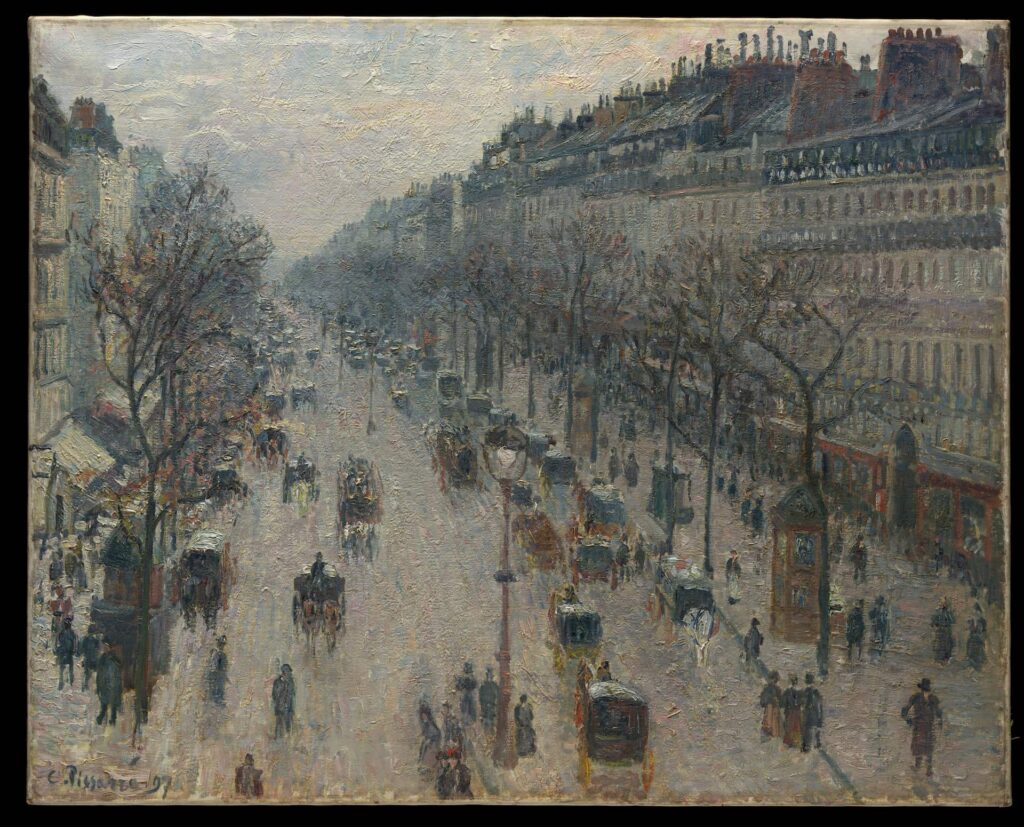
He came to spend eight weeks in Paris to paint from the window of this hotel room. What he went on to paint— sixteen canvases in eight weeks, including fourteen views of Boulevard Montmartre—became one of the most important urban series in the entire history of modern Western painting. *Boulevard Montmartre, Winter Morning*, now in the collection of the Metropolitan Museum of Art in New York, is one of the most accomplished works in this series.
This article explains how a physical constraint —the illness that prevented the peasant painter from painting outdoors—led, through a reversal of circumstances, to one of the great revolutions in painting at the end of the 19th century: urban landscapes viewed from above.
Éragny, Fall 1896 — Pissarro could no longer paint outdoors
By the fall of 1896, Pissarro had been living in Éragny-sur-Epte, in the Oise department, for twelve years. In 1892, he had purchased the large house there—surrounded by meadows and orchards—which he had been renting since 1884. He lived there with his wife Julie and their children. On paper, it was the ideal setting for a landscape painter: the Normandy countryside, a garden, the changing light of the seasons, and rural scenes at every turn.
But Pissarro can no longer paint outdoors.
Since the early 1890s, his chronic eye condition had worsened. Outdoor weather conditions—dust, wind, pollen, and temperature fluctuations—triggered inflammatory episodes in the lacrimal sac that could last several weeks. The painter, who for thirty years had painted outdoors systematically—as much an aesthetic principle as a practical one—could no longer do so.
This physical limitation led to a financial crisis. Sales slowed. His rural paintings were no longer evolving enough. He needs to find something else. Pissarro writes to his son Lucien, who is living in London as a printer and illustrator, that he plans to propose a new series—this time an urban one—to his dealer, Paul Durand-Ruel.
Pissarro had a business model in mind. Claude Monet’s *Haystacks* series (1890–1891), exhibited at Durand-Ruel in May 1891, sold out in a matter of days and caused the prices of Monet’s works to skyrocket. If Monet could paint the same haystack fifteen times under different lighting conditions and sell them all, why couldn’t he? The idea for the Parisian urban series arose from this dual constraint—physical (painting indoors) and commercial (following a model that worked).
The Grand Hôtel de Russie, 1 Rue Drouot
Pissarro arrived in Paris on February 10, 1897. He checked into the Grand Hôtel de Russie, located at 1 Rue Drouot, at the corner of Boulevard des Italiens and Rue Drouot. The hotel was not a luxury establishment—a five-star hotel would have been beyond his budget—but it offered modern amenities for the time: an elevator, bathrooms, and electric lighting in all the rooms.
He rents a room on the first floor. The window overlooks the intersection. From that window, Pissarro can see the following at the same time:
- On the left: Boulevard Montmartre, which slopes downward toward the southeast, lined with tall trees and Haussmann-style buildings arranged in perfect rows
- On the right: Boulevard des Italiens, which extends the view westward
- Below: Drouot Street itself, with its traffic of cars, omnibuses, and pedestrians
The intersection is one of the busiest in Paris. It is just a short walk fromthe Hôtel des Ventes Drouot (the auction house),the Opéra Garnier (opened in 1875), and the Boulevard Haussmann, which was nearing completion. It is the beating heart of fin-de-siècle Parisian modernity.
Pissarro wrote to his son Lucien in a letter dated February 1897, which is preserved in the Bailly-Herzberg edition of his Correspondence (5 volumes, 1980–1991):
“I have a splendid motif on my left that I’m going to explore in every possible way; I have another motif that’s terribly difficult—almost as if viewed from a bird’s-eye view—over the cars, the buses, and the people moving between the tall trees and the large houses that I have to draw straight—it’s tricky.”
— Camille Pissarro to his son Lucien, letter from February 1897
This sentence is crucial. Pissarro identifies two distinct subjects: a main subject (on the left, the Boulevard Montmartre), which he will “explore in all its variations”—that is, in a series of paintings, at different times of day and under varying weather conditions. And a secondary motif (on the right, the Boulevard des Italiens), which is more complex due to the bird’s-eye view from the second floor. The phrase“bird’s-eye view” is his own metaphor for describing the俯视角度 that would become the signature of the entire series.
The Painting — What It Depicts
*Boulevard Montmartre, Winter Morning* is an oil on canvas measuring 64.8 centimeters high by 81.3 centimeters wide (official dimensions from the Metropolitan Museum). Landscape format. Signed and dated “C. Pissarro 97.”
The composition is dominated by a powerful diagonal: Boulevard Montmartre runs from the upper right corner to the lower left edge, in a straight perspective. This diagonal structures the entire pictorial space. On either side, two perfectly aligned rows of trees flank the boulevard, their branches stripped bare by winter forming a crisp, graphic pattern against the facades of Haussmann-style buildings.
On the boulevard itself, the heavy traffic is more implied than clearly visible: horse-drawn carriages, fiacres, omnibuses, commercial carts, bicycles, and large numbers of pedestrians. Pissarro paints these silhouettes with small, quick brushstrokes, almost pointillist in places—a legacy of his Neo-Impressionist period from 1885 to 1890. The figures are not individually identifiable. They form a flow, a mass in motion, that animates the boulevard just as a river animates its bed.
In the background, the rows of Haussmann-style buildings display their standardized cream-beige facades, wrought-iron balconies, and gray zinc roofs. This isSecond Empire urban planning at its finest.
The sky occupies about one-third of the composition. It is misty, slightly milky, bathed in a subdued winter light. According to the Metropolitan Museum’s description, one can make out “a veiled winter sun through the mist, perhaps against a backdrop of urban coal fires” —the pollution from Parisian home furnaces that characterized the capital’s winters at the time.
The color palette is limited and cool: blue-gray for the sky, pinkish-beige for the building facades, dark green for the tree trunks, black spots for the silhouettes, and a few touches of gold for the car wheels and the horses’ harnesses. No bright colors. It’surban winter in all its simplicity.
Sixteen paintings in eight weeks
“Boulevard Montmartre, Winter Morning ” is not a standalone work. It is one of sixteen paintings in a carefully conceived series.
According to the catalog raisonné published in 2005 by Joachim Pissarro and Claire Durand-Ruel Snollaerts (Wildenstein Institute / Skira), the complete series includes:
- 14 views of Boulevard Montmartre (PDRS catalog nos. 1159–1172) — views toward the southeast from the window of the Grand Hôtel de Russie
- 2 views of Boulevard des Italiens (PDRS catalog nos. 1173 and 1174) — views looking west from the same window
That is, a total of sixteen paintings, created over eight weeks of intensive work, from February through April 25, 1897.
Pissarro’s method was meticulous. According to modern technical analyses of his paintings, he worked on several canvases simultaneously. He set several of them up on easels placed side by side in his hotel room. When the light changed—a cloud passing by, the sunrise, or mist rising—he would switch from one canvas to another to capture the corresponding effect. The next day, at the same time and under similar conditions, he would return to the first one. A single painting can therefore take several days—or even several weeks—to complete.
This method of creating series was not new to Pissarro—Monet had pioneered it with *The Haystacks* (1890–1891), *The Poplars* (1891), and *The Cathedrals of Rouen* (1892–1894). But Pissarro applied it with even greater systematic rigor: he captured the same geographical setting (the intersection of Boulevard des Italiens, Boulevard Montmartre, and Rue Drouot) across all possible variations of season (winter and early spring), time of day (morning, afternoon, evening, night), and weather (fog, sunshine, snow, rain).
Pissarro worked all day long, taking only a two-and-a-half-hour break for lunch. For a 66-year-old man suffering from a chronic eye condition, this was a heroic pace.
The Peasant Painter Who Became a Painter of Modernity
We need to take a closer look at the striking biographical paradox in this series.
For thirty-five years, Pissarro painted rural France: Pontoise (1872–1882) and Éragny from 1884 onward. Farms, peasant women, orchards, country roads, and vegetable gardens. He became known as the “peasant painter” of Impressionism, following in the tradition of Millet. His anarchist convictions shaped this preference: for Pissarro, the rural world was the setting for unalienated human dignity.
However, beginning in 1897, Pissarro became—more out of necessity than by choice— the painter of urban modernity. The Boulevard Montmartre he painted is the very embodiment of what an anarchist of his generation might have detested:
- This isHaussmannian urban planning (1853–1870)—commissioned by Napoleon III to prevent popular uprisings. The straight boulevards cut through the medieval fabric of Paris were strategically designed to facilitate the movement of troops and prevent barricades. For an anarchist, this isthe architecture of repression
- This is industrial capitalist modernity —the omnibuses are owned by private companies, the stores lining the boulevard are department stores (including Au Printemps nearby), and the passengers are wealthy members of the bourgeoisie
- It is the dissolution of the visible into the anonymous crowd—in Pissarro’s peasant paintings, the figures were individualized (Marie Larchevêque, the neighbor; the children identified by their first names). On the boulevard, the figures are interchangeable, without identity, flowing
Yet Pissarro makes no judgments in his paintings. He observes, he records, he transcribes. His paintings of the boulevards are surprisingly noncontroversial —compared, for example, to the satirical drawings in his 1889 series *Social Turpitudes*, in which he explicitly denounces urban inequalities. On the boulevard, the painter recedes into the background, giving way to the play of light and the movement of the crowd.
This approach is undoubtedly the series’ greatest artistic merit: Pissarro paints Haussmann’s Paris as it is, neither celebrating nor condemning it. The result is an uncompromising chronicle of Parisian modernity—precisely what makes the series so valuable to historians today.
From the Grand Hôtel de Russie to the Metropolitan Museum
The Grand Hôtel de Russie, where Pissarro painted his series, no longer exists. The hotel was demolished in 1923 to make way for the construction of the final section of Boulevard Haussmann, right at the corner where it meets Rue Drouot. The historical irony is striking: Pissarro painted from a late Haussmann-style building that was destroyed to complete the Haussmann project itself.
*Boulevard Montmartre, Winter Morning* was sold to a private collector on a specific date not documented in public sources. The painting remained in American private collections throughout the 20th century. In 1960, it was donated to the Metropolitan Museum of Art in New York by Katrin S. Vietor, in memory of her husband Ernest G. Vietor. It has been on permanent display there ever since.
The other paintings in the series have met with varying fates. Seven are now housed in the world’s leading museums:
- National Gallery, London: Boulevard Montmartre, Night Scene —the only night scene in the series
- The Hermitage Museum, Saint Petersburg: Several Views
- Metropolitan Museum, New York: The “Winter Matinee” version (the subject of this article)
- Israel Museum, Jerusalem: Montmartre Boulevard, Mardi Gras
- And several others in private collections in the United States, the United Kingdom, and Japan
One of the paintings in the series, *Boulevard Montmartre, Spring Morning*, sold for 19.9 million British pounds at Sotheby’s in London in February 2014—equivalent to approximately 38.3 million U.S. dollars in adjusted value. To date, this is the all-time record price for a work by Camille Pissarro at public auction.
Pissarro, who painted these works at the age of 66 to cope with a financial crisis and compensate for an eye condition, could never have imagined that a century later they would fetch such high prices on the global market.
How to View the Work Today
“Boulevard Montmartre, Winter Morning ” is housed at the Metropolitan Museum of Art in New York. Practical information:
- Address: 1000 Fifth Avenue, New York, NY 10028, United States
- Gallery: 19th-century European gallery, rooms dedicated to the Impressionists
- Admission: Pay-what-you-can for residents of New York City, New York State, Connecticut, and New Jersey; fixed admission fee (approximately $30 for adults) for other visitors
- Reservations: recommended; tickets available online
Other highlights at the Metropolitan Museum on the same day:
- Other works by Pissarro from the same period (Pissarro is very well represented at the Met)
- Monet’s *Cathedrals of Rouen* (the series that inspired Pissarro commercially)
- Several Parisian landscapes by other Impressionists: Pissarro, Caillebotte, Renoir, Manet
To see other works from the series without going to New York:
- National Gallery, London : Boulevard Montmartre, Night Scene —the only night scene
- The Hermitage Museum, Saint Petersburg: several paintings
- Musée d’Orsay, Paris: no paintings from the Boulevard Montmartre series, but several other urban works by Pissarro (from the Avenue de l’Opéra, Jardin des Tuileries, and Louvre series)
If you visit Paris, the intersection of Boulevard Montmartre and Rue Drouot is still there. The Grand Hôtel de Russie is gone, but the view of the boulevard that Pissarro painted is still recognizable from the sidewalk. It’s a five-minute walk from the Hôtel des Ventes Drouot.
Further Reading
Institutional sources cited in this article
- Metropolitan Museum of Art, official entry for *The Boulevard Montmartre on a Winter Morning*. Primary source.
- Joachim Pissarro and Claire Durand-Ruel Snollaerts, *Pissarro: Critical Catalog of Paintings*, 3 volumes, Wildenstein Institute / Skira, Paris/Milan, 2005. The definitive catalog raisonné (PDRS 1160 for this work).
- Janine Bailly-Herzberg (ed.), *The Correspondence of Camille Pissarro*, 5 volumes, PUF / Éditions du Valhermeil, Paris, 1980–1991. A critical edition of the letters.
- John Rewald (ed.), Camille Pissarro, Letters to His Son Lucien, Albin Michel, Paris, 1950.
Modern Studies
- Encyclopædia Britannica, article ” The Boulevard Montmartre on a Winter Morning ” by Ann Kay.
- Pissarro, the First of the Impressionists, exhibition catalog from the Musée Marmottan Monet, 2017.
Institutional Documentation
- Metropolitan Museum of Art, New York — the institution has owned it since 1960.
See also on Hors Cadre
- Camille Pissarro—the unassuming master who trained an entire generation —a portrait of the painter.
- *La Bergère*—the Pissarro painting that took twenty-nine years to sell —is the other major work by Pissarro featured on *Hors Cadre*, complementing the artist’s career.
— M