Little Girl in a Blue Armchair — The Painting of Scandal and Freedom
Mary Cassatt — Berthe Morisot's American Heiress →Paris, summer of 1878. Mary Cassatt is thirty-four years old. She has been living in Paris for thirteen years. She has participated in seven official Salons, exhibiting her work between 1868 and 1876. But in 1877, the Salon jury rejected both of her submissions. She found herself in direct conflict with the French art establishment. That same year, Edgar Degas knocked on her door on Rue de Laval to invite her to exhibit with the Impressionists—an invitation she accepted.
The Impressionist exhibition scheduled for 1878 was postponed to 1879 due to competition withthe 1878 World’s Fair in Paris. Cassatt therefore came up with another plan: to exhibit her new painting, Portrait of a Little Girl, in the American section of the World’s Fair. It is a large-format work —89.5 × 129.8 centimeters, almost twice the size of her usual portraits. She worked on it for months, receiving advice and even having parts of it repainted by her friend Edgar Degas, who himself painted the background featuring the window.
The American jury at the 1878 World’s Fair rejected the painting. Three jurors, including “a pharmacist,” as Cassatt would later recall with mocking bitterness. Mary Cassatt was furious. All the more so, she would write to Ambroise Vollard twenty-five years later, “since he [Degas] had worked on it.” The daughter of Pennsylvania’s banking elite, trained under Gérôme in Paris, and an exhibitor at the Salon for ten years, was rejected by a pharmacist.
This article recounts the genesis of this work, which caused a double scandal —it was rejected by the American jury at the 1878 World’s Fair, then triumphantly presented at the 4th Impressionist Exhibition in April 1879 as the signature work of Cassatt’s first official participation in the movement. It also explores the secret collaboration between Cassatt and Degas, revealed by a recent infrared photograph from the National Gallery of Art (NGA) in Washington; the small Brussels Griffon dog that Degas gave to Cassatt; and the unique historical significance of this painting, which, in fact, marks the beginning of Mary Cassatt’s entire Impressionist career.
1877 — The Break with the Salon
To understand the origins of *Little Girl in a Blue Armchair*, we must go back to 1877, a pivotal year in Mary Cassatt’s career.
From her debut in 1868, Cassatt exhibited at the Paris Salon. There she enjoyed some success— During the carnival at the 1872 Salon, *Bullfighter and Young Girl* in 1873 (a work very similar in color palette to Manet’s, which drew attention from critics). Her Spanish and Oriental subjects earned her a modest reputation in official Parisian art circles.
But starting in 1875, the Salon jury became more stringent. Cassatt was rejected in 1875. She was accepted again in 1876. Then she was rejected once more in 1877 — two paintings rejected in quick succession. The jury at the time was dominated by academic painters— Alexandre Cabanel, Léon Bonnat, William Bouguereau —whose polished aesthetic Cassatt openly despised. The feeling was mutual.
Cassatt, deeply hurt, was going through a period of uncertainty. She was considering returning to the United States. She wrote to her family in Pennsylvania to discuss the possibility of a career in America. But Paris remained, in her eyes, the only place where modern painting was being created. She hesitated.
It was against this backdrop of institutional upheaval that Edgar Degas visited her at her studio on Rue de Laval in the spring of 1877. Degas had been noticing Cassatt’s work since 1874—he is said to have remarked while standing before one of her paintings on display at the Salon: “Here is someone who feels the same way I do.” Three years later, he came to offer her an alternative: to join the Impressionists, that group of independent artists who, since 1874, had been organizing their own exhibitions on the fringes of the Salon.
Cassatt accepted enthusiastically. In her own words, as she recounted much later to her friend Louisine Havemeyer, “it meant freedom.” Leaving the Salon jury. Choosing a side. Joining an avant-garde rejected by the institution, whose fate she now shared.
The Impressionist exhibition scheduled for 1878 was, however, postponed until 1879 —Degas and the group believed that competition with the 1878 World’s Fair would overshadow any other art exhibition. Cassatt therefore had to wait a year before participating in the group’s exhibition for the first time.
She decided to use the year 1878 to pursue two goals simultaneously: to prepare for her triumphant debut among the Impressionists in 1879, and to make one last attempt to gain recognition within the American section of the 1878 Paris World’s Fair.
The Painting — What It Depicts
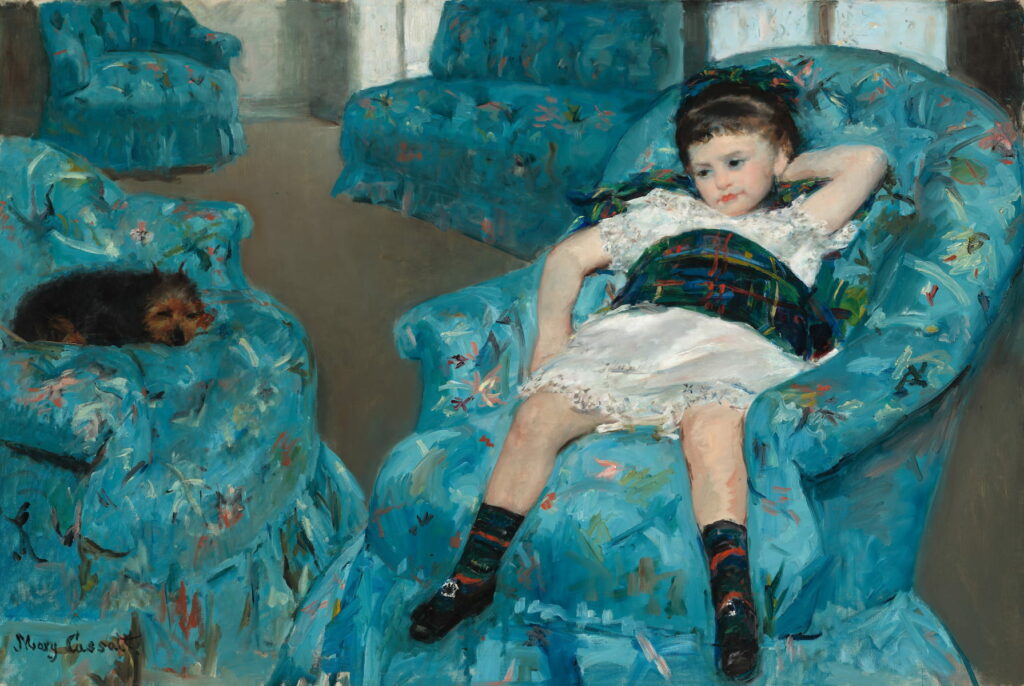
Little Girl in a Blue Armchair is an oil on canvas measuring 89.5 × 129.8 centimeters — a horizontal, wide format. Unlike the intimate maternal works Cassatt would produce later, this is an ambitious large-scale piece, a portrait fit for a parlor.
The composition features four main elements:
In the center of the painting is a little girl, about four or five years old, wearing a white polka-dot dress with a lace collar, a plaid belt, white socks, and black slippers. She is slumped in an armchair. She is not sitting upright, as was customary in children’s portraits—instead, she is slumped, her legs dangling, her arms casually resting on the armrests, her absent gaze turned toward the right corner of the painting. Sheis openly bored, tired of posing, perhaps even sulking.
Next to her, on the right, a small dog is curled up in another blue armchair, asleep with its head resting on its paws. It is a Brussels Griffon —a Belgian breed, small and shaggy, which was rare in France at the time. The dog is sleeping in the armchair—something that would have been forbidden in a respectable bourgeois home of the 1870s.
All around the two figures, several blue armchairs with green and beige floral patterns are scattered haphazardly throughout the room. They’re not lined up. They’re not symmetrical. It’s as if someone had just moved the furniture or as if no one cared about how it was arranged.
At the back of the room, a large window opens onto the light-filled outdoors. The cool light streams in from the left, illuminating the armchairs in the foreground and setting off the child’s silhouette.
The color palette is dominated by the deep turquoise blues of the armchairs. “It dazzles with its dominant shade of deep turquoise, ” art critic Karen Rosenberg would write in The New York Times. The off-whites (dress, socks, skin) and warm browns (wood floor, dog) contrast with this central blue.
The composition is radically unconventional for a portrait of a child from 1878. At the time, portraits of children followed a specific protocol: the child sitting upright, well-dressed, facing the viewer head-on or in a three-quarter profile, against a neutral background or in a tidy garden, with a well-behaved dog at his feet (never on an armchair). Cassatt breaks all these conventions at once.
According to British art historian Griselda Pollock, this is what makes the painting “one of the most radical depictions of childhood ever painted.” Cassatt does not depict the idealized childhood of bourgeois portraits—well-behaved, presentable, and clean. She depicts real childhood: boring, restless, tired, and untidy. This is something new.
Degas painted the background
One of the most valuable pieces of information about Little Girl in a Blue Armchair was scientifically revealed in the 2010s and 2020s by the National Gallery of Art in Washington: Edgar Degas personally painted part of the canvas.
This direct collaboration between Cassatt and Degas—long suggested by biographers but never scientifically confirmed—was established through an infrared photographic analysis of the painting conducted by the museum’s curators. Beneath the visible layer of paint, the imagery reveals two distinct painters’ hands: Cassatt’s on the child’s figure, and Degas’s on the background — the large, light-filled window, the back wall, and the arrangement of the armchairs in perspective.
Cassatt herself confirmed this collaboration in a letter to Ambroise Vollard written in 1903, twenty-five years after the painting was created. Vollard, a prominent Parisian art dealer, was then preparing a Cassatt retrospective and had asked the painter for biographical details. She wrote to him:
“It was a portrait of a friend of Mr. Degas. I had painted the child in the armchair, and he thought it was good; he gave me advice on the background and even worked on it himself. I sent it to the American section of the great exhibition [of 1878], and they rejected it… I was furious, especially since he had worked on it. At the time, it seemed like something new, and the jury consisted of three people, one of whom was a pharmacist!”
— Mary Cassatt, letter to Ambroise Vollard, 1903
This quote is doubly valuable. It confirms the model’s identity: the daughter of friends of Degas, and not—contrary to what some misinformed sources claim— Degas’s daughter (Degas never had children, never married, and never had any recognized descendants).
It also reveals Cassatt’s fury in the face of rejection, and the unique nature of their collaboration: Degas did not merely advise Cassatt—he physically painted part of the painting. It is, in fact, a four-handed work —one of the rarest in the entire history of Impressionist painting.
This collaboration in no way detracts from Cassatt’s artistic authorship of the painting. The concept, the overall composition, the choice of subject, and the treatment of the central figure —all of this comes from Cassatt. Degas provided technical assistance with perspective and lighting —areas in which he himself was an absolute master. The painting remains predominantly Cassatt’s work, with “assistance” from Degas.
The Dog — A Gift from Degas
The little dog curled up in the armchair next to the child is not just a minor detail. It is a Brussels Griffon —a relatively new Belgian breed (developed in Brussels in the mid-19th century) that was still little known in France in 1878.
According to several biographical sources (notably the definitive biography by Nancy Mowll Mathews, *Mary Cassatt: A Life*, Yale University Press, 1994), this dog is likely Mary Cassatt’s own dog —a gift from Edgar Degas.
Degas himself had received this dog from another painter in the Impressionist circle, Ludovic-Napoléon Lepic (1839–1889), an engraver and amateur breeder of Brussels Griffons. Lepic was a friend of Degas’s and a member of the Impressionist group—in particular, he had introduced Degas to several new engraving techniques in the 1870s.
The gift of the puppy to Cassatt in 1877 or early 1878 underscores the depth of the friendship between Cassatt and Degas—it was not merely a professional relationship between painters, but a genuine friendship marked by intimate gestures and personal acts of kindness.
Cassatt would grow to love this dog and the breed in general. She kept Brussels Griffons throughout her life, until her death in 1926. Several archival photographs show her in the 1900s and 1920s at the Château de Beaufresne, surrounded by her shaggy little dogs—descendants of that first line of dogs given to her by Degas.
The depiction of the dog in the painting is therefore, in fact, more personal than it appears. It is Cassatt’s dog, painted in her home, in the presence of the child of a friend of Degas’s —the scene itself is a constellation of intertwined friendships between Cassatt, Degas, Lepic, and their respective family circles.
The Rejection of the 1878 World’s Fair
Spring 1878: Mary Cassatt submits Portrait of a Little Girl (as it was then titled) to the jury of the American section atthe 1878 Paris World’s Fair.
The 1878 World’s Fair—the third held in Paris (after 1855 and 1867)—took place from May 1 to October 31, 1878, at the Champ-de-Mars and the Trocadéro. It welcomed 16 million visitors over the course of six months. Each national pavilion featured an art section curated by a national jury that selected works representative of their country.
The jury for the American section consisted of three people. Cassatt noted their identities with bitterness in her 1903 letter to Vollard: one of them was a pharmacist. None of the three jurors was a professional painter or a recognized art critic. None possessed the institutional authority that Cassatt deemed necessary to evaluate modern painting.
The rejection is final. The U.S. jury refuses Portrait of a Little Girl likely because the composition is too modern, too unconventional, and too far removed from the academic standards the American public expected.
Cassatt is furious. Her fury is documented in several family letters from the summer of 1878 (correspondence with her mother, Katherine Cassatt, and her brother, Alexander). She makes a twofold decision:
1. She subsequently turned down two American awards that were bestowed upon her—a gesture of protest against the American art establishment that had rejected her.
2. She kept the painting in reserve forthe 1879 Impressionist exhibition —which she had now clearly decided to turn into a personal triumph.
In retrospect, this rejection was a major turning point in her life. It marked Cassatt’s definitive break with the traditional American and French art establishments. It pushed her irrevocably into the Impressionist camp, where she would flourish for the next forty years.
As several art historians have pointed out, had she not been rejected in 1878, Cassatt might have continued to waver between the Salon, the World’s Fair, and the Impressionists. With that rejection, she made her final choice.
April 1879 — The Impressionist Comeback
The 4th Impressionist Exhibition, April 10–May 11, 1879, at 28 Avenue de l’Opéra in Paris’s 9th arrondissement. This marked Mary Cassatt’s first official participation in the Impressionist group. She exhibited eleven works —a considerable number for a first exhibition.
Among these eleven works: Little Girl in a Blue Armchair, presented under the title Portrait of a Little Girl. It isthe most ambitious work in the exhibition, both in terms of its size (89.5 × 129.8 cm) and its formal intensity.
Unlike the three previous exhibitions (1874, 1876, 1877), which had been relative commercial and critical failures, the 1879 exhibition was a resounding success. 16,000 visitors attended the exhibition in one month—a considerable number for the time. The success was driven in particular by the works of Degas, Pissarro, and Caillebotte, as well as by newcomers Mary Cassatt and Paul Gauguin (who was also making his debut with this group).
The critical reception of *Little Girl in a Blue Armchair* has been largely positive. Several critics praise the modernity of the composition, the naturalness of the child subject, and the technical mastery. Critic Edmond Duranty, writing in the Chronique des arts , hails Cassatt as “a new talent, and we welcome her with pleasure.”
Some critics, who were more conservative, were surprised by the child’s slumped posture and the dog’s presence on the armchair. Butthe overall reception was very favorable—far more so than what Cassatt had experienced at the Salon in previous years.
Financially, the success was more mixed. *Little Girl in a Blue Armchair* was not sold at the end of the exhibition. The painting returned to Cassatt’s studio. It would not be purchased until later, in the 1880s or 1890s, by the art dealer Ambroise Vollard.
But symbolically, it was a complete victory. The painting that the American pharmacist had rejected a year earlier was now being hailed by modern Parisian critics. It was, quite literally, Cassatt’s revenge on the American art establishment.
Vollard, Mellon, Washington — A Material History
The provenance of *Little Girl in a Blue Armchair* after 1879 took the painting through several prestigious private collections before it entered American public collections.
1879–circa 1890: The painting remained inMary Cassatt’s studio in Paris. No buyer came forward after the 4th Impressionist exhibition. Cassatt kept the work, which she likely considered one of her most important from that period.
Around 1890–1900: The painting was purchased by Ambroise Vollard (1866–1939), a prominent Parisian art dealer who had been based at 6 rue Laffitte since 1893. Vollard was then the most influential dealer in the Parisian avant-garde—he championed Cézanne, Picasso, Gauguin, Van Gogh, and several other artists who would go on to become major figures. He acquired several works by Cassatt, including *Little Girl in a Blue Armchair*.
1908: Vollard sold the painting to a private collector. The exact provenance of this first sale is not fully documented—the Vollard archives, which were partially destroyed, do not allow for complete traceability.
1930s–1960s: The painting passed through several private American collections as part of estates and auctions.
1983: The painting was donated to the National Gallery of Art in Washington by Paul Mellon and Rachel “Bunny” Mellon, one of the greatest American patron couples of the 20th century. Paul Mellon (1907–1999), heir to the Mellon fortune (aluminum and banking), had built up a prodigious collection of American and European art with his wife, which he gradually donated to the NGA.
The 1983 Mellon gift included *Little Girl in a Blue Armchair* as its centerpiece. Upon its entry into the American national collection, the painting became one of the flagship works in the museum’s Impressionist section.
1983–present: *Little Girl in a Blue Armchair* is on permanent display at the NGA in Washington, Gallery M-90 (West Building, main level). It has become the iconic image of Cassatt in Washington—widely reproduced in catalogs, textbooks, and traveling exhibitions.
Historical significance: The painting rejected by the American jury at the 1878 World’s Fair is now part of the United States’ premier national art collection, donated bythe Mellonfamily, a leading American patron of thearts. Forty-five years after it was rejected by the anonymous pharmacist, America has finally publicly recognized the exceptional value of this work.
Posterity — Modern Childhood in Painting
With *Little Girl in a Blue Armchair*, Mary Cassatt pioneered modern painting of childhood in the strictest sense of the term.
Before Cassatt, Western painting depicted childhood according to three main conventions:
1. The Infant Jesus — Madonnas and Child, Nativity Scenes, Religious Scenes (from the Renaissance to 19th-century academic paintings)
2. The Aristocratic Child — Ceremonial Portraits of Royal and Noble Children (Velázquez, Van Dyck, Lawrence)
3. The idealized child — a sentimental style of 19th-century painting (Greuze, followed by the academic painters of the Second Empire) that depicts childhood as pure and touching innocence, evoking a sense of moral emotion in the adult viewer
Cassatt breaks with all three conventions at once. Her little girl is neither divine, nor regal, nor idealized. She is real: bored, slumped over, poorly dressed (the tartan sash contrasts with the white dress), tired, and expressive even in her weariness.
This innovation had, in fact,a considerableinfluence on painting at the turn of the 20th century. Several lines of influence have been documented:
Lineage 1 — The Nabis: Édouard Vuillard in his paintings of children from the 1890s onward; Pierre Bonnard in his domestic scenes featuring children. Both painters were familiar with and admired Cassatt’s work.
Lineage 2 — American painting at the turn of the century: John Singer Sargent (who painted several portraits of children in the Cassatt style), William Merritt Chase, Cecilia Beaux —all influenced by the modern perspective on childhood that Cassatt had introduced.
Lineage 3 — Modern Family Photography More indirectly, Cassatt’s portrayal of childhood— unposed, real, captured in the moment —foreshadows what 20th-century amateur photography (Kodak, beginning in the 1900s) would systematically do: capture the imperfect moments of childhood—its boredom, its weariness, its little whims. Pictorially speaking, Cassatt is a contemporary of this revolution in perspective.
As art historian Griselda Pollock has written, *Little Girl in a Blue Armchair* is “one of the most radical images of childhood ever painted.” The term “radical” is apt—in the etymological sense, meaning to go to the root of things. Cassatt goes to the very rootof real childhood, without any conventional filters, and transforms it into a painting.
How to View the Work Today
Little Girl in a Blue Armchair is housed at the National Gallery of Art in Washington, D.C. Practical information:
- Address: 6th and Constitution Avenue NW, Washington, DC 20565, United States
- Subway: Smithsonian Station (Blue, Orange, and Silver lines) or Archives-Navy Memorial (Green and Yellow lines)
- Gallery: Gallery M-90, Main Level, West Building
- Hours: Monday through Saturday, 10 a.m.–5 p.m.; Sunday, 11 a.m.–6 p.m.
- Admission: Free (the NGA is entirely free—a policy unique among major American museums)
- Reservations: Not required for the permanent collections
Also on view in the same gallery at the NGA:
The National Gallery of Art houses the world’s largest collection of works by Mary Cassatt —more than 80 pieces. Gallery M-90 and the adjacent galleries feature, among other works:
- Family in a Garden (circa 1878–1879) — another work from the early Impressionist period
- Woman in a Dressing Room (1879) — a major work also featured in the 4th Impressionist Exhibition
- Mother and Child (The Oval Mirror) (1899) — a major work from his later period
- The artist’s sister with her child (circa 1872) — Lydia Cassatt and her niece
To see other works from the French Impressionist period:
- Musée d’Orsay, Paris — Woman Sewing in a Garden (1880–1882)
- Art Institute of Chicago — *The Child’s Bath* (1893), Cassatt’s signature work
- Petit Palais, Paris — Japanese-style engravings and pastels
The NGA offers a free download of *Little Girl in a Blue Armchair* in very high resolution on its Open Access platform (CC0, free to use). This is one of the rare occasions when a work of this significance is freely available in museum-quality resolution for any reproduction.
Further Reading
Institutional sources cited
- National Gallery of Art, Washington, official entry for *Little Girl in a Blue Armchair*.
- Exhibition catalog: *Mary Cassatt, an American Impressionist in Paris*, Musée Jacquemart-André, 2018.
- Encyclopædia Britannica, articles on Mary Cassatt and the 1878 World’s Fair.
Primary sources cited
- Mary Cassatt, letter to Ambroise Vollard, 1903 — the only autobiographical source on the painting’s creation.
Modern Studies
- Nancy Mowll Mathews, *Mary Cassatt: A Life*, Yale University Press, 1994. A modern standard biography.
- Griselda Pollock, *Mary Cassatt: Painter of Modern Women*, Thames & Hudson, 1998 — a seminal feminist study.
- Frederick A. Sweet, *Miss Mary Cassatt: Impressionist from Pennsylvania*, University of Oklahoma Press, 1966.
- Adelyn Dohme Breeskin, *Mary Cassatt: A Catalogue Raisonné of the Graphic Work*, Smithsonian Institution Press, 1979.
Institutional Documentation
- National Gallery of Art, Washington — owned by the institution since 1983 (gift of Paul Mellon).
- Art Institute of Chicago — home to *The Bath of the Child*.
See also on Hors Cadre
- Mary Cassatt — Berthe Morisot’s American successor — a portrait of the artist, a comprehensive overview of her career.
- *The Child’s Bath*—motherhood reimagined through Japanese prints —Cassatt’s signature work at the Art Institute of Chicago, another masterpiece from the Impressionist period.
- Berthe Morisot—the painter who influenced Manet’s work —the other woman of the Impressionist movement, a friend and correspondent of Cassatt.
— M