A Funeral in Ornans — The Manifesto of Realism
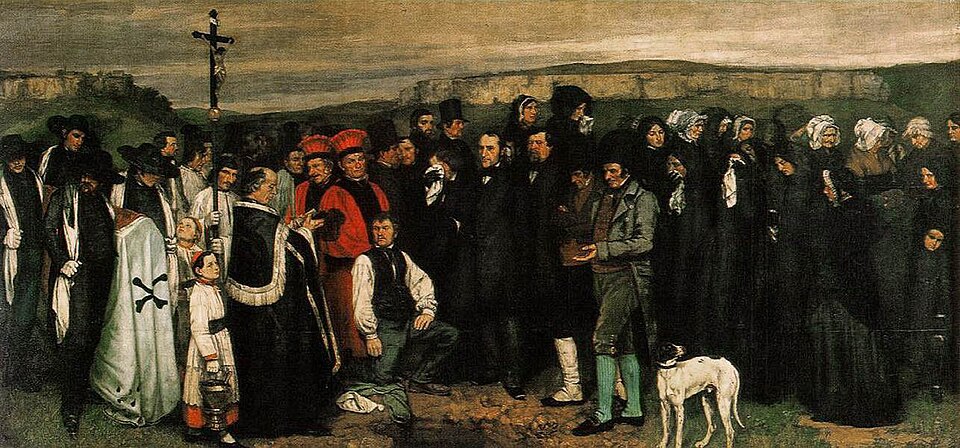
Gustave Courbet — The Scandal of Reality →A gaping grave opens up in the foreground, empty, awaiting the coffin. Gathered around it are about fifty villagers, depicted life-size: the priest reading his prayers, the sextons in their red robes, the gravedigger kneeling, the dignitaries in top hats, the weeping women beneath their white headdresses, and even a dog. Behind them, the limestone cliffs of Franche-Comté close in on the horizon beneath a gray sky. This immense canvas, nearly seven meters wide, *A Burial at Ornans*, caused a scandal at the 1850 Salon—and became the manifesto of Realism, one of the most revolutionary works of the entire 19th century.
What shocked his contemporaries was not the subject itself—a village funeral—but the way Gustave Courbet depicted it. By depicting ordinary people—nameless, unremarkable peasants and provincial bourgeois—on a monumental scale and in a format previously reserved for scenes from sacred history, mythology, and the heroic deeds of kings, Courbet upended the entire hierarchy of art. He asserted that even the humblest aspects of daily life deserved the same dignity as the noblest subjects. It was a revolution.
But the work is much more than a provocation. It is a serious and powerful meditation on death, on community, and on the human condition. The empty grave in the foreground—where any one of us could be buried—confronts the viewer with his or her own mortality. And the rejection of all pathos, of all facile religious exaltation, gives the scene a raw, almost harsh truth that still unsettles us today. Courbet does not console; he shows.
This article explores the secrets of this seminal work—what it represents, why its format caused a scandal, who these very real villagers are, the extraordinary conditions under which it was painted, the significance of the gaping pit in the foreground, its roots in Dutch painting, its possible political significance, and how this painting put an end to Romanticism to usher in the era of modern art.
The Painting — What It Depicts
*A Funeral in Ornans* is an oil-on-canvas painting of colossal dimensions: 315 centimeters high by 668 centimeters wide—more than six and a half meters long. It is the largest canvas in Courbet’s entire body of work, and one of the largest of the 19th century. Its original title at the Salon was, in fact, quite explicit: “Painting of Human Figures, A History of a Funeral in Ornans.”
The scene takes place in the cemetery in Ornans, Courbet’s hometown, in Franche-Comté. We are witnessing a specific moment in the funeral ceremony: the procession has just arrived at the freshly dug grave, and the village community has gathered for the burial of one of their own. The composition is arranged as a long horizontal frieze, in which the figures, spread across the entire width of the canvas, form a dense and solemn assembly.
Several groups can be distinguished. On the left are the coffin bearers, the clergy—the parish priest reading his breviary, the altar boys, and the sextons, recognizable by their bright red robes. In the center, near the grave, the gravedigger kneels, waiting for the coffin. On the right, separated from the men as they are in church, are the women in mourning, wearing white headdresses and black hoods, several with handkerchiefs pressed to their eyes. In the foreground, the open, gaping grave, and a skull resting on the turned-over earth. A dog, in the lower right corner, completes the scene.
The background features the characteristic landscape of Ornans: the high limestone cliffs that frame the Loue Valley, beneath a gray, cloudy sky. The overall color palette is dark, dominated by the blacks of the mourning clothes, punctuated by the vivid reds of the church wardens’ robes, the whites of the headdresses and shawls, and the muted tones of the landscape. This somber and restrained color scheme matches the subject: a funeral ceremony, austere and contemplative.
The Format Scandal
To understand why this work caused such a scandal at the 1850–1851 Salon, one must grasp what made it so transgressive in the eyes of the public and critics of the time. The scandal stemmed not so much from the subject matter as from the combination of that subject matter and its format.
Academic art was based on a strict hierarchy of genres that had been in place since the 17th century. At the top stood history painting—religious, mythological, and historical scenes, as well as the heroic deeds of heroes and kings—which alone was deemed worthy of large formats and grand ambitions. At the bottom of the hierarchy were the “minor” genres: portraiture, landscape, still life, and the “genre scene”—that is, the depiction of ordinary daily life—which were confined to small formats.
Yet Courbet did exactly the opposite of what this hierarchy prescribed. He took a genre scene—a mundane village funeral—and rendered it in the monumental format reserved for history painting. These dimensions—nearly seven meters—in which he depicts anonymous villagers life-size, were a deliberate and provocative transgression. It was as if Courbet were proclaiming that these peasants and provincial bourgeois deserved the same grandeur, the same pictorial dignity as the gods, saints, and kings.
Criticism raged. The work was criticized for its “vulgarity,” and Courbet was accused of painting “the ugly,” “the trivial,” and “the vile.” People were outraged to see a popular “anecdote” treated with such monumental seriousness. Cartoonists seized upon the figures deemed grotesque. But what contemporaries perceived as a lapse in taste was in reality a revolution: Courbet asserted that no subject was unworthy of art, that ordinary reality could and should be painted with grandeur. This idea would transform all of modern painting.
A gallery of real villagers
One of the most remarkable—and, for its time, most puzzling—featuresof *A Burial at Ornans* is that all of its characters are real people, residents of Ornans whom Courbet knew and who posed for him. This is neither a fictional nor an idealized scene: it is a collective portrait of an authentic village community.
The painting features about forty figures—historians estimate the number to be around forty-six—and, thanks to municipal archives and records, nearly all of them have been identified. Among them are the notables of Ornans, small-scale winegrowers, artisans, the local clergy, and gravediggers: a true cross-section of mid-19th-century rural Franche-Comté society. This carefully depicted social diversity makes the painting a valuable record of the world it portrays.
Several of the figures are people close to Courbet. In the foreground, among the women in mourning, are his mother and three of his sisters; the little girl on the far right is a cousin. The gravedigger, kneeling near the grave, is a man named Antoine-Joseph Cassard, the son of a shoemaker and a poor farmer—a real person. On the far left, among the older figures, Courbet’s maternal grandfather—a former revolutionary—has been identified. In this way, the painter included his own family, his neighbors, and his fellow villagers in this grand fresco of village death.
We also notice two figures dressed in old-fashioned attire, identified as veterans of the 1793 Revolution, wearing their period costumes. Their presence anchors the scene in the community’s collective and political memory. Courbet had all these models pose one by one in his studio—a considerable undertaking that lends the work its extraordinary authenticity: every face is a portrait, every posture is carefully observed; nothing is contrived or idealized. It is the true humanity of a village, in all its diversity, that stands before us.
In the attic in Ornans
The circumstances under which Courbet painted this immense canvas are worth recounting, as they highlight the work’s greatness and reveal the artist’s tenacity.
Courbet painted *A Burial at Ornans* not in a spacious Parisian studio, but in the attic of his family home in Ornans, which served as his studio. However, this attic was far too small and had a ceiling that was too low for a canvas of this size. Because of the slope of the roof and the lack of space, Courbet could never see his entire painting at once: he had to paint one section, then roll up the sections already completed on the right and left to access the rest of the canvas. In fact, the seams dividing the canvas—which was assembled from several panels—are still visible today.
The painter himself described these difficult conditions in a letter to his friend, the writer Champfleury, in early 1850. In it, he mentions the need to be almost frenzied to work this way—blindly, without any perspective from which to judge the overall effect. Completing fifty life-size figures in such a small space was a daunting challenge. That Courbet succeeded, under these conditions, in creating a work of such coherence and power is a testament to his exceptional mastery.
This circumstance is not merely an anecdotal detail: it reveals something about Courbet’s art and his deep roots. It was in Ornans, in his family home, in the heart of his native land, surrounded by his fellow townspeople who came to pose, that the painter conceived his manifesto. The work was born from the very place it depicts, in complete intimacy with its subject. The attic in Ornans—that small, cluttered space where Courbet painted by feel—is the unlikely cradle of one of the great revolutions in modern art.
The gaping chasm—death without idealization
At the heart of the composition, one element captures and unsettles the viewer’s gaze: the open pit in the foreground, gaping and empty. This hole in the ground is not merely a realistic detail; it is the key to the work’s meaning and one of Courbet’s most profound artistic boldnesses.
First, this grave places the viewer in a unique position. The hole is dug at the bottom edge of the canvas, right in front of us, as if we ourselves were standing at the edge of the grave. The coffin has not yet been lowered; the grave awaits. This gaping opening facing the viewer has something dizzying about it: it is our own death that we are contemplating, the grave where each of us will end up. Next to it, a skull resting on the turned-over earth underscores this memento mori—this reminder of universal mortality.
But what is most striking is the absence of the deceased. The dead person himself does not appear: his identity is not even known, and art critics have never been able to determine who was being buried. The main figure in this funeral—the deceased—is absent, replaced by an empty space. Courbet thus shifts the focus: it is not this or that specific deceased person who matters, but death itself—anonymous, universal—and the community of the living gathered before it.
Above all, Courbet rejects any idealization, any pathos, and any facile religious consolation. The faces of those present show little conventional emotion: one sees neither spiritual elevation nor the hope of salvation, but rather a prosaic solemnity, a somewhat oppressive atmosphere, and even boredom in some. The crucifix does stand out clearly against the sky, but the ceremony seems devoid of genuine fervor. This way of depicting death without transcendence, without the promise of an afterlife, has led some to see in the work a materialistic, even despairing, vision of the human condition—a meditation on death as a mere end, in the spirit of a century gripped by religious doubt. For Courbet, death is not a gateway to heaven: it is a hole in the ground.
The Dutch Legacy
Although *A Burial at Ornans* is a radically new work, it is nonetheless rooted in a great pictorial tradition that Courbet admired and knew intimately: that of 17th-century Dutch group portraits.
During his trip to the Netherlands in 1846–1847, Courbet discovered and studied the Dutch masters—Rembrandt, Frans Hals—and in particular their great group portraits: those paintings in which guilds, brotherhoods, and civic guard companies had themselves depicted as a group, with each member paying to appear in the painting. These works, such as Rembrandt’s *The Night Watch* or Hals’s group portraits, brought together real individuals, depicted with realism, within a collective composition.
A Funeral in Ornans revives this tradition, while adapting it. As in Dutch group portraits, Courbet brings together real, identifiable individuals—each treated with the attention of a portraitist—within a vast collective composition. The frieze-like arrangement, the absence of a marked hierarchy among the figures, and the authenticity of the faces—all of these elements recall those Northern models. Courbet thus places his modernity within a prestigious lineage, demonstrating that his revolution is not a whim but rather the renewal of a great realist tradition.
The composition itself draws its strength from this approach. Organized as a long, static horizontal frieze, without depth of perspective or a single focal point, it rejects the dramatic effects of academic or romantic composition. The viewer’s gaze travels across the assembly from left to right, then returns to the center, settling on the orchestra pit. This egalitarian structure, in which each figure counts as much as the others, visually conveys an idea that Courbet held dear: the equal dignity of all members of the human community.
A political landscape?
Does *A Burial at Ornans* have political significance? Historians have long debated this question, and the answer—as is often the case with Courbet—is both thought-provoking and uncertain.
The context lends itself to a political interpretation. Courbet completed the work in 1850, during a pivotal period. The revolution of 1848 had overthrown the July Monarchy and proclaimed the Second Republic, which held out hopes for democracy and social progress. But as early as December 1848, Louis-Napoléon Bonaparte—the future Napoleon III—was elected president, and a conservative backlash took hold, stifling republican hopes. Courbet, a staunch republican and sympathetic to Proudhon’s socialist ideas, was keenly aware of this backlash.
Some have therefore suggested interpreting the painting as a political allegory: the funeral depicted is not merely that of a villager, but that of the Second Republic itself, of Marianne, and of democratic hopes—all laid to rest by the Bonapartist reaction. In this interpretation, all segments of society—notables, the clergy, and the people—would be attending the funeral of republican liberty. Courbet himself asserted that “realism is, by its very nature, democratic art,” and that he wanted to introduce democracy into art.
But we must remain cautious. As the Musée d’Orsay points out, the political interpretation of the work remains uncertain, and Courbet’s painting is always more complex than it appears, much like the reality that serves as its model. The painting can be seen as a democratic manifesto—an affirmation of the equal dignity of all people—as a meditation on death, as a portrait of a community, or as all of these things at once. Its richness lies precisely in the fact that it resists a single interpretation. Courbet depicts reality in all its complexity, leaving it up to the viewer to find meaning in it.
The Death of Romanticism
Beyond all these interpretations, *A Burial at Ornans* holds great significance in the history of art: it marks the end of one era and the beginning of another. Courbet himself was aware of this and summed it up in a phrase that has remained famous: with this painting, he said, he was in fact celebrating the funeral of Romanticism.
This approach is illuminating. Romanticism, which had dominated the first half of the 19th century with Delacroix, was a style of painting characterized by passion, exoticism, drama, exalted imagination, and grand heroic or tragic subjects. Courbet turns his back on all of that. No more fantasized Orient, no more heroes, no more unbridled passions: just a village funeral, ordinary people, the prosaic reality of life and death in a small town in Franche-Comté. Courbet replaced the romantic dream with reality; exaltation with observation; and the ideal with the concrete.
In doing so, Courbet not only put an end to Romanticism: he laid the foundation for Realism and paved the way for all of modern painting. By asserting that ordinary reality is a subject worthy of the greatest art, he liberated painting from the constraints of noble subjects and idealization. Subsequent generations would build upon this liberation. Twelve years after*The Burial*, Édouard Manet would in turn cause a scandal with *Luncheon on the Grass* and *Olympia*, pushing the depiction of modern life even further. The Impressionists, and later all modern artists, would inherit this freedom won by Courbet.
A Burial at Ornans is thus a pivotal work, a threshold. On one side, Romanticism and Academicism, the ideal and tradition; on the other, Realism and modernity, reality and freedom. By burying Romanticism in the Ornans cemetery, Courbet opened the tomb of an old world—and the cradle of modern art.
From the attic in Ornans to the Musée d’Orsay
The journey of this work—from the attic where it was painted to the gallery walls of the Musée d’Orsay—is worth tracing.
After the scandal at the 1850–1851 Salon, Courbet kept *A Burial at Ornans*, which he exhibited on several occasions—notably in his *Pavillon du Réalisme* in 1855, where he presented it as one of his masterpieces. The painting, too large and too controversial to find a buyer easily, remained for a long time in the artist’s collection, and later in that of his family.
It was the painter’s sister, Juliette Courbet, who safeguarded her brother’s legacy after his death in exile. In 1881, she donated the work to the French government, thereby allowing this masterpiece to enter the public collections. The painting was first housed at the Louvre, before being transferred, upon the founding of the Musée d’Orsay in 1986, to this new museum dedicated to art from the period 1848–1914. There it occupies a place of honor among the works that laid the foundations of modernity.
The work recently underwent a major restoration project, completed in 2025, which restored the freshness of its colors and the subtlety of its dark tones. Today, standing before this immense canvas, visitors to the Musée d’Orsay still experience something of the shock that gripped contemporaries in 1850 — but now recognizing it not as a scandal, but as one of the greatest paintings of the 19th century and the birth of Realism.
How to View the Work Today
A Funeral in Ornans is housed at the Musée d’Orsay in Paris, where it is displayed among the masterpieces of 19th-century French painting. Its monumental dimensions make it one of the museum’s most impressive works. The Orsay entrance provides access to these galleries; since the museum is so popular, it’s best to book your ticket in advance and aim for off-peak hours.
Seeing the work in person is an irreplaceable experience: only by standing directly in front of this nearly seven-meter-long canvas can one fully appreciate the life-size presence of the figures, the depth of the blacks, the brilliance of the red beaux, and the dizzying effect of the open pit in the foreground.
To further explore Courbet’s work, the Musée d’Orsay houses his other masterpieces— *The Painter’s Studio*, *The Origin of the World*, *The Young Ladies on the Banks of the Seine*, and some superb landscapes. And to understand the painter’s connection to his homeland, nothing beats a visit to the Gustave-Courbet Museum in Ornans itself, located in the artist’s birthplace, just a few steps from the cemetery and the cliffs depicted in the painting.
Further Reading
Institutional sources cited
- Musée d’Orsay, description of *A Burial at Ornans*.
- History Through Images (RMN), The Demise of the Second Republic.
- Napoleon.org, a study of *A Burial at Ornans*.
Sources and Reference Studies
- Jean-Luc Mayaud, Courbet, *The Burial at Ornans*: A Tomb for the Republic, La Boutique de l’histoire, 1999.
- Linda Nochlin, “Innovation and Tradition in Courbet’s *Burial at Ornans*,” 1965.
- Gustave Courbet, Correspondence (letter to Champfleury, 1850).
Institutional Documentation
- Musée d’Orsay, Paris — the institution that houses the work.
- Gustave-Courbet Departmental Museum, Ornans — the painter’s birthplace.
See also on Hors Cadre
- Gustave Courbet — The Scandal of Realism — A Portrait of the Artist, His Life, and His Art.
- Eugène Delacroix—the standard-bearer of Romanticism —the Romanticism that, according to Courbet, this funeral was about to bury.
- Édouard Manet—the painter of modern life —the heir who, twelve years later, took the scandal of realism even further.
— M