The Night Watch — The Revolution in Group Portraiture
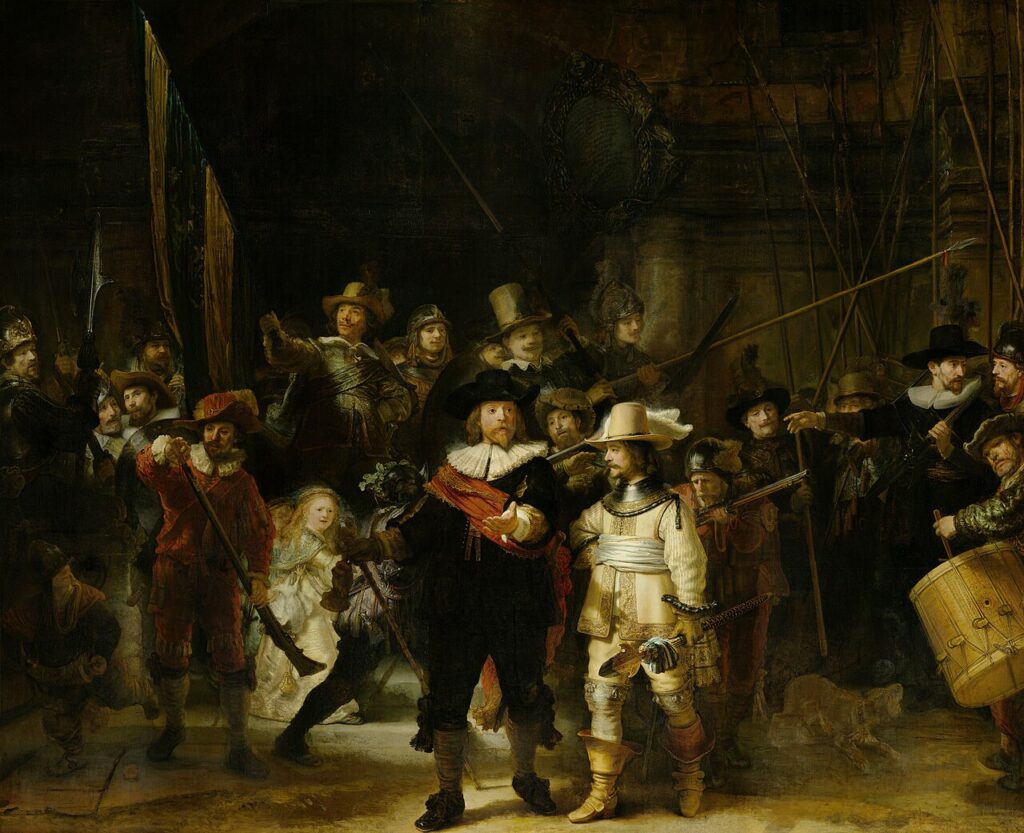
Rembrandt — The Self-Portrait as a Diary of a Life →Amsterdam, summer of 1642. A monumental canvas measuring 363 centimeters high by 437 centimeters wide — nearly sixteen square meters of oil painting—was delivered to the musketeers of the city’s District II civic militia. The painting was intended to adorn the great hall of the Kloveniersdoelen (Archers’ Hall), the company’s headquarters. The painter, Rembrandt van Rijn, was thirty-six years old and had been working on the commission for two years. The price paid for the painting was 1, 600 florins, a considerable sum for the time, equivalent to several years’ wages for an Amsterdam laborer. Each of the eighteen members of the company depicted contributed in proportion to their prominence in the composition.
The official title of the work, as recorded in the Kloveniers register, is Officers and Other Carabinier of District II of Amsterdam, Led by Captain Frans Banninck Cocq and Lieutenant Willem van Ruytenburgh. But no one calls it that. Since the 18th century, visitors and art historians have referred to the work by a nickname that has eclipsed its official title: The Night Watch (in Dutch: De Nachtwacht). A doubly misleading title—this is not a night patrol but a daytime outing by the militia, and the scene does not take place at night but in broad daylight. The historical confusion stems from the successive layers of varnish applied to the canvas over the centuries, which gradually darkened it to the point that 18th-century visitors believed they were looking at a nighttime scene.
The work is, in fact, one of the most famous paintings in the entire history of Western painting. More than 2 million visitors a year come to see it at the Rijksmuseum in Amsterdam, where it has been on permanent display since 1808 in the Gallery of Honor (Eregalerij). It isthe museum’smost-visited work, the Dutch national masterpiece, andthe globally recognizablesymbol of the Dutch Golden Age. It survived two acts of vandalism (1975, 1990), being moved to a safe location during World War II, a barbaric amputation in 1715 that reduced its original dimensions by about 20%, and is currently the subject of the largest scientific research project ever conducted on a work of art—theOperation Night Watch , launched by the Rijksmuseum in 2019 and still ongoing.
This article recounts the genesis of this pivotal work, the commission from the Kloveniers of Amsterdam, the revolution in group portraiture that Rembrandt brought about in 1642,the documented identities of the eighteen militia members depicted,the mystery of the radiant blonde girl who may be a hidden tribute to Saskia van Uylenburgh (Rembrandt’s wife, who died that same year, 1642),the barbaric cropping of 1715 when the painting would not fit into a room at Amsterdam City Hall, the two acts of vandalism in the 20th century, andthe current“Operation Night Watch,” which in recent years has revealed secrets hidden for four centuries.
The Amsterdam Kloveniers Company
To Understand The Night Watch, one must understand the specific context of the commission. The work is neither a free invention by Rembrandt, nor an allegorical scene, nor a historical portrait. It is, in fact, a commercial group portrait commissioned directly by a bourgeois militia in Amsterdam.
The schutterijen were citizen militia companies that every Dutch city had maintained since the late Middle Ages. Composed of amateur citizens (rather than professional soldiers), they were responsible for defending the city in the event of an external threat, maintaining order during public festivals and receptions, and guarding the fortifications in peacetime. In 17th-century Amsterdam, there were three main schutterijen, organized according to the weapons they used:
- The Voetboogdoelen (crossbowmen) — ancient weapons falling into disuse
- The Handboogdoelen (archers) — a traditional archery group
- The Kloveniersdoelen (arquebusiers or musketeers) — a modern elite corps, firearms
Each had a majestic headquarters in the city—a dedicated building featuring a large reception hall, training rooms, a shooting range, and banquet facilities for company meetings.
The Kloveniersdoelen —the headquarters of the musketeers —were located on the Singel in Amsterdam, near what is now Doelenstraat. The building, constructed in the 1630s, featured a large reception hall 35 meters long and 8 meters high, intended to host the company’s official banquets and visits by dignitaries.
1638–1639: The Kloveniers Company decided to commission a series of seven monumental group portraits to decorate their great hall, each depicting one of the seven companies that made up the Amsterdam arquebusiers’ corps. Several Amsterdam painters were commissioned for this collective project: Jacob Adriaensz Backer, Nicolaes Eliasz Pickenoy, Joachim von Sandrart, Govert Flinck (a student of Rembrandt), Bartholomeus van der Helst, and Rembrandt van Rijn.
Rembrandt was commissioned by the Second District Company, led by Captain Frans Banning Cocq (1605–1655), deputy mayor and future mayor of Amsterdam, and his lieutenant Willem van Ruytenburgh (c. 1600–1652). The commander and his lieutenant were prominent local figures —city patricians, wealthy merchants, and influential political figures.
Funding system: Each member of the troupe who wished to appear in the painting paid a fee proportional to their visibility. The figures in the foreground—well-lit and easily identifiable—paid the highest price. The figures in the background, partially obscured by those in the foreground, paid less. This pricing structure explains the exact number of identifiable figures: eighteen in all, corresponding to the eighteen men in the company who paid for their portraits. All the other figures (the little girl, the minor characters) are scenic elements added by Rembrandt to enliven the composition.
Total amount paid: According to the company’s records held at the Amsterdam Municipal Archives, approximately 1,600 florins in total, or about 100 florins per identifiable member. This was a considerable sum for the time—theequivalent of about three years’ wages for an average Amsterdam laborer.
Time frame: Rembrandt began the painting around 1640–1641 and completed it in 1642. It took him two years of intense work to complete such a large canvas, all while fulfilling other commissions in his thriving studio on Sint Antoniesbreestraat.
The Painting — What It Depicts
The Night Watch is an oil on canvas that now measures 363 × 437 centimeters. But its original dimensions were larger —approximately 400 × 500 centimeters beforethe barbaric cropping of 1715.
Landscape format, wide, monumental. It is one of the largest canvases painted in 17th-century Holland—only a few works by Rubens, Jordaens, and Van Dyck reach comparable dimensions in contemporary Flemish painting.
Apparent subject: a company of Amsterdam’s bourgeois militia marching out, in broad daylight, from a building or portico visible in the background. The eighteen men are depicted marching, preparing to fan out into the street for a mission —a procession, a parade, or a public drill. No combat, no war scene —just a dynamic depiction of a company on the move.
Composition: Rembrandt organizes the complex scene around a triangular structure centered on the two main figures:
- In the center, at the front, Captain Frans Banning Cocq —a massive black figure, with a dazzling white ruff, a bright red sash diagonally across his chest, and an officer’s baton in his outstretched right hand, giving the order to march
- To his right, standing slightly back, is Lieutenant Willem van Ruytenburch —wearing a bright golden-yellow suit, an ornate white sash, and a halberd resting on his shoulder. His light-colored silhouette reflects the light falling on the center of the painting
Surrounding the two main characters, in a variety of lighting and dynamic poses:
- On the left, a musketeer dressed in red is loading his musket —according to some sources, this is Jan Aertsz van der Heede. His dynamic figure balances the composition on the left
- Further to the left, another soldier fires an arquebus into the sky—a cloud of gunpowder smoke, a burst of light
- To the lieutenant’s right, several arquebusiers are preparing to march, pikes raised, wearing a variety of uniforms
- In the background, a crowd of extras can be made out— flags, pennants, silhouettes blurred in the golden twilight
- On the right, in the shadows, a dog —a detail recently restored by Operation Night Watch
The use of light and shadow is the most technically revolutionary aspect of the painting. Rembrandt does not illuminate his composition uniformly —as his contemporaries did in their militia portraits. Instead, he selects:
- Spotlight on the captain, the lieutenant, and a mysterious little blonde girl
- A golden twilight falls over the other recognizable figures
- Deep shadows on the background and secondary characters
This hierarchy of light allows Rembrandt to guide the viewer’s gaze —the eye is immediately drawn to the three luminous central figures, then wanders through the golden half-light to gradually discover the other figures. No painter before Rembrandt had dared to employ such a radical disparity in the treatment of light in a commissioned group portrait—each figure, who had paid for the portrait, was theoretically supposed to be equally visible.
Color palette: Rembrandt’s characteristic golden-brown tones. Bright red accents (the captain’s sash, the musketeer’s garment on the left), luminous yellows (the lieutenant’s uniform), and dazzling whites (the captain’s ruff, the little girl’s sash). No bright blues or greens —Rembrandt favors warm, earthy tones.
Movement: Dynamism is everywhere. No figure is static. All the characters are in motion —walking, gesturing, speaking, exchanging glances. It is this dynamism that radically distinguishes *The Night Watch* from all earlier militia portraits.
The Group Portrait Revolution
To appreciate the revolution Rembrandt brought about in *The Night Watch*, one must understand what militia portraits were like in the Dutch tradition before 1642.
The Dutch Group Portrait (in Dutch groepsportret) is a distinct genre that emerged in the 16th century in the United Provinces, closely linked to the Protestant civic culture of the Dutch bourgeoisie. UnlikeCatholic religious art (which was prohibited by Dutch Calvinism), Protestant burghers commissioned group portraits to celebrate their civic institutions —trade guilds, professional associations, bourgeois militias, and the boards of directors of hospitals and orphanages.
Typical of the era: these portraits are static, formal, and arranged in a row. The figures are arranged in parallel rows, facing the viewer, evenly lit, each clearly identifiable by its fixed position within the composition. Conventional poses: a hand resting on a table, a sword tucked into a belt, an open book or an important document. No action, no movement, no narrative.
A typical example: Captain Roelof Bicker’s Company (1639) by Bartholomeus van der Helst —painted just three years before *The Night Watch*, for the same Kloveniersdoelen. Thirty-three figures perfectly aligned in tight rows, all looking toward the viewer, with uniform lighting and conventional poses. No sense of movement.
Rembrandt completely breaks with this convention. His *Night Watch* introduces a new type of group portrait:
- Dynamic Composition (Movement, Action, Gestures)
- Selective lighting (highlight-shadow contrast, lighting hierarchy)
- Implicit narration (the scene depicts a militia outing, not just a group gathering)
- Spatial depth (background, perspective, figures in the shadows)
- Psychological individualization (each character has their own expression, attitude, and state of mind )
As stated in the official entry on the Histoire-image.org website:
“The group portrait Rembrandt painted in 1642 differs from all comparable paintings in that it offers a vision of a society in the making, one that has not yet managed to come together as a single entity.”
— Histoire-image.org, official analysis of *The Night Watch*
Ambivalent contemporary reception. Several members of the company reportedly protested to Rembrandt, dissatisfied with their reduced visibility in the composition—why pay full price if one is partially shrouded in shadow? No direct archival records document these protests, but historical tradition reports dissatisfaction upon the painting’s delivery.
Yet the company ultimately accepted the painting andproudly displayed it in the main hall of the Kloveniersdoelen for more than seventy years. They were implicitly aware that they possessed a masterpiece, despitethe composition’sawkwardness.
Frans Banning Cocq and the Militia Men
The eighteen identifiable figures in the painting were real Amsterdam burghers, whoseidentities are partially documented in the company’s records held at the Amsterdam Archives.
Captain Frans Banninck Cocq (1605–1655)—the central figure in the painting. Born into a patrician family in Amsterdam, he was deputy burgomaster of the city (the modern equivalent of deputy mayor) at the time the painting was commissioned, and he would go on to serve as burgomaster (mayor) of Amsterdam on several occasions between 1650 and 1655. A wealthy merchant, married to an heiress, and owner of several rural estates in the province of Holland. His dark figure in the center of the painting, with a white ruff and red sash, isa world-renownedimage. Height: a tall, slender man, according to contemporary sources. Face: high forehead, neatly trimmed beard, light-colored eyes.
Lieutenant Willem van Ruytenburgh (c. 1600–1652)—second in command, to the captain’s right. A member of the rural nobility from the Amsterdam area (Lord of Vlaardingen and Vlaardinger-Ambacht). Elaborately embroidered golden-yellow uniform, white embroidered sash, halberd slung over his shoulder. A symbol of the patrician upper middle class that led the militia. He died prematurely at age 52 from undocumented complications.
Jan Aertsz van der Heede — according to institutional sources, a musketeer dressed in red to the captain’s left, loading his weapon. An active member of the company and a merchant in downtown Amsterdam.
The other identifiable musketeers are recorded in the registers, but their exact identities remain a subject of debate among historians. According to the preserved archives:
- Jacob Dirksz de Roy
- Walich Schellingwou
- Jan Brugman
- Claes van Cruysbergen
- Reijnier Janszen Engelen
- Barent Harmansen
- Jacob Banning (presumably the captain’s relative)
- And several others whose names appear on the company’s payroll lists
Precise visual identifications of each individual in the painting remain incomplete —Rembrandt combined several models into certain figures and invited several unpaid extras to enliven the composition. A total of about thirty people appear in the painting, although only eighteen were paid.
A valuable historical detail: on the shield above the portico, in the back on the left, Rembrandt painted the names of the eighteen paying members of the company. This handwritten list (which is very difficult to read today without magnification) serves as the portrait’s collective signature — a certification that all the paying members are indeed represented in the painting, even those whomthe lighting makes less visible.
The Mysterious Blonde Girl
In the center-left of the painting, behind the musketeer in red, a radiant little blonde girl crosses the scene. Dressed in a bright pale yellow dress, she is illuminated just like the captain and the lieutenant (and thus bathed in the same privileged light as the two main characters), she wears a dead rooster (or a white hen) hanging from her belt and holds a ritual weapon or a small horn in her right hand. Her gaze is directed toward the viewer—she addresses the viewer directly.
This little girl has puzzled art historians for 380 years. She is clearly not a paying member of the militia ( all of whom are adult men). Nor is she a neutral extra —the brilliant light bathing her gives her major compositional importance, on par with the two official protagonists.
Several theories have been competing for the past four centuries:
1. Heraldic allegory of the Kloveniers. The dead rooster hanging from his belt evokesthe company’semblem. The Old Dutch word kloven (from which “Kloveniers” is derived) means “claw” —a heraldic emblem associated with the rooster (the bird with fierce claws). The girl is thus a symbolic allegory of the company itself, personified as a young girl bearing the emblem.
2. Allegory of Victory or Civic Glory. Baroque iconographic tradition: military and civic virtues are personified as young allegorical women. The young girl is believed to be a symbolic representation of the militia’s mission —to defend the city.
3. A hidden tribute to Saskia van Uylenburgh. Saskia, Rembrandt’s first wife, died on June 14, 1642, from complications related to the birth of their son Titus. *The Night Watch* was completed that same year. Several recent art historians (notably the analysis by Histoire-image.org) have noted the resemblance between the girl in the painting and Saskia’s face in Rembrandt’s other works. The painter’s gaze in the painting (Rembrandt painted a partial eye that can be glimpsed over the shoulder of a standard-bearer on the right) seems to be fixed precisely on the little girl. A hidden tribute to her? The romantic hypothesis remains unproven but appealing.
4. A simple, anonymous extra. A prosaic hypothesis: Rembrandt may have included a female figure simply to balance the male composition and add a touch of light to the center of the painting. No symbolism, no identity. This hypothesis, advocated by some positivist historians, reduces the girl to a formal element with no narrative significance.
The debate remains open. Recent research byOperation Night Watch (since 2019) has not yet definitively settled the issue. The company’s records do not mention any young girls among the paying customers or the official models.The model’strue identity (if there was one) remains unknown.
What is certain is that the girl occupies a central position in the painting, is bathed in the brightest light, and represents one of the most debated iconographic mysteries in the entire history of Western painting.
1642 — A Year of Triumph and Mourning
The year 1642 in Rembrandt’s life was, at the same time, a year of great artistic triumph and personal tragedy.
Artistic Triumph: The Night Watch is delivered and installed in the main hall of the Kloveniersdoelen. It is Rembrandt’s masterpiece from his mature period. He is 36 years old, runs the leading studio in Amsterdam, trains dozens of students, owns the largest private home in the Jewish quarter (Sint Antoniesbreestraat), and commands the highest prices on the Dutch art market.
Personal tragedy: On June 14, 1642, Saskia van Uylenburgh died at the age of thirty from complications related to the birth of their son Titus nine months earlier. Saskia, a Frisian patrician and daughter of the mayor of Leeuwarden, had been Rembrandt’s muse and favorite model for eight years; she died of either a puerperal infection or poorly treated tuberculosis —a medical diagnosis that cannot be established with certainty in retrospect. She left Rembrandt a widower, with an eight-month-old son and three children from a previous marriage who had died in infancy.
The coincidence ofthe completion of *The Night Watch* and Saskia’s death had a profound impact on Rembrandt. Several modern biographers (Schama 2002, Bikker 2019) consider 1642 to be a pivotal year in the painter’s life— a turning point between the triumphant Amsterdam decade (1631–1642) and the gradual decline that would lead to his bankruptcy in 1656.
The theory that the face of the radiant blonde girl is a hidden tribute to Saskia finds, within this timeline, a possible emotional basis. Rembrandt may have completed his painting after Saskia’s death, incorporating into the composition a cryptic portrait of his late wife—a sort of pictorial mourning in a public work. This hypothesis is unproven but chronologically consistent.
Why “The Night Watch”? The Age-Old Misinterpretation
One of the most intriguing mysteries surrounding the painting is its nickname — The Night Watch. In fact, it is doubly incorrect: it is neither a round dance nor a night scene. Why, then, this title?
The painting dates from 1642. No contemporary 17th-century source refers to it as *The Night Watch*. The Kloveniers’ records, the company’s archives, and references by 17th-century biographers (Joachim von Sandrart 1675, Filippo Baldinucci 1681, Arnold Houbraken 1718) refer to the “portrait of Captain Banninck Cocq” or the “Company’s outing.” There is no mention of a patrol or of nighttime.
In the 18th century, the situation changed. The painting was moved in 1715 from the Kloveniersdoelen toAmsterdam City Hall. Over the course of decades, it accumulated successive layers of varnish —transparent resin coatings applied to protect the painting, which gradually browned upon contact with candle smoke, household fumes, and sunlight. By the early 19th century, the varnish had become thick, browned, and opaque. The painting’s original bright light has been obscured by a dark film.
Around 1797, the title De Nachtwacht (“The Night Watch”) appeared in a catalog from Amsterdam City Hall. Visitors, looking at the painting darkened by varnish, interpreted the golden twilight as a nocturnal scene. The company appears to be patrolling a dark street, lit only by the lanterns the soldiers would be carrying.
The title spread rapidly. During the 19th century, the work became known worldwide by this nickname, which permanently overshadowed the official title documented in the archives. No serious art historian seriously disputes the title—it has become part of European cultural folklore.
20th century: Successive cleanings (1851, 1889, 1922, 1946–1947, 1975–1976 following acts of vandalism) gradually removed the thick layers of varnish. The painting regained its original colors — vibrant light, a golden palette, and a clearly daytime scene. But the traditional title persists, out of cultural habit.
Today, the Rijksmuseum itself acknowledgesthe historical error but retains the nickname in its public presentations: Officers and other constables of Amsterdam’s Second District, led by Captain Frans Banninck Cocq and Lieutenant Willem van Ruytenburgh, known as “The Night Watch”. Recognition of the dual title —official and popular.
1715 — The Barbaric Amputation
One of the most remarkable episodes in the painting’s physical history is its forced trimming in 1715 —an event that permanently reduced its original dimensions by about 20 percent.
1715: The Amsterdam city government decided to move “The Night Watch” from the main hall of the Kloveniersdoelen toAmsterdam City Hall (now the Royal Palace of Amsterdam, on Dam Square). The Kloveniersdoelen building had become dilapidated, its historical military function had faded, and the city council wanted to reclaim the masterpiece to display it in a more prestigious location.
A major practical problem: the room in City Hall designated to house the painting is too small. The painting, at its original dimensions of approximately 400 × 500 centimeters, does not fit between the two doors that frame the wall where it is to be hung. It is about 50 to 70 centimeters too wide.
The decision made by the city officials is astonishingly cavalier: to cut the painting so that it would fit the size of the room. No other solution was considered—neither enlarging the room, nor finding another exhibition space, nor leaving the painting at the Kloveniersdoelen.
The cuts were made in 1715. The cut strips are mainly:
- On the left: approximately 60–65 cm wide (the majority of the cropping) — Rembrandt had painted two additional figures and a detailed architectural background on the left. The musketeer who is now firing at the far left of the painting was more central in the original composition
- Top: approximately 15–20 cm — a portion of the sky and the upper architectural structure has been cropped out
- At the bottom: approximately 15 cm — a cut in the lower part of the pavement on which the company is walking
- On the right: approximately 5–10 cm — a minor cut through an architectural element
The cut-off fragments are lost. No physical trace of the removed strips remains—they were destroyed, reused as patchwork for other works, or simply thrown into the trash bins at City Hall. This serves as a historical testament to the attitude toward 18th-century artistic heritage —at the time, a work of art was still considered a decorative object to be adapted to the needs of its owner, not an untouchable masterpiece.
Modern reconstruction based on a copy. Fortunately, a complete copy of the painting exists from before it was cut down —painted by Gerrit Lundens (probably around 1642–1655, in Rembrandt’s own studio or shortly thereafter). This smaller-scale copy(approximately 66 × 85 cm), faithful in every detail, is housed at the National Gallery in London. Thanks to this copy, we know precisely what the painting depicted before the 1715 cropping:
- Two more characters on the left
- A more complex architectural background (arches, windows)
- More depth in the composition
The 1715 amputation is, in fact,one of the most regrettableacts of administrative vandalism in the entire history of Western art. It irrevocably diminished the original monumentality of the masterpiece.
From Vandalism to Operation Night Watch
The Material History of *The Night Watch* since the 20th century has been marked by two acts of vandalism, its relocation to a safe location during the war, and the largest scientific research project ever conducted on a work of art.
World War II (1939–1945). At the start of the conflict, in September 1939, the Rijksmuseum took the precautionary measure ofevacuating its most valuable works to protect them from bombing. The Night Watch was rolled up (with extreme care, given its size) and transported to Sint-Pietersberg near Maastricht, where it was hidden in a tunnel in the former underground quarry. It remained in storage there for six years, under difficult storage conditions (humidity, fluctuating temperatures). It was returned to the museum in 1945 after the liberation of the Netherlands. Minor restoration was necessary following this prolonged storage.
September 14, 1975: First attempt at vandalism. A Dutch man named Wilhelmus de Rijk (mentally unstable, an unemployed schoolteacher ) entered the room where *The Night Watch* was on display, pulled a kitchen knife hidden under his coat, and slashed the painting several times. Twelve knife wounds were inflicted on the central part of the composition, mainly on the figure of Captain Banninck Cocq. Deep gashes cut through the canvas.
A spectacular restoration. The Rijksmuseum team, led by chief conservator Luitsen Kuiper, is carrying out a restoration project that will last one year. The painting has been restored: the fragments of canvas have been reattached to the back using a new backing, and the tears have been filled in with meticulous inpainting. The restoration was controversial but successful —the traces of the cuts are invisible to the naked eye after the restoration, except under special lighting.
Wilhelmus de Rijk was put on trial, found not criminally responsible, and committed to a psychiatric hospital. He committed suicide while institutionalized in April 1976, shortly after the events.
April 6, 1990: Second attempt at vandalism. Another mentally unstable man threw sulfuric acid on the painting. Fortunately, the varnish recently applied after the 1975 restoration protected the underlying paint layer. A few areas sustained superficial damage, but the masterpiece was saved. Rapid restoration was carried out on site in the weeks that followed.
After 1990: a major increase in security. The painting is now protected by bulletproof glass, motion-detection systems, and security guards who are stationed in the Gallery of Honor at all times when the museum is open to the public.
2019 — Operation Night Watch. The Rijksmuseum launches the largest scientific research project ever conducted on a single work of art. Objectives:
- Comprehensive analysis of the material composition (pigments, techniques, supports)
- Ultra-high-resolution multispectral imaging
- Gentle restoration of damaged areas (particularly the dog in the right-hand corner, which has been worn away by repeated cleanings)
- Digital reconstruction of the limbs amputated in 1715
- Public Outreach: The restoration is being carried out in a glass-enclosed room within the Gallery of Honor itself, allowing visitors toobserve the process during their visit
Spectacular discoveries since 2019:
- 2020: Confirmation that Rembrandtused lead-tin for his luminous yellows (an unusual technique he also used for skin tones)
- 2021: Reconstruction using artificial intelligence of the parts that were cut off in 1715, based on Gerrit Lundens’ copy and a machine-learning algorithm trained onRembrandt’s entire body of work. Public presentation of the fully reconstructed version from April through October 2021
- 2024–2025: Restoration of the dog that had been overlooked in the lower right corner. The animal, worn down by successive cleanings over the preceding centuries, had lost its original colors. Gentle restoration was carried out using carefully documented color reintegration techniques. The dog has regained its original hues — a typical Dutch yellow-brown dog of the period.
Operation Night Watch is still underway as of this writing (June 2026). It is scheduled to continue until around 2027. New discoveries continue to transform our understanding of this masterpiece.
How to View the Work Today
*The Night Watch* is housed at the Rijksmuseum in Amsterdam. Practical information:
- Address: Museumstraat 1, 1071 XX Amsterdam, Netherlands
- Tram: Line 2 or 12, Rijksmuseum stop
- Gallery: Eregalerij (Gallery of Honor), main level—at the far end of the gallery, the centerpiece of the collection
- Hours: Daily, 9 a.m.–5 p.m.
- Price: approximately €22.50 full price (adults); free for those under 18
- Reservations: Strongly recommended online; limited availability during peak season
Important note: During theOperation Night Watch (until around 2027), the glass-enclosed restoration chamber is set up in the Gallery of Honor. Visitors can see both the painting and the restorers at work. This is a spectacle unique in the world—it is rare for the public to be able to observe the scientific restoration of a masterpiece in real time.
Also worth seeing in the same museum:
The Rijksmuseum houses the world’s largest collection of Rembrandt works — more than 400 pieces, including paintings, drawings, and etchings. Alongside *The Night Watch*:
- The Officers of the Clothmakers’ Guild (1662) — Rembrandt’s last great group portrait
- Portrait of Maria Trip (1639)
- Several self-portraits, including Self-Portrait at Age 22 (1628)
- Numerous etchings
- Major Works ofthe Dutch Golden Age: Vermeer (The Milkmaid, The Love Letter), Frans Hals, Jan Steen, Gerard ter Borch, Pieter de Hooch
In Amsterdam, additional sights:
- Rembrandt House (Jodenbreestraat 4) — the painter’s former home from 1639 to 1656, now a museum. A faithful reconstruction of his studio, a collection ofetchings, and 17th-century artifacts. A must-see destination, just a 15-minute walk from the Rijksmuseum
- Westerkerk (Prinsengracht 281) — the church where Rembrandt was buried in 1669 in a rented grave (which could not be preserved; see the article on Rembrandt’s portrait)
In Paris:
The Louvre Museum has several major Rembrandt works in its collection, but no version of *The Night Watch*. To see the painting, you have to go to Amsterdam.
Further Reading
Institutional sources cited
- Rijksmuseum Amsterdam, official page for *The Night Watch* and *Operation Night Watch*.
- Larousse, official entry on *The Night Watch*.
- Histoire-image.org, a comprehensive analysis of the painting.
- Encyclopædia Universalis, article “Rembrandt van Rijn.”
Primary sources cited
- Amsterdam Municipal Archives — Kloveniers Registers (1638–1715).
- Gerrit Lundens (c. 1642–1655), copy of *The Night Watch*, National Gallery, London.
- Eugène Fromentin, *The Masters of the Past*, Paris, 1876.
Leading Modern Studies
- Bob Haak, *Rembrandt: His Life, His Work, His Times*, Citadelles & Mazenod, Paris, 1984.
- Jonathan Bikker, *Rembrandt: Biography of a Rebel*, Rijksmuseum, Amsterdam, 2019. A recent biography related to Operation Night Watch.
- Simon Schama, *The Face of Rembrandt*, Seuil, Paris, 2002.
- Pieter J. J. van Thiel et al., *Rembrandt: A Genius and His Impact*, exhibition catalog, Rijksmuseum, 1991.
About Operation Night Watch
- Robert Erdmann (chief scientist at the Rijksmuseum), publications on AI-based reconstruction (2021).
- Operation Night Watch Official Website: Real-time tracking of scientific discoveries.
Institutional Documentation
- Rijksmuseum, Amsterdam — a museum since 1808.
- Rembrandt House, Amsterdam — the painter’s studio-museum.
- National Gallery, London — holds the complete copy by Gerrit Lundens.
See also on Hors Cadre
- Rembrandt—the Self-Portrait as a Diary of a Life —a portrait of the artist, with a comprehensive biographical context including the pivotal year of 1642 (Saskia’s death).
- Caravaggio—the inventor of chiaroscuro —the inventor of Baroque chiaroscuro, which inspired Rembrandt through engravings circulating in Amsterdam.
— M