The Entrance to the Port of Marseille — Signac’s Light
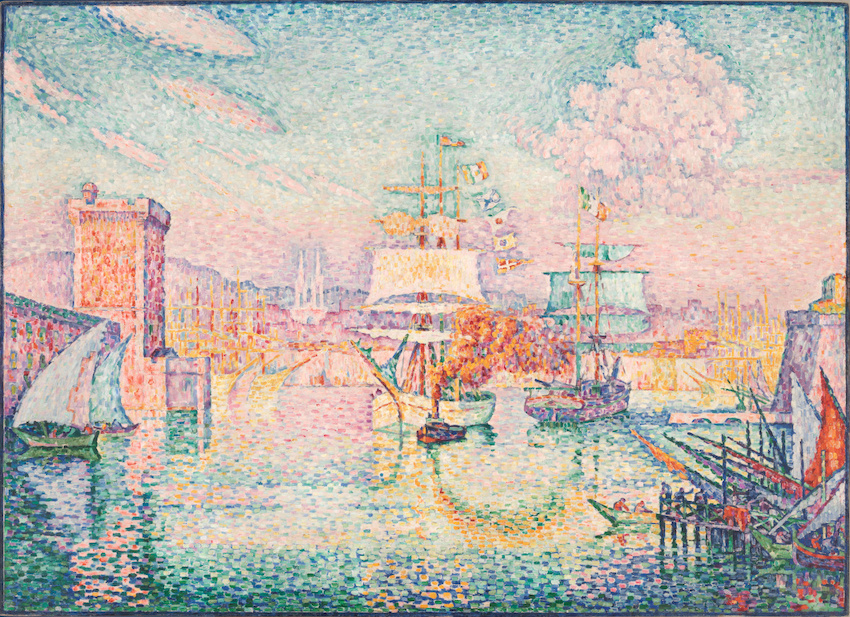
Paul Signac — The Pioneer of Neo-Impressionism →Sailboats glide into the entrance of a large Mediterranean port, their masts and sails silhouetted against a sky and water that shimmer with a thousand colorful hues. Pink and blue dominate, in a soft yet brilliant light that seems to make the entire surface of the canvas sparkle. We are in Marseille, in 1911, and Paul Signac displays the full extent of his artistry as a seafaring painter and colorist: *The Entrance to the Port of Marseille* is one of the most beautiful celebrations of the sea, light, and color in all of Neo-Impressionism.
This painting belongs to Signac’s late mature period. The passionate sailor, who spent his entire life sailing the coasts of France and Europe aboard his own boats, paints here the port he knows and loves—Marseille, the great maritime city of the Mediterranean. But more than just a harbor landscape, the work is a striking demonstration of how Signac had developed Divisionism: no longer Seurat’s small, regular, and precise dots, but broad, colorful brushstrokes, applied like the tesserae of a mosaic, that make the light shimmer and the colors sing.
For it is indeed light that is the true subject of this work. The light of the South, the light that floods the harbor, reflects off the water, makes the sails and facades shimmer, and dissolves forms into a shimmering play of colors. Signac, heir to the Impressionists and their quest for light, renders it through the techniques of Divisionism: by juxtaposing touches of pure color that, together, recreate the radiance of the Mediterranean sun.
This article explores the secrets of this luminous seascape—what it represents, what Marseille meant to Signac, how his colorful mosaic technique is employed in it, what the work reveals about his passion for the sea, and the unique fate of a painting that, housed at the Musée d’Orsay, is now on display in the very city it celebrates.
The Painting — What It Depicts
*The Entrance to the Port of Marseille* is a large-scale oil on canvas painted by Signac in 1911. As its title suggests, it depicts the entrance to the port of Marseille, the great seaport city in southern France, bustling with the comings and goings of ships.
The composition depicts several sailboats at the entrance to the harbor. In the foreground and center, boats with sails either unfurled or furled glide across the water, their masts standing tall and providing a vertical rhythm to the composition. In the background, the outlines of the harbor are visible—its docks, buildings, and perhaps the fortifications guarding its entrance. The sky occupies a large portion of the canvas, bathed in southern light, and the water below reflects this light in a play of colorful reflections.
The composition is dominated by a harmony of pinks and blues—the pinks of the sky and the light, the blues of the sea and the shadows. This delicate, luminous color palette lends the work an atmosphere of gentleness and serenity, reminiscent of a beautiful Mediterranean day. Signac does not seek drama or violent movement: he celebrates the luminous peace of a sun-drenched harbor, the tranquil beauty of the sea and the boats.
The entire surface of the canvas is rendered using the Divisionist technique, but in its mature and personal form: broad, juxtaposed strokes of color, like pieces of a mosaic, that create a vibrant shimmer. Up close, one sees only a multitude of colorful brushstrokes; from a distance, they coalesce into a luminous and coherent view of the harbor. This is the essence of Divisionism according to Signac: making light vibrate through the juxtaposition of pure colors.
Marseille, the major port
The choice of Marseille as a subject is not insignificant. For Signac, a sailor at heart and a lover of the Mediterranean, the port of Marseille represented one of the great centers of French maritime life, and he returned to paint it on several occasions.
Since ancient times, Marseille has been the largest port on the French Mediterranean coast, the gateway to the East and Africa, and a hub of cultural exchange, trade, and shipping. At the beginning of the 20th century, the port was bustling with activity: merchant ships, fishing boats, and vessels of all kinds crisscrossed the waters in ceaseless motion. For a painter as passionate about the sea and boats as Signac, it was an inexhaustible subject, rich in forms, light, and life.
Signac knew this maritime world intimately. As the owner of several boats throughout his life and an experienced sailor, he had traveled along the Mediterranean coastline and visited numerous ports. He did not paint the sea as a tourist, but as a sailor who understood the rigging, the maneuvers, and the interplay of wind and light on the water. This familiarity is evident in the accuracy of his seascapes and in the precision with which he depicts sailboats and their movement.
Marseille appears repeatedly in his work. Signac painted the harbor in various lights and at different times of year, in both oils and watercolors. Each version is a variation on the same theme dear to his heart: the beauty of the harbor, the light of the South of France, and the poetry of the sailboats. The 1911 painting *The Entrance to the Port of Marseille* is one of the most accomplished of these celebrations, where Signac’s technical mastery and his love of the sea come together in a vision of perfect harmony.
The Mosaic of Colors — Mature Divisionism
*The Entrance to the Port of Marseille* perfectly illustrates how Signac had developed the Divisionist technique, clearly distinguishing it from Seurat’s. It is the culmination of more than twenty years of exploration into color and brushwork.
Let us recall the fundamental principle of Divisionism: applying juxtaposed dots of pure color to the canvas, rather than mixing pigments on the palette, so that the eye can reconstruct the hues and perceive maximum luminosity. But whereas Seurat applied tiny, regular, almost mechanical dots, Signac had gradually enlarged his brushstrokes. In this 1911 work, the brushstrokes have become large colored tiles, placed side by side as in a mosaic or a stained-glass window.
This development has significant consequences. The broad brushstrokes give the surface a decorative, almost architectural quality: the canvas resembles a Byzantine mosaic or a stained-glass window, where each fragment of color plays its part in the overall harmony. The painting gains in brilliance, vibrancy, and physical presence. Far from Seurat’s somewhat cold rigor, Signac’s Divisionism became freer, more sensual, and more joyful—a celebration of color for its own sake.
Colors, in fact, are at the heart of the work. Signac juxtaposes touches of pink, blue, mauve, orange, and green, which respond to and enhance one another according to the laws of contrast. The pink of the sky vibrates against the blue of the water; the shadows are not gray but colorful; each pure stroke contributes to the luminous brilliance of the whole. This controlled profusion of pure colors, applied in broad strokes, is the signature of Signac in his mature period—and it was this very style that, a few years earlier, had so impressed the young Matisse and paved the way for Fauvism.
The Sailor-Painter
“The Entrance to the Port of Marseille ” expresses, perhaps better than any other work, what was the great passion of Signac’s life: the sea. To understand this passion is to understand the heart of his art.
Signac was not just a painter who occasionally painted the sea: he was a true sailor, for whom sailing was a way of life. He owned several boats over the years—sailboats that he loved to sail himself—and he spent much of his life on the water, sailing along the coast, stopping at ports along the way, and even participating in regattas. Sailing was not just a casual pastime for him, but an essential part of his life and his inspiration.
From this passion emerged one of the greatest collections of seascapes and harbor views in the entire history of French painting. Signac tirelessly painted the ports he visited: Saint-Tropez, of course, but also Marseille, La Rochelle, Collioure, Antibes, and, during his travels, Venice, Constantinople, and Rotterdam. Each port offered him an opportunity to study a particular light, different boats, and a unique atmosphere. His intimate knowledge of the sea and ships lends these works a precision and authenticity that a painter on dry land could never achieve.
This passion was officially recognized in 1915, when Signac was appointed official painter to the Navy—an honorary title that affirmed his special connection to the maritime world. *The Entrance to the Port of Marseille* is the consummate expression of this calling: a sailor who paints, with love and mastery, the world he knows best. The sea, sailboats, and the light on the water are not merely subjects among others for him, but the very heart of his art and his life.
Light and Serenity
Beyond its technical execution and subject matter, *The Entrance to the Port of Marseille* captivates with its atmosphere: a luminous serenity and a peaceful harmony that characterize Signac’s art in his mature period.
The work does not seek drama. There is no storm, no turmoil, and no tension here. The harbor is calm, bathed in beautiful light; the sailboats glide peacefully across the still water. Everything exudes the gentleness of a Mediterranean day, the tranquility of a world in harmony. This serenity is not limited to the subject alone: it is also evident in the composition—balanced and orderly—and in the color palette, whose soft harmonies of pinks and blues create a sense of peace and fulfillment.
This quest for harmony was at the heart of Signac’s ideal. We recall that, in the 1890s, he painted a large utopian composition titled *Au temps d’harmonie* (*In the Age of Harmony*), a vision of a reconciled humanity living in peace. This ideal of harmony—among people, but also among colors, and between art and nature—permeates his entire body of work. His luminous seascapes are a serene expression of this ideal: a world where the beauty of light and color creates perfect harmony, an image of a possible happiness.
This celebration of Mediterranean light also reflects the legacy of the Impressionists. Like Monet—whom he admired and who had encouraged him in his early days—Signac sought to capture light, its reflections, and its vibrations. But where Monet dissolved forms into the atmosphere with blended brushstrokes, Signac recomposes them through the rigorous juxtaposition of pure colors. The result is a light that is more constructed, perhaps more dazzling, but just as vibrant. *The Entrance to the Port of Marseille* is thus the meeting point of the Impressionist legacy, the Neo-Impressionist method, and the personal sensibility of a man enamored with the sea, light, and harmony.
From the Musée du Luxembourg to the Musée d’Orsay and Marseille
The history of *L’Entrée du port de Marseille*, from its creation to the present day, holds an interesting detail that you should be aware of before going to see the work.
Painted in 1911, the painting was acquired by the French government in 1920—relatively early on, a sign of the recognition Signac enjoyed during his lifetime, unlike Seurat. It became part of the public collections, first at the Musée du Luxembourg, which at the time was dedicated to living artists and long served as the venue where the government showcased contemporary art.
During the major reorganization of the national collections and the creation of the Musée d’Orsay in 1986—a museum dedicated to art from the period 1848–1914— the work was incorporated into the Musée d’Orsay’s collections, where it is officially listed under its inventory number. Legally speaking, therefore, it is a work belonging to the Musée d’Orsay.
But here’s the unique aspect: since 1983, *The Entrance to the Port of Marseille* has been on loan to the Cantini Museum in Marseille. In other words, although it belongs to the Orsay Museum’s collection, the work is physically on display in Marseille—in the very city it depicts. This loan, which allows Marseille to display a famous work that celebrates the city, means that you won’t necessarily see this painting when you visit the Musée d’Orsay. It’s a fine example of how French museums circulate their collections, and yet another reason—for anyone who loves this work—to visit Marseille, where the painting, in a sense, rediscovers its subject and its original light.
How to View the Work Today
*The Entrance to the Port of Marseille* is part of the collections of the Musée d’Orsay in Paris, but it has been on loan to the Musée Cantini in Marseille since 1983. It is therefore in Marseille, and not in Paris, that one can generally view the original—in the very city that Signac painted. However, it is recommended that you check with the relevant museums to confirm the work’s current location before visiting, as loan arrangements may change and works may be on loan for exhibitions.
To explore Signac’s work in Paris, the Musée d’Orsay houses several of his other major works, including *Women at the Well* (1892) and *The Palace of the Popes, Avignon* (1900). It is the essential place to discover the sailor-painter in the capital.
And to fully understand the connection between Signac and the Mediterranean, nothing beats a visit to the Musée de l’Annonciade in Saint-Tropez—in the harbor that Signac discovered, loved, and painted so often. There, one can appreciate the deep connection between the artist, the light of the Midi, and the birth of modern art, since it was this light that, through Signac, inspired Matisse and the Fauvists.
Further Reading
Institutional sources cited
- Musée d’Orsay, description of *The Entrance to the Port of Marseille*.
- Cantini Museum, Marseille (where the work is on loan).
- Larousse and Encyclopædia Universalis, entries on “Paul Signac.”
Sources and Reference Studies
- Françoise Cachin, *Signac: A Catalog Raisonné of His Paintings*, Gallimard, 2000.
- Paul Signac, *From Eugène Delacroix to Neo-Impressionism*, Paris, 1899.
- Signac Catalog . The Ports of France, La Piscine, Roubaix, 2011.
Institutional Documentation
- Musée d’Orsay, Paris — the collection to which the work belongs.
- Musée de l’Annonciade, Saint-Tropez — in the harbor that Signac painted so often.
See also on Hors Cadre
- Paul Signac—the Pioneer of Neo-Impressionism —a portrait of the artist, his life as a sailor-painter, and his role as a pioneer.
- The Portrait of Félix Fénéon — Signac’s Boldness — Signac’s Other Side: Experimental and Proto-Abstract.
- Henri Matisse—the liberation of color —the young painter whom the light of the South of France and Signac’s Divisionism led toward Fauvism.
— M