The Shepherds of Arcadia — Death in Paradise, by Poussin
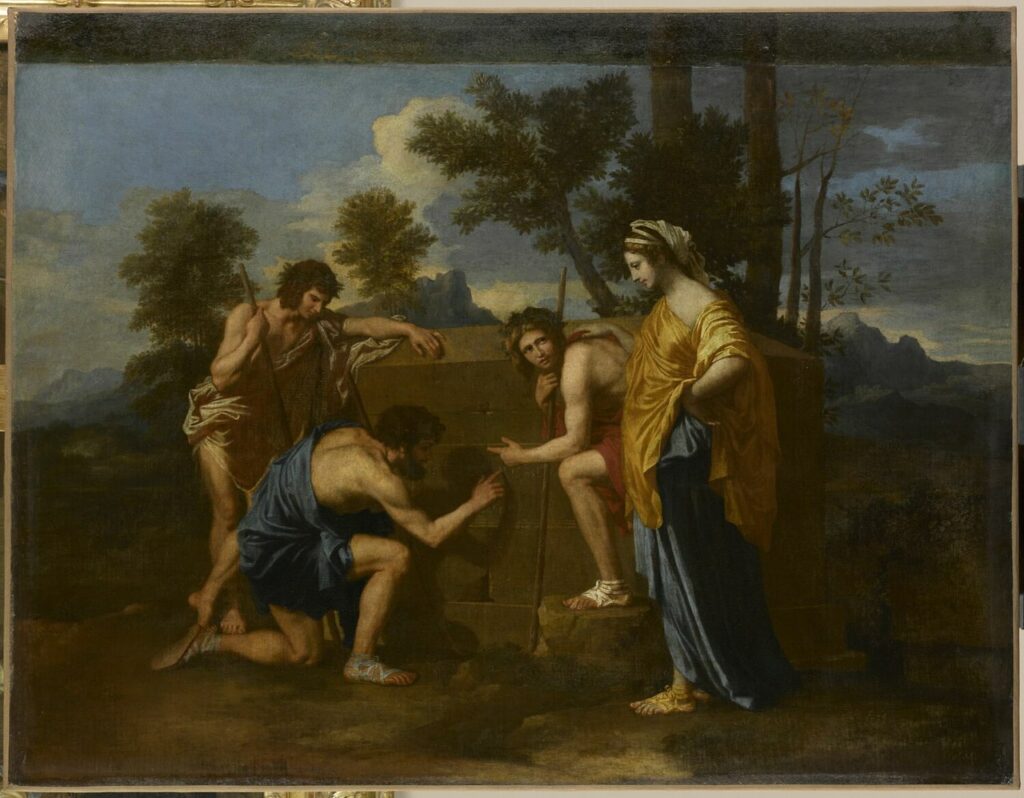
Nicolas Poussin — the painter-philosopher →In an idyllic landscape, bathed in golden light, three shepherds and a woman have stopped in front of a stone tomb. One of them, kneeling, traces with his finger an inscription carved into the marble. The others lean in, intrigued and pensive. What does this inscription say? Four Latin words, enigmatic and deeply moving: Et in Arcadia ego. “I, too, am in Arcadia.” ” This “I” is Death. And Arcadia, this land of shepherds, is paradise on earth, the place of perfect happiness. The message is clear and terrible: even in paradise, even at the heart of the purest happiness, Death is present.
This painting by Nicolas Poussin, *The Shepherds of Arcadia*, painted around 1638 and housed at the Louvre, is one of the most famous and profound works in the entire history of painting. It is the masterpiece of the painter-philosopher, the perfect embodiment of his art: a meditation on death and the human condition, rendered in images with a clarity, nobility, and restrained emotion that are uniquely his own. When standing before this work, one does not merely look: one meditates, one ponders, one is deeply moved.
For *The Shepherds of Arcadia* is entirely crafted for reflection. Every element—the tomb, the inscription, the figures’ gestures, the woman’s soothing gesture, the serene light—contributes to a meditation on the fragility of happiness and the inevitability of death. But far from being morbid or despairing, this meditation is imbued with a strange serenity, a peaceful, almost consoling acceptance. Poussin does not frighten us: he invites us to contemplate, with gravity and gentleness, the truth of our condition.
This article explores the secrets of this masterpiece—what it represents, the meaning of the famous inscription, what Arcadia is, the way Poussin introduces death into the heart of happiness, the woman’s central gesture, the two versions of the subject, the perfection of its classical composition, the many interpretations it has inspired, and the considerable legacy of this painted meditation.
The Painting — What It Depicts
*The Shepherds of Arcadia* is a medium-sized oil on canvas: 85 centimeters high by 121 centimeters wide. It is an intimate format, on the scale of a cabinet painting intended for close contemplation by a cultured connoisseur—not a large-scale decorative work.
The scene is set in an idealized landscape—a serene, sunlit countryside with bluish hills on the horizon and a gentle sky. In the center stands a stone tomb—austere and massive—on which is engraved the Latin inscription *Et in Arcadia ego*. Gathered around this tomb are four figures, dressed in ancient style, in the manner of figures from ancient Greece or Rome.
Three of them are shepherds, recognizable by their staffs. One, kneeling, traces the engraved inscription with his finger, as if slowly deciphering it. A second, leaning forward, points to the text and appears to be pondering or asking a question. A third, standing, appears to be meditating on these words. The fourth figure is a woman, a feminine figure of great nobility, standing on the right, who gently rests her hand on the shoulder of one of the shepherds and contemplates the scene with a solemn and serene demeanor. This woman, often interpreted as a personification—Nature, Reason, or a figure of wisdom—plays a key role in the work’s meaning.
The overall atmosphere is one of meditative calm. The light is soft, golden, and peaceful; the movements are slow, measured, and contemplative; the faces express attentiveness, reflection, and a serene melancholy. Nothing dramatic, nothing violent: everything is contemplation, gentle solemnity, shared meditation. The monumental figures, arranged like ancient sculptures, possess the dignity of characters from a tragedy. It is a scene of contemplation, a suspended moment in which happy beings discover and reflect on the truth of death.
“Et in Arcadia ego”—the mystery of the inscription
At the heart of the painting—both literally and figuratively—is the inscription engraved on the tomb: *Et in Arcadia ego*. These four Latin words are the key to the work, and their interpretation has been the subject of endless debate for centuries.
The literal translation of the phrase is: “And in Arcadia, me.” The sentence is elliptical, incomplete: the verb is missing, which leaves room for several interpretations. The most common and profound interpretation has Death itself speaking: “I, Death, am present even in Arcadia.” In this reading, it is Death who addresses the shepherds—and the viewer—to remind them that no place, however paradisiacal, escapes its dominion. Even in the land of perfect happiness, death reigns. It is a memento mori—“remember that you will die.”
But another interpretation, advocated in particular by Poussin’s biographer, André Félibien, suggests a different meaning: “I, too, have lived in Arcadia. ” In this reading, it is the deceased buried in the tomb who is speaking, saying that he, too, knew and enjoyed the joys of Arcadia before he died. The meaning is thus gentler, more nostalgic: no longer the threat of death, but the memory of past happiness, the melancholic evocation of a happy life now gone.
This ambiguity is not a flaw, but an intentional richness. The great art historian Erwin Panofsky devoted a famous essay to this concept, demonstrating how the two interpretations—the threat of death and the memory of the deceased—have coexisted and enriched one another throughout history. Poussin, as a painter-philosopher, undoubtedly played on this depth: his painting does not impose a single message; rather, it invites contemplation. Whether the inscription is understood as a warning or as a remembrance, it confronts the viewer with the same truth: the presence of death at the heart of life, and the fragility of all human happiness.
Arcadia — the pastoral paradise
To grasp the full significance of the work, one must understand what Arcadia is—this place evoked by the inscription and depicted in the landscape. For Arcadia is not merely a backdrop: it is a powerful myth, rich in meaning.
Geographically speaking, Arcadia is a real region of Greece, located in the center of the Peloponnese. But in ancient culture and throughout Western literary tradition, it has come to mean much more than that: it is the symbol of a pastoral paradise, a golden age, and a world of simple, pure happiness. Far from the cities, far from the hustle and bustle and the corruption of civilization, the Arcadians are said to have led the peaceful, innocent lives of shepherds, in harmony with nature. Arcadia has thus become the poetic name for an ideal: that of a happy, natural, unspoiled existence, where love, music, poetry, and the good life reign.
This Arcadian myth runs through all of literature, from the ancient poetry of Virgil—who sang of the shepherds of Arcadia in his *Bucolics*—to the pastoral poetry of the Renaissance. In Poussin’s time, Arcadia was a major cultural reference, the recognized symbol of pastoral happiness and the lost golden age. By setting his scene in Arcadia, Poussin evokes this entire imaginary world: the place of perfect happiness, innocence, and a pure and joyful life.
That is precisely what makes the work so poignant. For it is in this place of absolute happiness, in this pastoral paradise where death seemed to have no place, that Poussin introduces a tomb. The contrast is striking: right in the heart of Arcadia, amidst bliss, a reminder of death looms. The juxtaposition of this happy utopia and the somber tomb creates a contemplative tension of extraordinary depth. Even the purest happiness cannot escape the condition of mortality. This is the truth that the shepherds discover, and that Poussin invites us to contemplate.
Death at the Heart of Happiness
The true subject of *The Shepherds of Arcadia* is not the anecdote of a tomb’s discovery, but a universal meditation on death and the human condition. This is what gives the work its philosophical greatness.
The painting depicts a specific and deeply moving moment: the instant when young, happy, carefree people, living in pastoral bliss, suddenly become aware of death. Upon discovering the tomb and its inscription, the shepherds realize that death exists, that it is present even in their paradise, and that it awaits them as well. It is the encounter between youth and its carefree nature and the tragic truth of existence. A moment earlier, they were unaware of death; now, they know it. The painting captures this transition, this realization, this moment when happiness takes on a somber tone.
This meditation on death at the heart of life is one of the great themes of human thought, and Poussin conveys it with unparalleled power. The memento mori—the reminder of mortality—was a common motif in art, often depicted in a macabre manner, featuring skulls, skeletons, and symbols of decay. But Poussin treats it quite differently: without macabre elements, without terror, with a nobility and serenity that transform the somber warning into a philosophical meditation. Death, here, is not a horror, but a truth to be contemplated, accepted, and integrated into a wisdom of life.
This serene approach to death brings the work closer to ancient wisdom, particularly Stoicism—the philosophy that taught the peaceful acceptance of death as a natural part of the order of things. Poussin’s shepherds do not lament or fear: they meditate, they contemplate, and they integrate the truth of death into a solemn and serene reflection. Poussin, the painter-philosopher, invites us to do the same: not to flee from the thought of death, but to look it in the face, with clarity and serenity, in order to better appreciate the value of life. It is a lesson in wisdom as much as it is a work of art.
The Woman’s Gesture
Among all the elements in the painting, one gesture in particular catches the eye and encapsulates much of the work’s meaning: that of the woman gently resting her hand on the shoulder of one of the shepherds. This gesture, of infinite tenderness, is the emotional and spiritual heart of the composition.
This female figure, standing on the right, stands out from the shepherds by her nobility, her calm, and her dignified bearing. She does not try to decipher the inscription, nor does she wonder like the others: she already knows. She contemplates the scene with serene gravity and peaceful wisdom, like a superior figure who understands the meaning of it all. This is why she has often been interpreted not as a simple shepherdess, but as a personification—Nature, Reason, Wisdom, or even a maternal and comforting figure.
His gesture—his hand resting on the young shepherd’s shoulder—is rich in meaning. It is a gesture of comfort, reassurance, and consolation. Faced with the discovery of death, and with the fear or melancholy that might overwhelm the young man, this reassuring hand brings calm and serenity. It seems to say: yes, death exists, but there is no need to fear it; we must accept it wisely and integrate it into a peaceful view of existence. An ancient commentator admirably described this woman “holding back her laughter” and surrendering to the thought of death—caught between joy and solemnity.
This gesture makes all the difference between anguish and wisdom. Without it, the painting might be nothing more than a terrible observation: death reigns everywhere, even in paradise. But with this soothing gesture, the work becomes a comforting meditation: death is part of life, and wisdom lies in accepting it serenely. This is why this gesture has been recognized as the central motif of the composition, the key to its atmosphere of meditative serenity. By placing this gesture at the heart of his painting, Poussin transforms a memento mori into a lesson in wisdom—and makes painting an instrument of thought and philosophical consolation.
Two Versions — From Surprise to Reflection
A little-known fact sheds light on the depth of the Louvre’s version: Poussin painted the subject of *The Shepherds of Arcadia* twice, ten years apart. A comparison of the two versions reveals the evolution of his art toward an ever purer and more serene meditation.
The first version, painted around 1628–1630, is now in the collection at Chatsworth House in England. It depicts the same theme—shepherds discovering a tomb bearing the inscription *Et in Arcadia ego* —but in a more dramatic, Baroque style. The figures are more agitated, seized by the surprise and dread of the discovery. A skull lies on the tomb, a macabre and explicit reminder of death. The composition is more dynamic, the emotion more immediate and theatrical. It is the work of a still-young Poussin, influenced by the Baroque and Venetian art of his early years in Rome.
The second version, the one in the Louvre, painted around 1637–1638, is quite different. Poussin eliminated all elements of surprise and drama. The skull has disappeared. The shepherds are no longer seized with fear: they contemplate, meditate, and decipher with a solemn and melancholic curiosity. The composition has become perfectly balanced, serene, and orderly. The emotion no longer lies in the shock of discovery, but in the depth of meditation. This is the work of a mature Poussin, fully in command of his classical art, who has moved beyond drama to reach pure thought.
This evolution is indicative of Poussin’s entire artistic journey. From the first to the second version, he moves from the Baroque to Classicism, from movement to order, from drama to meditation, and from immediate emotion to philosophical reflection. The Louvre version represents the culmination of this quest: a work in which all facile effects have been eliminated in favor of serene and profound contemplation. It is this second version that has become one of the most famous and influential works in the history of art—the pinnacle of Poussin’s career as a painter-philosopher.
A classic composition
*The Shepherds of Arcadia* is a perfect example of Poussin’s classical art. Every aspect of its composition illustrates the principles of clarity, order, balance, and nobility that define his ideal—and that make this meditation on death a work of absolute formal beauty.
The composition is constructed with admirable rigor and balance. The four figures are arranged around the tomb in such a way as to form a harmonious, balanced, and clearly legible group. Their poses and gestures echo one another and flow together with perfect fluidity, guiding the viewer’s gaze from the inscription to the woman’s soothing gesture. Nothing is confusing, nothing is superfluous: each figure occupies its exact place within a composition as precisely orchestrated as a scene from ancient theater. The tomb, at the center, structures the entire composition and serves as its focal point.
The figures themselves possess the nobility and grandeur of ancient statues. Dressed in the classical style, draped like figures from classical Greece or Rome, they possess a dignity, a solemnity, and an ideal beauty that elevate them above the merely anecdotal. Poussin does not paint real shepherds, but idealized figures—embodiments of humanity confronting its destiny. Their sculptural beauty, their calm, and their nobility lend the scene a universal and timeless significance.
The light and the landscape contribute to this classical perfection. The soft, golden light bathes the scene in a serene and even atmosphere, without sharp contrasts or dramatic effects. The landscape—idealized and orderly, with its harmonious hills and peaceful sky—is not real nature but nature recomposed according to the laws of beauty and harmony. Everything—composition, figures, light, and landscape—contributes to an impression of calm, order, nobility, and serenity. The classical form perfectly complements the meditative subject: the perfection of the visual order conveys the serenity of wisdom in the face of death.
Interpretations of an Enigmatic Painting
*The Shepherds of Arcadia* is one of the most discussed and interpreted works in the entire history of art. Its meditative depth and the ambiguity of its inscription have given rise, over the centuries, to a multitude of interpretations—some serious and insightful, others more fanciful.
Scholarly interpretations have focused on the meaning of the inscription and the philosophical significance of the work. The painting has been interpreted as a memento mori, a Stoic meditation on the acceptance of death, a humanist reflection on the human condition, and an elegy on the fragility of happiness. Erwin Panofsky’s essay, which analyzes the dual interpretation of the phrase, remains a major reference. These interpretations, grounded in art history, philology, and philosophy, shed light on the work’s richness of meaning and confirm its status as a philosophical meditation.
But the work has also inspired much more daring, even fanciful, interpretations. Some have believed they detected hidden geometric structures, esoteric messages, links to secret societies, or religious mysteries within the composition. It has been speculated that the tomb represents that of Christ, that the woman is Mary Magdalene, and that the inscription conceals anagrams revealing secrets. These interpretations, popularized by certain sensationalist literature, stem more from imagination than from rigorous analysis. They attest to the work’s power to fascinate, but stray from what art history can establish.
We should therefore maintain the sense of proportion and clarity that characterized Poussin himself. The essence of the painting lies not in some hidden secret, but in its open and profound meditation on death and the human condition. The true richness of the work is philosophical and poetic, not esoteric. Poussin, a painter of reason and clarity, invites us to reflect lucidly on our mortal destiny—not to seek out imaginary mysteries. It is in this serene and universal meditation that the inexhaustible greatness of *The Shepherds of Arcadia* lies.
The Legacy of a Masterpiece
“The Shepherds of Arcadia ” has had a considerable influence on the history of art and culture, becoming one of the most famous and most widely contemplated images in Western painting.
As one of Poussin’s major works, the painting helped establish the prestige of French classicism and made its creator the model for the Royal Academy. Its balanced composition, noble figures, and depth of meaning have made it a model studied and admired by generations of artists. The very theme of*Et in Arcadia ego*, popularized by Poussin, has become a recurring motif in Western culture, reappearing in painting, literature, and poetry as the quintessential expression of meditation on the fragility of happiness and the presence of death.
The work had a particularly profound impact on the classical tradition of which Poussin was the master. The painters who followed in his footsteps—the Poussinists, and later the Neoclassicists such as David and Ingres—saw in *The Shepherds of Arcadia* a model of masterful composition, noble figures, and depth of subject matter. Moreover, Poussin’s meditative and carefully constructed art—of which this painting is one of the pinnacles—inspired the thinking of modern painters such as Cézanne, who, like Poussin, were concerned with structure, order, and the essential.
Today, *The Shepherds of Arcadia* remains one of the most famous works in the Louvre and one of the most profound paintings in the entire history of art. Standing before this painting, the 21st-century visitor is struck by the same contemplation as the shepherds: an awareness of death at the heart of life, and the serene wisdom that allows one to accept it. Four centuries after its creation, this image continues to speak to everyone, inviting them to reflection, contemplation, and wisdom. This is the hallmark of the painter-philosopher’s masterpieces: they never cease to inspire thought.
How to View the Work Today
*The Shepherds of Arcadia* is housed at the Louvre Museum in Paris, where it is displayed among the masterpieces of 17th-century French painting. The Louvre’s main entrance provides access to these galleries; since the museum is so crowded, it’s best to book your ticket in advance and visit during off-peak hours. The galleries featuring classical French painting are often quieter than those housing the great Italian masterpieces.
Seeing the work in person allows one to appreciate its meditative quality: the softness of the light, the nobility of the figures, and above all, the invitation to contemplation that emanates from the scene. This is a painting before which one must take the time to pause, to decipher it just as the shepherds did, and to meditate in turn on the meaning of the inscription. Its intimate size invites a close and contemplative approach.
To further your exploration of Poussin, the Louvre houses the world’s finest collection of his works: *The Rape of the Sabine Women*, the *Four Seasons* cycle, *The Inspiration of the Poet*,the *Self-Portrait* from 1650, and many others. Viewing these works side by side allows visitors to appreciate the full depth and coherence of the painter-philosopher’s art.
Further Reading
Institutional sources cited
- Louvre Museum, description of *The Shepherds of Arcadia*.
- Encyclopædia Universalis, article “Nicolas Poussin.”
- Academic notes (Utpictura18) on the Louvre version.
Sources and Reference Studies
- Erwin Panofsky, “Et in Arcadia ego.” Poussin and the Elegiac Tradition (in *The Work of Art and Its Meanings*), 1955.
- André Félibien, *Conversations on the Lives of the Most Distinguished Painters*.
- Pierre Rosenberg, Louis-Antoine Prat, *Nicolas Poussin: A Catalog*, RMN, 1994.
Institutional Documentation
- Louvre Museum, Paris — the institution that houses the work.
See also on Hors Cadre
- Nicolas Poussin—the painter-philosopher —a portrait of the artist, his life, and his art of meditation.
- Ingres—the cult of the line —the classical heir who traced his lineage back to Poussin.
- Paul Cézanne—the father of modern art —the man who wanted to “recreate Poussin from life,” drawn to his composition and order.
— M