The Family — Schiele’s Moving Testament
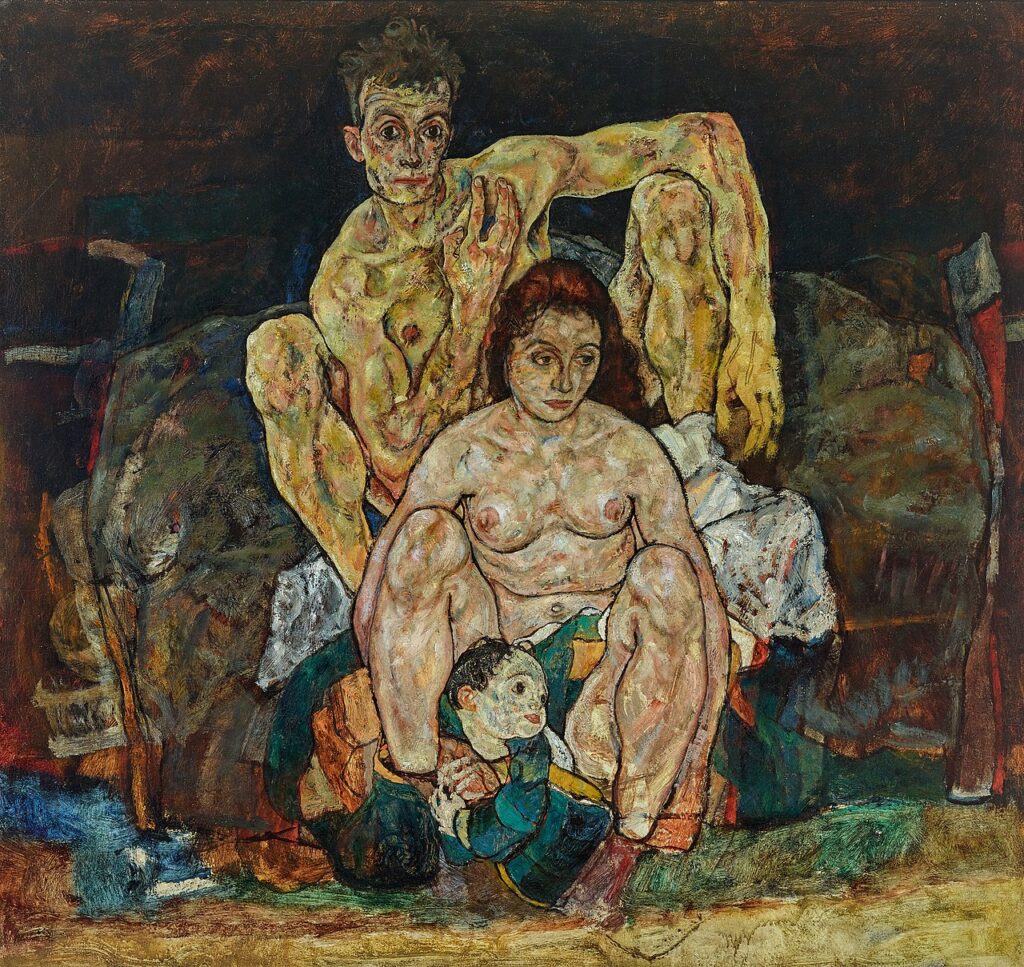
Egon Schiele — The Body Lay Bare →A naked man, crouching with his gaze directed toward us, shields a naked woman sitting between his legs with his body; and between the woman’s legs, a child appears, shyly looking out of the painting. Three beings, three generations, brought together in a pyramidal composition imbued with a gentle, melancholic solemnity. This work, *The Family*, is one of the last paintings Egon Schiele ever created—and one of the most deeply moving in the entire history of art, for a tragic reason: this family never existed.
Painted in 1918, the very year of the artist’s death, *The Family* reveals a Schiele who is at peace, matured, and having attained a newfound serenity. Gone are the tortured body, raw anguish, and provocation: here, gentleness, tenderness, and a meditative solemnity reign. The man, with the painter’s features, watches over them protectively; the woman is lost in thought; the child is awakening to life. It is an image of family, of continuity, of the cycle of generations—a subject of peace and hope, in stark contrast to the tormented work of his youth.
But fate would give this work a heart-wrenching resonance. A few months after painting it, in the fall of 1918, Schiele lost his wife Edith, who was six months pregnant, to the Spanish flu; the unborn child did not survive; and Schiele himself died three days after his wife. The family he seemed to be heralding in this painting never came to be. The work, painted as a promise of life, became the tomb of a family that never existed. It is this tragic coincidence between art and life that makes *The Family* a work that will forever be poignant.
This article explores the secrets of this pictorial testament—what it depicts, the story behind its title, the tragedy that haunts it, the serenity of his mature style, his meditation on existence and the generations, and how this final great work became one of the pinnacles of Schiele’s art.
The Painting — What It Depicts
*The Family* is a large-scale oil on canvas—approximately 150 centimeters high by 161 centimeters wide. This expansive, almost square format lends the scene a sense of monumentality and solemnity that befits its serious subject matter.
The composition brings together three figures, arranged in a solid, stable pyramid. At the top and in the background, a nude man is crouching, slightly elevated, as if seated on a bed or a couch. He gazes calmly at the viewer; his left arm rests on his knee, and his right hand is drawn up toward his heart. This man, with his recognizable features, is Schiele himself. In front of him, between his legs, a nude woman sits on the floor, her gaze lost in the distance, turned downward and to the side, her arms at her sides, in a pensive and resigned pose. And finally, between the woman’s legs, a young child appears, half-hidden, looking out of the painting.
The figures are rendered with Schiele’s characteristic contrast. The man’s body is bony, angular, and dark-skinned, with a tanned complexion; the woman’s is softer, with full curves and a lighter pink hue; the child, standing between them, adds a touch of fragility. The skin tones range from pale pink to deep ochre, set against a dark background that envelops the figures. This warm, muted palette and this subdued light create an intimate and solemn atmosphere.
One detail stands out: despite their physical proximity, despite the protective embrace that unites them, the three figures seem strangely isolated. Each is looking in a different direction; no one’s gaze meets another’s; each appears absorbed in their own thoughts, their own solitude. This solitude within the very heart of family intimacy lends the work a melancholic depth. The family is together, and yet each member remains alone in the face of existence. This is one of the painting’s most subtle and moving tensions.
The Crouching Couple — A Posthumous Title
The title by which we know this work, *The Family*, is not the one Schiele gave it. The story behind this title is revealing, and further adds to the painting’s emotional impact.
Schiele had initially titled his work *The Crouching Couple* (in German, *Kauerndes Menschenpaar*). The original title, therefore, did not refer to a “family”: it simply depicted a couple of human beings crouching. This clarification is important because it sheds light on the artist’s original intention. It is also important to note that the female model was not Edith, Schiele’s wife, but likely a professional model, and that the child was added to the composition. The work was therefore not originally conceived as a portrait of the artist’s own family, but as a more general composition on the human couple and, with the addition of the child, on generations.
It was after Schiele’s death that the work was renamed *The Family*. The Viennese art critic Berta Zuckerkandl, an influential figure in the art world, used this title to refer to the work—and it stuck. This change in title is significant: it reflects how the work was received and interpreted in light of the tragic deaths of the artist, his wife, and their unborn child. The public and critics naturally saw in this man with Schiele-like features, surrounded by a woman and a child, the image of the family the painter had never had.
This posthumous title has thus profoundly shaped the reception of the work. What was originally a meditation on couples and generations became, in the eyes of posterity, a heart-wrenching portrait of a dream family that never came to be. The power of this interpretation is such that it is now impossible to view the work in any other way. The title *La Famille*, born of a retrospective view of a tragedy, has made this painting a symbol—one of life and hope cut short by death. The history of the title is thus inseparable from that of the work itself and its emotional power.
The Tragedy of a Family That Never Existed
The emotional power of *La Famille* stems entirely from the tragic coincidence between the work and the life of its creator. This story, one of the most poignant in modern art, deserves to be told.
In 1918, Schiele was at the height of his career. Klimt’s death in February had made him the leading figure in Viennese art; his exhibition at the Secession that spring was a triumph. His wife Edith, whom he had married in 1915, was pregnant with their first child. Everything seemed to be going the artist’s way: recognition, financial security, and soon, fatherhood. It was against this backdrop of hope that he painted this large composition of a man, a woman, and a child—this image of life being passed on and perpetuated.
But in the fall of 1918, the terrible Spanish flu epidemic, which was ravaging Europe, reached Vienna. Edith, six months pregnant, fell ill. She died on October 28, 1918. The child she was carrying did not survive. And three days later, on October 31, Schiele, in turn, succumbed to the same illness. Within the space of a few days, the flu claimed the life of his wife, their unborn child, and the artist himself. The family that Schiele seemed to foreshadow and hope for in his painting never came to be.
This coincidence lends the work a deeply moving resonance. Painted as a portrayal of life, love, and the passing down of a legacy, *The Family* has, by a twist of fate, become a monument to a family wiped out before it even had a chance to exist. The man with Schiele-like features, a protector watching over a woman and a child, appears in retrospect as a tragic prophecy—an image made all the more poignant by the knowledge of what was to come. The painting that once celebrated life became the tomb of a future cut short.
We must guard against any overly literal interpretation—the female model was not Edith, and the work was not intended as a family self-portrait. But the power of the symbol transcends these historical details. In the collective memory, *The Family* has come to represent shattered hope, a life cut short, and the fragility of human happiness. Few works carry such emotional weight, born of the encounter between an image and a destiny. It is this emotional weight that makes this painting one of the most moving works of 20th-century art.
The Serenity of a Final Work
*The Family* reflects a major shift in Schiele’s art: the softening of his style in the final years of his life. Compared to the turbulent works of his youth, it reveals an artist who had attained a newfound serenity and maturity.
Schiele’s early works, from around 1910–1912, were marked by anguish, tension, and provocation: tortured, emaciated, flayed bodies; contorted poses; grimacing expressions; and raw sexuality. It was the art of a young man in revolt, exploring the most unsettling aspects of human existence with feverish intensity. Beginning in 1915–1916, influenced by marriage, the war, and maturity, his style softened. The bodies became fuller and more sculpted; the compositions more expansive and stable; the atmosphere more solemn and serene.
*The Family* is the culmination of this evolution. Everything in the work exudes a sense of calm. The pyramidal composition is solid, balanced, and monumental. The figures, without losing any of the anatomical accuracy so dear to Schiele, have shed their tortured gauntness: the woman’s figure, in particular, with its soft, full curves, expresses a new sense of fullness. Their gestures are calm, protective, and tender. The man’s gaze toward the viewer is peaceful, solemn, almost serene. Anxiety has given way to meditation, provocation to tenderness, and fever to solemnity.
This sense of calm reflects just how far Schiele had come in just a few years. The scandalous young man, imprisoned for his drawings and obsessed with tortured bodies and raw sexuality, had become, at the age of twenty-eight, a mature artist capable of painting tenderness, family, and the passing down of traditions with serene gravity. One can only imagine how this evolution might have continued had death not cut it short. *The Family* offers a glimpse of a new, more serene Schiele—one who did not have time to fully emerge. It is also in this sense that the work serves as a testament: it shows where the artist stood at the time of his death and hints at what he might have become.
A Meditation on Existence
Beyond its biographical and emotional weight, *La Famille* is a work of great meditative depth that touches on universal themes of existence: love, generation, the transmission of life, and the inescapable loneliness of being.
The subject itself—a man, a woman, a child—is one of the most universal themes there is. It evokes the cycle of life, the perpetuation of the species, and the passing of life from one generation to the next. It ties in with the great images of the human family, from the Holy Family of Christian tradition to secular depictions of the couple and the child. Schiele thus places his work within an age-old meditation on the human condition, on life that is given and passed on. The child appearing between the woman’s legs evokes birth, origin, and the beginning of life.
But Schiele gives this meditation a tone all its own, marked by gravity and melancholy. For this reunited family is also a family of solitary beings. As has been noted: despite their proximity, the three figures do not look at one another, each absorbed in their own thoughts, their own solitude. This solitude at the heart of intimacy speaks volumes about the human condition according to Schiele: even when united by love and blood ties, individuals remain alone in the face of existence and death. Love does not dissolve the fundamental loneliness within each person.
This tension between unity and solitude, between the continuity of life and the finitude of each individual, gives the work its philosophical depth. *The Family* is not an idealized and reassuring portrayal of family happiness: it is a solemn meditation on the human condition, on life and death, on love and solitude. Schiele, who had spent his entire life exploring anxiety and mortality, integrates these themes here into a broader, more serene—yet no less profound—vision. The family becomes a symbol of the human condition as a whole: life continuing, and each person’s solitude in the face of their destiny. It is this depth, combined with the tragedy of his life, that makes the work a meditative masterpiece.
The Unfinished Work
One final element adds to the emotional impact of *The Family*: its partially unfinished nature. Since Schiele’s death cut short his creative work, the piece bears the marks of this abrupt interruption.
Experts have noted that certain parts of the painting appear unfinished, particularly the man’s left hand, which remains in a rough, sketchy state. These unfinished areas suggest that Schiele may still have been working on the painting—or at least that he had not brought it to its final completion—when illness and death took him. The work is thus suspended, forever interrupted, just like the life of its creator.
Far from detracting from the work, this sense of incompleteness adds to its power. It serves as a reminder of the tragic circumstances of its creation—the brutality with which death cut the artist down at the height of his artistry. It gives the work a sense of being suspended, open, and unfinished, which echoes Schiele’s life cut short and the family that never came to be. The unfinished nature of the work takes on meaning: it imprints upon the very fabric of the painting the tragic interruption that struck the artist and his loved ones.
*The Family* is thus, in every respect, a testamentary work. As Schiele’s last major composition, it shows him having reached full maturity, serene and contemplative; it bears the mark of his death cutting short his work; and, through a tragic twist of fate, it has become the symbol of a shattered life and shattered hope. Few works so powerfully encapsulate the connection between art and life, between creation and death. When looking at *The Family*, one cannot separate the painting from the deeply moving story surrounding it—and it is this inseparability that gives it its unique greatness.
From *The Crouching Couple* to *The Belvedere*
The journey of this work—from Schiele’s studio to the walls of the Belvedere—is worth tracing, as it establishes this masterpiece as part of Austria’s artistic heritage.
The work was exhibited during Schiele’s lifetime at the 49th exhibition of the Vienna Secession in the spring of 1918 — that triumphant exhibition in which Schiele, having become the leading figure in Viennese art after Klimt’s death, occupied the place of honor, and for which he himself had designed the poster. *The Family* was among his most important works on display there, reflecting the artistic maturity he had achieved.
After the artist’s death, the work passed through the hands of various owners before entering public collections. It was finally acquired in 1948 by the Belvedere Gallery, one of Vienna’s major museums, which purchased it from the Austrian artist Hans Böhler, who was living in the United States at the time. The Belvedere, which already housed masterpieces of the Vienna Secession, thus enriched its collection with one of Schiele’s last major paintings.
Since then, *The Family* has been one of the jewels of the Belvedere, where it is on display alongside other masterpieces by Schiele and Klimt. The museum has also made it part of its open-access policy, allowing everyone to freely view and reproduce this major work. Today, it captivates and moves visitors from around the world, who come to contemplate this deeply moving testament to a genius cut down at the age of twenty-eight—this image of a family that never existed, painted by a man who would die with his loved ones just a few months later.
How to View the Work Today
“The Family ” is housed at the Belvedere Museum in Vienna, in the Baroque Upper Belvedere Palace, which contains one of the world’s richest collections of Austrian art. It is there that visitors can admire the original of this deeply moving work.
Seeing the painting in person allows one to fully appreciate its gravity and tenderness: the large scale, the softness of the skin tones, the subdued atmosphere, and the subtle melancholy that emanates from the three figures—together, yet alone. It is a work that compels you to linger, captivated by its serene beauty and the tragic story behind it.
The Belvedere houses other masterpieces by Schiele, including *Death and the Maiden* (1915), as well as Gustav Klimt’s famous *The Kiss *. Seeing these works together allows visitors to appreciate the journey Schiele undertook—from the anguish of youth to the serenity of maturity—and the dialogue between the disciple and his master, Klimt. To explore the artist’s work more extensively, the Leopold Museum and the Albertina in Vienna offer exceptional collections of his works.
Further Reading
Institutional sources cited
- Belvedere, Vienna, entry on *La Famille* (*Kauerndes Menschenpaar / Die Familie*).
- Leopold Museum, Vienna, materials on Schiele.
- Kallir Research Institute, Schiele’s catalog raisonné.
Sources and Reference Studies
- Jane Kallir, Egon Schiele: The Complete Works, a catalogue raisonné.
- Christian M. Nebehay, Egon Schiele 1890–1918: Life, Letters, Poems.
- Catalogs of the Schiele retrospectives (Belvedere, Leopold Museum).
Institutional Documentation
- Belvedere, Vienna — the institution that houses the work.
- Leopold Museum, Vienna — the largest collection of Schiele’s works.
See also on Hors Cadre
- Egon Schiele — The Raw Body — A Portrait of the Artist, His Life, and His Art.
- Death and the Maiden—Schiele’s heart-wrenching farewell —the other great painting at the Belvedere, where love and death are already entwined.
— M