The Floor Planers — Caillebotte’s Modern Realism
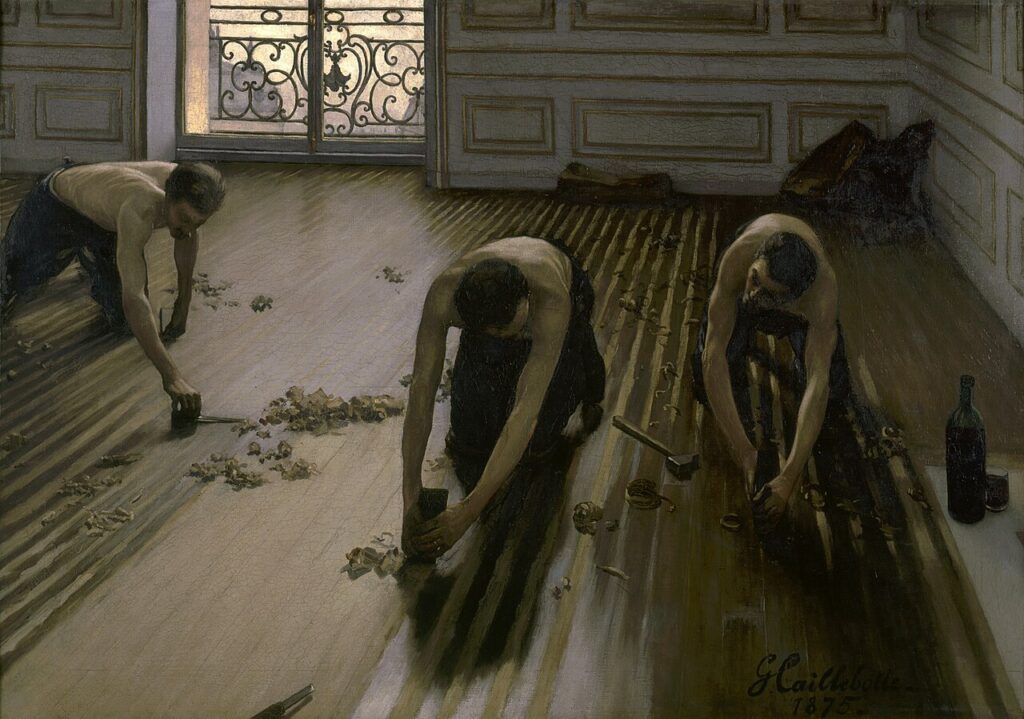
Gustave Caillebotte — the painter of modern Paris →Three shirtless men, kneeling, are scraping the floor of a Parisian apartment. Their bodies are tense with exertion, their movements precise and repetitive, as wood shavings curl into long ribbons beneath their blades. Light streams in through a window at the back, gliding across the parquet floor being sanded and over the workers’ bent backs. This is Gustave Caillebotte’s *The Floor Sanders* —one of the first major modern paintings to take manual labor as its subject, and the masterpiece that revealed its creator’s genius.
Painted in 1875, this work is a manifesto. By choosing to depict workers at work in a new bourgeois interior, Caillebotte broke with the tradition that reserved painting for noble subjects—history, mythology, and portraits of high society. He introduced into art a subject considered trivial, almost shocking for the time: the laboring body and the reality of urban manual labor. In doing so, he asserted a new, resolutely modern vision of what painting can and must depict.
But *The Floor Scrapers* is not only bold in its subject matter: the work is equally bold in its form. The bird’s-eye view, the rigorous geometry of the parquet floor, the precise framing, and the subtle lighting make it a strikingly modern composition, in which the realism of the subject is combined with a mastery of composition inherited from the classical tradition. In this work, Caillebotte already reveals what would become his signature style: a fresh, precise, almost photographic gaze on the modern world.
This article explores the secrets of this masterpiece—what it represents, the boldness of its subject, the authenticity of the body at work, the artistry of its perspective, its place between Realism and Impressionism, and the story of its rejection by the Salon before it was recognized as one of the major works of modern art.
The Painting — What It Depicts
*The Floor Planers* is a medium-sized oil on canvas: 102 centimeters high by 146.5 centimeters wide. This format gives the scene a sense of presence without making it a monumental composition—it captures the scale of everyday life.
The scene takes place in a Parisian apartment, which is clearly new or still being furnished. Three shirtless men are kneeling on the floor, busy planing and sanding a wooden floor. Two of them, on the right, are working side by side, bent over their task; the third, on the left, stands slightly apart. Their tools scrape against the wood, sending shavings swirling in spirals across the floor, which has already been partially sanded. Off to the side, a bottle of wine and some glasses are visible—a detail of working-class life. In the background, a large window, adorned with wrought-iron grating, lets in daylight.
This light plays an essential role. It streams in through the window at the back, spreads across the hardwood floor, makes the sanded wood gleam, and casts light on the workers’ backs and arms. The contrast between the areas that have already been worked on—light and shiny—and those that are still rough creates a subtle interplay of tones and reflections. The color palette is dominated by the warm browns of the wood, ochres, and flesh tones, creating a sober and luminous harmony. The scene, seemingly ordinary, is rendered with such care and attention that it is transformed.
What strikes one immediately is the realism of the depiction. The workers’ bodies, their taut muscles, their postures, and their gestures are rendered with remarkable precision and accuracy. You can sense the effort, the concentration, and the repetition of the movements. Caillebotte clearly observed the scene closely, capturing the truth of the workers’ postures and movements. Nothing is idealized, nothing is conventional: this is the reality of labor, depicted with a newfound honesty and insight. This truth, combined with the beauty of the composition and the light, is what gives the work its power.
A Scandalous Topic
What seems natural to us today—depicting workers at work—was, in 1875, a bold move, almost a provocation. To understand how groundbreaking *The Floor Scrapers* was, one must appreciate just how transgressive that choice of subject was.
The hierarchy of genres, inherited from the academic tradition, reserved “great painting” for noble subjects: historical and mythological scenes, religious subjects, and portraits of illustrious figures. Manual labor and the lives of the working classes were deemed unworthy of high art, or relegated to minor genres, often depicted in a picturesque or sentimental manner. Depicting urban workers in the midst of their labor, in all the rawness of their physical reality, was therefore a break with convention—an assertion that the world of modern labor, too, deserved a place in art.
Caillebotte was not quite the first to take an interest in the world of work. Before him, realist painters such as Gustave Courbet and Jean-François Millet had depicted peasants and laborers, affirming the dignity of the people. In Germany, that same year—1875—Adolph Menzel painted a large factory. But Caillebotte brought something new to the table: he depicted urban labor—the working class of the modern city—with a realism devoid of any sentimentality, without idealization or pathos, set in a resolutely contemporary setting—the new Haussmann-style apartment. It is modern labor, in the modern city, that he brings to light.
This artistic choice was not without consequences. When Caillebotte submitted the work to the official Salon of 1875, it was rejected by the jury. The subject matter, deemed too crude, too vulgar, and too far removed from the canons of “noble” painting, ran counter to established conventions. Far from discouraging Caillebotte, this rejection brought him closer to the Impressionists, who had also been rejected by the institution: he exhibited the work the following year at the second Impressionist exhibition in 1876, where it attracted attention. The Salon’s rejection had turned *The Floor Scrapers* into a manifesto for the new style of painting.
The Truth of the Body at Work
At the heart of the work are the bodies—these three men bent over their work, rendered with a realism and presence that give the painting its power. In it, Caillebotte displays a focus on the laboring body that was, at the time, a novelty.
Caillebotte depicts the workers bare-chested, revealing their muscular bodies, taut with exertion. He renders their anatomy with a precision rooted in his academic training: the muscles of the back and arms, the crouching postures, the tension in their movements. But this precision is far from a cold exercise: it serves to express the physical reality of labor—the body’s commitment to the effort, the fatigue, and the concentration. One senses the weight of the repeated motion, the toil and dedication of the men at work. In Caillebotte’s work, the worker’s body becomes a subject of painting in its own right, worthy of observation and depiction in all its truth.
This treatment of the figures avoids two pitfalls. On the one hand, Caillebotte does not succumb to academic idealization, which would have turned these workers into noble, sculptural figures in the classical style. On the other hand, he does not fall into miserabilism or social pathos, which would have turned them into pitiable victims. He shows them as they are: men at work, absorbed in their task—neither heroes nor martyrs, simply real. This accuracy, this refusal of any sensationalism, is a mark of respect and a sign of modernity. Caillebotte views labor with a honesty that was rare at the time.
Light, once again, plays a role in this celebration of the body at work. It glides over the bent backs, makes the muscles stand out, and highlights the movements. It gives the bodies a sculptural presence, a quiet dignity. Without ever idealizing them, Caillebotte bestows upon these workers a sense of grandeur—that of a job well done, of precise movements, of honest effort. This is one of the first instances in modern art where urban manual labor is viewed in this way, with such attention and respect. In this sense, *The Floor Planers* is a pioneering work that paved the way for an entire genre of painting depicting the world of labor.
Bird’s-eye view
While the subject matter of *The Floor Scrapers* is bold, its composition is no less so. It is here that what would become Caillebotte’s signature style first appears in all its glory: the bird’s-eye perspective, the daring framing, and the rigorous mastery of composition.
Caillebotte adopts a slightly bird’s-eye view: the viewer looks down on the scene from slightly above, so that the wooden floor occupies a large portion of the canvas and seems to spread out before him, like a surface drawing him toward the background. This bird’s-eye perspective draws the eye into the interior of the painting, creating a striking impression of space and depth. The floor becomes a major element of the composition, a vast geometric expanse that structures the entire scene.
For the parquet floor, specifically, is treated as a geometric composition. Its parallel planks and lines receding into the background form a network of perspective lines with almost mathematical precision. Caillebotte, trained in academic drawing, has a perfect command of perspective construction, and he employs it with virtuosity. The lines of the floor, the walls, and the window are arranged in a precise geometric pattern that gives the scene its structure and power. This structural rigor, combined with the realism of the subject, is one of the work’s greatest original features.
This compositional style—the unconventional viewpoint, the accentuated perspective, the geometry of the framing—foreshadows what would define the modernity of Caillebotte’s entire body of work. We can already see here that almost photographic eye, that boldness of vision that would characterize his great urban scenes. Photography, which was booming at the time and which his brother practiced, undoubtedly played a role in shaping this vision. Thus, as early as 1875, *The Floor Scrapers* was a doubly modern work: in its subject matter—urban labor—and in its form—the bold composition. It is this dual modernity that makes it a masterpiece.
Between Realism and Impressionism
*The Floor Planers* holds a special place in the art of its time: straddling the line between Realism and Impressionism, the work draws on both movements while asserting its own distinct style. This unique position highlights Caillebotte’s originality.
In terms of its subject matter and treatment, the work belongs first and foremost to the realist tradition. The choice of the world of labor, the attention to the truth of the bodies and gestures, the precision of observation, and the rejection of idealization: all of this places Caillebotte in the tradition of Courbet and the Realists. The style itself—precise, drawn, and structured—owes much to Caillebotte’s academic training and sets him apart from the loose brushwork of the Impressionists. Here, we are far removed from the vibrant blur of a Monet: the contours are sharp, the volumes well-defined, and the composition rigorous.
And yet, the work also belongs to Impressionism, a movement with which Caillebotte identified. It is primarily a matter of context: rejected by the Salon, the work was exhibited at the second Impressionist exhibition in 1876, alongside works by Monet, Renoir, and Degas. It is also a matter of artistic sensibility: his attention to light, reflections, and atmospheric effects, as well as his desire to depict modern and contemporary life, bring Caillebotte closer to his friends. The light streaming in through the window, gliding over the wood and shaping the bodies, attests to this Impressionist sensitivity to the effects of light.
It is from this synthesis that Caillebotte’s originality emerges. He combines the rigor of realism with the sensibility of Impressionism, the precision of drawing with an attention to light, and the truth of the subject with the boldness of composition. This unique position, straddling two worlds and long difficult to categorize, partly explains the lack of understanding he faced—but it also accounts for the richness and modernity of his work. *The Floor Scrapers* embodies this synthesis with dazzling mastery and foreshadows the artist’s entire future body of work.
From Rejection to Masterpiece
The history of *The Floor Scrapers*, from its rejection at the Salon to its current status as a masterpiece, encapsulates Caillebotte’s fate and, more broadly, that of modern painting—first rejected, then acclaimed.
Rejected by the jury of the 1875 Official Salon because its subject matter was deemed too trivial, the work was exhibited the following year at the Impressionists’ second exhibition, in 1876. There, alongside works by Monet, Renoir, Degas, and others, it caught the attention of critics and the discerning public. What had shocked the official establishment appeared, in the eyes of the avant-garde, to be a powerful and innovative work. Paradoxically, the Salon’s rejection had established *The Floor Scrapers* as a manifesto of modernity.
The work remained in Caillebotte’s personal collection, and after his death, it entered the national collections. Although it was not part of the initial bequest to the State, it was ultimately added to the collection thanks to the artist’s executors. *The Floor Scrapers* thus became part of France’s public collections, where the work gradually gained the recognition it deserved. Transferred to the Musée d’Orsay when it opened in 1986, it is now counted among the masterpieces of Impressionism and Realism.
Today, *The Floor Scrapers* is unanimously considered one of Caillebotte’s masterpieces and one of the masterpieces of 19th-century French painting. The work, which had been rejected for the triviality of its subject, has become an icon, admired for its realism, its modernity, and its beauty. It is one of the most beloved works at the Musée d’Orsay, and one of those that best embody the fresh perspective Caillebotte brought to the modern world. The fate of this painting—from rejection to fame—speaks to the revolution in perspective brought about by modern painting, of which Caillebotte was one of the most original architects.
How to View the Work Today
*The Floor Scrapers* is housed at the Musée d’Orsay in Paris, which holds the world’s largest collection of Impressionist art. The work is on display there alongside masterpieces by Caillebotte and his contemporaries.
Seeing the painting in person allows you to appreciate its subtleties: the golden light on the wood, the precision of the figures and their gestures, the depth of perspective, and the harmony of the warm tones. It is a work that is best viewed up close, to take in all the details, and then from a distance, to appreciate its overall composition. Its serene presence and authenticity continue to move visitors.
The Musée d’Orsay houses other works by Caillebotte, as well as the core of the Impressionist collection from his bequest—works by Monet, Renoir, Pissarro, Degas, and Manet that the painter had assembled. Seeing *The Floor Scrapers* amidst these works allows one to appreciate Caillebotte’s dual genius: that of the painter and that of the patron, inextricably linked in this place that owes so much to his generosity.
Further Reading
Institutional sources cited
- Musée d’Orsay, entry on *The Floor Scrapers*.
- History of the Arts, Ministry of Culture, feature on *Les Raboteurs de parquet*.
- Catalog for the Caillebotte exhibition (Musée d’Orsay).
Sources and Reference Studies
- Anne Distel et al., *Gustave Caillebotte 1848–1894*, catalog, RMN, 1994.
- Karin Sagner-Düchting, Gustave Caillebotte.
Institutional Documentation
- Musée d’Orsay, Paris — the institution that houses the work.
See also on Hors Cadre
- Gustave Caillebotte — the painter of modern Paris — a portrait of the artist, his life, and his art.
- Jean-François Millet —the painter who captured the dignity of workers, whose vision Caillebotte extends into the urban world.
- Edgar Degas —the other great Impressionist painter known for his realism and bold compositions.
— M