The Mona Lisa — the world’s most famous smile
Leonardo da Vinci — the universal genius →It is the most famous painting in the world. Every year, millions of visitors flock to the largest hall in the Louvre to catch a glimpse of it, protected by a bulletproof glass case, amid a constant crowd. Leonardo da Vinci’s *Mona Lisa* —that small portrait of a woman with an enigmatic smile—has become a universal icon, the most recognizable image in the entire history of art. But behind this overwhelming fame lies a masterpiece of infinite subtlety and depth, one that is well worth rediscovering.
Painted by Leonardo in the early 16th century, the *Mona Lisa* is a portrait of a Florentine woman, Lisa Gherardini, the wife of a merchant named Francesco del Giocondo—hence its name. But this simple commissioned portrait became, under Leonardo’s brush, much more than a likeness: a meditation on the human face, on the soul, on the mystery of expression. The Mona Lisa’s smile—elusive and ever-changing—has fascinated and intrigued generations of viewers, becoming the very embodiment of mystery in painting.
The work’s fame stems from a convergence of factors: Leonardo’s technical genius, particularly his invention of sfumato; the psychological depth of the portrait; and an eventful history—marked by theft and myth-making—that has turned the painting into a legend. To understand the Mona Lisa is to untangle these different threads—art, history, and myth—to rediscover, beneath the icon, the masterpiece.
This article explores the secrets of the Mona Lisa—what she represents, the identity of her model, the sfumato technique that lends her smile its mystery, the revolution it brought to the art of portraiture, the story of this painting that was never delivered and was taken to France, the sensational theft of 1911 that made it world-famous, and its current status as an absolute icon.
The Painting — What It Depicts
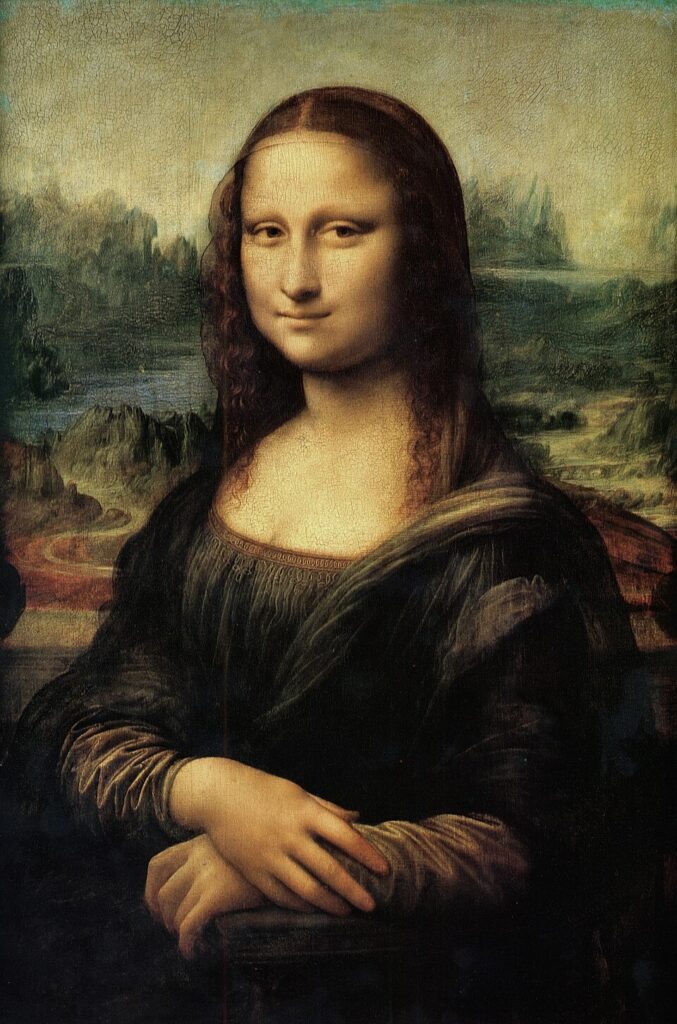
The Mona Lisa is an oil painting on a poplar panel, surprisingly modest in size given its fame: approximately 77 centimeters high by 53 centimeters wide. In fact, many visitors are surprised by its small size when they first see it.
The work depicts a woman, shown from the waist up, seated and turned slightly three-quarters to the left, her face turned toward the viewer. She is dressed simply, in a dark dress, with a light veil over her hair. Her hands are clasped, resting gracefully on the armrest of an armchair. Her fair-skinned face is framed by long hair; her gaze, remarkably intense, seems to fix on the viewer and follow them. And on her lips is that faint, subtle, ambiguous smile that has made her famous.
Behind the figure lies a vast and strange landscape: mountains, rocks, streams, a path, and a bridge, all fading into a bluish, misty distance. This landscape, rendered according to the principles of atmospheric perspective—where distant objects appear bluish and fade into the distance—creates immense depth and lends the entire scene a mysterious, almost unreal atmosphere. The figure of the woman, posed before this panorama, seems to emerge from a dreamlike world.
What is striking about this work is its overall harmony and the extraordinary presence of the figure. The composition, seemingly simple, is in fact perfectly balanced, built according to a stable pyramidal structure. The modeling of the face and hands, with infinite softness, gives the figure a lively, almost unsettling presence. And the famous smile—both gentle and enigmatic—adds the final touch to the work’s mystery. Everything in this small panel comes together to create an image of unparalleled power and subtlety.
Who was Mona Lisa?
The identity of the woman depicted has long been a mystery and continues to fuel speculation and legends. But the most widely accepted theory, confirmed by recent research, now allows us to put a name to this most famous of faces.
According to tradition—first recorded in the 16th century by the biographer Giorgio Vasari and confirmed by the discovery of an old note in 2005—the Mona Lisa depicts Lisa Gherardini, a Florentine woman born in 1479. She was the wife of Francesco del Giocondo, a wealthy silk merchant from Florence. The title of the work derives from this name: “La Gioconda” in Italian—the feminine form of the name Giocondo (which also means “the joyful one”)—which was adapted into French as “La Joconde.” As for the name “Mona Lisa”—or more precisely, “Monna Lisa”—it simply means “Lady Lise,” from “Monna,” a contraction of “Madonna.”
The portrait is believed to have been commissioned by Francesco del Giocondo, likely to mark a family occasion, such as the birth of a child or the purchase of a house—a common practice in Florence at the time, where prominent figures had portraits made of their wives. Leonardo began the work around 1503 in Florence. Remarkably, however, he never delivered the portrait to his patron: he kept it with him, reworking it for years, and even took it with him to France toward the end of his life. The painting thus remained in the hands of its creator until his death.
This well-established identity has not prevented the proliferation of alternative, often fanciful theories: some have interpreted the Mona Lisa as a disguised self-portrait of Leonardo, others as a portrait of a man, and still others have sought hidden messages within it. These speculations, generally dismissed by serious historians, are above all a testament to the fascination the work exerts and the desire to unravel its mystery. The truth is simpler, but no less fascinating: the Mona Lisa is the portrait of a real woman, a Florentine from the early 16th century, whom Leonardo’s genius transformed into an eternal and universal image.
Sfumato — the secret of a smile
The mystery of the Mona Lisa’s smile, which has fascinated people for five centuries, is not an unsolvable riddle: it stems directly from Leonardo’s painting technique, the sfumato. Understanding the sfumato means unraveling the secret of that smile.
Sfumato—from the Italian sfumare, “to fade like smoke”—is the technique Leonardo used to blur contours and blend tones into one another, without sharp lines. To achieve this, he applied countless layers of extremely thin and translucent paint—glazes that, according to modern analyses, numbered in the dozens in the *Mona Lisa*, each thinner than a strand of hair. This painstaking layering, spread out over years, created a model of extraordinary softness, where light and shadow blended imperceptibly. The smooth and stable poplar panel allowed for this meticulous and prolonged work.
It is this sfumato that creates the mystery of the smile. At the corners of the lips and the eyes—precisely the areas of the face that express emotion—Leonardo left a blurriness, a soft shadow, a deliberate lack of precision. The outline of the smile is never clearly defined: it fades into a subtle twilight. As a result, the viewer’s brain cannot pinpoint a single expression. The smile seems to change depending on the angle from which it is viewed, whether one focuses on the eyes or the mouth, and depending on the distance. At times it seems to emerge, at other times to fade away. This instability and ambiguity give the impression of a living face, animated by an elusive expression.
Leonardo’s genius lay in turning this ambiguity into a strength. Whereas traditional portraiture froze an expression, Leonardo, through sfumato, created a face that is fluid and mysterious, whose expression seems to defy definition. The viewer is invited to interpret, to project, to search—without ever being able to fully grasp it. This is what gives the Mona Lisa her unsettling presence, her air of inner life, and her inexhaustible mystery. The Mona Lisa’s smile is not an enigma that Leonardo intended to conceal: it is the result of a revolutionary technique, employed to serve a new way of representing human life and the human soul.
A Revolution in Portraiture
Beyond her smile, the *Mona Lisa* marked a revolution in the art of portraiture. In this work, Leonardo invented a new way of depicting the human figure, one that would have a lasting influence on all of Western painting.
Before Leonardo, Renaissance portraits were often static and conventional: figures shown in profile or full face, with neutral expressions, rigid poses, and plain backgrounds. Leonardo broke with these conventions. He adopted a three-quarter pose—more natural and lively—that lends volume and presence to the figure. He constructed his composition according to a stable and harmonious pyramidal structure, with the crossed hands in the foreground forming the base. He placed the figure against a vast landscape, creating a new sense of depth and atmosphere. Each of these innovations was widely adopted by subsequent painters.
But the most profound revolution was psychological. Leonardo did not merely seek to reproduce his subject’s features: he wanted to convey their inner life, their soul, and their state of mind. “A good painter essentially has two things to depict,” he said, in essence: “the figure and the state of her mind.” ” Through her gaze, her smile, and her posture, Leonardo gave the Mona Lisa a psychological presence, an inner life, and a mystery that make her far more than a mere likeness: a living being whose thoughts we seek to fathom. The welcoming smile and the gaze that follows the viewer create a direct, almost unsettling connection between the artwork and the person looking at it.
This innovation—the portrait as an expression of inner life—had a considerable influence. Beginning in Leonardo’s time, artists drew inspiration from it: the young Raphael, in particular, studied the Mona Lisa and adopted its composition in several of his portraits. Over the centuries, the Mona Lisa became the model for portraiture, the ultimate standard, the work that all painters contemplated. By imbuing the portrait with this psychological depth and vivid presence, Leonardo transformed the genre and opened up paths that art would explore for centuries to come. The Mona Lisa is not merely a beautiful portrait: it is the birth of the modern portrait.
A Painting That Was Never Delivered
The story of the *Mona Lisa*, from its creation in Florence to its arrival at the Louvre, is as unique as the painting itself. It begins with a remarkable fact: Leonardo never delivered the portrait to the person who had commissioned it.
Although commissioned by Francesco del Giocondo, the Mona Lisa was never delivered to him. Leonardo, either dissatisfied with it or too attached to his work, kept it with him, constantly reworking it for years. This behavior, unusual for a commissioned portrait, attests to the special relationship Leonardo had with this work: he regarded it less as a commission to fulfill than as a personal endeavor, a quest for perfection that he did not want to see come to an end. He took it with him on his travels, cherishing it dearly.
When Leonardo left for France in 1516 at the invitation of Francis I, he took the *Mona Lisa* with him—one of his most prized paintings—to the Château du Clos Lucé, near Amboise. It was there that the King of France acquired the work, around 1518, adding it to the royal collections. The Mona Lisa thus became French property. After Leonardo’s death, it remained in the collections of the kings of France, moving from Fontainebleau to Versailles, where it was admired by successive monarchs.
It was the French Revolution that brought the Mona Lisa to the Louvre, when the royal collections became national collections and the palace was transformed into a museum. Since then, the painting has belonged to the French government, for which it is one of the most precious treasures—an inalienable asset that can neither be sold nor purchased. Thus, through a series of circumstances—Leonardo’s attachment to France, his settlement there, and its acquisition by Francis I—the portrait of a Florentine woman painted in the early 16th century has become one of the jewels of France’s cultural heritage and the most famous work in the world’s greatest museum.
The flight that made her famous
While the Mona Lisa is now the most famous work of art in the world, it owes this status in part to a sensational event: its theft in 1911, which turned it into a true global star. This episode, worthy of a novel, deserves to be told.
On August 21, 1911, the Mona Lisa disappeared from the Louvre. It had been stolen. The news came as a bombshell: the fact that the most valuable painting in the world’s most famous museum could have been stolen caused immense astonishment. The press around the world picked up the story, investigators followed leads, and the number of suspects grew—for a time, even the poet Guillaume Apollinaire and the young Picasso were suspected. For two years, the Mona Lisa remained missing, and her absence, paradoxically, increased her fame: crowds came to gaze at the empty space where she had once hung.
The thief was an employee of the Louvre, an Italian craftsman named Vincenzo Peruggia. Driven by misguided patriotism, he believed that the painting had been stolen from Italy by Napoleon, and wanted to return it to his homeland. He had simply taken the painting off the wall, concealed it under his clothes, and walked out of the museum. He kept the Mona Lisa hidden in his Paris apartment for two years before attempting to sell it in Florence in 1913. It was when he approached the director of the Uffizi Gallery that he was exposed. The painting, once recovered, was exhibited in Italy before being solemnly returned to the Louvre.
That theft had an unexpected consequence: it turned the Mona Lisa into a global icon. The incident, which was covered by the press around the world, brought the painting to the attention of people far beyond art circles, etching it into the popular imagination. The Mona Lisa was no longer just a masterpiece admired by connoisseurs: it had become a celebrity, a myth, the object of universal fascination. Over time, other incidents followed this theft—attempts at vandalism, the most recent of which occurred in 2024, when activists splashed soup on its bulletproof glass. Far from diminishing her status, each of these events reinforced her iconic status. The Mona Lisa had become the most famous painting in the world.
The Ultimate Icon
Today, the Mona Lisa has transcended its status as a work of art to become a unique cultural phenomenon—the most reproduced, most parodied, and best-known image in all of history. This extraordinary fame is both its glory and its burden.
The Mona Lisa draws a huge crowd to the Louvre: a significant portion of the museum’s millions of annual visitors come primarily to see her. They crowd into the Salle des États, the Louvre’s largest room, which has been specially fitted out to house it, where the painting is protected by bulletproof glass and a rigorous security system. In front of it, there is a constant crowd, with people holding up their phones and taking thousands of photographs. This phenomenon, unique in the art world, attests to the status of absolute icon that the work has achieved—to the point that the Louvre plans to create a dedicated space for it to better manage this influx.
There is a downside to this fame. By being constantly reproduced, appropriated, and trivialized—on merchandise, in advertisements, and in countless parodies—the Mona Lisa risks being reduced to a mere logo, an image stripped of its meaning. Many visitors, who come to see it out of a sense of tourist obligation, catch a glimpse of it for a few seconds through the crowd, without really looking at it. The icon has at times overshadowed the masterpiece. That is why it is so valuable to return to the work itself, to take the time to contemplate it, to rediscover its subtlety, depth, and mystery—beyond its overwhelming fame.
For the Mona Lisa remains, beyond its iconic status, one of the greatest masterpieces in the history of art. Its sfumato, its smile, its gaze, its presence, and its psychological depth make it an inexhaustible work, whose undiminished power reveals itself to those who know how to truly look at it. Five centuries after its creation, it continues to fascinate, intrigue, and move us. It stands as a striking testament to Leonardo da Vinci’s genius and proof that art, at its highest level, can attain a form of eternity. The Mona Lisa will never cease to smile upon humanity.
How to View the Work Today
The Mona Lisa is housed at the Louvre Museum in Paris, in the Salle des États (Room 711), on the first floor of the Denon Wing. It is the museum’s largest room, specially designed to accommodate the painting and the crowds of its admirers.
Seeing the Mona Lisa requires a bit of patience and strategy. The painting attracts a constant, dense crowd; to get a better view, it’s best to arrive as soon as the museum opens, or take advantage of the late-night hours on Wednesday and Friday evenings. Signs point the way to the Salle des États right from the entrance. Once there, you’ll have to elbow your way through the crowd to get close, but the thrill of standing in front of the original—so small and yet so famous—is well worth it. Photography is allowed, provided you don’t use a flash or a selfie stick.
To prepare for and enhance your visit, you can consult our comprehensive guide to the Louvre Museum, which covers the history of the palace, its masterpieces, and all the practical information you need. And to continue exploring Leonardo’s work, the Louvre houses other masterpieces by him — *The Virgin of the Rocks*, *Saint Anne*, *Saint John the Baptist*, and *La Belle Ferronnière* — which are often less crowded than the *Mona Lisa* and are just as worthy of your attention.
Further Reading
Institutional sources cited
- Louvre Museum, entry for *The Mona Lisa * (Portrait of Lisa Gherardini).
- Giorgio Vasari, *The Lives of the Most Excellent Painters* (1550).
- Cécile Scailliérez, Leonardo da Vinci: The Mona Lisa, Louvre Éditions.
Sources and Reference Studies
- Daniel Arasse, Leonardo da Vinci: The Rhythm of the World, 1997.
- Vincent Delieuvin and Louis Frank (eds.), exhibition catalog *Leonardo da Vinci* (Louvre, 2019).
Institutional Documentation
- Louvre Museum, Paris — the institution that houses the work.
- Louvre Collections — detailed description of the work.
See also on Hors Cadre
- Leonardo da Vinci—the Universal Genius —a portrait of the artist, his life, and his art.
- The Last Supper—Milan’s masterpiece —Leonardo’s other great masterpiece, the mural at Santa Maria delle Grazie.
- The Louvre Museum—the world’s largest museum —the palace that houses the Mona Lisa and the most extensive collection of Leonardo’s paintings.
— M