The Lady with the Ermine — The Milan Portrait
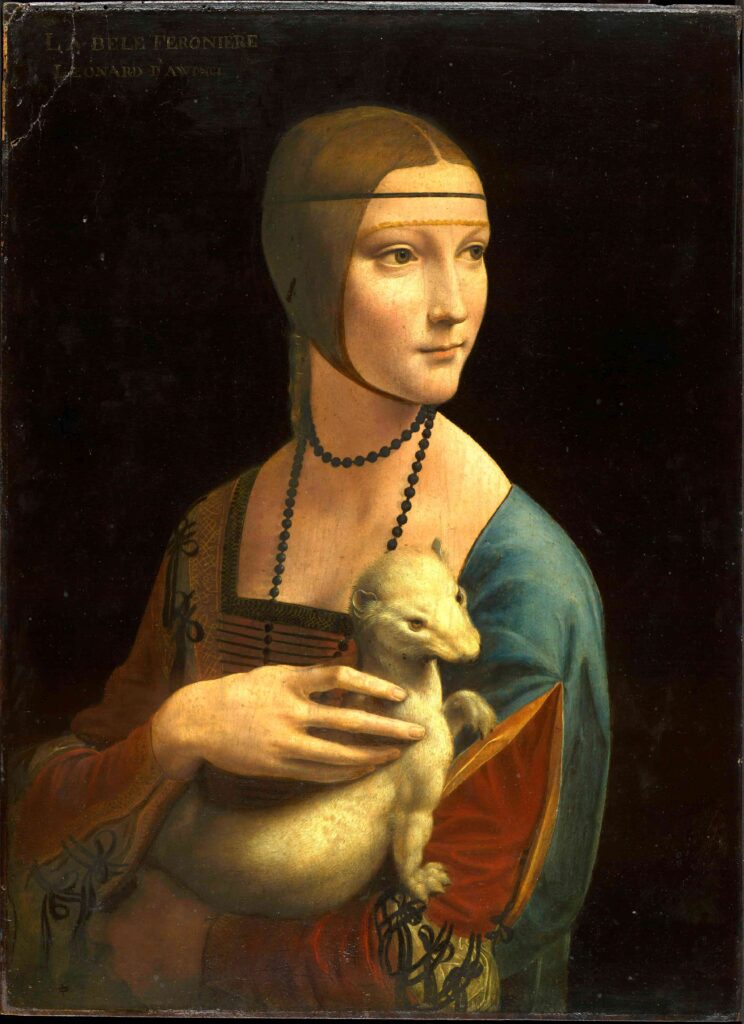
Leonardo da Vinci — the universal genius →A young woman turns, as if startled by a presence to her left. She holds close to her a small white animal with silky fur—an ermine—which she strokes with a long, delicate hand. Her face, radiant with grace, expresses intelligence and liveliness; her body is captured in a lively twisting motion. This is Leonardo da Vinci’s *Lady with an Ermine* —one of the most beautiful portraits of the Renaissance, and one of the most modern ever painted.
Painted around 1489–1490, during Leonardo’s Milanese period, this work depicts Cecilia Gallerani, the young mistress of Ludovico Sforza, Duke of Milan. It is a court portrait, commissioned by the powerful ruler to immortalize the woman he loved. But under Leonardo’s brush, this commissioned portrait becomes a masterpiece of astonishing modernity, breaking with all the conventions of the genre and foreshadowing the innovations that Leonardo would bring to their pinnacle in the *Mona Lisa*.
What is striking about this work is the life that animates it. Whereas Renaissance portraits froze their subjects in rigid poses and solemn expressions, Leonardo captures Cecilia in motion, in a twist of the body, in a single moment. The young woman seems alive, present, reacting to something outside the frame. This capture of movement and life, this psychological presence, make *The Lady with the Ermine* a revolutionary work—one of the first to imbue portraiture with such vitality and depth.
This article explores the secrets of this masterpiece—what it represents, the identity of Cecilia Gallerani, the mystery and symbolism of the ermine, the revolutionary shift in style it brought to portraiture, and the remarkable fate of a work that has become a treasure of a museum in Kraków.
The Painting — What It Depicts
*The Lady with an Ermine* is an oil painting on a walnut panel of modest dimensions: approximately 54 centimeters high by 39 centimeters wide. This intimate format is well-suited to the genre of court portraiture, intended for close inspection.
The work depicts a young woman, shown from the waist up, against a dark background. She is turned in a three-quarter profile, her body facing one direction and her head another, her gaze directed toward a point outside the frame, to her left, as if her attention had been drawn to someone or something. Her face, which is exceptionally refined, with a high forehead and delicate features, conveys intelligence, liveliness, and a kind of attentive presence. Her hair is neatly styled, held back by a thin headband and a sheer veil, which frames her face.
In her arms, the young woman holds a small animal with white fur: an ermine. This elegantly shaped animal, with its elongated body, is depicted with remarkable precision and vitality. It, too, appears alert, facing the same direction as its mistress, as if sharing her attention. The young woman’s hand, with its long, slender fingers, caresses and holds the animal with the utmost delicacy. This hand, beautifully painted, is one of the highlights of the work, a testament to Leonardo’s mastery.
What strikes the viewer in this composition is the life and movement that animate it. The twist of the body, the gaze directed into the distance, and the alert posture of both the woman and the animal create the impression of a moment captured on the spot, of a living presence. The light, coming from the left, gently contours the face and body, making the figure stand out against the dark background. The whole exudes an elegance, a grace, and an intelligence that make this portrait much more than a likeness: it is a vivid evocation of a person, of her character, and of her soul.
Cecilia Gallerani, the Lady of Milan
The subject of this portrait is a real person whose story sheds light on the work: Cecilia Gallerani, a young woman at the court of Milan who was beloved by Duke Ludovico Sforza. Knowing her story means understanding the context and meaning of this court portrait.
Cecilia Gallerani was a young woman of the late 15th century, born into a cultured Milanese family. Beautiful, intelligent, and well-versed in literature and poetry, she became, at a very young age, the mistress of Ludovico Sforza—known as Ludovico il Moro—the powerful Duke of Milan who was then Leonardo’s patron. Cecilia held an important place in the duke’s heart and in the life of the Milanese court, until Ludovico’s marriage to Beatrice d’Este changed her situation. She nevertheless remained a respected figure, surrounded by artists and scholars.
It was Duke Ludovico Sforza who commissioned Leonardo to paint a portrait of his young mistress. This commission followed the tradition of court portraits, through which the powerful had the people in their inner circle—and especially the women they loved—immortalized. For Leonardo, who was then in the duke’s service as a painter and engineer, this was an opportunity to showcase his portraiture skills. Indeed, it is generally believed that it was perhaps *The Lady with an Ermine* that established his reputation as a portraitist at the court of Milan, earning him further commissions.
Cecilia’s portrait reflects Leonardo’s perspective on his subject. He does not merely depict a beautiful young woman; he captures her intelligence, her liveliness, and her presence. Cecilia’s face exudes wit and refinement; her demeanor, attentiveness and grace. Leonardo captured not only her features but also the personality and character of this cultured and remarkable woman. This is one of the most modern aspects of the work: this concern for conveying the model’s inner life and personality, which makes the portrait much more than an image—a vivid evocation of a unique individual.
The Mystery of the Ermine
The most intriguing element of the work is the animal held by the young woman: the white-furred ermine that gives the painting its title. Far from being a mere detail, it is imbued with multiple meanings that enrich the portrait’s significance.
During the Renaissance, the ermine held several symbolic meanings. First and foremost, it was a symbol of purity and moderation: according to an ancient belief, the ermine would rather die than soil its immaculate fur. By placing this animal in Cecilia’s arms, Leonardo may have been suggesting the young woman’s virtues—her purity, her nobility of spirit, and her self-control. The ermine thus became a moral attribute, a way of extolling the model’s qualities.
But the ermine also had a more specific meaning, linked to the patron. Ludovico Sforza had received a prestigious honor, the Order of the Ermine, and the animal had become one of his emblems. By depicting the ermine, Leonardo was thus making a subtle allusion to the duke, her lover and patron: the animal evoked the invisible yet implied presence of Ludovico Sforza. Through this symbol, Cecilia’s portrait thus contained a reference to the man who loved her and had commissioned the painting. The ermine symbolically united the young woman and the duke.
A third, more subtle level of meaning has been proposed. In ancient Greek, the word for “ermine” or “weasel” was similar to the name “Gallerani.” The animal could therefore constitute a clever play on words, a hidden allusion to the model’s very name—a visual “rebus,” of the sort that the Renaissance appreciated. This hypothesis, unverifiable but appealing, further adds to the symbolic richness of the work. The ermine would thus be, at once, a symbol of purity, an emblem of the duke, and an allusion to Cecilia’s name. This layering of meanings attests to Leonardo’s intellectual refinement and the culture of the Milanese court. Far from being a mere pet, the ermine is a sign laden with meaning, a key to interpreting the portrait.
The Movement Revolution
What makes *The Lady with the Ermine* a revolutionary work—beyond its beauty—is the way Leonardo infuses it with movement and life, breaking with the tradition of the static portrait and foreshadowing the innovations of all art to come.
Until then, Renaissance portraiture generally depicted its subjects in static poses: in profile or full face, with a serious, motionless expression, and their hands demurely resting on their chests or absent altogether. Leonardo broke radically with this tradition. He captured Cecilia in motion: her body turned in one direction, her head in another, her gaze directed toward a point outside the frame. This twist—this dissociation between the orientations of the body, the head, and the gaze—creates an impression of movement, of life, of a moment captured in the heat of the action. The young woman seems to be reacting to a presence, turning around, coming to life.
This movement transforms the portrait. The model is no longer a static figure, posing for eternity, but a living being, captured in a moment of her existence, reacting to her surroundings. Her gaze directed outside the frame suggests a world beyond the painting, a scene of which the young woman is a part. Her alert demeanor, shared with the ermine, creates tension, life, and a fleeting moment. Leonardo endows his model with an unprecedented psychological and physical presence: Cecilia is there, alive, attentive, and fully present. This is one of the first times a portrait has achieved such vitality and authenticity.
This revolution in movement foreshadowed the artistic explorations that Leonardo would pursue throughout his life, and which he would bring to their pinnacle in *Mona Lisa*. In *The Lady with an Ermine*, we find the principles that would define the modernity of Leonardo’s portraiture: the three-quarter pose, the twist of the body, the expression of inner life, and psychological presence. *The Lady of Milan* is like an early formulation of what *Mona Lisa* would later achieve. It attests to the precocious genius of Leonardo and his ability, even during his Milanese period, to revolutionize the art of portraiture. With this work, Leonardo blazed a new trail that all of Western painting would follow.
The Fate of a Masterpiece
The story of *The Lady with the Ermine*, from the court of Milan to a museum in Kraków, is that of a traveling masterpiece—one that has faced numerous threats—and has now become one of Poland’s artistic treasures. This journey is worth recounting.
After being painted in Milan, the work’s fate remained obscure for a long time. All trace of it was lost for centuries before it reappeared. At the end of the 18th century, it was acquired by a Polish prince from the Czartoryski family—a prominent aristocratic family of art collectors—who added it to his collection. And so this Italian masterpiece became one of the jewels of a Polish collection and one of Poland’s most precious works of art. The Lady of Milan had found a new home.
The painting’s fate was a turbulent one, mirroring the tragedies of Polish history. During the various periods of turmoil, partition, and war that afflicted Poland, the painting had to be hidden, moved, and protected. During World War II, it was coveted by Nazi officials and endured dramatic twists and turns before finally being recovered and returned to Poland after the war. Like so many masterpieces, *The Lady with the Ermine* weathered the storms of history, narrowly escaping dispersal or destruction.
Today, the work is housed at the National Museum in Kraków, where it is on display as one of the greatest treasures in Polish collections—one of the few works by Leonardo da Vinci that can be seen outside of France and Italy. Acquired by the Polish government along with the entire Czartoryski collection, it is now part of the nation’s cultural heritage. It attracts art lovers from around the world to Kraków, who come to admire this masterpiece of the Italian Renaissance—a portrait of a young woman from Milan painted more than five centuries ago by the greatest of geniuses. In Kraków, *The Lady with an Ermine* remains a striking testament to Leonardo’s artistry.
How to View the Work Today
*The Lady with an Ermine* is housed at the National Museum in Kraków, Poland, where it is the centerpiece of the Czartoryski Collection. It is one of the country’s greatest artistic treasures and one of Leonardo’s most accessible works in Europe, outside of Italy and France.
Seeing the work in person allows one to appreciate its full subtlety: the delicacy of the face and hands, the softness of the modeling, the rendering of the ermine’s fur, and the vitality that animates the composition. It is a work of an intimate scale, meant to be viewed up close, and one that rewards careful observation of its admirable details. Its beauty and modernity, five centuries after its creation, continue to captivate visitors.
To explore Leonardo da Vinci’s work more fully, one must visit the Louvre in Paris, which houses the most extensive collection of his paintings—including the *Mona Lisa*, the culmination of his portrait experiments foreshadowed by *The Lady with an Ermine *—or travel to Milan to admire *The Last Supper*. Together, these works trace the journey of the most universal of the Renaissance geniuses. *The Lady with an Ermine*, a masterpiece from his Milanese period, is one of the most precious and endearing milestones in that journey.
Further Reading
Institutional sources cited
- National Museum in Kraków, description of *The Lady with the Ermine*.
- Documentation on the Czartoryski Collection.
- Giorgio Vasari, *The Lives of the Most Excellent Painters* (1550).
Sources and Reference Studies
- Daniel Arasse, Leonardo da Vinci: The Rhythm of the World, 1997.
- Walter Isaacson, *Leonardo da Vinci*, 2017.
Institutional Documentation
- National Museum in Kraków — the institution that houses the work.
- Louvre Museum, Paris — the most extensive collection of Leonardo’s paintings.
See also on Hors Cadre
- Leonardo da Vinci—the Universal Genius —a portrait of the artist, his life, and his art.
- The Mona Lisa—the world’s most famous smile —the culmination of the portrait studies foreshadowed by *The Lady with the Ermine*.
- The Last Supper—Milan’s masterpiece —is the other great masterpiece from Leonardo’s Milanese period.
— M