Monet at the Orangerie — One Hundred Years Later: The Painter of the Passing of Time
The year 2026 marks the 100th anniversary of the death of Claude Monet, who passed away in December 1926. To celebrate this anniversary, the Musée de l’Orangerie—home to the magnificent Water Lilies series—is dedicating a major exhibition to the master…
📍 Orangerie Museum 🗓 Du 30 septembre 2026 au 25 janvier 2027
| Dates | Du 30 septembre 2026 au 25 janvier 2027 |
| Location | Orangerie Museum |
| Opening hours | 9 a.m. – 6 p.m., late night hours on Fridays until 9 p.m., and closed on Tuesdays |
| Full price | 12.5 euros |
| Reduced price | 10 euros |
| Metro | Concorde (lignes 1, 8, 12) |
The year 2026 marks the 100th anniversary of the death of Claude Monet, who passed away in December 1926. To celebrate this anniversary, the Musée de l’Orangerie—home to the magnificent Water Lilies series—is dedicating a major exhibition to the master of Impressionism: Monet, Painting Time. From September 30, 2026, to January 25, 2027, nearly forty paintings explore the unique, haunting relationship between Monet’s work and time.
This is the heart of the matter, and the unique perspective of this exhibition. Monet’s entire career can be seen as a struggle with time. The young Impressionist sought to capture the instant, the fleeting impression of a moment—the light of a single second that would never return. The mature painter, in his major series of the 1890s, breaks down time, painting the same subject at different hours and in different seasons, as if to dissect its passage. And finally, the old master, in the Water Lilies cycle, sought to dissolve time itself, to create a space for contemplation outside of duration—a continuum without beginning or end.
The exhibition brings together a selection of nearly forty paintings, drawn primarily from the collections of the Musée d’Orsay and the Musée Marmottan Monet, supplemented by public and private loans from France and abroad. It is only natural that it should be held at the Orangerie, the only place in the world to house, in its two oval rooms, the large-scale “Water Lilies” murals that Monet donated to France—what the painter André Masson called the “Sistine Chapel of Impressionism.”
This article explores the theme of this anniversary exhibition, the Orangerie’s unique place in Monet’s history, the exhibition layout and key works, the evolution of his series and the *Water Lilies*, and all the practical information you need to plan a visit through January 25, 2027.
The Reason Behind the Exhibition — One Hundred Years After Monet
The year 2026 marks the centennial of the death of Claude Monet, who was born in 1840 and died in Giverny in December 1926 at the age of eighty-six. A century after his death, the master of Impressionism remains one of the world’s most beloved artists, and his work is among the most widely viewed. This anniversary provided an opportunity to pay him a major tribute, and several institutions in Paris and Normandy joined forces to make 2026 a true “Year of Monet.”
The Musée de l’Orangerie holds a special place in this celebration. For it is here, in this building in the Tuileries Garden, that Monet’s final masterpiece is housed: the large-scale “Water Lilies” murals, eight immense panels displayed in two oval rooms, which the painter designed specifically for this location and donated to the French government. Celebrating Monet’s centennial at the Orangerie, therefore, means doing so in the very place where his artistic legacy—his final and most ambitious work—rests.
Rather than a traditional retrospective, the exhibition has chosen a specific and original angle: Monet’s relationship with time. This central theme allows us to reinterpret the painter’s entire body of work—from his Impressionist beginnings to his final paintings—in a new light, by showing how the concepts of time, the moment, and duration permeate and unify his artistic approach. This distanced perspective, informed by various fields of research, thus offers a fresh examination of a body of work whose significance, a century later, remains fundamental.
Who is Claude Monet?
Claude Monet is the leading figure and icon of Impressionism, the movement that revolutionized painting in the late 19th century. In fact, the movement owes its name to one of his paintings, *Impression, Sunrise* (1872). Painting outdoors, capturing light and its variations, and rendering the fleeting impression of a moment with quick brushstrokes and light colors: Monet embodies these founding principles more than anyone else.
Born in Paris in 1840 and raised in Le Havre, Normandy, Monet devoted his entire long life to painting—the banks of the Seine, train stations, the cliffs of Normandy, fields, gardens, and above all, water, which was his favorite subject. Over the decades, without ever renouncing Impressionism, he pushed its logic ever further, to the point of creating works of astonishing boldness and modernity that foreshadowed 20th-century abstract painting.
His final years in Giverny, where he had created an extraordinary water garden, were devoted almost entirely to a single subject: the water lilies in his pond. From this obsession emerged the large murals at the Orangerie, the culmination of a lifetime of painting. To learn more about this master’s career and art, we invite you to read our profile of Claude Monet, which traces his life and work. [Internal link: /claude-monet/]
“Water Lilies,” Monet’s Legacy
To understand why this exhibition is being held at the Orangerie, one must know the history of the *Water Lilies*—that monumental series that was Monet’s obsession and his legacy, and for which the Orangerie serves as a unique setting.
Beginning in the 1890s, and especially during the last two decades of his life, Monet devoted himself almost exclusively to a single subject: water lilies, the flowers that floated on the pond in his garden at Giverny. He painted more than two hundred and fifty canvases of them, endlessly exploring the reflections, the light, the water, and the sky mirrored in it. This immersion in a single subject, this prolonged contemplation of the water’s surface, led him toward an ever-freer style of painting, in which forms dissolve into color and reflection.
The crowning achievement of this cycle was the large-scale decorative project. In the aftermath of the 1918 armistice, Monet presented France with a series of large-scale *Water Lilies* panels as a monument to peace. His friend Georges Clemenceau, the statesman who had led France to victory, played a decisive role in this donation and in its installation. Two oval rooms were specially fitted out at the Orangerie to house these panels, in accordance with the painter’s precise wishes, which were to offer visitors a total envelopment—an immersion in water and light. Monet worked on these murals until his death in 1926; they were unveiled the following year, in 1927.
These large-scale murals in the Orangerie are Monet’s final masterpiece, his artistic legacy. In 1952, the painter André Masson described them as the “Sistine Chapel of Impressionism”—placing them among art’s greatest achievements. Immersive, enveloping, and timeless, this unique collection offers an unparalleled contemplative experience. The exhibition *Monet: Painting Time* centers its entire concept around it, creating a dialogue between the selection of paintings and this permanent masterpiece.
The Exhibition Itinerary
The exhibition brings together nearly forty paintings by Monet, selected to shed light on his relationship with time through the major stages of his career. These works come primarily from the collections of the Musée d’Orsay and the Musée Marmottan Monet—the two most extensive collections of Monet’s work in France—and are supplemented by loans from public and private collections in France and abroad.
The exhibition traces the passage of time in both senses of the word: the span of Monet’s career, and time as the subject of his painting. It begins by showcasing the young Impressionist’s dedication to capturing the instant—the fleeting impression of a moment of light. It then explores the major series of the 1890s—*The Haystacks*, *The Poplars*, *Rouen Cathedral*, *Mornings on the Seine*—in which Monet painted the same subject at different times of day and in different seasons, as if to break down and dissect the passage of time. It culminates, finally, in the *Water Lilies* cycle, where time dissolves into an endless continuum.
The tour concludes with a virtual reality experience titled *Monet — Along the Water*. Lasting about 20 minutes, this immersive experience offers a unique journey into the heart of the painter’s world, using technology to extend the contemplation of his works. It provides a new and evocative way to enter Monet’s world, particularly suited to a broad audience, including families.
The exhibition as a whole offers a journey on a human scale—nearly forty works, making for a rich but not overwhelming visit—organized around a powerful and illuminating theme. Far from being an exhaustive retrospective, the exhibition focuses on perspective and depth, inviting visitors to see Monet in a new light, through the prism of time.
The Series — A Dissection of Time
The heart of the exhibition—and undoubtedly its most fascinating insight—lies in the major series that Monet painted in the 1890s. It is these works that best reveal his obsessive relationship with time and that shifted his art toward a radical modernity.
The concept behind the series is simple yet breathtaking: to paint the same subject tirelessly—a haystack, a row of poplars, the facade of Rouen Cathedral—but at different times of day, under different lighting conditions, and in different seasons. Monet would set up several canvases side by side and move from one to the next as the light changed, seeking to capture each fleeting moment. *The Haystacks* (1888–1891), *Poplars on the Banks of the Epte* (1891–1892), *Rouen Cathedral* (1892–1898), and *Mornings on the Seine* (1896–1897) are the major achievements of this approach.
In doing so, Monet was achieving something new. The subject, in reality, was no longer the haystack or the cathedral: it was the light, the moment, time itself. By creating multiple views of the same subject, Monet revealed not merely an object, but the passage of time upon that object—the continuous transformation of the world through light. It was, as the exhibition puts it, a form of “dissection of time.” When Rouen Cathedral was exhibited in 1895, Clemenceau saw it as a revolution—the revelation of an entirely new way of painting and seeing.
These series also reflect the era’s fascination with the meticulous, almost scientific observation of the world. But in Monet’s work, this analysis of time and light never results in coldness: it produces paintings of overwhelming sensuality and beauty. These series serve as the laboratory where the late Monet was born—the artist who, by pushing the logic of the moment to the point of fragmentation, would pave the way for the *Water Lilies* and the ultimate dissolution of forms into color. They are the linchpin of his entire body of work—and the beating heart of this exhibition.
Monet and Time — From the Moment to the Continuum
The central theme of the exhibition—Monet’s relationship with time—traces a path of striking coherence that lends unity to the painter’s entire body of work. To understand this path is to grasp the essence of his genius.
In the beginning, there is the moment. The young Monet, an Impressionist, sought to capture the fleeting impression of a moment: the light of the rising sun over the port of Le Havre, the glistening of the water at a precise instant, the atmosphere of a second that will never be repeated. It is this fleeting moment, the brilliance of the ephemeral, that Impressionism seeks to capture on canvas. Painting quickly, en plein air, to seize the moment before it slips away.
Then came the series, and with it a more complex conception of time. Monet understood that a single moment is not enough to capture the truth of a subject, since it is constantly changing. He therefore painted the same subject over time, through its successive transformations, breaking down the passage of time into a sequence of states. Time is no longer an isolated moment, but the continuous flow of variations, the perpetual metamorphosis of the world in the light. It is a dissection, an analysis of the passage of time.
Finally, in the *Water Lilies*, Monet moves beyond analysis to reach a form of timeless contemplation. Facing the water’s surface, with no horizon or points of reference, the viewer loses all sense of ordinary time; they enter a continuum, a perpetual present, an immersion that abolishes measured time. This experience has been likened to the concept of “duration” as conceived by the philosopher Bergson, a contemporary of Monet—a lived, fluid, continuous time, as opposed to the fragmented time of clocks. From the Impressionist moment to the continuum of the *Water Lilies*, Monet thus explored every dimension of time. It is this journey that the exhibition invites visitors to witness and reflect upon.
The Musée de l’Orangerie — the setting for the *Water Lilies*
The exhibition offers an opportunity to rediscover the Musée de l’Orangerie itself—a place unlike any other in the world, designed entirely around Monet’s *Water Lilies*. Located in the Tuileries Garden, on the edge of Place de la Concorde, this intimate museum is one of the most charming in Paris.
The Orangerie building, constructed in the 19th century to house the orange trees of the Tuileries, was renovated in the 1920s to display Monet’s large-scale works. The two oval rooms, designed according to the painter’s wishes, offer an immersive viewing experience: the eight panels of the Water Lilies series envelop visitors in a continuous panorama of water, reflections, light, and flowers, bathed in natural overhead light. It is one of the most serene and sublime spaces in all of Paris.
In addition to the *Water Lilies*, the museum houses a remarkable collection of modern paintings—the Jean Walter and Paul Guillaume Collection—featuring works by Renoir, Cézanne, Matisse, Picasso, Modigliani, Soutine, and many others. A visit to the Orangerie thus offers the chance to admire Monet’s ultimate masterpiece, surrounded by a beautiful collection of early 20th-century art. For the duration of the exhibition, this already exceptional venue becomes the center of the celebrations marking Monet’s centennial.
Practical Information
- Location: Musée de l’Orangerie, Tuileries Garden (on the Seine side), Place de la Concorde, 75001 Paris.
- Dates: September 30, 2026, through January 25, 2027.
- Directions: Metro lines 1, 8, and 12, Concorde station; buses 42, 45, 52, 72, 73, 84, and 94; Vélib’ stations at Cambon-Rivoli, Assemblée Nationale, and Quai Anatole France.
- Hours: Daily from 9 a.m. to 6 p.m. (ticket offices close 45 minutes earlier); extended hours on Fridays until 9 p.m.; closed on Tuesdays, as well as January 1, May 1, July 14, and December 25.
- Prices: Full price 12.50 euros; reduced price 10 euros; free for those under 18 and EU residents under 26.
- Recommended duration: 1 hour 30 minutes to 2 hours (exhibition, Water Lilies galleries, and virtual reality experience).
- Reservations: We strongly recommend booking online and selecting a time slot on the Musée de l’Orangerie website.
- Accessibility: The museum is accessible to people with limited mobility.
- Good to know: The Marmottan Monet Museum is also currently presenting *Histoires de paysages, de Monet à Hockney*—the perfect Parisian weekend to celebrate Monet’s centennial.
Further Reading
Institutional Documentation
See also on Hors Cadre
- Claude Monet — the master of Impressionism
- Gustave Caillebotte — the painter of modern Paris
— M
| Dates | Du 30 septembre 2026 au 25 janvier 2027 |
| Location | Orangerie Museum |
| Opening hours | 9 a.m. – 6 p.m., late night hours on Fridays until 9 p.m., and closed on Tuesdays |
| Full price | 12.5 euros |
| Reduced price | 10 euros |
| Metro | Concorde (lignes 1, 8, 12) |
Latest articles
Masterpieces
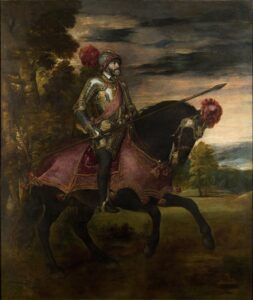
Charles V on Horseback — Titian
Alone in a twilight landscape, clad in his gleaming armour, a long lance in hand, the emperor advances on horseback, sovereign and grave: Titian’s Equestrian Portrait of Charles V at Mühlberg is one of the most famous portraits in the history of art and the birth certificate of the modern equestrian portrait. In a single...
Masterpieces
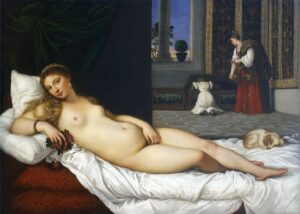
The Venus of Urbino — Titian
A young naked woman, reclining on a bed in a Venetian palace, holds the viewer’s gaze with quiet assurance: Titian’s Venus of Urbino is the most famous nude of the Renaissance and one of the most discussed images in the whole history of art. Through its assumed sensuality, its direct gaze and its composition, it...
Masterpieces
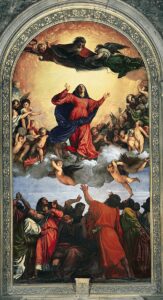
The Assumption of the Virgin — Titian
Above the high altar of one of the largest churches in Venice, an immense altarpiece nearly seven metres high unfolds a celestial vision: the Virgin Mary, borne by a host of angels, rises towards God in a blaze of golden light, while below the apostles, astonished, stretch out their arms towards her. Titian’s Assumption of...

