The Gulf Stream — Winslow Homer’s lone man at sea
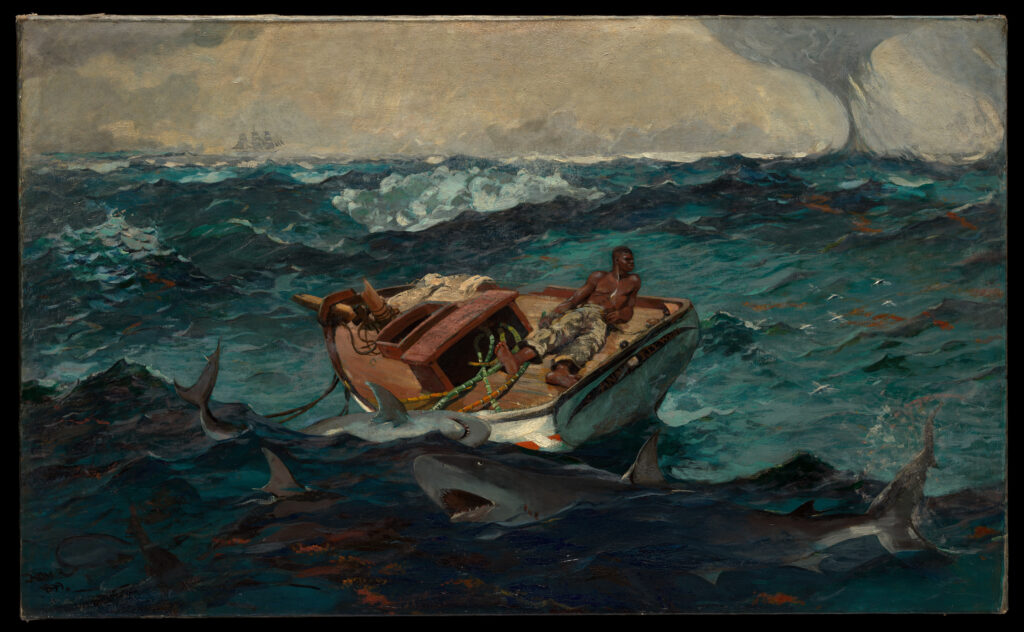
National Gallery of Art, Washington →The boat has lost its mast. All that remains is a broken stump, trailing ropes and a hull heeling in the swell. On deck, a Black man lies half-reclined, propped on one elbow, gazing out to sea. Around him the water is a strange, almost violet color, and sharks circle with open jaws. In the distance a waterspout rises under a stormy sky. On the very edge of the horizon, barely visible, a ship passes.
The Gulf Stream is Winslow Homer’s most famous painting, and probably one of the most famous in all of American art. Painted in 1899 and reworked by the artist in the years that followed, it entered the Metropolitan Museum of Art in New York as early as 1906. It holds a special place there — so much so that it was the centerpiece of the museum’s major 2022 Homer exhibition, Winslow Homer: Crosscurrents.
It is also one of the most debated works of its time and ours. What is this man looking at? Will he be rescued? What does his presence mean, alone, in the current that links the Caribbean to the Atlantic? Homer, as usual, took care not to answer.
From the Caribbean to Maine
The painting grew out of Homer’s fascination with the Caribbean. He had discovered Florida and the Bahamas in 1885 and returned several times, in search of the light and warmth his Maine winters lacked. There he painted dozens of dazzling watercolors: sponge fishermen, divers, fishermen’s huts, turquoise water.
The motif of a sailor adrift first appears in these watercolors. From 1885 Homer was painting sharks and abandoned boats, in sheets such as Shark Fishing and Sharks (The Derelict). The subject ripened for nearly fifteen years — the longest gestation of his career — before becoming a major painting. Homer knew these waters firsthand: he later said he had crossed the Gulf Stream ten times.
In 1898-99 Homer made another stay in Nassau and Florida, from December to February. It was on his return, in his studio at Prouts Neck facing the North Atlantic, that he painted the large canvas. The contrast is striking: a picture of a warm, menacing tropical sea, conceived in a studio battered by Maine’s cold winds.
On the stern of the boat Homer lettered a name and a home port: Anna — Key West. The detail anchors the scene in a precise geography, that of the Straits of Florida, where the Gulf Stream, the great warm current, flows out of the Gulf of Mexico and up into the Atlantic.
A composition of menace
Everything in The Gulf Stream is built to encircle the figure.
The boat sits at the center of the canvas, tilted slightly, as though the swell were about to capsize it. The sailor, in the middle, is the only human figure in the picture. Around him the dangers spread in every direction: the five sharks in the foreground, one of them breaking the surface with open jaws, while flying fish skim the waves; the waves lifting the hull; the waterspout to the right, advancing across the sea; the heavy sky above.
The palette reinforces the feeling. The blue of the sea shades into violet and ultramarine, the wave crests are hard and white, the sky is loaded with gray. The only warm color, almost, is the sailor’s skin and the wood of the boat. On deck you can make out stalks of sugarcane, cargo or debris, recalling the economy of the islands.
The ship on the horizon, upper left, was added later. Homer painted it after the picture’s first showing in 1900, reworking the sea at the same time. This distant vessel, which the sailor does not look at, changes the reading profoundly: it introduces a chance of rescue, but an ambiguous one, since nothing suggests it has seen the boat.
A gaze that resists
The heart of the painting is the man. And it is here that The Gulf Stream defies every expectation.
In a traditional shipwreck painting, the figure cries out, pleads, raises his arms to the sky. Nothing of the kind here. The sailor is still, propped on one elbow, his gaze fixed in the distance, turned away from both the sharks and the ship. His expression is unreadable: resignation, exhaustion, courage, indifference? The historian Daniel Immerwahr has stressed this emotional ambiguity, which is the essence of the painting’s power.
That Homer chose a Black man as the sole figure in his great painting was no small matter in the America of 1899, a third of a century after the abolition of slavery, as segregation laws were hardening across the South. The Metropolitan Museum points out that the Gulf Stream — the current that carried ships from the Caribbean into the Atlantic — links, in the painting, sugarcane, a commodity central to the economy of empire, with the history of the transatlantic slave trade. The museum presents the figure as a stoic survivor, facing nature and history alike.
Other readings have accumulated over time. The philosopher Alain Locke, a leading figure of the Harlem Renaissance, held that Homer had broken with the “cotton-patch and back-porch tradition” and begun, in his words, “the artistic emancipation of the Negro subject in American art.” The Caribbean poet Derek Walcott, winner of the Nobel Prize in Literature, saw in that seaward gaze a gaze turned toward Africa. The painting sustains all these interpretations without imposing any, which is surely why it still sparks debate more than a century after it was made.
From the critics to the Met
First shown in 1900 at the Pennsylvania Academy of the Fine Arts in Philadelphia, the painting did not win everyone over, and it sat unsold for several years at M. Knoedler & Co., Homer’s New York dealer.
The public, for its part, wanted to know what would happen to the sailor. When the gallery asked him for a description to give to curious visitors, Homer replied with a letter of biting irony. “I regret very much that I have painted a picture that requires any description,” he wrote, adding that the gallery could tell “inquisitive schoolmarms” that the man “will be rescued & returned to his friends and home.” The answer, of course, promised nothing: Homer wanted viewers to draw their own conclusions.
The turning point came in December 1906, when the painting was shown at the National Academy of Design in New York. According to the account most often told, the jury, impressed, urged the Metropolitan Museum to acquire it. The museum bought it for $4,500, through the Catharine Lorillard Wolfe Fund.
The arrival of The Gulf Stream at the Met, in the painter’s lifetime, was a consecration. Being bought by the country’s greatest museum while still alive was a rare honor, and from then on the painting took its place among the nation’s icons.
Where to see the painting
The Gulf Stream hangs at the Metropolitan Museum of Art in New York, on Fifth Avenue, in the American Wing, Gallery 767, on the second floor.
The canvas measures 28 1/8 by 49 1/8 inches (71.4 × 124.8 cm). Its wide, panoramic format gives the sea its full scope and puts the viewer almost at wave level, as if floating near the boat too.
The Met also owns other major Homer paintings, including Northeaster and Prisoners from the Front, which let you measure the distance traveled between the Civil War and the great seascapes of his maturity.
The image of the painting is available in high definition and open access on the museum’s website, marked “Public Domain.”
Further Reading
Institutional Documentation
- The Gulf Stream — The Metropolitan Museum of Art — the catalogue record and a high-definition image.
- Photo credit : Metropolitan Museum of Art, New York
See also on Hors Cadre
- Winslow Homer — painter of America and the sea — a portrait of the painter, from Boston to Prouts Neck.
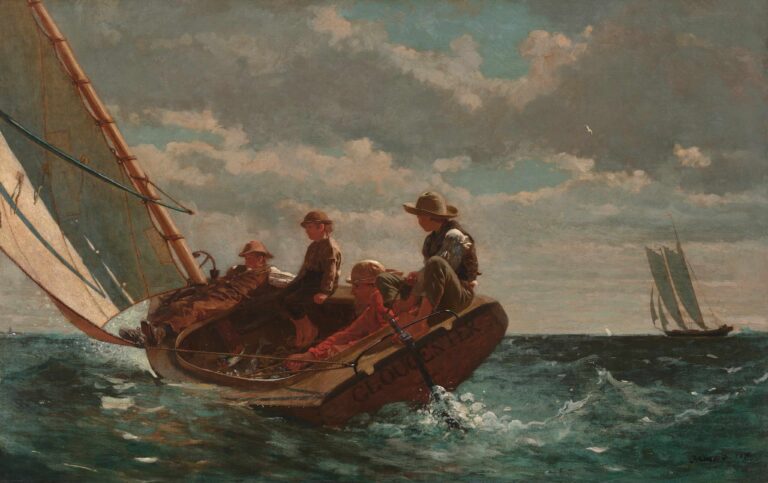
- Breezing Up — America under full sail — twenty-three years earlier, another boat, another ocean: the optimism of the postwar years.
— M