Las Meninas — Velázquez’s masterpiece
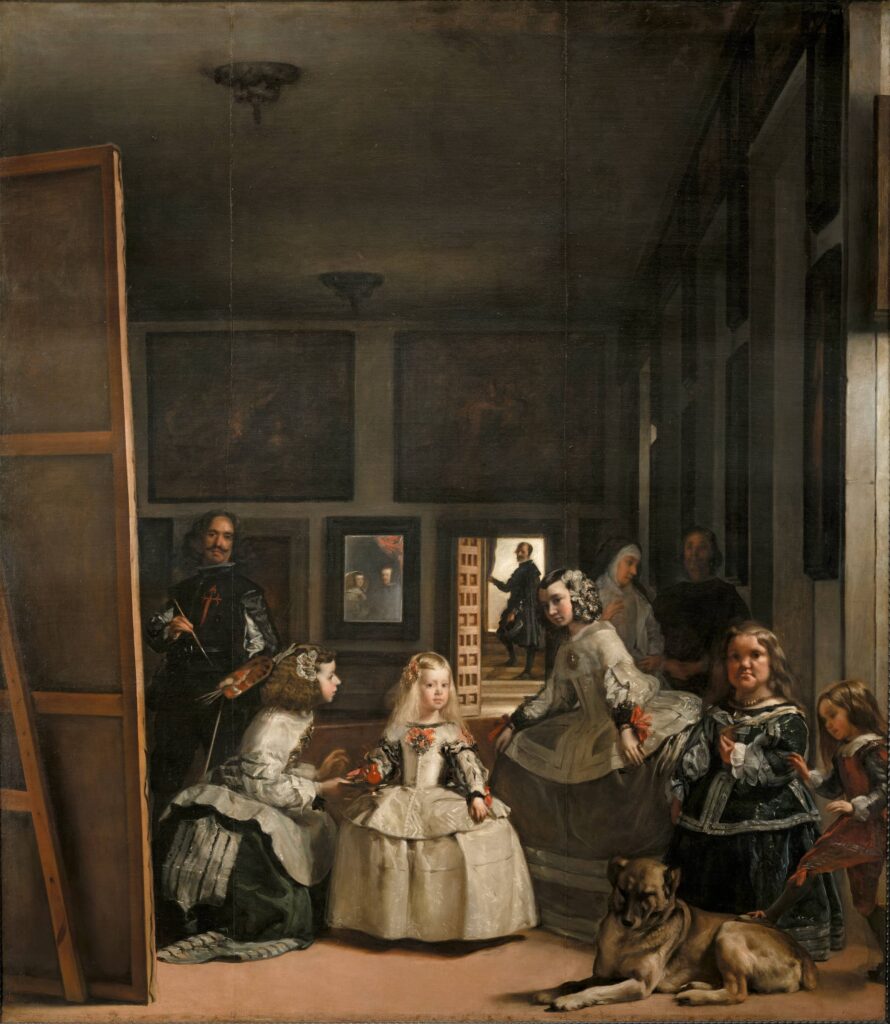
Velázquez — the painter of painters →A fair-haired five-year-old girl in a hooped dress stands at the centre of a large, dim room. A young woman kneels to offer her a small jug on a tray; another curtsies on the other side. On the right, a dwarf with a grave face and a child resting his foot on a large sleeping dog. Behind them, a lady and a guard talk in the half-light. On the left, a man in black, brush raised, stands before a giant canvas of which we see only the back. He is looking at us. And at the far end, in a mirror, two blurred faces: the king and queen of Spain.
Las Meninas, painted by Velázquez in 1656, is probably the most discussed painting in the entire history of art. Writers, philosophers, historians and painters have questioned it for more than three centuries without exhausting its mystery. The Neapolitan painter Luca Giordano, who came to Madrid in the late seventeenth century, already called it “the theology of painting”: the work that holds among pictures the supreme place theology held among the sciences.
The canvas, more than three metres high, hangs in Room 12 of the Prado Museum, where it remains a rallying point for every visitor. Beneath the appearance of an everyday scene at the palace, it builds a dizzying play of gazes between the painter, his sitters and the viewer.
It all begins with a simple question that the painting never answers: who is looking at whom?
A scene at the palace
The scene takes place in the Cuarto del Príncipe, a room in the old Alcázar of Madrid, the royal residence that burned down in 1734. Velázquez had his studio there. So it is his own workplace that the painter depicts, with its tall windows on the right and large pictures hanging on the walls.
At the centre stands the Infanta Margarita, daughter of Philip IV and his second wife, Mariana of Austria. She was five years old in 1656, and Velázquez painted her several times during those years. Around her bustle her two maids of honour, the meninas who eventually gave the painting its name — the word, of Portuguese origin, referred to the young noblewomen attached to the service of the royal children. On the left, María Agustina Sarmiento offers her a drink; on the right, Isabel de Velasco begins a curtsy.
The rest of the little court is just as well identified. In the right foreground, the dwarf Mari Bárbola stares at the viewer, while young Nicolasito Pertusato, another palace dwarf, nudges a dozing mastiff with his foot. Further back, the lady-in-waiting Marcela de Ulloa talks with a guard. In the bright frame of the far doorway, on the steps of a staircase, stands José Nieto Velázquez, the queen’s chamberlain, drawing back a curtain.
We know these names thanks to Antonio Palomino, Velázquez’s biographer in the early eighteenth century. They are a reminder that the painting is no abstract allegory: it is a precise, lively group portrait of the members of a real household at a given moment.
The painter in the picture
On the left, standing behind his immense canvas, Velázquez has portrayed himself. It is one of the very few self-portraits of him to have survived, and his presence changes everything.
The painter does not hide in a corner of the composition, as Renaissance artists sometimes did: he takes a front-rank position, on the same level as the infanta, palette and brush in hand, dressed in black with a courtier’s dignity. For a seventeenth-century artist, whose trade was still often regarded as manual labour, this is a statement. Velázquez asserts the nobility of painting, and his own.
On his chest stands out the red cross of the Order of Santiago. Yet Velázquez was not knighted until 1659, three years after the painting was finished. Tradition holds that the cross was added afterwards, perhaps by the painter himself, perhaps — according to a more romantic legend — on the king’s orders. Either way, it makes Las Meninas the monument to its author’s social consecration.
Then there is the riddle of the large canvas turned away from us. What is Velázquez painting? A portrait of the king and queen, posing where the viewer stands? Las Meninas itself, seen in a mirror? Another work, interrupted by the arrival of the royal couple? The painting does not say, and that silence is one of the sources of its fascination.
The play of gazes and the mirror
What sets Las Meninas apart is the way the painting includes whoever is looking at it.
Several figures — the painter, the infanta, Mari Bárbola, Isabel de Velasco — gaze at a point outside the canvas, exactly where the viewer stands. At the back of the room, the mirror reveals who occupies that spot: King Philip IV and Queen Mariana. The royal couple, who appear only as a reflection, are in fact the invisible centre of the whole composition. And we, the viewers, find ourselves standing where the sovereigns stood.
This device creates a space that spills beyond the frame. The painting does not stop at its surface: it extends forward, into the room where we are, and backward, through the open door where José Nieto seems about to leave or enter. Depth is built by the light, which enters through the windows on the right, falls on the central group, fades into the gloom of the ceiling and then flares up again in the doorway.
On the back wall, above the mirror, two large dark pictures can barely be made out. They are copies by Juan Bautista Martínez del Mazo, Velázquez’s son-in-law, of works by Rubens and Jordaens: Pallas and Arachne, Apollo and Marsyas. Two myths in which a mortal challenges a god in the field of art. The choice is probably no accident: it echoes the ambition of a painter who places himself at the heart of the royal family.
A painting made of brushstrokes
Beyond its composition, Las Meninas is a high point of Velázquez’s late manner, the one that would so fascinate nineteenth-century painters.
Close up, almost nothing is described. The infanta’s dress is made of a few strokes of grey, white and pink laid on the surface; hands, hair and the flowers on her bodice dissolve into patches of colour. The red jug the menina offers her is a mere flash. The faces of the king and queen in the mirror are just two pale ovals. Yet a few steps back, everything reassembles with breathtaking accuracy: silk, velvet, light sliding over hair.
This economy of means is the culmination of the painter’s entire career. It conveys less the form of things than the visual sensation they produce, which explains why the Impressionists recognised Velázquez as a forerunner. Manet, standing before this picture, found confirmation of his own experiments.
The work is also in remarkable condition. It survived the Alcázar fire of 24 December 1734, and the 1984 restoration, led by John Brealey, conservator at the Metropolitan Museum, showed that it had suffered only minor damage. What we see at the Prado is very close to what Philip IV saw.
A painting without end
Few works have so nourished the thinking of later centuries. Las Meninas has become an object of thought as much as a painting.
Even its name has a history. In the 1666 inventory it is described as a portrait of the empress — the infanta, who had by then become empress through marriage — with her ladies and a dwarf; it was later called The Family. Only in 1843, in the Prado catalogue published by Pedro de Madrazo, did it take the title Las Meninas, under which the whole world knows it.
In 1966 the philosopher Michel Foucault opened his book The Order of Things with a long analysis of the painting, which he read as the very representation of classical representation, with, at its centre, the empty place of the subject. That text made Las Meninas an essential reference in philosophy and the humanities.
Painters have not been left behind. Goya made an etching after it; and in 1957 Picasso shut himself away for several months to paint dozens of variations on it, now in the Museu Picasso in Barcelona, in which he takes the picture apart, rebuilds it and transposes it into his own language. As these works are protected by copyright, we do not reproduce them, but they bear witness to the unique place Las Meninas holds in the imagination of artists.
Where to see the artwork
Las Meninas is in the Prado Museum in Madrid, which it entered with the royal collections when the museum was founded in 1819.
The painting hangs in Room 12, at the heart of the galleries devoted to Velázquez, surrounded by the great court portraits and the painter’s other masterpieces. It is one of the busiest rooms in the museum: it is best to come at opening time or late in the day so you can get close.
A tip: look at the painting from a distance, then walk slowly towards it until you see the brushstrokes come apart, before stepping back again. It is in that back-and-forth that you understand Velázquez’s art. Stand facing the mirror at the back, too: you are then occupying, more or less, the place of the king and queen.
The Prado also holds The Spinners, The Surrender of Breda and most of the royal portraits: a visit lets you see Las Meninas in the context of the painter’s whole body of work.
Further Reading
Institutional Documentation
- Las Meninas — catalogue entry, Museo del Prado — record, dimensions and high-definition image.
- Museo del Prado — encyclopaedia — the history of the painting, its titles and its restorations.
See also on Hors Cadre
- Velázquez — the painter of painters — a portrait of the painter, from Seville to the court of Philip IV.
- Pablo Picasso — the artist who devoted dozens of variations to Las Meninas in 1957.
— M