Calder at the Louis Vuitton Foundation — The Art of Balancing Movement
Paris, Fondation Louis Vuitton, Bois de Boulogne, April 15–August 16, 2026. Spanning 3,000 m² of exhibition space—including, for the first time, the lawn of the Jardin d’Acclimatation—the exhibition brings together nearly 300 works byAlexander Calder. Kinetic mobiles, monumental stabiles, wire…
📍 Louis Vuitton Foundation 🗓 Du 15 avril au 16 août 2026
| Dates | Du 15 avril au 16 août 2026 |
| Location | Louis Vuitton Foundation |
| Full price | 18 euros |
| Reduced price | 12 euros |
| Metro | Sablons |
Paris, Fondation Louis Vuitton, Bois de Boulogne, April 15–August 16, 2026. Spanning 3,000 m² of exhibition space—including, for the first time, the lawn of the Jardin d’Acclimatation—the exhibition brings together nearly 300 works byAlexander Calder. Kinetic mobiles, monumental stabiles, wire sculptures, drawings, paintings, and jewelry. This is one of the most comprehensive retrospectives ever dedicated to the American artist who reinvented 20th-century sculpture.
The exhibition is titled Calder: Dreaming in Balance. It celebrates a double anniversary: the 100th anniversary of Calder’s arrival in France in 1926 —when the young 28-year-old American engineer arrived in Paris and settled in Montparnasse, where he would meet Mondrian, Picasso, Miró, Léger, Duchamp, Cocteau, Le Corbusier—and the 50th anniversary of his death in 1976. Exactly a century separates his arrival in Paris from this current Parisian celebration.
Suzanne Pagé, artistic director of the Louis Vuitton Foundation, is curating the exhibition, alongside guest curators Dieter Buchhart and Anna Karina Hofbauer, withOlivier Michelon serving as associate curator. The exhibition is made possible through a partnership with the Calder Foundation in New York—home to the world’s largest collection of the artist’s works—and with the Whitney Museum of American Art, which has agreed to the exceptional loan of the *Calder Circus*, a major work that has been absent from Paris for fifteen years.
This article explores the significance of this monumental retrospective, the exhibition’s layout, the key works, the biographical context of the young Calder in Paris during the 1920s and 1930s, and all the practical information you need to plan a visit through August 16, 2026.
The Reason Behind the Exhibition — A Century Between Paris and New York
The year 1926 marked a complete turning point in Alexander Calder’s life. Born in 1898 in Lawnton, Pennsylvania, the son of sculptor Alexander Stirling Calder and painter Nanette Lederer, and the grandson of monumental sculptor Alexander Milne Calder (creator of the sculptures at Philadelphia City Hall), the young Alexander could have followed in the family’s footsteps.
He chose a different path. He first studied mechanical engineering at the Stevens Institute of Technology, from which he graduated in 1919. For five years, he worked as an engineer at several American industrial companies—a career that taught him how to calculate physical stresses, mechanical equilibria, and the relationships between form and motion. This training would shape his entire body of work.
At the age of twenty-five, in 1923, he returned to art. He enrolled atthe Art Students League of New York. Three years later, in 1926, he took a ship to Paris —a city that was then the undisputed center of global artistic creation. Calder would remain there for the rest of his life, making regular trips back and forth to the United States.
Paris was the setting for his pivotal encounters, his seminal works, and the birth of his formal inventions (the mobile, the stabile, and the wire portrait). It was in Paris that he met Joan Miró (1928), Marcel Duchamp (who coined the term “mobile” for him in 1931), Piet Mondrian (1930, a pivotal encounter discussed later), and Hans Arp (who coined the term “stabile” for him in 1932). It was in Paris that he presented his famous Calder Circus as early as 1927.
The double anniversary in 2026 —the centennial of his arrival and the fiftieth anniversary of his death—was an occasion not to be missed. The Louis Vuitton Foundation, which since its opening in 2014 has dedicated major retrospectives to leading figures in modern and contemporary art (Étienne-Jules Marey, Jean-Michel Basquiat, Charlotte Perriand, Mark Rothko, Andy Warhol, Cézanne, Matisse, Tom Wesselmann), was perfectly qualified to lead this project.
Who is Alexander Calder?
Alexander Calder (1898–1976) is probably the greatest American sculptor of the 20th century andthe inventor of kinetic sculpture.
Before Calder, sculpture was static. It had been that way since antiquity—since the earliest Greek kouroi, since Phidias, since Michelangelo, Bernini, and Rodin. A sculpture was, by definition, a stable form in space. Movement, when suggested, was only virtual —through the pose, the frozen gesture, or the suspended drapery.
Calder changed that. In the 1930s, he invented a new category: the moving sculpture. Not a motor-driven machine, not a fountain, not an automaton—but a sculpture in which movement is an essential part of the work, suspended from a wire or mounted on a pivot, set in motion by air currents, by the movements of viewers, and by changes in temperature.
This invention has a name, given to it by Marcel Duchamp in 1931: the mobile. The term would become part of the international art vocabulary. Later, in 1932, Jean Arp proposed the word stabile — by contrast. Today, these two words, “mobile” and “stabile,” are used in all languages to refer to the two types of abstract sculptures created by Calder.
As the exhibition’s guest curators, Dieter Buchhart and Anna Karina Hofbauer, note in the official press kit:
“Calder’s innovative approach expanded the dimensions of sculpture to include time as an essential fourth dimension.”
— Dieter Buchhart and Anna Karina Hofbauer, guest curators of the exhibition, 2026
The statement captures the essence. Time, the fourth dimension. Before Calder, sculpture occupied space in three dimensions (height, width, depth). Calder added time —that is, the duration of movement, the continuous passage of forms past one another, the random choreography of suspended elements. A kinetic sculpture by Calder is not viewed as one views a static statue: it is viewed over time, waiting for it to move, observing its slow rotations, its subtle oscillations, and its pauses.
1930 — Calder walked into Mondrian’s studio
This pivotal moment in Calder’s artistic career is documented in all reputable sources. It took place in October 1930.
At that time, Calder was 32 years old. He was living between New York and Paris. He was known—in the small circle of the Parisian avant-garde—for his Calder Circus, a small miniature theater featuring wire-frame figures that he manipulated himself during private performances in his studio on Rue Daguerre (14th arrondissement). The Cirque’s performances attracted Fernand Léger, Le Corbusier, Jean Arp, Joan Miró, Piet Mondrian, Jean Cocteau, and the entire artistic elite of Montparnasse.
In October 1930, Piet Mondrian invited Calder to his studio at 26 rue du Départ in Paris (near the Montparnasse train station). Calder pushed open the door. He discovered a white space, organized according to the principles of Neo-Plasticism that Mondrian had theorized: white walls, a white floor, and rectangles of primary colors (red, blue, yellow) affixed to specific spots on the walls. The studio itself was a living example of Neo-Plasticism.
In his own words—as recounted in his memoirs published in 1966 (*Calder, an Autobiography with Pictures*)—Calder was deeply moved. He immediately said something to Mondrian along the lines of: “But these rectangles—couldn’t we make them move?” Mondrian, committed to the absolute stability of his compositions, politely refused.
Calder returned to his studio on Rue Daguerre. A few weeks later, he abandoned figurative art —the wire portraits, the circus figurines—to devote himself entirely to abstraction. He began creating abstract structures out of metal and wood, at first static, but soon mobile. The first mechanical mobile appeared in 1931. The first air-current mobile—the suspended mobile— came in 1932.
This visit to Mondrian’s studio was, in fact, the catalyst for the invention of abstract kinetic sculpture —one of the major formal revolutions of the 20th century. The Louis Vuitton Foundation gives this moment a central place in its exhibition.
The Exhibition Layout — 3,000 m², 300 works, half a century
The exhibition occupies the entire space of the Louis Vuitton Foundation—the eleven galleries of Frank Gehry’s glass-veiled architecture, spread across three levels. A total of 3,000 m ². For the first time, a lawn outside the building has been set aside to display monumental sculptures.
The exhibition follows a chronological order and features nearly 300 works organized into several major sections:
Section 1 — The American Years (1920–1926): early wire portraits, sketches, and early paintings. We discover a figurative, expressive Calder, shaped by his family’s sculptural tradition.
Section 2 — Arrival in Paris and the Calder Circus (1926–1930): wire portraits of Parisian personalities (notably Joséphine Baker in wire, Aztec version, 1930), circus figurines, and early encounters with the avant-garde.
Section 3 — The Invention of the Mobile and the Stable (1930–1940): The Major Break After the Visit to Mondrian. The First Mechanical Mobiles, the First Air-Current Mobiles, and the First Abstract Stables.
Section 4 — Constellations and Works of War (1940–1945): the Constellations — sculptures made of carved wood and wire, more static but retaining the formal language of the mobiles.
Section 5 — Maturity (1945–1965): development of large-scale mobile sculptures, first monumental commissions (United States, Europe), paintings, and works on paper.
Section 6 — Monumental Sculptures (1965–1976): the large-scale public sculptures that brought Calder international fame in the 1960s and 1970s. These works redefined the concept of public sculpture in the 20th century.
Outdoor Space — The Lawn: For the first time in the history of the Louis Vuitton Foundation, the lawn of the Jardin d’Acclimatation is hosting monumental outdoor installations. The dialogue between Gehry’s architecture and Calder’s sculptures thus extends to the natural environment.
The recommended duration for a full tour is 2 to 2.5 hours. Allow more time if you’d like to attend the screenings at the Cirque Calder (archival films) or the themed tours organized by the Foundation.
The Signature Work — Cirque Calder, a Special Return to Paris
The work that alone makes the visit worthwhile is the Calder’s Circus (1926–1931). A legendary work, one of the best known of the 20th century, and probably the most unique in the history of Western sculpture.
The Calder Circus is not a sculpture in the traditional sense. It is a complete miniature theater, made up of small wire figures (trapeze artists, animal trainers, animals, clowns, horseback riders, jugglers) that can be manipulated by hand by the artist. Calder worked on it from 1926 to 1931 in his Paris studio on Rue Daguerre.
Originally, *Le Cirque* was not intended to be exhibited: it was meant to be performed. Calder organized private performances at his home, where he brought his figurines to life before a small audience of artist friends. These performances left a lasting impression on the Parisian avant-garde: Fernand Léger, Le Corbusier, Jean Arp, Joan Miró, and Piet Mondrian were among the spectators of the Cirque. Several archival films document these performances—notably the one directed by Jean-Michel Meurice in 1973 (Calder, Miró, Prévert, INA Archives), which is screened in the exhibition.
The Calder Circus is now housed at the Whitney Museum of American Art in New York. Acquired by the Whitney in 1983, it isthe centerpiece of the museum’s modern collection. The loan to Paris for 2026 is exceptional: the Cirque had not left New York for more than fifteen years. The fragility of the materials (thin wire, fabric, string, and small attached objects) requires extremely strict conditions for both transport and exhibition.
Seeing the Calder Circus in Paris in 2026—set against Gehry’s architecture, in the country where it was conceived, designed, and first performed—is likelythe most unique cultural event in Paris this season.
A Dialogue with the Avant-Garde — Mondrian, Picasso, Miró, Klee
One of the exhibition’s most distinctive features is that it does not merely present Calder’s work: it situates it within the broader context of the Parisian avant-garde movements of the 1920s–1940s.
According to the Foundation’s official press release, the exhibition broadens its scope by including works by artists contemporary to Calder, notably:
- Piet Mondrian (1872–1944) — his studio on Rue du Départ, visited in 1930
- Pablo Picasso (1881–1973) — admired by Calder, occasional contact
- Joan Miró (1893–1983) — close friend, numerous collaborations
- Jean Arp (1886–1966) — the person who coined the term “stabile”
- Jean Hélion (1904–1987) — French abstract painter and member of the Abstraction-Création group
- Paul Klee (1879–1940) — formal influence on mobiles
- Barbara Hepworth (1903–1975) — British sculptor, formal parallels
These works are not presented as a comparison of level or quality—Calder remains the central focus—but rather as an intellectual and formal context. Visitors can appreciate what Calder owes to his contemporaries (Mondrian’s primary colors, Miró’s organic spontaneity, Hélion’s geometric rigor ) and what he contributes in return ( movement,balance, and the fourth dimension of time).
This is one of the exhibition’s most compelling curatorial promises: not to isolate Calder in a monographic retrospective, but to situate him within the network of innovations in which he was immersed. This approach is consistent with the curatorial vision of major contemporary retrospectives—see also the recent exhibitions at the Musée d’Orsay, the Centre Pompidou, and the Grand Palais—which are increasingly moving away from isolated monographic exhibitions in favor of a contextualized dialogue.
Gehry’s Architecture and Mobiles—A Dialogue
The Louis Vuitton Foundation building, designed by Frank Gehry and inaugurated in 2014, is one of the most distinctive museum architectures in Europe. Eleven galleries spread across three levels, enveloped in twelve monumental glass panels that resemble the sails of a ship or the wings of a giant butterfly.
This non-orthogonal architecture—not a single straight wall, not a single rectangular window—enters into an exceptional dialogue with Calder’s mobiles. Gehry’s architecture is itself an expression of frozen movement: the glass panels seem to be catching the wind, and the building appears to be suspended above the Bois de Boulogne.
When Calder’s mobiles are suspended there, their actual movement interacts with the architecture’s virtual movement. Natural light, filtered through the glass panels, changes throughout the day —creating different lighting conditions on the works. The shadows cast by the mobiles on the white walls add a secondary graphic dimension to the exhibition.
The exhibition makes this Gehry-Calder dialogue a strong editorial focus. According to the press kit: “At the Foundation, suspended within the architecture of the spaces designed by Frank Gehry, his mobiles transform the exhibition into a choreographed performance. ” That’s an accurate description. This is likely the first time in recent history that Calder’s mobiles have been presented in an architectural space so attuned to their formal language.
Practical Information
Location: Fondation Louis Vuitton, 8 Avenue du Mahatma Gandhi, 75116 Paris, Bois de Boulogne
Dates: April 15, 2026, to August 16, 2026 (exactly 4 months)
Directions:
- Subway: Line 1, Les Sablons station (Exit 2, then a 10-minute walk through the Bois)
- Free shuttle: from the Charles de Gaulle metro station – Étoile (Exit 2, 44 Avenue de Friedland), departures every 20 minutes, €2 round trip (reserved for visitors with an exhibition ticket and a valid transit pass)
- Bus: 244 (Fondation Louis Vuitton – Jardin d’Acclimatation stop)
Hours of operation:
- Closed on Tuesdays
- Monday, Wednesday, Thursday: 11 a.m. – 8 p.m.
- Friday: 11 a.m. – 9 p.m. (late-night hours)
- Saturday, Sunday: 10 a.m. – 8 p.m.
- School break (Zone C ): Every day, 10 a.m. – 8 p.m. (until 9 p.m. on Fridays)
Prices:
- Full price: 18 €
- Reduced rate: 5 to 10 € (students, seniors, groups)
- Free through April 25, 2026, for residents of the European Union
- Permanent free admission for children under 3 and recipients of minimum social benefits
Recommended duration of visit: 2 to 2.5 hours
Reservations: Recommended online via the Louis Vuitton Foundation website (limited time slots to manage visitor flow)
Accessibility: The Foundation is fully accessible to people with limited mobility. Adapted tours are available upon request.
Guided tours: available in French, English, and Spanish. Audio guide included in the admission price. The Fondation Louis Vuitton mobile app is available (iOS and Android).
Further Reading
Institutional sources cited in this article
- Fondation Louis Vuitton, official exhibition page.
- Official press kit for the exhibition *Calder: Dreaming in Balance*, Fondation Louis Vuitton, 2026.
- LVMH, official press release, April 2026.
- Calder Foundation, New York — a co-organizer of the exhibition.
- Whitney Museum of American Art — on loan from the Calder Circus.
Key Biographical Sources
- Alexander Calder, *Calder: An Autobiography with Pictures*, Pantheon Books, 1966. The artist’s memoirs, a primary source for his biography.
- Joan M. Marter, *Alexander Calder*, Cambridge University Press, 1991. A leading academic monograph in English.
- Daniel Marchesseau, *Calder, Intimate*, Maeght Foundation, 1995.
- Jed Perl, *Calder: The Conquest of Time*, Knopf, 2017. The first part of the definitive contemporary biography.
- Jed Perl, *Calder: The Conquest of Space*, Knopf, 2020. Part Two.
Institutional Documentation
- Louis Vuitton Foundation — organizing institution.
- Calder Foundation, New York — the artist’s foundation; complete archives available online.
- Whitney Museum of American Art — the institution that loaned the Calder Circus.
Movies and Archives
- Calder, Miró, Prévert, a film by Jean-Michel Meurice, 1973, INA Archives. Documents a performance by the Cirque Calder.
- Archival films from the INA and the Centre Pompidou are available in the exhibition.
— M
| Dates | Du 15 avril au 16 août 2026 |
| Location | Louis Vuitton Foundation |
| Full price | 18 euros |
| Reduced price | 12 euros |
| Metro | Sablons |
Latest articles
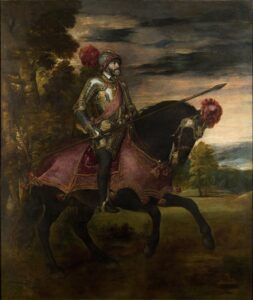
Masterpieces
Charles V on Horseback — Titian
Alone in a twilight landscape, clad in his gleaming armour, a long lance in hand, the emperor advances on horseback, sovereign and grave: Titian’s Equestrian Portrait of Charles V at Mühlberg is one of the most famous portraits in the history of art and the birth certificate of the modern equestrian portrait. In a single...
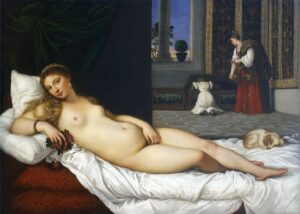
Masterpieces
The Venus of Urbino — Titian
A young naked woman, reclining on a bed in a Venetian palace, holds the viewer’s gaze with quiet assurance: Titian’s Venus of Urbino is the most famous nude of the Renaissance and one of the most discussed images in the whole history of art. Through its assumed sensuality, its direct gaze and its composition, it...
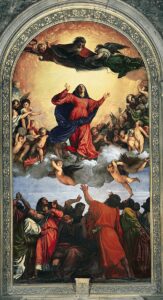
Masterpieces
The Assumption of the Virgin — Titian
Above the high altar of one of the largest churches in Venice, an immense altarpiece nearly seven metres high unfolds a celestial vision: the Virgin Mary, borne by a host of angels, rises towards God in a blaze of golden light, while below the apostles, astonished, stretch out their arms towards her. Titian’s Assumption of...

