Rembrandt — The Self-Portrait as a Diary of a Life
Amsterdam, summer of 1669. A sixty-three-year-old Dutch painter stands before his easel in a small, modest studio on Rozengracht, a working-class neighborhood in the northwest of the city. He had already lost his first wife, Saskia (who died in 1642), his second partner, Hendrickje (who died in 1663), and his only son, Titus (who died the previous year, in 1668). His large house on Sint Antoniesbreestraat was sold at auction in 1656 to pay off his debts. His art collection —which he had built up over thirty years and included works by Raphael, Mantegna, Leonardo, Titian, and Rubens —was dispersed. He now lives in relative poverty, supported by his daughter Cornelia and his daughter-in-law Magdalena.
Standing before his easel, the old man paints himself. A canvas measuring 86 × 70.5 centimeters. A frontal view of his face. Hands crossed over his stomach. A black beret atop his white hair. A brown coat lined with fur. His gaze is direct, fixed on the viewer, without self-indulgence or self-pity. The flesh is painted in thick, layered strokes, and the folds of his face are modeled with a mastery of chiaroscuro honed over fifty years of practice. The background is almost black — a dense shadow from which the light of the face emerges.
This self-portrait from 1669, now in the collection of the National Gallery in London, was the last one Rembrandt painted before his death on October 4, 1669. It is also, according to several modern art historians, the most moving self-portrait in the entire history of Western painting. But it is not an isolated self-portrait. It is the final entry in a visual diary that Rembrandt kept for forty-five years, and which has no parallel in the history of world painting.
Nearly one hundred self-portraits have been identified and documented in Rembrandt’s body of work—paintings, drawings, and etchings. From his first known self-portrait (1628, when he was 22 years old, now in the Rijksmuseum in Amsterdam) to his last in 1669, Rembrandt depicted himself every one to two years throughout his adult life. No painter in Western history has painted as many self-portraits, as regularly, or with such introspective rigor.
This article recounts the remarkable life story of this miller’s son, born in 1606 in Leiden, who, by the age of 25, had become the most sought-after portrait painter in Amsterdam, amassed a considerable fortune, married into a patrician family, built one of the greatest private art collections of 17th-century Holland, went bankrupt in 1656 amid a sensational legal scandal, lost everyone he loved one after another, and died in 1669 in relative poverty. This article also traces, as a narrative thread, the series of self-portraits that punctuate his life like a visual heartbeat —each marked by an emotional truth deeper than the one before.
Leiden, 1606 — The Childhood of the Miller’s Son
Rembrandt Harmenszoon van Rijn was born on July 15, 1606, in Leiden, in the Republic of the United Provinces (now the Netherlands), thirty-five years after the Dutch gained independence from Spain (proclaimed in 1581). His family belonged to the modest but education-minded middle class of this university town.
His father, Harmen Gerritszoon van Rijn (1568–1630), was a miller. He operated a windmill on the Old Rhine ( Oude Rijn in Dutch)—hence the family surname van Rijn (“of the Rhine”). The family owned their own mill and several houses in Leiden—a comfortable but non-aristocratic situation. His mother, Neeltje Willemsdr van Zuydtbroeck (1568–1640), was the daughter of a baker.
Rembrandt was the ninth of ten children in the family. Several of his brothers followed in their father’s footsteps (as millers) or choseother manual trades (such as bakers and shoemakers). But his parents quickly recognized Rembrandt’s interest in learning and drawing. They decided to invest in his education.
1613–1619: Rembrandt attendedthe Latin School in Leiden —a rigorous classical education that includedinstruction in Latin, Greek, rhetoric, and ancient history. Such a humanistic education was rare for a miller’s son. It would have a lasting impact on Rembrandt’s iconography: his in-depth knowledge of classical mythology,the Old Testament, and ancient history would later enable him to paint biblical and mythological subjects with remarkable literary precision.
1620: At the age of fourteen, Rembrandt was enrolled atthe University of Leiden —one of the most prestigious universities in the United Provinces (founded in 1575 by William the Silent). But according to university records, he did not attend any classes there. The enrollment was likely an initiative by his family to protect Rembrandt from military service or to keep open the option of higher education for the future.
Around 1621: Rembrandt officially gave up his university studies and turned to painting. This was an unusual decision for a family of millers—at the time, painting was considered a craftsman’s trade rather than a respectable profession. His parents agreed. Rembrandt began his apprenticeship with Jacob Isaacszoon van Swanenburgh (1571–1638), a local painter in Leiden who had spent several years in Italy (particularly in Naples) and ran a renowned studio.
Education — Swanenburgh in Leiden, Lastman in Amsterdam
Rembrandt’sformal apprenticeship with Swanenburgh lasted about three years (1621–1624). There he learned the fundamental techniques of oil painting, drawing from life, the rules of Baroque composition, and how to master lighting effects in night scenes (Swanenburgh’s specialty).
1624: Rembrandt, at the age of eighteen, left for Amsterdam for six months to further his training inthe studio of Pieter Lastman (1583–1633). Lastman was, at the time, one of the most respected history painters in the United Provinces. He had spent time in Italy between 1604 and 1607, where he studied the works of Caravaggio andthe Roman Baroque school firsthand. In Amsterdam, he became the primary source of Italian artistic innovations for the younger generation of Dutch artists.
Rembrandt’s stay with Lastman was, in fact, a defining experience for him. There he discovered:
- Caravaggesque chiaroscuro —a stark contrast between areas of deep shadow and bursts of bright light
- The theatrical staging of biblical episodes —exaggerated gestures, intense expressions
- The warm Italo-Roman color palette —golden browns, muted reds, ochres
- The Narrative Treatment of Historical Subjects
Rembrandt never traveled to Italy. This is a remarkable historical fact. Unlike virtually all of the great masters of 17th-century Europe (Velázquez, Poussin, Van Dyck, Rubens), Rembrandt never crossed the Alps. He studied Italy vicariously —through the engravings circulating in Amsterdam, through copies of Italian works, and through his teacher Pieter Lastman, who shared his experiences in Rome directly with him. This lack of travel to Italy would later become a source of criticism among some of his contemporaries, who saw it as a sign of provincialism —but in reality, it forced Rembrandt to develop an original style, one that was less influenced by Italian art than that of his contemporaries.
Late 1624–early 1625: Rembrandt returns to Leiden. At barely eighteen years old, heestablished himself as an independent painter. This early professional success was typical of the era—painters with a solid education typically achieved technical maturity around the ages of seventeen or eighteen.
1625–1631 — the Leiden workshop with Jan Lievens
From 1625 to 1631, Rembrandt worked in Leiden in a studio he shared with another young painter, Jan Lievens (1607–1674), his exact contemporary and friendly rival. Lievens, a precocious prodigy, had studied in Lastman’s studio a few years earlier. The two young painters worked together, shared models, and inspired one another.
1628: At the age of twenty-two, Rembrandt painted his first known self-portrait — Self-Portrait at Age 22 (Rijksmuseum, Amsterdam). Small format (22.5 × 18.6 cm), oil on wood. The face emerges from a deep brown background, with light coming from the left; the right eye is in shadow, while the left eye is illuminated. This marks the first entry in a visual journal that would span 45 years.
1629: A pivotal visit. Constantin Huygens (1596–1687), secretary to Stadtholder Frederick Henry of Orange-Nassau, a Dutch diplomat, and a renowned man of letters, visited the studio of Rembrandt and Lievens in Leiden. He subsequently wrote, in his diary — which was published later—a crucial account of these two young painters:
“The miller’s son… already displays such depth of imagination and such inventiveness that he surpasses painters who are much older and far more experienced.”
— Constantin Huygens, diary, circa 1629–1631
This recognition by Huygens—who was close to the Prince of Orange and the court in The Hague —was, in fact, the turning point in Rembrandt’s career. Huygens commissioned several works from the painter, notably the series *Five Episodes of the Passion* (1633–1639, now inthe Alte Pinakothek in Munich). He introduced Rembrandt to the court in The Hague —his first major aristocratic clientele.
1631: At the age of twenty-five, Rembrandt made the decision that would change his life. He left Leiden andsettled permanently in Amsterdam —the great commercial metropolis of the United Provinces, a world-class port, and the economic capital of Northern Europe. He first moved in with the art dealer Hendrick van Uylenburgh (1587–1661), a distant cousin by marriage to his future wife, Saskia.
1631–1642 — Amsterdam’s Triumphant Decade
The eleven years between 1631 and 1642 were, in fact, the most glorious of Rembrandt’s career. Within a few months, he became the most sought-after portrait painter in Amsterdam.
1632: Rembrandt paints The Anatomy Lesson of Dr. Nicolaes Tulp (Mauritshuis, The Hague)— a monumental group portrait depicting Professor Nicolaes Tulp and his fellow surgeons during a public dissection. The work revolutionizes the Dutch group portrait genre —with its dynamic composition, theatrical lighting on the dissected corpse, and distinct individual expressions for each surgeon. The painting definitively establishes Rembrandt in the Amsterdam art market.
1634: Rembrandt married Saskia van Uylenburgh (1612–1642), the niece of the art dealer Hendrick van Uylenburgh, with whom he was living. Saskia came from a patrician family in Friesland —her father had been mayor of Leeuwarden. For Rembrandt, the son of a miller, the marriage represented a significant rise in social status. Saskia also brought a substantial dowry, which enabled Rembrandt to expand his studio.
1635: The birth of their first child, Rumbartus, who died two months later. Their first loss.
1638: Birth of Cornelia I, who died in infancy. Second loss.
1640: Birth of Cornelia II, who also died young. Third bereavement.
1639: Rembrandt and Saskia bought a large house at 4 Sint Antoniesbreestraat (now the Rembrandt House Museum at numbers 4–6)— a stately home in Amsterdam’s Jewish quarter, a symbol of the couple’s social success. This house would be their home for seventeen years, until their bankruptcy in 1656.
1641: The birth, at last, of a child who would survive — Titus van Rijn (1641–1668), the only son of Rembrandt and Saskia. It was a time of immense joy for a family that had already suffered three previous losses.
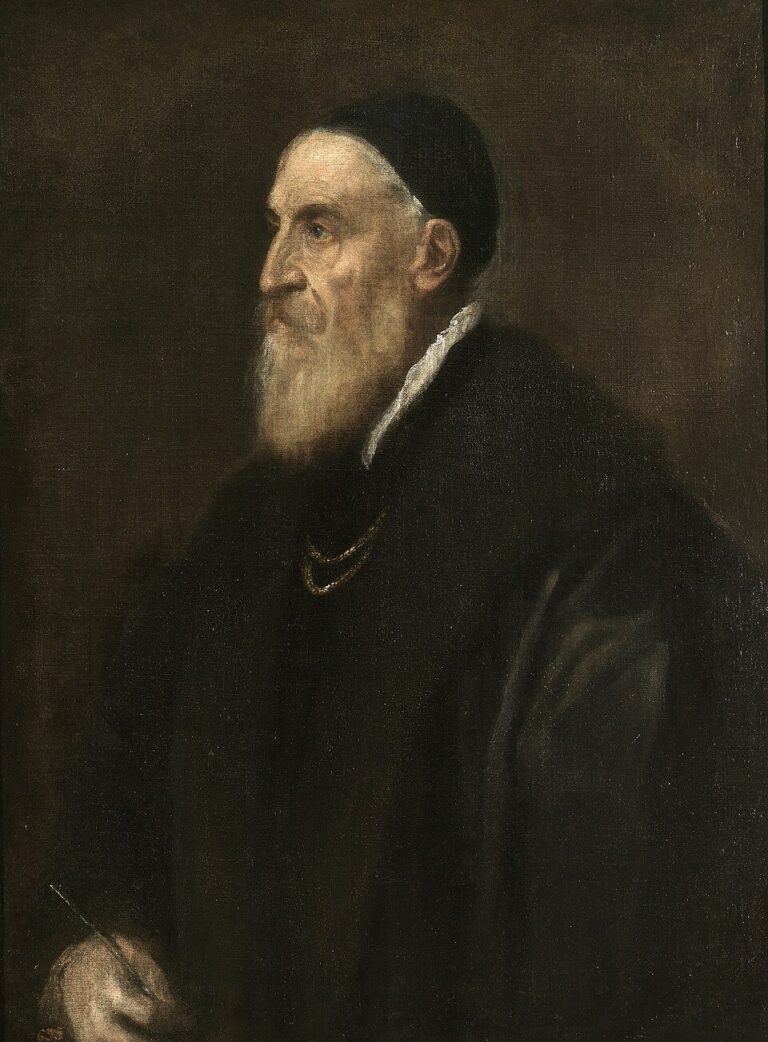
1640: Rembrandt paints Self-Portrait at Age 34 (National Gallery, London). A triumphant work. The painter depicts himself standing, seen in three-quarter profile, dressed in a Renaissance suit —a white shirt with a lace collar, a brown waistcoat, and a gold chain around his neck. Confidence. Elegance. The painting is directly inspired by theSelf-Portrait by Titian (c. 1550, Prado, Madrid), which Rembrandt had seen in an engraving circulating in Amsterdam. It is a tribute to the Italian tradition, with which he now rivals on equal terms.
A thriving studio. During this decade,Rembrandt’s studio trained about fifty students —a considerable number. Among them were Govert Flinck, Ferdinand Bol, Gerrit Dou (one of his earliest apprentices and a future leading painter among the Leiden fijnschilders ), Carel Fabritius (future painter of *The Goldfinch*, 1654, Mauritshuis), Samuel van Hoogstraten, and Nicolaes Maes. Many would go on to become important painters in their own right.
1642 — *The Night Watch* and the Death of Saskia
The year 1642 was, in Rembrandt’s life, both a year of artistic triumph and personal disaster.
The Night Watch (De Nachtwacht, original title The Company of Frans Banning Cocq and Willem van Ruytenburch) was completed in 1642. This monumental work measures 363 × 437 centimeters (it was cropped in the 18th century to fit a wall—the original version was larger) and is painted in oil on canvas. Commissioned by the Amsterdam civic militia — Captain Frans Banning Cocq’s company —to decorate their meeting hall in the Kloveniersdoelen (Amsterdam Arquebusiers’ Hall).
A revolution in group portraiture. Traditionally, Dutch militia portraits were static and formal —the figures lined up facing the viewer, with uniform lighting and conventional poses. Rembrandt completely reinvented the genre. It depicts the company on the move — leaving their headquarters for a mission—in a dynamic composition where each character is distinguished by their posture, lighting, and expression. The captain gives orders to the lieutenant. The men load their arquebuses. A blonde girl (a mysterious figure never fully explained—possibly an allegory for the company) crosses the stage with a dead rooster hanging from her belt.
The interplay of light and shadow is taken to its peak. A bright light illuminates the captain and the lieutenant in the center, singles out the blonde girl on the left, and plunges the rest of the composition into a golden twilight. The effect is so powerful that for centuries (and as late as the 1940s), the painting was known as The Night Watch — a misinterpretation: the scene takes place in broad daylight, but successive layers of varnish accumulated over time had darkened the composition to the point of making it appear nocturnal. Recent restorations (notably the major “Operation Night Watch” project led by the Rijksmuseum in 2019–2023) have restored the painting to its original colors, which are lighter than the version that has been known since the 19th century.
But 1642 was also the year of tragedy. On June 14, 1642, Saskia van Uylenburgh died at the age of thirty from complications related to the birth of their son Titus (born the previous year). This untimely death devastated Rembrandt. His wife was thirty years old. Their son Titus was eight months old. Three of their earlier children had already died. This series of losses left a deep mark on Rembrandt and transformed his work.
Saskia’s will contains an important restrictive clause: Rembrandt would inherit his wife’s estate only if he did not remarry. If Rembrandt were to remarry, Saskia’s fortune would pass directly to Titus upon his coming of age. This clause largely explains why Rembrandt never remarried, not even to Hendrickje Stoffels, with whom he shared his life for twenty years.
1642–1656 — Hendrickje, the decline of the business, and bankruptcy
The years following Saskia’s death were marked by a twofold trend: artistic depth on the one hand, and a gradual commercial decline on the other.
Artistic Evolution. Beginning in the 1640s, Rembrandt developed a more intimate, more pictorial, and more experimental style. He gradually moved away from the “polished finish” that had characterized his bourgeois clientele in the 1630s. He now favored broader brushstrokes, impasto glazes, and visible textural qualities. The self-portraits from this period (notably the 1652 Self-Portrait, Kunsthistorisches Museum, Vienna; and the 1659 Self-Portrait, NGA, Washington) are more introspective, less flattering, and more truthful.
Hendrickje Stoffels (1626–1663). Around 1646–1649, a young maid, about 20 years old, entered Rembrandt’s household as a governess for Titus (his son, then aged 5–8). Hendrickje Stoffels, who came from a poor family in the province of Bredevoort, gradually became Rembrandt’s intimate partner. The couple could not marry because of a clause in Saskia’s will.
1654: Hendrickje was summoned before the council of the Reformed Church of Amsterdam for “living in a concubinate with the painter Rembrandt” —a situation morally condemned bythe Calvinist Church. She appeared before the council several times, refused to leave Rembrandt, and was ultimately excommunicated. A few months later, she gave birth to Cornelia van Rijn (1654–1684), Rembrandt’s daughter, who would be the only child of hers and Rembrandt to survive.
Commercial Decline. During the 1640s and 1650s, Amsterdam’s artistic taste gradually shifted toward a smoother, more elegant, and more refined classicism—embodied by Rembrandt’s former students, such as Govert Flinck and Ferdinand Bol, who adapted their style to the new bourgeois taste. Rembrandt, remaining true to his more intense and rugged vision, gradually lost commissions. His clientele dwindled.
An extravagant lifestyle. Rembrandt, however, continued to spend lavishly —he bought works of art, engravings, books, and curiosities for his personal collection. His house on Sint Antoniesbreestraat had become a veritable private museum, with hundreds of works of art and thousands of objects gathered over the course of twenty years.
1656: Financial disaster strikes. Rembrandt is declared insolvent by the Amsterdam court. There are several reasons for this:
- A costly lifestyle in the long run
- Compulsive Art Purchases
- Depreciation of Real Estate Investments
- Decline in orders due to changing tastes
- A difficult economic climate (the First Anglo-Dutch War of 1652–1654 had weakened the Dutch economy)
The house on Sint Antoniesbreestraat was put up for forced sale. The personal collection was dispersed at several auctions between 1657 and 1658. The auction catalog (preserved in the Amsterdam Municipal Archives) lists 363 lots of works and objects— a unique record of the contents of a 17th-century Dutch artist’s collection.
Rembrandt moved into a more modest house on the Rozengracht, in a working-class neighborhood of Amsterdam. Hendrickje and Titus set up a business (the van Rijn firm) to protect Rembrandt’s future works from creditors —a legal maneuver that allowed him to continue painting without his income being seized.
The Later Years — Bathsheba and the Return of the Prodigal Son
Paradoxically, the years following his bankruptcy (1656–1669) produced some of the most profound works of Rembrandt’s entire career.
1654: Bathsheba at Her Bath (Louvre Museum, Paris). A deeply intimate work depicting the biblical Queen Bathsheba holding in her hand the letter from King David summoning her to seduce him—a psychological moment in which she becomes aware of the tragedy that is about to unfold (Bathsheba’s husband, Uriah the Hittite, will be sent to his death by David so that David can marry her). Hendrickje Stoffels is likely the model for Bathsheba. Non-erotic nudity, a meditative expression, and a golden, autumnal color palette. A pivotal work from Rembrandt’s mature period.
1660–1665: the period of the late group portraits. The Syndics of the Drapers’ Guild (1662, Rijksmuseum) — the last major commission for a group portrait. A majestic work, yet more restrained than *The Night Watch* — a limited color palette, a balanced composition, and the individualized characterization of each guild master.
1661–1669: The Return of the Prodigal Son (The Hermitage, Saint Petersburg). Rembrandt’s final work. Depiction of the Gospel parable (Luke 15:11–32): the ungrateful son who squandered his share of the inheritance returns, kneeling before his blind father, who blesses him. Monumental format (262 × 205 cm). Golden light falls on the father’s hands resting on his son’s back. According to the critical consensus, this is the greatest spiritual work in Rembrandt’s entire oeuvre. The subject —a son returning to his father after failure— clearly resonates with the aging and ruined painter’s own situation.
More self-portraits. During these years, Rembrandt continued to paint himself more regularly than ever before. Self-Portrait, 1659 (NGA, Washington) — Age 53, direct gaze, features marked by fatigue. Laughing Self-Portrait (1662–1663, Wallraf-Richartz Museum, Cologne) — a rare work in which Rembrandt is smiling. Self-Portrait with Two Circles (1665–1669, Kenwood House, London) — the painter at work, palette in hand.
1663: Hendrickje Stoffels died at the age of 37, likely from the plague that ravaged Amsterdam that year. Another major loss for Rembrandt.
1668: Titus van Rijn died at the age of 26, shortly after marrying Magdalena van Loo. His wife gave birth to Titia van Rijn (1668–1721), Rembrandt’s only granddaughter. This was the family’s fourth major loss.
1669 — The Last Self-Portrait
Summer 1669. Rembrandt is sixty-three years old. He lives modestly on Rozengracht with his daughter Cornelia (age 15) and his daughter-in-law Magdalena (Titus’s widow), who takes care of little Titia (age 1).
He painted his last known self-portrait — Self-Portrait at Age 63, now in the collection of the National Gallery in London. Medium-sized (86 × 70.5 cm). Simple composition: an elderly man viewed head-on, wearing a black beret and a brown coat, with his hands crossed over his stomach and his gaze directed straight at the viewer.
The work is, quite simply, one of the absolute masterpieces in the history of Western painting. No sentimentality. No staging. No symbolism. Just an old man looking at the viewer with uncompromising emotional truth. The folds of his face are modeled by thick layers of paint applied with both a palette knife and a brush. His white hair stands out against a deep black background. His gaze seems to say , “This is what I’ve become” —without sadness or pride, simply the acknowledgment of a life lived.
October 4, 1669: Rembrandt died in Amsterdam at the age of sixty-three in his modest apartment on the Rozengracht. His daughter Cornelia, his daughter-in-law Magdalena, and his granddaughter Titia were by his side.
The family could not afford to have a private tomb built for him. Rembrandt was buried in a rented grave atthe Westerkerk in Amsterdam —the same church that still overlooks the Prinsengracht in the historic center today. According to Amsterdam custom, rented graves were reused after twenty years. The family was never able to purchase the burial plot. Twenty years after his death, in 1689, Rembrandt’s grave was likely emptied and his remains scattered throughout the parish’s communal cemetery. No identifiable grave site for Rembrandt remains today—only a commemorative plaque on a pillar in the Westerkerk marks his approximate burial place.
The Self-Portrait as a Diary of a Life
Rembrandt’sbody of self-portraits is, in terms of its consistency, scope, and introspective depth, unparalleled in the entire history of Western painting.
Some figures:
- Approximately 80 to 100 documented self-portraits (the Rembrandt Research Project has been regularly revising attributions since the 1980s)
- Paintings: approximately 40 oil self-portraits
- Etchings: approximately 31 engraved self-portraits
- Drawings: about 10 to 15 self-portraits in pencil, red chalk, and ink
- Period covered: 1628 (Rembrandt was 22) – 1669 (the year of his death) = 41 years
- Frequency: an average of one to three self-portraits per year, with a higher frequency during certain periods (1630–1640, 1655–1665)
No other painter in Western history has painted as many self-portraits, so regularly, and with such introspective rigor. Dürer painted about 15 over the course of 30 years. Van Gogh painted about 35 over 4 years (an intense but brief period of production). Courbet painted about 20. Cézanne painted about 26. Picasso painted fewer than 80 over an 80-year career. Rembrandt alone produced 80 to 100 works over a period of 41 years.
Why this series? Art historians have been debating this for centuries. Several converging hypotheses:
1. Ongoing technical practice. Rembrandt used his own face as a model to study expressions, lighting, and new techniques. It was a free model, always available, and perfectly controllable.
2. The Artist’s Signature. In 17th-century Holland, self-portraits by famous artists were highly prized by collectors. Rembrandt regularly sold his self-portraits. A legitimate economic rationale.
3. Philosophical introspection. As the decades passed, the self-portraits became more introspective, less flattering, and more truthful. The young Rembrandt of 1628 painted himself with an air of mystery (a shadow over his eye). The mature Rembrandt of 1640 painted himself in Titian’s triumphant pose. The aging Rembrandt of 1659 paints himself unvarnished, with a weary gaze. The dying Rembrandt of 1669 paints himself without any social pretense. The evolution between these self-portraits is, in fact, a visual diary of spiritual maturation.
As Eugène Fromentin wrote in his seminal work *The Masters of Old* (1876), regarding Rembrandt’s self-portraits:
“He painted himself more than anyone else, and always in a different way, and always more truthfully.”
— Eugène Fromentin, *The Masters of Yesteryear*, 1876*
This interpretation has remained canonical in art history. Rembrandt’s late self-portraits are considered one of the pinnacles of human representation in the entire history of Western art. No self-pity. No pretense. An emotional truth that few works in the global art canon have achieved.
Posthumous Legacy — The Dutch School, Vermeer, and Their Influence on Impressionism
Rembrandt’sinfluence onthe history of Western painting is, in fact, considerable.
During his lifetime (1631–1669), he trained about 50 students in his Amsterdam studio. Several went on to become major painters in their own right:
- Gerrit Dou (1613–1675) — Rembrandt’s first apprentice in Leiden, founder ofthe Leidenschool of the Fijnschilders (painters known for their extremely precise detail)
- Govert Flinck (1615–1660)—one of Rembrandt’s most successfulsuccessors, who adapted his style to the more classical tastes of the 1650s
- Ferdinand Bol (1616–1680)—another successful student who carried on the Rembrandt style
- Carel Fabritius (1622–1654)— the most important link between Rembrandt and Vermeer —settled in Delft in the 1650s and likely trained Johannes Vermeer there. His masterpiece The Goldfinch (1654, Mauritshuis) isthe pivotal work linking Rembrandt to the Delft School
- Samuel van Hoogstraten (1627–1678)—painter and art theorist, author of*Introduction to the Higher School of the Art of Painting* (1678)
- Nicolaes Maes (1634–1693) — Late-Period Works, Intimate Scenes
Connection to Vermeer. The common thread linking Rembrandt and Vermeer runs through Carel Fabritius. Fabritius was a student of Rembrandt in the 1640s. Hesettled in Delft in the 1650s and, according to the likely historical consensus, taught Johannes Vermeer (1632–1675) there. When Fabritius died prematurely inthe explosion at the Delft gunpowder magazine in October 1654 (a disaster that destroyed part of the city and killed about 100 people), Vermeer carried on the Rembrandt tradition butadapted it into a more contemplative and intimate style. Without Rembrandt and Fabritius,Vermeer’s work would, in fact, be unthinkable.
Influence on Impressionism. In 19th-century France, Rembrandt was regarded by the Impressionists asone of the greatest masters. Several documented connections:
- Édouard Manet studied Rembrandt’s self-portraits during his visits to the Louvre. His *Olympia* (1863) draws on Rembrandt’s chiaroscuro to create the effectof a figure emerging from a dark background
- Paul Cézanne considers Rembrandt to be one of the three greatest masters in history (along with Veronese and Poussin)
- In 1885, Vincent van Gogh wrote to his brother Theo that Rembrandt was “the painter of my painters” and studied his self-portraits obsessively
- Edgar Degas studied Rembrandt’s printmaking techniques —Rembrandt was also a major printmaker, with about 300 etchings of exceptional quality
In the 20th century, Rembrandt remained an undisputed authority. Lucian Freud, Francis Bacon, Frank Auerbach —all the great figurative painters of the 20th-century Anglo-Saxon world acknowledge their debt to Rembrandt. His approach to the human form, psychology, and old age is structurally embedded in modern Western painting.
How to View His Works
The major Rembrandt collections are scattered around the world, but are concentrated in a few major museums.
In the Netherlands (a must for enthusiasts)
Rijksmuseum, Amsterdam — the world’s largest collection of Rembrandts. Conservatory of The Night Watch (1642)—on display in the “Gallery of Honor,” designed specifically for this painting. More than 400 works, including paintings, drawings, and etchings. Must-see:
- The Night Watch (1642)
- The Trustees of the Clothmakers’ Guild (1662)
- Portrait of Maria Trip (1639)
- Several Self-Portraits
- Numerous etchings
Mauritshuis, The Hague — a small museum but with an exceptional collection. It houses “The Anatomy Lesson of Dr. Tulp” (1632), several self-portraits, Susanna and the Elders (1647).
Rembrandt House, Amsterdam — the house and studio where Rembrandt lived from 1639 to 1656. A faithful reconstruction of his studio, a complete collection of his etchings, and artifacts from the 17th century. A must-see for art lovers.
In Paris
Louvre Museum — home to one of the world’s most extensive French collections of Rembrandt works. Highlights include:
- Bathsheba at Her Bath (1654) — a masterpiece from his mature period
- The Pilgrims of Emmaus (1648) — a major religious scene
- The Flayed Ox (1655) — an exceptional still life
- Self-Portrait at the Easel (1660)
- Several other major works
In the United Kingdom
National Gallery, London — houses theSelf-Portrait at Age 63 (1669)—the featured image of this article. Several other major works.
Kenwood House, London — is home to theSelf-Portrait with Two Circles (1665–1669).
Buckingham Palace Royal Collection — several important works.
In the United States
National Gallery of Art, Washington — a major collection that includes Self-Portrait from 1659.
Metropolitan Museum of Art, New York — extensive collection of Rembrandt works.
Frick Collection, New York — owns The Polish Horseman (1655) and several self-portraits.
In Russia
Hermitage, St. Petersburg — a major collection, including The Return of the Prodigal Son (1661–1669) and Danaë (1636–1647).
Further Reading
Institutional sources cited
- Rijksmuseum, official pages on Rembrandt.
- Louvre Museum, Rembrandt Collection.
- Encyclopædia Universalis, article “Rembrandt van Rijn (1606–1669).”
- Rembrandt Research Project, *A Corpus of Rembrandt Paintings*, 6 volumes, Springer/Nijhoff, The Hague, 1982–2015. The definitive scholarly reference for the catalogue raisonné.
Primary sources cited
- Constantin Huygens, diary (circa 1629–1631) — the earliest account of the young Rembrandt.
- Filippo Baldinucci, *Notizie de’ professori del disegno*, Florence, 1681 — the first Italian biography of Rembrandt.
- Eugène Fromentin, *Les Maîtres d’autrefois*, Paris, 1876. A leading French critical source, featuring a major chapter on Rembrandt.
Leading Modern Studies
- Bob Haak, *Rembrandt: His Life, His Work, His Times*, Citadelles & Mazenod, Paris, 1984. The definitive biography in French.
- Pascal Bonafoux, *Rembrandt and the Self-Portraits*, Skira, Geneva, 1985.
- Mariët Westermann, *Rembrandt*, Phaidon, London, 2000.
- Jonathan Bikker, *Rembrandt: Biography of a Rebel*, Rijksmuseum, Amsterdam, 2019. A recent biography related tothe Rijksmuseum’s“Operation Night Watch” initiative.
- Simon Schama, *The Face of Rembrandt*, Seuil, Paris, 2002.
Institutional Documentation
- Rijksmuseum, Amsterdam — primary holding institution.
- Mauritshuis, The Hague — a major collection from the Dutch Golden Age.
- Rembrandt House, Amsterdam — the painter’s studio-museum.
- Louvre Museum, Paris — an important French collection.
See also on Hors Cadre
- Caravaggio—the inventor of chiaroscuro —the undisputed master of Baroque chiaroscuro, whose work Rembrandt studied through engravings without ever having traveled to Italy.
- Musée d’Orsay — what to see, hours, tickets — a museum that houses works by Impressionists deeply influenced by Rembrandt (Manet, Cézanne, Van Gogh, Degas).
— M