The Eternal Tintoretto — The Dramatic Passion of the Venetian Master
At the start of the 2026 school year, the Jacquemart-André Museum will dedicate a major exhibition to one of the greatest geniuses of the Italian Renaissance: “The Eternal Tintoretto.” From September 11, 2026, to January 24, 2027, the museum will…
📍 Jacquemart-André Museum 🗓 Du 11 septembre 2026 au 24 janvier 2027
| Dates | Du 11 septembre 2026 au 24 janvier 2027 |
| Location | Jacquemart-André Museum |
| Opening hours | 10 a.m.–6 p.m., Friday at 10 p.m., Saturday and Sunday at 7 p.m. |
| Full price | 18 euros (during the exhibition) |
| Reduced price | starting at 14.50 euros |
| Metro | Miromesnil / Saint-Philippe-du-Roule |
At the start of the 2026 school year, the Jacquemart-André Museum will dedicate a major exhibition to one of the greatest geniuses of the Italian Renaissance: “The Eternal Tintoretto.” From September 11, 2026, to January 24, 2027, the museum will present, for the first time in France, a comprehensive overview of the entire career of Jacopo Robusti, known as Tintoretto (1518/19–1594) — the Venetian master of unparalleled dramatic energy, whom his contemporaries nicknamed “Il Furioso.”
The exhibition brings together some forty paintings and graphic works from public and private collections in France, Italy, and around the world. Through a thematic journey, it showcases the full diversity and scope of an immense body of work: large-scale religious compositions, psychological portraits, and mythological scenes. It reveals a complex and unclassifiable artist whose bold compositions, dizzying perspectives, spectacular lighting effects, and lively brushwork—the famous “prestezza”—revolutionized 16th-century painting.
But the exhibition doesn’t stop at the Renaissance. It demonstrates how Tintoretto’s legacy has spanned the centuries and crossed borders, eventually making him a key influence on 19th-century French painting—from Ingres to Cézanne, including Delacroix and Manet. The Venetian master thus emerges as an unexpected milestone in the long history of modernity—a painter whose energy continues to fascinate.
This article explores the significance of this unprecedented retrospective, the figure of Tintoretto and his genius, his unique position between Michelangelo and Titian, his career and major works, his legacy extending to the modern era, and all the practical information you need to plan a visit through January 24, 2027.
The Reason Behind the Exhibition — A First in France
The “Éternel Tintoret” exhibition is a major event, as it fills a surprising gap: never before has France devoted a comprehensive retrospective to this master, who is nonetheless a pivotal figure of the Renaissance. This is the first time that an overview of his entire career has been presented to the French public.
Tintoretto is one of the three great names in 16th-century Venetian painting, alongside Titian and Veronese. But in France, he long remained in the relative shadow of his illustrious rivals. His vast body of work is found primarily in Venice, where he spent his entire life and created countless monumental works of art that are difficult to transport. Bringing together some forty of his works, drawn from collections around the world, is therefore a remarkable undertaking, offering a rare opportunity to appreciate the full scope of his genius.
The exhibition takes a two-pronged approach. On the one hand, it offers a thematic retrospective that highlights the diversity of his work—religious art, portraiture, and mythology. On the other hand, it explores Tintoretto’s legacy, his influence on later artists, and his impact up to the modern era. In doing so, it does more than simply present an old master: it reveals his modernity, his resonance across the centuries, and his place in the long chain of artistic creation. Tintoretto is portrayed not as a static figure from the past, but as an “eternal” artist whose energy transcends time.
Who is Tintoretto?
To fully appreciate the exhibition, one must understand the unique figure of Tintoretto—the son of a dyer who became one of the greatest painters of his century and who, all by himself, embodied the creative energy of Renaissance Venice.
Jacopo Robusti was born in Venice around 1518 or 1519. His nickname, “Tintoretto”—the little dyer—came from his father’s trade as a silk dyer. He carried this modest nickname throughout his life, and it has remained associated with his fame. Unlike many artists of his time, Tintoretto traveled very little: he remained in Venice his entire life, where he enjoyed an exceptionally long and prolific career. In this city with its powerful artistic influence, the heart of a commercial and cultural empire, he found the ideal setting to realize his ambitions.
Tintoretto worked tirelessly for Venice’s institutions—churches, confraternities, palaces—creating vast decorative works and cycles of monumental paintings. His output was colossal, matching his boundless energy. He covered the walls of Venice’s major institutions with religious and historical scenes of unprecedented dramatic power. His ambition, endurance, and speed of execution made him a central figure in Venetian artistic life, capable of rivaling the greatest artists.
His artistic personality was as unique as it was powerful. The biographer Giorgio Vasari, who did not care for him much, nevertheless described him as “the most formidable mind painting has ever known”—acknowledging, in that ambiguous phrase, the almost frightening power of his genius. He was nicknamed “Il Furioso,” the Furious One, so overwhelming and indomitable did his creative energy seem. Tintoretto was not a painter of restraint and serene balance: he was a painter of fury, movement, drama, and audacity. It is this energy that defines his uniqueness and his greatness.
Il Furioso — Dramatic Energy
What sets Tintoretto apart from all others—what defines his signature style and brings him fame—is the dramatic energy of his painting: that fury, that movement, that theatrical power that animate his compositions and earned him his nickname.
Tintoretto’s art is characterized by movement and drama. His compositions are bold and dynamic, often built around powerful diagonals that draw the eye. He favors dizzying perspectives, unusual viewpoints, and spectacular foreshortening, which give his scenes striking depth and tension. His figures are captured in full motion, in dynamic poses, with sweeping gestures and twists that express action and emotion. Nothing in his work is static: everything is momentum, energy, and life.
Light plays an essential role in this dramatic composition. Tintoretto is a master of spectacular lighting effects: contrasting lighting, supernatural light, and chiaroscuro that sculpt the bodies and create an atmosphere charged with tension. His lighting is almost theatrical, even cinematic ahead of its time: it sets the scene, dramatizes the action, and heightens the intensity of the narratives. To design his complex lighting and perspectives, Tintoretto employed an original and very modern method: he built small models—veritable miniature theaters with wax or clay figurines—which he illuminated to study the effects of light and space.
Finally, Tintoretto’s brushwork is famous for its liveliness: the “prestezza”—that speed and freedom of execution that give his paintings remarkable energy and spontaneity. Where others painted with meticulous precision, Tintoretto worked quickly and passionately, leaving the brushstrokes visible. This free and energetic style, sometimes deemed too hasty by his critics, was the very expression of his temperament. Through its freedom, it foreshadows much later artistic explorations and partly explains the fascination Tintoretto would exert on modern painters.
Between Michelangelo and Titian
Tintoretto’s greatness lies in an original synthesis that no one else had been able to achieve: the union of the sculptural draftsmanship of the Tuscan masters and the vibrant colors of the Venetians. It was by reconciling these two traditions that he brought the Renaissance in Venice to its zenith.
Italian Renaissance painting was divided between two major traditions, two rival conceptions of art. On the one hand, the Tuscan and Roman schools, embodied by Michelangelo, emphasized the “disegno”: drawing, line, the sculptural construction of the figure, and mastery of anatomy and form. On the other hand, the Venetian school, dominated by Titian, emphasized “colorito”: color, light, pictorial texture, and the sensuality of tones. These two approaches were often pitted against one another and considered irreconcilable.
Tintoretto, for his part, sought to unite them. Fascinated by Michelangelo, whose sculptural power and mastery of the human form he admired, he sought to incorporate this “disegno” into his painting. But he was Venetian, heir to Titian and his mastery of color. His ambition—summed up in a phrase attributed to him—was to combine Michelangelo’s drawing with Titian’s use of color. From this bold synthesis emerged his unique style: powerfully rendered, sculptural, dynamic figures, bathed in a light and color that were quintessentially Venetian. In this way, Tintoretto achieved the reconciliation of two worlds.
This ambition placed him in a unique—and at times uncomfortable—position. Titian, the undisputed master of Venice, was his rival; relations between the two men were tense and marked by competition. Tintoretto had to assert himself in the face of his elder’s overwhelming fame by emphasizing his distinctiveness, his energy, and his audacity. This rivalry stimulated his genius and drove him to surpass himself. By synthesizing disegno and colorito and infusing them with his own dramatic intensity, Tintoretto elevated Venetian painting to new heights and established himself as one of the three great masters of Venice, alongside Titian and Veronese.
The Exhibition Itinerary
The exhibition brings together some 40 paintings and works on paper, arranged in a thematic sequence that showcases the diversity of Tintoretto’s oeuvre. These works come from public and private collections in France, Italy, and around the world, brought together especially for this occasion.
The exhibition is organized around the major genres in which Tintoretto worked. Religious compositions play a central role: it is here that his dramatic power is most fully expressed, along with his ability to breathe new life into sacred subjects through intense and original interpretations. The exhibition thus features works such as The Miracle of Saint Augustine (1547–1549, now in the Palazzo Chiericati in Vicenza) and *The Trinity* (c. 1561–1562, from the Galleria Sabauda in Turin), which demonstrate his approach to dramatizing religious narratives and imbuing them with unprecedented emotional and visual power.
Alongside religious art, the exhibition highlights other facets of Tintoretto’s genius. His portraits, marked by great psychological subtlety, reveal his keen sense of observation and characterization; he was able to capture the presence and character of the Venetians of his time. His mythological scenes showcase his sensuality, his inventiveness, and his freedom. Through this diversity, we discover a well-rounded artist, capable of tackling any subject with the same energy and boldness. We also perceive, as the exhibition highlights, the painter’s humor, sensuality, and critical eye—aspects of his art that are sometimes overlooked.
The exhibition thus reveals the full modernity and uniqueness of an artist endowed with extraordinary creative energy. Work after work, a portrait emerges of an indomitable, unclassifiable genius, whose every canvas bears the mark of a powerful personality. The exhibition offers an immersive journey into this theatrical and fiery world, set in the heart of Renaissance Venice, and allows visitors to appreciate why Tintoretto remains, five centuries later, an indispensable figure in art history.
The Legacy — From Tintoretto to the Moderns
One of the exhibition’s most original contributions is its demonstration of Tintoretto’s lasting influence—an influence that, across the centuries, made him a point of reference for 19th-century French painters and a milestone in the history of modernity.
Tintoretto’s energy, his free brushwork, and the boldness of his compositions and lighting resonated powerfully with 19th-century artists seeking renewal. The exhibition highlights this unexpected connection, showing how several of the great names in French painting looked to and admired the Venetian master. From Ingres to Cézanne, including Delacroix and Manet, Tintoretto was a source of inspiration for them, a model of freedom and power. Delacroix, in particular—that great painter of movement and color—found in Tintoretto a precedent for his own romantic fervor.
This legacy sheds new light on Tintoretto’s place in art history. Far from being an old master confined to his own century, he emerges as a pioneer—an artist whose boldness foreshadowed modernity. His free brushwork foreshadowed the pictorial explorations of the modernists; his dramatic energy fueled their quest for expression. The exhibition even goes so far as to evoke the profound interpretation of Tintoretto by the philosopher Jean-Paul Sartre, who devoted several texts to this painter, seeing in him the embodiment of a certain condition of the artist. Tintoretto thus transcends the centuries, from the Venetian Renaissance to 20th-century thought.
By showcasing this legacy, the exhibition fully justifies its title: *Eternal Tintoretto*. The Venetian master does not belong solely to the past: he is a living presence in art history, a source to which artists have continually returned. His energy, his boldness, and his freedom continue to inspire and fascinate. It is this permanence, this eternity, that the exhibition celebrates—that of a genius whose power has lost none of its strength, five centuries later.
The Jacquemart-André Museum—A Showcase for the Renaissance
The exhibition finds an ideal setting at the Jacquemart-André Museum, one of the most beautiful museums in Paris, whose permanent collection has a special affinity for Italian Renaissance art.
Housed in a sumptuous mansion on Boulevard Haussmann, the Jacquemart-André Museum was born out of the passion of two great 19th-century collectors, Édouard André and his wife, Nélie Jacquemart. This couple of discerning art lovers assembled an exceptional collection of artworks, with a marked preference for the Italian Renaissance. The museum thus houses a remarkable collection of Italian art—a veritable “Italian museum” in the heart of Paris—featuring works by the great masters of the Italian peninsula. Hosting an exhibition dedicated to Tintoretto is therefore a natural extension of the museum’s mission.
The setting itself—with its stately reception rooms, grand staircase, and refined décor—provides a sumptuous backdrop for exploring the artworks. Visiting the Jacquemart-André Museum also means exploring the home of a Belle Époque couple of collectors, immersing yourself in their lifestyle and passion for art. The “Eternal Tintoretto” exhibition is part of the prestigious program that has earned this museum its reputation, where each season features a major exhibition dedicated to a master. The Venetian master is perfectly at home here, in a place where a love of the Italian Renaissance permeates every room.
Practical Information
Location: Musée Jacquemart-André, 158 Boulevard Haussmann, 75008 Paris
Dates: September 11, 2026, through January 24, 2027
Directions:
- Subway: Line 9 or 13, Miromesnil station; Line 9, Saint-Philippe-du-Roule station
- Bus: Lines 22, 28, 32, 43, 52, 80, 84, 93 (Haussmann-Courcelles, Haussmann-Miromesnil, and Saint-Philippe-du-Roule stops)
Hours:
- Open daily from 10 a.m. to 6 p.m.
- Late-night hours on Fridays until 10 p.m. (during exhibitions)
- Last admission and end-of-day closing of the ticket windows: see the website
Prices (exhibition period, to be confirmed on the official website):
- Full price: 18 euros
- Reduced rate: starting at approximately 14.50 euros (depending on the category)
- Free for children under 7
- Audio guide: additional fee of approximately 4 euros
Recommended duration of visit: about 1 hour and 15 minutes to 1 hour and 30 minutes
Reservations: We strongly recommend booking online and selecting a time slot on the Jacquemart-André Museum website. The museum gets very crowded during major exhibitions.
Accessibility: Please contact the museum for information on access for visitors with limited mobility (historic mansion).
Good to know: This exhibition is the perfect continuation of an exploration of the Italian Renaissance. On Hors Cadre, it ties in with our articles on the Italian masters, from Leonardo da Vinci to Caravaggio.
Further Reading
Institutional sources cited
- Jacquemart-André Museum, exhibition brochure for ” The Eternal Tintoretto.”
- Giorgio Vasari, *The Lives of the Most Excellent Painters, Sculptors, and Architects* (1568).
- Jean-Paul Sartre, Essays on Tintoretto.
Sources and Reference Studies
- Exhibition catalog for *The Eternal Tintoretto* (Jacquemart-André Museum, 2026).
- Miguel Falomir, Studies in Venetian Renaissance Painting.
Institutional Documentation
- Jacquemart-André Museum — organizing institution and ticket office.
See also on Hors Cadre
- Leonardo da Vinci—the universal genius— the master who ushered in the Italian Renaissance, to which Tintoretto belongs.
- Caravaggio— the other great Italian master of chiaroscuro and drama.
- Eugène Delacroix —the Romantic painter who admired Tintoretto and inherited his passion.
— M
| Dates | Du 11 septembre 2026 au 24 janvier 2027 |
| Location | Jacquemart-André Museum |
| Opening hours | 10 a.m.–6 p.m., Friday at 10 p.m., Saturday and Sunday at 7 p.m. |
| Full price | 18 euros (during the exhibition) |
| Reduced price | starting at 14.50 euros |
| Metro | Miromesnil / Saint-Philippe-du-Roule |
Latest articles
Masterpieces
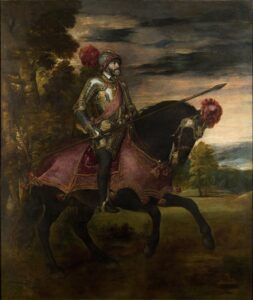
Charles V on Horseback — Titian
Alone in a twilight landscape, clad in his gleaming armour, a long lance in hand, the emperor advances on horseback, sovereign and grave: Titian’s Equestrian Portrait of Charles V at Mühlberg is one of the most famous portraits in the history of art and the birth certificate of the modern equestrian portrait. In a single...
Masterpieces
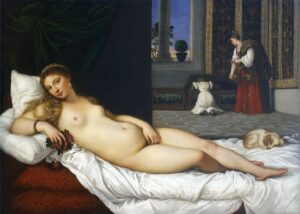
The Venus of Urbino — Titian
A young naked woman, reclining on a bed in a Venetian palace, holds the viewer’s gaze with quiet assurance: Titian’s Venus of Urbino is the most famous nude of the Renaissance and one of the most discussed images in the whole history of art. Through its assumed sensuality, its direct gaze and its composition, it...
Masterpieces
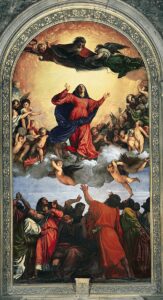
The Assumption of the Virgin — Titian
Above the high altar of one of the largest churches in Venice, an immense altarpiece nearly seven metres high unfolds a celestial vision: the Virgin Mary, borne by a host of angels, rises towards God in a blaze of golden light, while below the apostles, astonished, stretch out their arms towards her. Titian’s Assumption of...

