Titian — the Prince of Painters
For more than sixty years, one man reigned over the painting of Venice and fascinated the greatest sovereigns of Europe: Tiziano Vecellio, whom posterity has remembered as Titian. Undisputed master of the Venetian school, portraitist of emperors and popes, sovereign colourist, inventor of a revolutionary freedom of brushwork, he was in his lifetime the most famous and sought-after of painters, hailed as the “prince of painters” — and the painter of princes.
Born around 1488 at Pieve di Cadore, in the mountains of the Veneto, and dying in Venice in 1576, Titian spanned almost the whole of the sixteenth century, dominating his age with his genius. With Leonardo da Vinci, Raphael and Michelangelo, he is one of the summits of the Renaissance. But where the Florentine and Roman masters based their art on drawing, Titian brought the Venetian path to its height: that of colour, light and painterly matter. His influence on all subsequent Western painting was incalculable.
What defines Titian is colorito — that Venetian art of colour and brushwork, in which form is born of colour and light rather than of line. Titian was the absolute master of this manner, which he never ceased to deepen, all the way to an astonishing freedom in his final works, where the painterly matter becomes vibrant, dissolved, almost abstract. A portraitist without equal, able to capture the soul of his sitters, a painter of religious and mythological works of extraordinary power, he deployed his genius in every field, with exceptional mastery and creative longevity.
This article traces the life and work of this giant of the Renaissance — the child of Cadore become prince of painters, the master of Venice, the portraitist of the powerful, the father of the Venetian school of which Tintoretto and Veronese were the heirs. As Titian is in the public domain, his works may be freely admired and reproduced — we describe the most significant ones here.
From Cadore to Venice
Titian was born in the mountains of the Veneto, at Pieve di Cadore, around 1488, into a well-off and respected family. But it was in Venice, where he was sent as a child, that his whole destiny as an artist was decided.
His family, established at Cadore, counted soldiers, men of law, notables holding public office. It was not a milieu of artists, but a comfortable and esteemed one. Around the age of ten, the young Tiziano was sent to Venice, the great city, to learn a trade. He first entered the workshop of a mosaicist, before joining that of the Bellini, the most illustrious dynasty of Venetian painters. It was with Giovanni Bellini, then the most admired artist in Venice, that Titian received his true training, learning the foundations of Venetian art, its sense of colour and light.
In Bellini’s workshop, Titian made a decisive encounter: that of Giorgione, a painter of genius, a few years his senior, whose friend and collaborator he became. Giorgione, a poetic and mysterious figure of Venetian painting, exerted a profound influence on the young Titian. Together they worked notably on the frescoes of a great building in Venice. Giorgione’s manner — his atmospheric poetry, his softness, his sense of landscape and light — marked Titian’s early works, to the point that it is sometimes difficult to distinguish their hands in certain youthful works. Giorgione’s early death, shortly after, left Titian the sole heir of this new poetry.
The young Titian’s talent asserted itself rapidly, and his rise was meteoric. On the death of Giovanni Bellini, in 1516, Titian succeeded him as official painter of the Republic of Venice, a prestigious position that made him the first painter of the city. He was not yet thirty, and already he dominated the Venetian artistic scene. This office assured him official commissions, honours, an eminent position. The son of Cadore had become the painter of Venice. It only remained for him to confirm, through a dazzling work, the extent of his genius — which he did masterfully with an immense altarpiece for one of the greatest churches of the city.
The Assumption and recognition
The work that definitively established Titian’s genius and imposed him as the greatest painter in Venice was an immense religious altarpiece: The Assumption of the Virgin, known as the Assunta, made for the church of the Frari.
Commissioned around 1516 and unveiled in 1518, this monumental altarpiece — nearly seven metres high — was intended for the high altar of the basilica of Santa Maria Gloriosa dei Frari, one of the largest churches in Venice. In it Titian depicted the Assumption of the Virgin, rising to heaven, borne by angels, in a spectacular ascending movement, while below the apostles, seized with wonder, stretch out their arms towards her, and above God welcomes her. The work broke with traditional compositions, static and compartmentalised, to create a unified dynamic, an ascending movement that carries everything along, underlined by gestures, gazes, and by the power of the colours — the brilliant reds, the gold, the light.
This work caused a sensation. By its scale, its daring, its dramatic force and the brilliance of its colouring, it established Titian as a leading master, capable of deeply renewing religious painting. The composition, of a new unity and energy, already announced, through its dynamism, the Baroque art that would come a century later. The powerful resonance of the colours, the vivacity of the light, the density of the forms revealed an exceptional temperament. With this altarpiece, Titian did not merely bring off a successful work: he asserted a manner, a vision, an ambition that would dominate Venetian painting for half a century.
The Assunta has remained in its original place, on the high altar of the Frari, where it can still be admired today, in the setting for which it was conceived. Remarkably, it is also in this church that Titian was buried, on his death in 1576, as if his life ended where his glory had begun. This inaugural work remains one of his absolute masterpieces and one of the summits of Renaissance religious painting. It marks the true beginning of Titian’s great career, which, from then on, would never cease to grow.
The master of colorito
What makes Titian’s unique place in the history of art is his sovereign mastery of colour — colorito, that Venetian path which stands against disegno, drawing, dear to the Florentine school. Titian was its greatest master.
The Italian Renaissance was traversed by a fundamental aesthetic debate, opposing two conceptions of painting. On one side, the Florentine and Roman school, dominated by Michelangelo, placed drawing at the foundation of art: line, form, mastery of the human body, rigorous construction. On the other, the Venetian school, of which Titian became the champion, gave priority to colour: it is through colour, light and painterly matter that forms, space and emotion are born. This path of colorito, in which painting proceeds from colour rather than from line, was the great Venetian tradition, and Titian carried it to an unequalled summit.
In Titian, colour is not a mere ornament applied over a drawing: it is the very substance of painting. His works radiate with a rich, warm, sensual colouring — deep reds, golds, flesh tones, shimmering fabrics — arranged with incomparable skill and sensibility. Light, in his work, models the forms, creates the atmosphere, gives life to the figures. This mastery of colour and light gives his works a presence, a density, a warmth that set them apart. Titian paints flesh, light, the matter of the world with a sensual truth that belongs to him alone.
This approach had considerable consequences for the history of painting. By asserting the primacy of colour, Titian opened a path that all the great colourists of the following centuries would follow. His way of building through colour and brushwork, rather than through drawing, would nourish Western painting until the modern age. Venetian colorito, of which he was the master, stood durably against Florentine drawing, and this tension between colour and drawing ran through the whole history of art. Titian, by carrying colour to its height, established himself as one of the major sources of modern painting.
The portraitist of the powerful
If Titian excelled in every genre, it is perhaps as a portraitist that he attained a glory and an influence without equal. He was the appointed portraitist of the greatest sovereigns of his time, and he revolutionised the art of the portrait.
Titian’s fame, sustained notably by his friend the writer Aretino, won him the favour of the most prestigious courts of Europe. He worked for the princely courts of Italy — Ferrara, Mantua, Urbino — for the papal court and the powerful Farnese family, including Pope Paul III, and above all for the court of the Habsburgs. The emperor Charles V, the most powerful sovereign of his time, took him under his protection, made him his appointed painter, and honoured him with exceptional distinctions, ennobling him — an unheard-of favour for a painter. A legend even reports that the emperor once picked up a brush that Titian had dropped, a symbolic gesture of the esteem the artist enjoyed. After Charles V, his son Philip II of Spain became in turn one of his greatest patrons.
Titian revolutionised the art of the portrait. Where tradition often confined itself to representations frontal or in profile, fixed, he was able to give his portraits a presence, a life, a psychological depth without precedent. He placed his sitters in a space, with a background, an attitude, a light that revealed their character, their power, their inner life. His portraits are not mere likenesses: they are living evocations of human beings, caught in their dignity, their power, their complexity. His equestrian portrait of Charles V, in particular, redefined the image of the sovereign and set a model for centuries.
Through this art, Titian became the forerunner of the great portraitists of the following centuries. The masters of the seventeenth-century portrait, such as Van Dyck or Velázquez, are his direct heirs, extending his way of capturing the presence and soul of the powerful. Titian had created a model of the state portrait and the psychological portrait that would dominate European court painting. Painter of princes, he was also the prince of portraitists, the one who knew, better than anyone, how to immortalise the faces and figures of the masters of the world. This dimension of his work, together with his religious and mythological creations, shows the exceptional breadth of his genius.
The mythological poesie
Alongside his religious works and his portraits, Titian deployed his genius in a third field in which he excelled: mythological painting. These works, often sensual nudes inspired by ancient mythology, are among his most admired creations.
Nourished by the humanist culture of the Renaissance, which rediscovered with passion the mythology and poetry of Antiquity, Titian painted many mythological scenes, in which the gods and goddesses of ancient fable gave him the opportunity to celebrate the beauty of the body, love, sensuality. He gave these subjects a refined and carnal interpretation, mingling humanist erudition and an assumed sensuality. His famous nude, the Venus of Urbino, is one of the most celebrated images of the whole Renaissance, the matrix of a long tradition of the female nude that ran through the centuries. Other works, such as Danaë or Sacred and Profane Love, deploy this same art of the female figure and of allegory.
For King Philip II of Spain, Titian created a series of mythological works that he himself called his poesie — his “poems” — a term that captures well the poetic and sensitive dimension of these creations. These canvases, inspired notably by the Latin poet Ovid, depict episodes from mythology: the loves of the gods, scenes of hunting, of metamorphosis, of desire and drama. In them Titian deploys all the richness of his colouring, the sensuality of the flesh, the beauty of the landscapes, in compositions of growing freedom and power. These poesie are among the summits of Renaissance mythological painting.
These works reveal another facet of Titian’s genius: his ability to celebrate the sensual beauty of the world, the body, desire, with a rare freedom and richness. Far from any prudery, he fully assumed the carnal dimension of these subjects, while elevating them through the beauty of his painting and the richness of their meaning. This mastered sensuality, this celebration of beauty and love, made Titian a master of mythological painting, admired and imitated for centuries. His nudes and mythological scenes nourished the imagination of generations of artists, until the modern age.
The free brushstroke and the late works
One of the most fascinating aspects of Titian’s genius is the evolution of his manner over his long life, all the way to an astonishing painterly freedom in his final works. This evolution makes him a forerunner of modern painting.
In his youth and maturity, Titian painted with a brilliant finish, a rich but controlled matter, full and luminous forms. But over the decades, his manner transformed profoundly. His brushstroke became freer, broader, more apparent; the painterly matter, more and more worked, vibrant, dissolved. In his final works, Titian abandoned the polished finish in favour of a painting by patches, by juxtaposed touches, which he sometimes worked, it is said, directly with his fingers. The forms seem to be born and to dissolve in the coloured matter, the light vibrates, the whole attains an extraordinary intensity and freedom.
This late manner disconcerted some of his contemporaries, accustomed to more sharpness, but it is today admired as one of the summits of his art, and as a prodigious anticipation of modern painting. This painting by patches, in which the brushstroke becomes visible and expressive, in which the form is suggested rather than described, announces researches that would only fully blossom centuries later, up to Impressionism and beyond. Titian, at the end of his life, attained a freedom that few artists have equalled, making the painterly matter itself the subject and substance of his art.
His last works, often grave and poignant religious subjects, bear the mark of this freedom and of a new depth. His Pietà, which he was painting, it is said, for his own tomb and which he left unfinished at his death, is one of the most moving, the testament of an old master at the height of his art, meditating on death and salvation. Titian died in Venice in 1576, very old, carried off by the plague that was ravaging the city. He left an immense body of work, spanning more than sixty years of creation, and a way of painting that would fertilise all of Western painting. The old master was dying, but his genius was more alive than ever.
The founder of the Venetian school
Titian holds an absolutely central place in the history of Venetian art: he is its founding master, the dominant figure from whom the whole school of Venice proceeds, and of whom the great masters of the following generation were the heirs and rivals.
For more than half a century, Titian reigned unchallenged over Venetian painting. His manner, his colouring, his art of the portrait and of the great composition defined what Venetian painting was, and set the reference for all the artists of the city. He formed, directly or indirectly, generations of painters, and his workshop was a major centre of creation. His authority, his glory, his genius made him the undisputed master, the one against whom all measured themselves. Venetian painting of the sixteenth century, in its brilliance and richness, is largely his work.
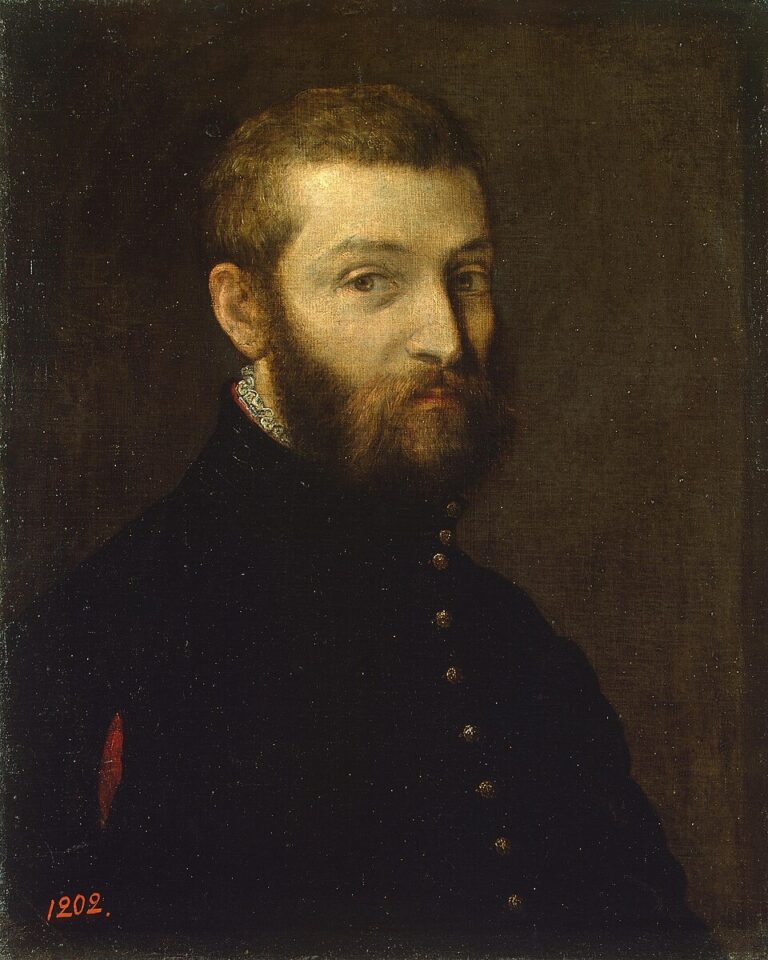
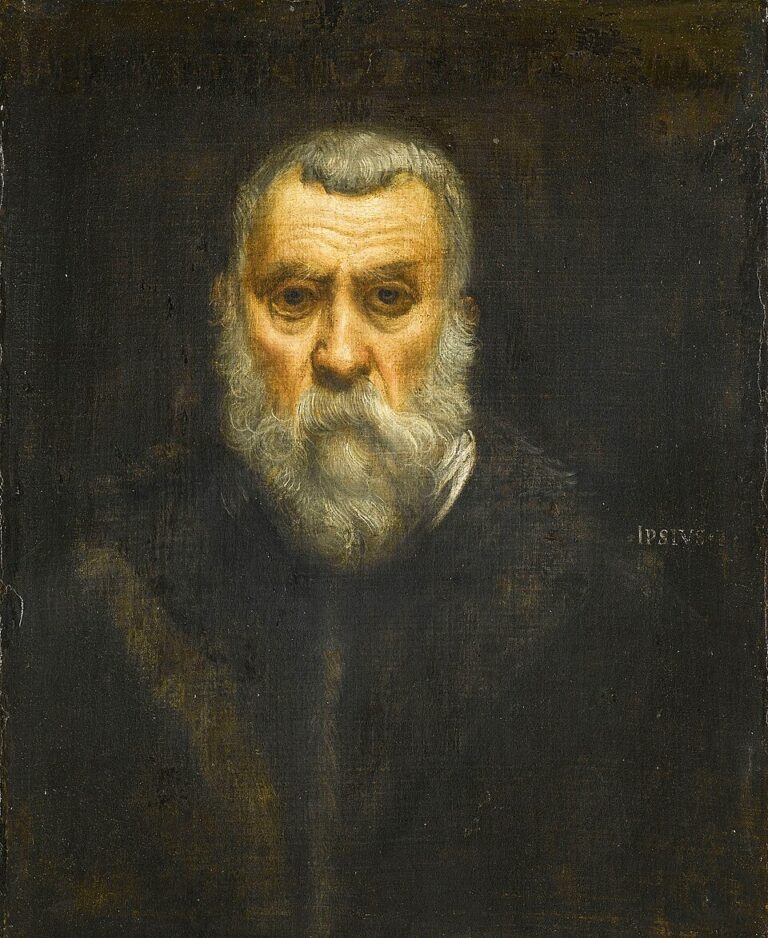
The two great masters of the following generation, Tintoretto and Veronese, were his heirs, but also his rivals. Tintoretto, it is said, was briefly his pupil, before their paths diverged in a rivalry that lasted their whole lives; he carried Venetian art towards drama, movement, chiaroscuro. Veronese, who arrived in Venice in Titian’s shadow, developed its lavish and luminous side, brilliant colour and the celebration of the world. Both, each in his own way, extended and transformed Titian’s legacy, forming with him the great triumvirate of Venetian painting. But it was Titian who was its source, its founder, the master from whom the others set out.
This founding position secures Titian an eminent place in the history of art. He is not only one of the greatest painters of the Renaissance: he is the master who, in Venice, carried the painting of colour to its height and made of it a major tradition, destined to shine across all of Europe. Without him, the Venetian school, and through it a large part of Western painting, would have been different. He is, in the full sense of the term, a founder, whose influence extends far beyond his city and his age.
The Legacy
Titian’s influence on Western painting was immense, lasting, incalculable. Few artists have so marked the history of art, and his posterity extends over centuries, up to the modern age.
In his own lifetime, Titian already enjoyed an exceptional European fame, celebrated by princes, popes, emperors, writers. A theorist of his time affirmed that in Titian alone were gathered all the qualities that, in other painters, existed only separately — a tribute that captures the esteem he enjoyed. This glory never wavered after his death. Titian was recognised, across the centuries, as one of the greatest masters of all time, alongside the most illustrious.
His influence on later painters was decisive. The greatest colourists in history claimed descent from him. Rubens studied and copied him with passion, finding in him the source of his own art of colour and flesh. Velázquez, at the court of Spain where so many works by Titian were held, made him one of his major models. Rembrandt, Van Dyck, and so many others, inherited his manner, his art of the portrait, his brushwork. Until the modern age, the painters who gave priority to colour and brushwork over drawing placed themselves in his lineage. Even the moderns, up to Impressionism, owe something to his painting by patches and to his freedom.
Today, Titian is universally recognised as one of the greatest painters in history, the sovereign master of the Venetian school, the prince of painters. His works, held in the greatest museums in the world, continue to dazzle by their power, richness, sensuality and depth. Incomparable colourist, portraitist without equal, painter of religious and mythological works of extraordinary power, inventor of a free manner that heralded the future, he dominates the Venetian Renaissance and the history of painting with all his stature. The son of Cadore become prince of painters remains, four and a half centuries after his death, an inexhaustible source of admiration.
Where to see his works
Titian’s work is present in Venice, where he worked all his life, and in the greatest museums of the world, in particular in Spain, where so many of his works were held.
In Venice
Venice holds several masterpieces by Titian. The basilica of Santa Maria Gloriosa dei Frari houses his Assumption of the Virgin, still in its original place on the high altar, as well as his tomb. The Gallerie dell’Accademia and other churches and institutions of the city hold major works by the master.
Around the world
The Prado Museum in Madrid holds one of the richest ensembles of works by Titian in the world, inherited from the collections of the Spanish Habsburgs, including Charles V at the Battle of Mühlberg. The Uffizi Gallery in Florence holds the Venus of Urbino. The Louvre, the National Gallery in London, the Kunsthistorisches Museum in Vienna, and many other great museums display works by Titian, testifying to his European fame.
Further Reading
Institutional Documentation
- Museo del Prado, Madrid — one of the richest ensembles of works by Titian, including the portrait of Charles V.
- Gallerie degli Uffizi, Florence — the Venus of Urbino.
- Basilica of Santa Maria Gloriosa dei Frari, Venice — The Assumption of the Virgin, in situ.
See also on Hors Cadre
- Tintoretto — the Fury of Venice — his heir and rival, who carried Venetian art towards drama.
- Veronese — the Splendour of Venice — the other great Venetian master, heir to his art of colour.
- Michelangelo — the Florentine master of drawing, whose art offers the counterpoint to Titian’s colorito.
— M